Banská Štiavnica: The Room Under the Square, Complete
Von Dr. Pooyan Ghamari · · 19 Min. Lesezeit · Englisch · Deutsch (gemischtsprachiges Original)
Dieser Artikel ist derzeit nur auf Englisch verfügbar. Eine deutsche Ausgabe ist nicht erschienen.
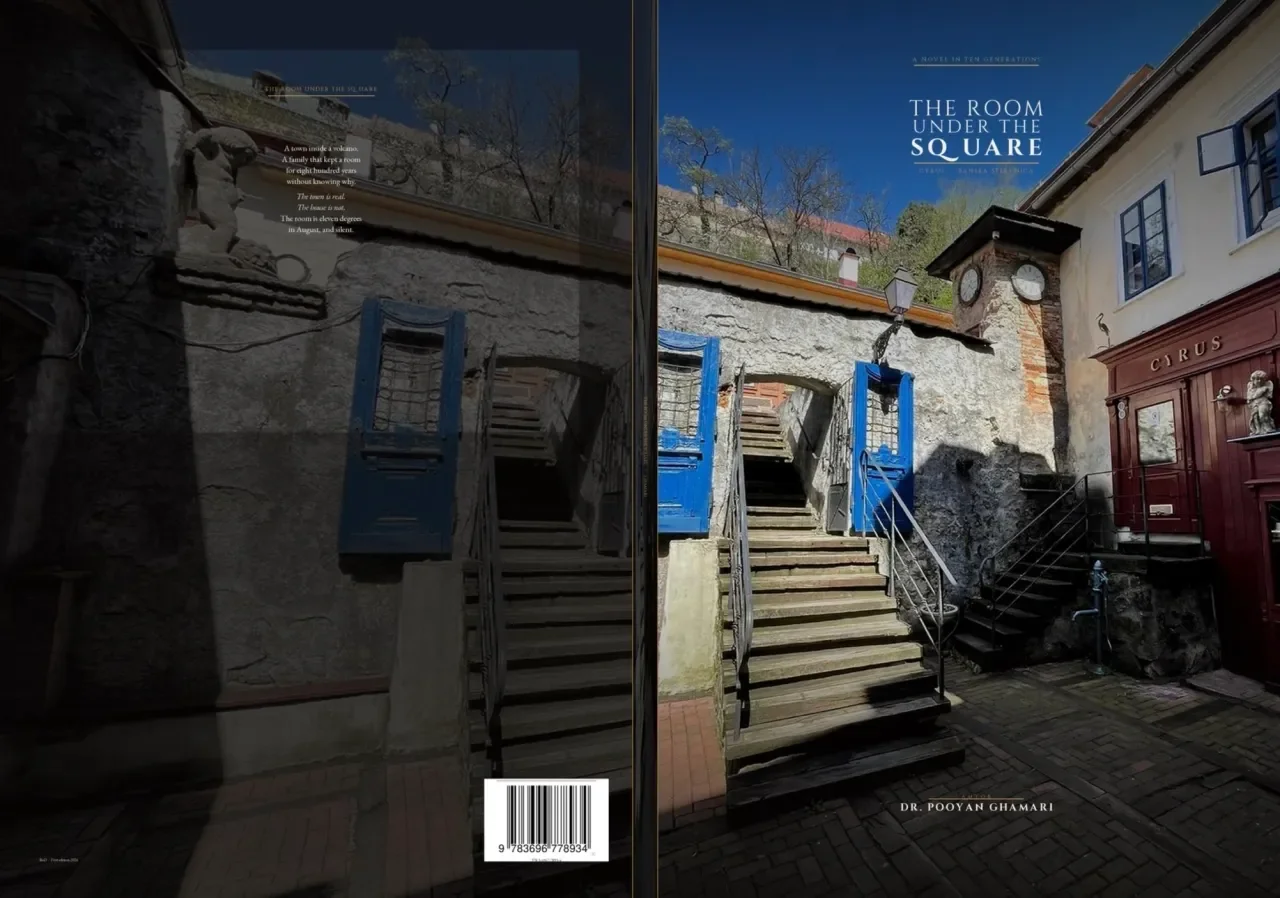
Podcast Series and 100 Book FAQs
Discover Dr. Pooyan Ghamari’s novel set in Banská Štiavnica, with subject summaries, all podcast links in English and German, and 100 questions about the book.
What remains of a family when its language changes, its business disappears, and the state that recorded its existence no longer exists?
In The Room Under the Square: A Novel in Ten Generations, Dr. Pooyan Ghamari explores that question through an invented family in Banská Štiavnica, Slovakia. Beneath its house lies a concealed underground passage. Generation after generation protects the entrance, often without fully understanding what it has inherited.
The historical narrative begins in 1156. Ten principal sections extend through 2001, while the contemporary narrative and coda bring the story into 2023.
For readers searching without Slovak diacritics, Banska Stiavnica refers to the same town.
What Is The Room Under the Square About?
The novel follows a family whose enduring responsibility is to preserve a hidden passage. Across the centuries, that space becomes a secret concealed from officials, a possible escape route, a refuge, and an obligation passed from parents to children.
Mining, religious persecution, industrial change, migration, war, and political transformation affect the household. History appears through what these changes demand of ordinary people: whether to leave, whom to trust, what to record, and when to open a door.
In 2023, Marek Pilch examines the papers and objects his family has left behind. His investigation reveals how much can survive without an official record, and how much can disappear despite one.
The author’s connection to the real Cyrus building and cellar in Banská Štiavnica provides a personal starting point. The novel’s family, house, concealed passage, and events within them are fictional. The book does not establish an archaeological history for the actual Cyrus cellar.
Main Subjects and Summary Points
- Memory: Objects, habits, language, and private responsibilities carry information that documents cannot fully preserve.
- Power: Authorities enter private life through surveys, registers, confiscation, and administrative decisions.
- Freedom: The possibility of an exit can matter even when nobody uses it.
- Belonging: A family’s connection to a place continues through changes in language, name, and government.
- Economic change: Mining, factory employment, institutional departure, and migration reshape the household.
- Courage: Food, silence, and shelter become practical forms of protection.
- Inheritance: Each generation must decide what to preserve and what to disclose.
- Community: Shared rooms, everyday exchanges, and collective action connect people beyond family boundaries.
Deutsche Einführung: Banská Štiavnica im Roman
The Room Under the Square von Dr. Pooyan Ghamari erzählt von zehn Generationen einer erfundenen Familie in Banská Štiavnica, Slowakei.
Unter ihrem Haus liegt ein verborgener Gang. Über Jahrhunderte hinweg bewahrt die Familie seinen Zugang. Was zunächst ein Geheimnis ist, wird zum Fluchtweg, zum Schutzraum und zu einer Verantwortung gegenüber kommenden Generationen.
Die historische Handlung beginnt 1156. Die zehn Hauptteile reichen bis 2001; die Gegenwartshandlung und die Coda führen bis 2023. Bergbau, religiöse Verfolgung, wirtschaftlicher Wandel, Auswanderung und politische Umbrüche werden durch ihre Folgen für den Alltag sichtbar.
Im Jahr 2023 untersucht Marek Pilch die hinterlassenen Dokumente und Gegenstände. Dabei entsteht ein Bild von Erinnerung, das weit über amtliche Aufzeichnungen hinausgeht.
Das reale Cyrus und sein Keller haben den Autor inspiriert. Die Familie, ihr Haus und der geheime Gang des Romans sind erfunden. Die Handlung ist kein archäologischer Nachweis über das tatsächliche Gebäude.
Zentrale Themen sind Erinnerung, Freiheit, Zugehörigkeit, wirtschaftlicher Wandel, Macht und die Verantwortung, die mit einem Erbe verbunden ist.
Complete Podcast Guide: English and German
The dates below indicate the historical periods covered, not episode running times. Follow the numbered sequence to accompany the book chronologically.
Die Jahreszahlen bezeichnen die behandelten Zeiträume, nicht die Laufzeit. Die Reihenfolge folgt dem historischen Aufbau des Romans.
1. Fire, Water, and the First Stones
Feuer, Wasser und die ersten Steine | 1156 to 1217
English: Kunz and Dobrena discover an older underground gallery behind their cellar and conceal it. Their decision begins the family’s long responsibility. Marek’s investigation in 2023 asks what they have actually preserved.
Deutsch: Kunz und Dobrena entdecken einen älteren Gang hinter ihrem Keller und verbergen ihn. Ihre Entscheidung begründet eine jahrhundertelange Verantwortung. Marek untersucht 2023, was die Familie tatsächlich bewahrt hat.
English: Spotify · YouTube
Deutsch: Spotify · YouTube
2. The Charter and the Unwritten Secret
Die Urkunde und das ungeschriebene Geheimnis | 1328
English: Margret Pilcher hides the entrance behind firewood when a royal surveyor arrives. The episode explores how official recognition can secure rights while exposing something previously concealed.
Deutsch: Margret Pilcher verbirgt den Zugang hinter Brennholz vor einem königlichen Vermesser. Amtliche Anerkennung kann Rechte sichern, aber auch den Zugriff auf etwas Verborgenes ermöglichen.
English: Spotify · YouTube
Deutsch: Spotify · YouTube
3. The Inquisition and the Escape
Die Inquisition und die Flucht | 1526 to 1571
English: When Marx refuses to recant, Ursula opens the passage so that he can escape. An inherited precaution becomes a practical response to religious persecution.
Deutsch: Als Marx seinen Glauben nicht widerruft, öffnet Ursula den Gang für seine Flucht. Eine überlieferte Vorsichtsmaßnahme wird zum konkreten Schutz vor religiöser Verfolgung.
English: Spotify · YouTube
Deutsch: Spotify · YouTube
4. The Black Powder
Das Schwarzpulver | 1627 to 1633
English: Blasting changes the mountain’s workings and threatens the concealed gallery. Barbara watches a candle flame for signs that the passage remains open.
Deutsch: Sprengungen verändern den Bergbau und bedrohen den verborgenen Gang. Barbara beobachtet eine Kerzenflamme, um festzustellen, ob die Verbindung noch offen ist.
English: Spotify · YouTube
Deutsch: Spotify · YouTube
5. The Printing Press and the Betrayal
Die Druckerpresse und der Verrat | 1669
English: Anna Maria conceals a printing press and refugees during military occupation. Betrayal comes from someone at her own table, placing hospitality and trust under pressure.
Deutsch: Anna Maria versteckt eine Druckerpresse und Flüchtlinge während einer militärischen Besetzung. Der Verrat kommt vom eigenen Tisch und stellt Vertrauen und Gastfreundschaft auf die Probe.
English: Spotify · YouTube
Deutsch: Spotify · YouTube
6. The Water Answer and the Map
Die Antwort des Wassers und die Karte | 1735 to 1782
English: Against the narrative of engineering responses to flooded mines, Katharina surveys the hidden passage and later destroys her map. Knowledge can protect a place, but its documentation can also endanger it.
Deutsch: Vor dem Hintergrund technischer Lösungen für überflutete Bergwerke vermisst Katharina den Gang und vernichtet später ihre Karte. Wissen kann schützen; seine Aufzeichnung kann zugleich gefährlich werden.
English: Spotify · YouTube
Deutsch: Spotify · YouTube
7. The Factory and the Break
Die Fabrik und der Bruch | 1849 to 1880
English: Industrial employment, language changes, and migration reshape the family. The story also follows Ilonka’s departure in 1881, when she writes down what earlier generations kept unwritten.
Deutsch: Industriearbeit, sprachlicher Wandel und Auswanderung verändern die Familie. Die Geschichte führt auch zu Ilonkas Abreise 1881. Sie schreibt auf, was frühere Generationen ungeschrieben bewahrten.
English: Spotify · YouTube
Deutsch: Spotify · YouTube
8. The Departure and the Flour
Der Abschied und das Mehl | 1918 to 1922
English: The departure of the Mining Academy brings uncertainty and lost income. Etelka rents the cellar to a flour merchant, bringing a stranger close to the hidden entrance.
Deutsch: Der Weggang der Bergakademie bringt Unsicherheit und Einkommensverlust. Etelka vermietet den Keller an einen Mehlhändler und bringt einen Fremden in die Nähe des geheimen Zugangs.
English: Spotify · YouTube
Deutsch: Spotify · YouTube
9. The Use
Der Einsatz | 1944 to 1948
English: In the novel’s fictional wartime events, Ondrej shelters eleven people behind the wall. Protection depends on food, silence, and ordinary routines. The later loss of the family business introduces another form of power over the household.
Deutsch: In der erfundenen Kriegshandlung schützt Ondrej elf Menschen hinter der Mauer. Nahrung, Schweigen und Alltagsabläufe sichern ihr Versteck. Der spätere Verlust des Familienbetriebs bringt eine weitere Form der Machtausübung ins Haus.
English: Spotify · YouTube
Deutsch: Spotify · YouTube
10. The Keys
Die Schlüssel | 1968 to 2001
English: Zuzana understands the passage as the knowledge that a way out exists. Political transformation, restitution, and family documents test what can be recovered. The concluding discussion also follows Marek’s later choices and the fictional Cyrus as a gathering place.
Deutsch: Zuzana erkennt im Gang das Wissen, dass es einen Ausweg gibt. Politischer Wandel, Rückerstattung und Familiendokumente zeigen, was zurückgewonnen werden kann. Der Abschluss führt zu Mareks späteren Entscheidungen und zum erfundenen Cyrus als Begegnungsort.
English: Spotify · YouTube
Deutsch: Spotify · YouTube
Full Podcast Channels and Playlists
A LAND in English
English Spotify show · English YouTube playlist
ALAND auf Deutsch
Deutscher Spotify Podcast · Deutsche YouTube Wiedergabeliste
Book Details
Title: The Room Under the Square
Subtitle: A Novel in Ten Generations
Author: Dr. Pooyan Ghamari
Setting: Banská Štiavnica, Slovakia
Edition language: English
First edition: 2026
Publisher: BoD · Books on Demand
ISBN: 9783696778934
100 Frequently Asked Questions About The Room Under the Square
The answers below discuss the novel’s characters, events, and themes. Later questions contain plot details. Interpretive answers offer readings of the text rather than claims about historical events.
Book, Author, and Setting
1. What is The Room Under the Square?
It is a historical novel by Dr. Pooyan Ghamari about ten generations of a fictional family protecting a hidden passage in Banská Štiavnica.
2. Who wrote The Room Under the Square?
The author is Dr. Pooyan Ghamari.
3. What is the book’s full title?
The full title is The Room Under the Square: A Novel in Ten Generations.
4. Where is the novel set?
Its principal setting is Banská Štiavnica, Slovakia, particularly an invented family house and the underground spaces beneath it.
5. Are Banska Stiavnica and Banská Štiavnica the same place?
Yes. Banska Stiavnica is the spelling without diacritics. Banská Štiavnica is the Slovak spelling used in the book.
6. What language is this edition written in?
The supplied edition is in English. The accompanying podcast series has English and German versions.
7. When was the book first published?
The copyright page identifies 2026 as the year of first publication.
8. Who is the publisher?
The edition names BoD, Books on Demand, as its publisher.
9. What is the ISBN?
The ISBN is 9783696778934, also written as 978-3-6967-7893-4.
10. When was the manuscript developed?
The copyright page states that the book was conceived in 2013, developed over approximately a decade, and completed in 2024.
Timeline and Narrative Structure
11. When does the historical narrative begin?
The first historical section covers 1156 to 1217 and introduces the beginnings of the family’s connection to the hidden passage.
12. When does the story end?
The narrative reaches 2023 through its contemporary passages and concluding coda.
13. What years do the ten main historical sections cover?
Their headings extend from 1156 to 2001, concentrating on selected periods rather than narrating every intervening year.
14. What period does the coda cover?
The coda covers 2007 to 2023.
15. Is the novel told entirely in chronological order?
No. The historical sections move forward through time, while recurring passages return to Marek’s investigation in 2023.
16. Why does the narrative return to 2023?
The contemporary passages show a descendant interpreting evidence whose origins the reader encounters in the historical narrative.
17. Who connects the contemporary passages?
Marek Pilch connects them through his examination of family papers, the cellar wall, and the space behind it.
18. Does the book describe every generation in equal detail?
No. It concentrates on selected lives and turning points through its ten principal historical sections.
19. Do the podcast titles exactly match the book’s chapter titles?
Not always. Some podcast titles expand or reinterpret the corresponding chapter subjects.
20. Why does Episode 7 mention 1881 when its heading ends in 1880?
The guide retains the principal period heading, while its summary includes Ilonka’s departure in 1881. The novel also extends beyond that heading.
Fiction, Inspiration, and the Cyrus
21. Is The Room Under the Square a true story?
It is fiction set against a historical background. The afterword distinguishes the invented family and spaces from the town’s history.
22. Is the Pilcher family real?
No. The afterword identifies the family and its members as invented.
23. Is the family house a documented building?
No. The house presented in the novel is fictional.
24. Is the concealed passage beneath the house real?
The novel’s concealed passage is invented. Its existence should not be inferred at the actual Cyrus property.
25. Is there a real Cyrus building connected with the author?
The author’s note and afterword describe a real Cyrus building and cellar in Banská Štiavnica associated with the author.
26. When does the author say he acquired the Cyrus?
The author’s note states that he bought it in 2009.
27. When does the author say he first visited Banská Štiavnica?
The author’s note places his first visit in 1999.
28. Does Marek’s restaurant establish that the real Cyrus operated as a restaurant?
No. Marek’s restaurant belongs to the fictional narrative. The author distinguishes its story from that of his own property.
29. Does the book prove the actual cellar is ancient?
No. The afterword explicitly declines to establish the real building’s age or fabric without the relevant records and architectural investigation.
30. Why does the book include an afterword?
The afterword separates invention from historical background and explains the limits of claims about the real Cyrus.
Characters and Family Relationships
31. Who is Marek Pilch?
Marek is the contemporary descendant who investigates the family’s inherited papers and concealed underground space.
32. Who is Kunz?
Kunz is an early family figure connected with the discovery of the gallery in the opening historical narrative.
33. Who is Dobrena?
Dobrena is a central figure in the family’s beginnings, bringing local knowledge into the meeting between newcomers and the valley’s inhabitants.
34. What does Margret Pilcher do?
She conceals the passage from a royal surveyor, protecting it from official registration.
35. What role does Ursula play?
Ursula opens the concealed route to allow Marx to escape religious persecution.
36. Why is Barbara important?
Barbara protects the continuity of the passage when blasting threatens it, watching a candle for evidence of airflow.
37. What is Anna Maria’s dilemma?
She offers concealment and refuge during occupation while facing the danger of betrayal within her own circle.
38. What makes Katharina’s decision significant?
She creates a survey of the passage and later destroys the map, weighing the usefulness of knowledge against the danger of its discovery.
39. Who is Ilonka?
Ilonka is the family member whose departure leads her to record a secret previously preserved without a surviving written account.
40. Who is Zuzana?
Zuzana is Marek’s mother and an archivist. Her life connects professional recordkeeping with the family’s largely unwritten inheritance.
The Hidden Passage and Its Objects
41. Why does the family conceal the passage?
Its reasons develop over time. Concealment keeps the space available outside ordinary official knowledge and later enables protection and escape.
42. Is the hidden space always used?
No. Much of its importance lies in being preserved as a possibility.
43. What can the passage represent?
A central reading is that it represents an available choice: the knowledge that a person may have somewhere to go.
44. What are the three loose stones?
They are part of the concealed access arrangement, a physical detail transmitted through the family’s knowledge of the wall.
45. Why is firewood repeatedly placed against the wall?
It conceals the access point. Replacing it becomes a recurring act through which different generations maintain the secret.
46. What role does the family box play?
It gathers surviving papers and objects whose meanings Marek tries to reconstruct.
47. Why does a clockmaker’s bill matter?
An ordinary bill survives as evidence of the house and its history, showing how practical documents can outlast more deliberate accounts.
48. What do the two clocks contribute to the novel?
They offer a recurring image of difference within continuity. Their disagreement belongs to the house’s fabric and becomes part of its identity.
49. What is the significance of the worn groove in the stone?
The groove records repeated human action. It can be read as a physical archive of lives absent from written history.
50. Why does Marek photograph the space?
Photographs let him gather evidence of what lies beyond the opening without entering it himself.
Memory, Documents, and Ownership
51. Does the novel suggest that documents are useless?
No. Documents can preserve evidence and support claims. The novel examines their limits alongside their value.
52. Why can recording the passage be dangerous?
A record could reveal its location to people whose interests differ from those of the family.
53. Why does Katharina destroy her map?
Within the story, protecting the passage from administrative discovery becomes more important than retaining the survey.
54. Why does Ilonka write the secret down?
Her departure changes the conditions of memory. Writing becomes a means of preserving what distance might otherwise erase.
55. Are Katharina and Ilonka’s decisions necessarily contradictory?
They respond to different circumstances. One protects a place by withholding information; the other protects memory by carrying information away.
56. How does the novel distinguish memory from proof?
Something may be meaningful and trusted within a family without satisfying the evidentiary requirements of an institution.
57. Why is Zuzana’s profession important?
As an archivist, she understands what records can establish, which sharpens the difficulty of documenting her family’s own claims.
58. What is the irony of the confiscation file?
The state’s detailed record of taking the business becomes evidence for a later attempt to recover what was taken.
59. Does Zuzana recover everything the family lost?
No. The novel describes partial recovery and compensation alongside losses that the process does not restore.
60. What does this suggest about restitution?
The story presents restitution as a process that can address certain legal claims without recreating the full life of a former household or business.
Economy, Language, and Belonging
61. Why is mining central to the book?
Mining shapes the setting’s work, settlement, technical change, and economic pressures throughout much of the narrative.
62. How does the opening connect local knowledge with technical skill?
The newcomers possess mining knowledge, while local people understand the valley’s water, terrain, and conditions. Their encounter joins different kinds of expertise.
63. Is technological progress presented as uncomplicated?
No. New capabilities create new vulnerabilities, including threats to the workings and the concealed passage.
64. What does the water engineering narrative contribute?
It shows how a technical crisis demands another form of knowledge and cooperation, connecting survival with practical problem solving.
65. Why does factory employment matter?
It marks changes in the economic foundation of everyday life as the narrative moves beyond its earlier mining focus.
66. How does migration affect the family?
Migration separates people from the place that holds their shared memory and changes how that memory must be transmitted.
67. Why do changing names and spellings matter?
They register shifts in language and administration while the family’s connection to the house continues.
68. What does the station sign scene explore?
It shows how political change reaches ordinary space through the official naming of a place whose inhabitants already know more than one name.
69. Why does the Mining Academy’s departure affect Etelka?
The institution’s departure disrupts the household economy, turning a public event into lost income and private uncertainty.
70. What does renting the cellar reveal?
It shows how financial necessity can force a family to accept risks that it would otherwise avoid.
Shelter, War, and Responsibility
71. How does the passage change during religious persecution?
It becomes a usable escape route, giving immediate purpose to generations of concealment.
72. Why is betrayal especially serious in the 1669 episode?
The household’s protection depends on discretion, and betrayal comes through a relationship that had allowed proximity and trust.
73. How many people does Ondrej shelter in the wartime narrative?
He shelters eleven people in the fictional events described by the novel.
74. Is their sheltering a documented rescue at the real Cyrus?
No. The afterword states that the eleven people and the circumstances of their hiding are invented.
75. Why does food receive attention in this part of the story?
Shelter depends on continuing practical support. Changes in food preparation also reveal what adults have tried to keep unspoken.
76. Does the novel identify all the sheltered people by category?
No. The afterword explains the decision not to classify them in that way.
77. Does the story explain with certainty why a search fails?
No. Ondrej remains uncertain about the motives behind the decision that leaves the hiding place undiscovered.
78. Why preserve that uncertainty?
It keeps the outcome distinct from an unprovable account of another person’s intentions.
79. Do all eleven people survive?
The narrative states that nine survive, one dies elsewhere, and one remains unaccounted for.
80. How is courage portrayed in these scenes?
Courage appears through sustained practical actions: supplying food, keeping silence, maintaining concealment, and accepting personal risk.
Marek, the Ending, and Interpretation
81. Why does Marek return to the town?
The coda connects his return with his mother’s illness.
82. When does Marek acquire the cellar in the story?
The coda places the start of his acquisition in 2007 and describes a prolonged process involving inherited shares.
83. When does the fictional Cyrus restaurant open?
Marek opens the restaurant in 2011.
84. What changes when strangers sit at the long tables?
People who arrive separately begin to speak. The room becomes a setting for ordinary exchange across differences.
85. What does the restaurant add to the book’s treatment of community?
It shows connection emerging through shared space and everyday encounters rather than formal declarations of belonging.
86. Does Marek enter the hidden chamber?
At the end of the novel, he says he has never been inside and does not intend to enter.
87. Is the hidden space conclusively dated?
No. The fictional museum correspondence presents a preliminary possibility and states that access and sampling would be needed to establish dating.
88. Why is that distinction important?
It keeps a suggestive interpretation from becoming a confirmed discovery, even within the fiction.
89. How does the 2023 fire connect with the wider narrative?
In the novel, collective efforts to protect the town’s collections echo earlier acts of preservation by individual family members.
90. What question does the ending leave with the reader?
One central question is whether understanding an inheritance requires opening everything it contains, or whether preserving a possibility can itself be meaningful.
Podcast Listening and Reading Discussion
91. How many episodes are in the accompanying series?
The supplied podcast guide lists ten numbered episodes, each with English and German versions.
92. Where can the English episodes be found?
The English Spotify and YouTube links appear under each episode above, with show and playlist links provided separately.
93. Where can the German episodes be found?
Each episode includes German Spotify and YouTube links. The ALAND auf Deutsch channel links also appear above.
94. In what order should the episodes be heard?
Follow Episodes 1 through 10 to move through the historical sequence from the family’s beginnings to the later generations.
95. Are the historical dates episode durations?
No. They identify the periods covered. The supplied guide does not provide running times.
96. Is the podcast guide a word for word audiobook?
It is presented as an episode series with subject summaries. The guide does not identify it as an unabridged reading of the manuscript.
97. Can the podcasts be used alongside the book?
Yes. Their historical sequence makes them a companion for revisiting the corresponding periods, characters, and questions.
98. Do the episode summaries reveal plot developments?
Yes. They disclose major events, including concealment, escape, betrayal, wartime shelter, and later decisions.
99. What is a useful question for a book club?
Ask when keeping information private protects people, and when writing it down becomes necessary to preserve their rights or memory.
100. What is the book’s central question in one sentence?
What do people owe the lives that came before them, and the lives that may one day need what they choose to preserve?
Originalartikel: https://ghamari.org/articles/f/bansk%C3%A1-%C5%A1tiavnica-the-room-under-the-square-complete