Do Tokenized Stocks Give Shareholder Rights
Von Dr. Pooyan Ghamari · · 14 Min. Lesezeit
Dieser Artikel ist derzeit nur auf Englisch verfügbar. Eine deutsche Ausgabe ist nicht erschienen.
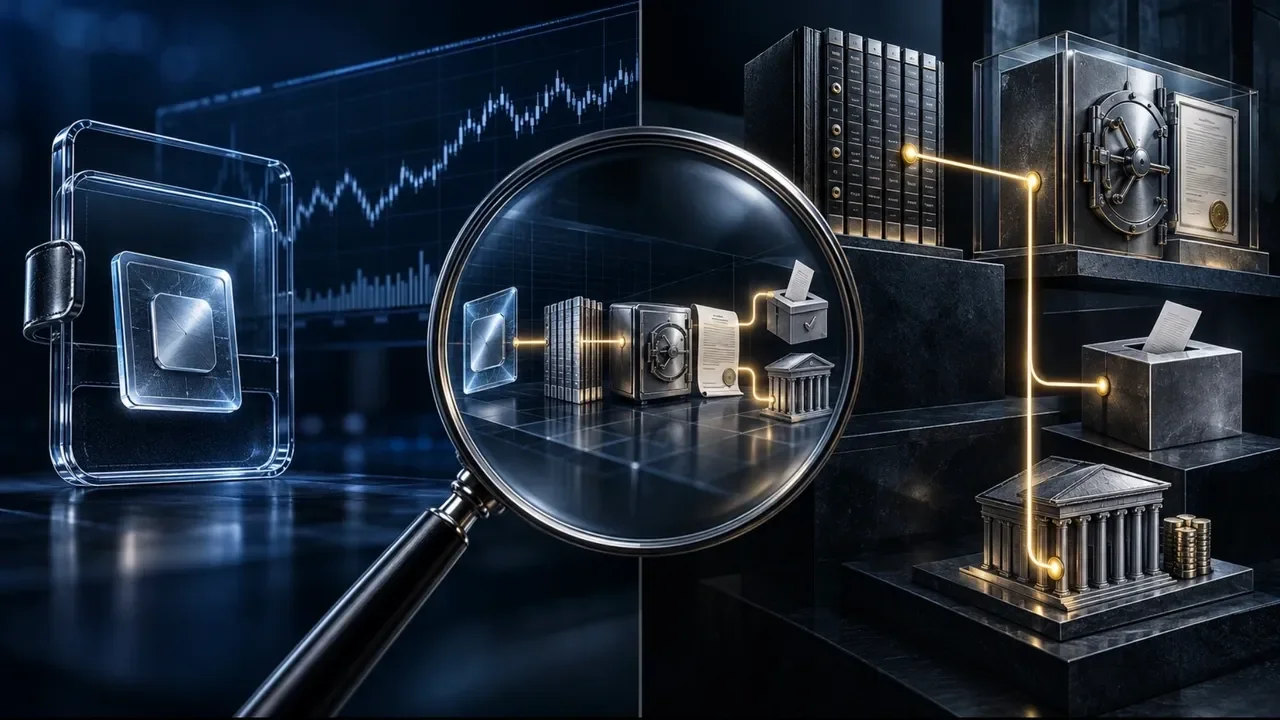
Do Tokenized Stocks Give Shareholder Rights? What You Actually Own
By Dr. Pooyan Ghamari, Economist and Author
Do tokenized stocks give shareholder rights? Sometimes, but not automatically. An issuer-sponsored token recorded as the company’s security can carry voting, dividend and ownership rights. A third-party token may provide only a custodial or contractual claim, while a synthetic token may offer price exposure without making its holder a shareholder.
The word “tokenized” describes a technical format. It does not, by itself, describe the legal asset.
That distinction is the most important fact for anyone considering a token linked to Apple, Tesla, Nvidia or another listed company. Two tokens can display the same ticker, move with the same share price and settle on the same blockchain while giving their holders entirely different rights.
One buyer may own a legally recognised security recorded through an authorised system. Another may hold a claim against an intermediary that keeps shares with a custodian. A third may own a derivative whose value follows the share price but conveys no ownership of the company.
The screen can make all three look almost identical. Law, custody and insolvency do not.
What is a tokenized stock?
The SEC describes a tokenized security as a security formatted as or represented by a crypto asset, with ownership recorded in whole or in part through one or more crypto networks. Stocks, bonds, fund interests and other securities can be tokenized.
This definition is narrower and more useful than the marketing phrase “stock token.” A digital token can relate to a stock without being the stock itself.
The token may perform several possible functions. It may be the legally recognised security. It may represent an entitlement to a security held through an intermediary. It may evidence a contractual obligation owed by a third party. It may also be a synthetic instrument whose return is linked to the price of a share.
The blockchain proves that a particular token moved from one address to another. It does not automatically prove what legal promise the token contains, whether the company recognises the holder, where any backing shares are kept, or what happens if an intermediary fails.
To understand a tokenized stock, investors must read the legal architecture behind the code.
Which tokenized stocks carry real shareholder rights?
There are three broad structures.
1. Issuer-sponsored tokenized shares
In the clearest structure, the company or fund issuer authorises the tokenization. The token is connected to the official ownership record maintained by the issuer or its transfer agent. A valid transfer updates the authoritative record, and the recognised holder receives the rights attached to that class of security.
Those rights can include dividends or distributions, voting, corporate communications and participation in corporate actions. The precise rights still depend on the security’s governing documents and applicable law. Tokenization does not give common stock the rights of preferred stock or create voting power where the underlying class has none.
The essential point is that the token and the official record refer to the same legally recognised security.
2. Third-party custodial or entitlement structures
A third party may buy or hold conventional shares through a broker or custodian and issue tokens connected to those holdings. The investor may receive economic exposure, distributions or redemption rights, but the legal relationship runs through the intermediary structure.
The investor might be a beneficial owner, a holder of a securities entitlement or a contractual claimant, depending on the documents and jurisdiction. Voting may be passed through, exercised by the intermediary or omitted. Redemption may produce shares, cash or only the value of the position.
The presence of one share in custody for each token can reduce some economic risk. It does not answer every legal question. The investor still needs to know whether the backing assets are segregated, who controls them, whether they can be pledged, and how token holders rank if the issuer or platform becomes insolvent.
3. Synthetic stock tokens
A synthetic token tracks a share’s price through a derivative, note, swap or other contractual arrangement. The holder does not own the referenced company merely because the token uses its ticker or follows its market price.
The investor’s claim is against the product issuer or counterparties. Voting rights normally do not arise from price exposure. A payment described as a “dividend equivalent” is not necessarily the same legal entitlement as a dividend paid to a shareholder.
This can still be a legitimate financial product if it is properly structured, disclosed and offered in compliance with applicable law. But it should not be described as ordinary share ownership.
Why the ownership record matters more than the blockchain
Every serious financial system needs an authoritative answer to one question: who is legally entitled to the asset?
In a conventional public market, that answer may involve the issuer’s register, a transfer agent, a central securities depository, a broker and beneficial-owner records. The system is already layered. Most retail investors who buy through a broker are not individually entered as registered owners on the company’s books. Their rights are transmitted through the securities-holding chain.
Tokenization can modernise that chain. It can also add another layer to it.
The critical issue is whether the blockchain record is itself authoritative, whether it updates the official record, or whether it merely points toward a separate promise maintained elsewhere. Possession of a token is not enough if the issuer, transfer agent or relevant law does not recognise that token as the security or entitlement.
This is why technical self-custody and legal ownership must not be confused. A private key can control movement of the token. It cannot manufacture shareholder rights that the instrument never contained.
What voting and dividend rights do token holders receive?
The answer must come from the exact product documents.
An issuer-sponsored token representing voting common stock can preserve voting rights. A regulated tokenization system can also deliver distributions and corporate actions in the same manner as conventionally recorded securities.
A custodial token may pass through dividends, pay a cash equivalent or reinvest the amount. Voting may depend on whether the intermediary solicits instructions from token holders. If it does not, the legal shareholder in the custody chain may exercise the vote or leave it unused.
A synthetic token may replicate price changes and dividend economics without passing through governance rights. The holder can gain or lose with the referenced share while having no voice in director elections, mergers or other shareholder proposals.
The distinction becomes particularly important in contested votes, takeovers, class actions and insolvency. A small investor may rarely vote, but the right still has economic and legal meaning. Large volumes of tokens without voting pass-through can concentrate dormant governance power in custodians or intermediaries.
What happens if the token platform fails?
Platform failure does not produce one universal result. The outcome depends on what the investor owns and which institution owes the obligation.
If the token is an issuer-sponsored security recorded in an authoritative ownership system, the investor’s rights may survive the failure of a particular app or interface. The investor would still need a practical route to prove identity, access records and transfer or service the security.
If an intermediary holds the underlying shares, recovery depends on custody, segregation, recordkeeping, governing law and the terms of the entitlement. Properly segregated customer securities may be treated differently from the intermediary’s own assets. Poor records, rehypothecation, cross-border custody or unclear beneficial ownership can complicate recovery.
If the token is a synthetic claim, the holder may be exposed directly to the solvency of the token issuer or counterparty. The referenced company could remain healthy while the product becomes impaired because the entity owing payment has failed.
The visible token can remain in a wallet throughout the failure. That does not guarantee redemption. A blockchain balance shows possession of the digital object. Recovery depends on whether someone remains legally and financially obligated to honour it.
Are tokenized stocks protected by SIPC?
Investors should not assume that every product called a tokenized stock receives Securities Investor Protection Corporation protection.
SIPC generally protects customers of a failed SIPC-member brokerage when cash or securities are missing, subject to statutory conditions and limits. It does not protect against market losses. It also does not protect every digital or crypto asset.
The correct questions are whether the intermediary is a SIPC member, whether the investor is a qualifying customer, whether the asset qualifies as a security under the relevant statute, and how the asset is held and recorded. A product offered through an offshore crypto platform can have a very different protection structure from a qualifying security held at a US broker-dealer.
Deposit insurance is also different. FDIC protection applies to qualifying bank deposits, not to the changing market value of shares. A token that tracks a stock does not become a bank deposit because it can be bought with dollars.
No investor should rely on a logo, app-store description or influencer summary. Protection must be confirmed for the exact legal entity, account and instrument.
Why 24-hour trading does not guarantee liquidity
Tokenization can expand trading hours, reduce minimum investment sizes and speed settlement. These are meaningful advantages.
But the ability to submit an order at any hour is not the same as the ability to sell a large position at a fair price. When the underlying exchange is closed, there may be fewer market makers, thinner order books and less reliable price discovery. The token can trade away from the last price of the underlying share.
Faster settlement can reduce counterparty exposure. It can also demand immediate funding and leave less time to correct errors. Programmability can automate compliance and corporate actions. It can also automate freezes, transfer restrictions or flawed instructions.
The technology changes the speed of the market. It does not abolish liquidity, operational or governance risk.
Who gains, who pays, who decides and who is excluded?
Who gains? Issuers can reach new investors and automate parts of distribution and recordkeeping. Exchanges, brokers, custodians, wallet providers and tokenization platforms can create new services and fee streams. Investors may gain fractional access, longer trading hours and faster movement of assets.
Who pays? Investors pay spreads, platform fees, custody costs, blockchain transaction charges and the consequences of legal ambiguity. Issuers may pay for parallel infrastructure and reconciliation. Markets can pay through fragmented liquidity when several tokens represent exposure to the same share across incompatible networks.
Who decides? The corporate issuer determines whether it authorises a token and which security class is represented. The transfer agent or depository determines how ownership is recorded. The token issuer writes the contractual promise. The custodian controls the backing assets. Regulators define which entities and transactions are permitted. The investor often sees only the ticker and interface.
Who is excluded? Eligibility rules can block residents of particular countries. Wallet allowlists can exclude unverified users. Sanctions and compliance rules can freeze transfers. Investors without technical knowledge may be unable to distinguish legal ownership from price exposure. People who lose keys can also lose practical access unless the system includes an identity-based recovery mechanism.
The promise of wider access is real, but access is governed. Tokenization does not remove gatekeepers. It changes their location and the tools they use.
My analysis: tokenization separates the asset from its appearance
My central judgment is that tokenization creates a new form of financial compression. A complex chain of issuers, custodians, brokers, transfer agents, smart contracts and courts is compressed into one symbol inside a wallet.
That simplicity is useful. It is also dangerous when the symbol hides the chain.
The token may look self-contained, but the value can depend on institutions outside the blockchain. Someone must safeguard the underlying shares, process a merger, distribute a dividend, recognise a court order, correct an erroneous transfer and determine who has standing when the system fails.
Decentralised transfer does not necessarily mean decentralised ownership. A token may move across a public network while the economic asset remains concentrated with one custodian and the legal promise depends on one issuer.
This does not make tokenization fraudulent. It means the investor should follow the obligation rather than the interface.
Ask who owes you the share, the cash or the redemption. Ask where that obligation is recorded. Ask what law enforces it. Those three answers reveal more than the blockchain name.
What is the strongest argument for tokenized stocks?
The strongest argument is that tokenization can preserve existing legal rights while improving settlement, programmability and access.
DTCC states that its tokenization service is designed so DTC-tokenized assets maintain the same ownership rights, investor protections and corporate-action entitlements as assets held in traditional form. The model demonstrates that blockchain technology does not require investors to surrender established protections.
Issuer-sponsored structures can also integrate the token into the official holder record. In that case, tokenization is not a synthetic copy of the share. It is a new recordkeeping and transfer method for the security itself.
My assessment would be wrong if it claimed that every tokenized stock is merely an unsecured promise or that blockchain settlement inevitably weakens investors. The technology can strengthen transparency and reduce reconciliation errors when law, records and custody are aligned.
The danger comes from category confusion. A real tokenized security and a synthetic tracker should not be sold under language that makes them appear equivalent.
A ten-question tokenized-stock checklist
Before buying, ask for written answers to these questions.
1. What is the exact legal name and type of the instrument?
2. Did the company whose stock is referenced authorise the tokenization?
3. Does the official shareholder or securities-entitlement record recognise me or my intermediary’s position?
4. Who holds any backing shares, and are they segregated from the token issuer’s own assets?
5. Do I receive voting instructions, dividends, distributions and corporate-action rights?
6. Can I redeem the token for shares, cash, or neither?
7. What happens if the platform, token issuer, broker, custodian or blockchain service fails?
8. Which country’s law and court govern my claim?
9. Is the intermediary regulated, and does SIPC or another investor-protection regime apply to this exact account and asset?
10. What are the spreads, fees, transfer restrictions, wallet rules and trading-hour liquidity risks?
If the provider cannot answer these questions clearly, the investor does not yet understand the asset well enough to price its risk.
What should regulators and issuers do?
Regulators should require plain-language classification at the point of purchase. The screen should state whether the product is an issuer-sponsored security, a custodial entitlement, a note, a derivative or another form of exposure.
Disclosures should identify the authoritative ownership record, backing-assets custodian, voting and dividend treatment, redemption method, insolvency position and investor-protection coverage. A long legal document is not enough if the trading interface creates a contrary impression.
Issuers should receive clear notice when third parties create products linked to their shares. Investors should be able to distinguish authorised securities from unaffiliated trackers. Market surveillance, sanctions compliance and corporate-action processing must work across both conventional and tokenized forms without creating hidden regulatory gaps.
Interoperability also matters. If one security appears on several networks, institutions must prevent double counting and maintain consistent rights through transfers, forks, upgrades and outages.
The objective should be technological neutrality with legal clarity. The same economic claim should receive comparable protection regardless of whether it is recorded in a conventional database or on a blockchain.
—-—
Tokenized stocks can give shareholder rights, but the word “tokenized” is not proof of ownership.
An issuer-sponsored token integrated into the official ownership record can represent a real share with voting, dividend and corporate-action rights. A third-party token may provide a claim through a custodian. A synthetic token may deliver only price exposure.
The practical rule is simple: do not ask only what price the token follows. Ask who owes you what, where that right is recorded, and what happens if the intermediary fails.
Blockchain can make securities move faster. It cannot replace the legal structure that makes ownership enforceable.
Frequently asked questions
Do tokenized stocks give voting rights?
Some do, but many do not. Voting depends on whether the token represents a recognised share or whether an intermediary contractually passes voting instructions to token holders.
Are tokenized stocks real shares?
They can be. Issuer-sponsored tokens integrated with the official ownership record may be real securities. Custodial and synthetic products may provide different claims without direct share ownership.
Do token holders receive dividends?
It depends on the product. A holder may receive the actual distribution, a cash equivalent, reinvested value or no dividend benefit. Read the instrument’s governing documents.
What happens if a tokenized-stock platform fails?
The outcome depends on the structure, custody, asset segregation and governing law. A token may survive technically while redemption or enforcement becomes difficult.
Are tokenized stocks SIPC protected?
Not automatically. Protection depends on the intermediary, customer status, legal classification of the asset and how it is held. SIPC does not cover market losses or every crypto asset.
This article is general educational analysis, not legal, securities or investment advice. Product rights and protections depend on the exact instrument, intermediary, jurisdiction and account.
Authoritative sources
1. US Securities and Exchange Commission, Statement on Tokenized Securities, 28 January 2026
2. SEC Chair Paul Atkins, Statement on the Innovation Exemption, 17 September 2026
3. Investor.gov, Tokenized Securities
7. Investor.gov, SIPC Protection Basics
Fact, uncertainty and analysis note
Verified descriptions of US regulatory treatment are based on SEC and investor-protection materials available on 8 October 2026. The SEC’s January taxonomy is a staff statement without independent legal force, and the September innovation-exemption announcement describes a developing framework rather than a universal classification of products worldwide. Rights under any specific token depend on its documents, custody chain and jurisdiction. Sections identified as Dr. Ghamari’s analysis are interpretation, not claims about undisclosed motives or guaranteed outcomes.
Originalartikel: https://ghamari.org/articles/f/do-tokenized-stocks-give-shareholder-rights