Do Tokenized Stocks Give You Ownership
Von Dr. Pooyan Ghamari · · 9 Min. Lesezeit
Dieser Artikel ist derzeit nur auf Englisch verfügbar. Eine deutsche Ausgabe ist nicht erschienen.
Do Tokenized Stocks Give You Ownership? What You Actually Buy
By Dr. Pooyan Ghamari, Swiss Economist and Author | September 24, 2026
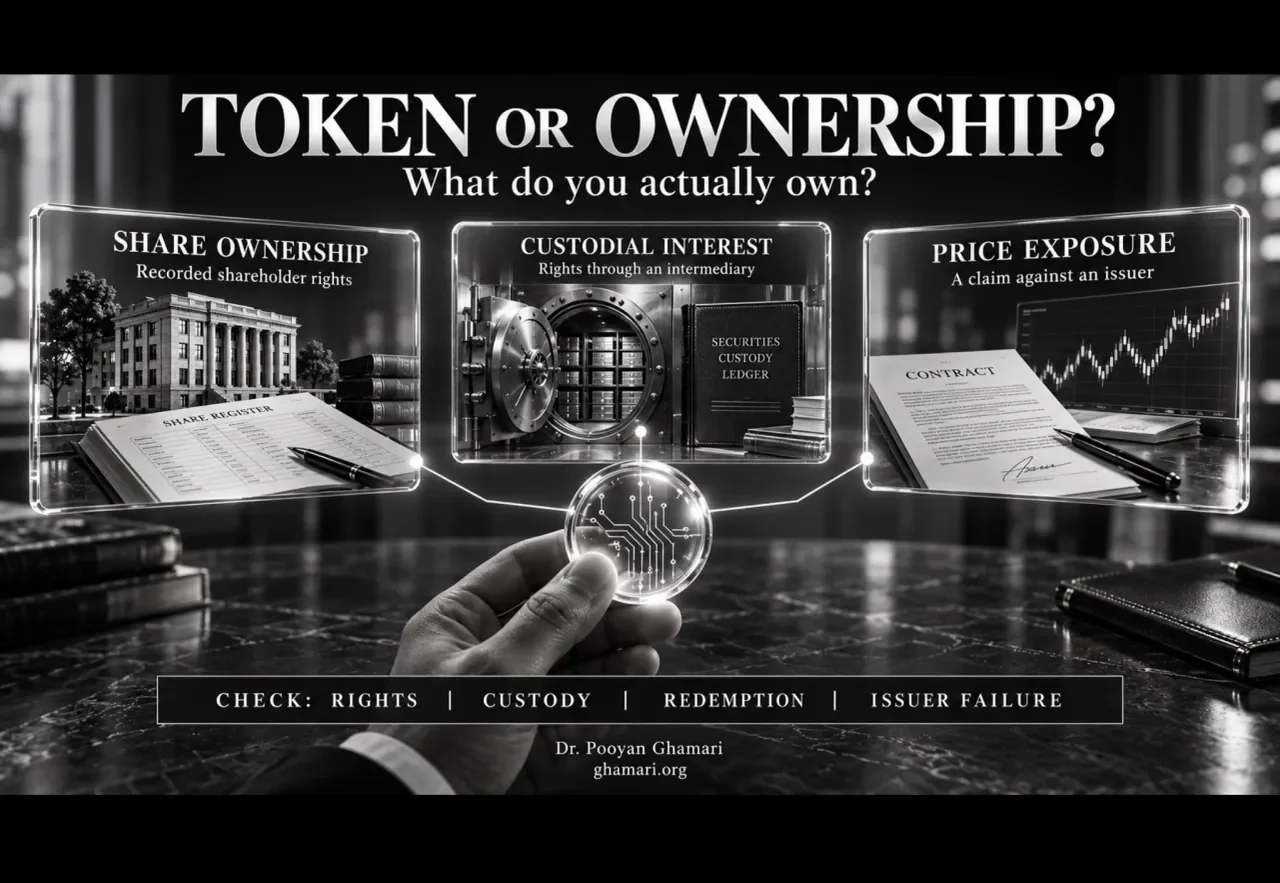
Some tokenized stocks give you ownership in a company or a legally recognized interest in its shares. Others give only contractual exposure to the share price. The issuer, legal structure and custody terms determine which rights you receive, not the token’s name.
That distinction is central to the SEC staff’s analysis of tokenized securities. A blockchain record does not, by itself, tell you what you can legally demand from another person.
I begin with a question that a price chart cannot answer: if the service disappears tomorrow, what do you still own, and against whom can you enforce your claim?
What changed on September 17, 2026
The US Securities and Exchange Commission announced temporary, conditional relief for certain venues trading tokenized National Market System stocks through permissioned automated trading pools. The exemptions are scheduled to expire five years after publication.
A participating venue must verify that the tokenized stock provides the rights and privileges of traditional stock of the equivalent class. Conditions also include trading limits, notice and an opportunity for the underlying company to object to unaffiliated tokenization, and trading stoppages aligned with the primary listing exchange. This is a specific framework, not blanket approval of every token sold internationally. SEC announcement, September 17, 2026.
My interpretation is that this puts a useful question at the centre of the debate: does a new trading format preserve the investor’s rights, or change the investment itself?
Do tokenized stocks give you ownership in every model?
No. Three structures help explain why.
With issuer sponsored tokenization, the company or its agent connects the token to its securities records. Rights depend on the share class and legal arrangement.
With custodial tokenization, an intermediary holds the underlying shares. A properly structured token can represent an indirect interest through a securities entitlement. Indirect ownership is not automatically inferior or fictitious.
With synthetic exposure, a third party issues a separate instrument linked to a stock’s performance. You may own that instrument without owning the referenced company’s shares or having rights against that company. The SEC’s Investor.gov explanation distinguishes these models.
The useful question is therefore not simply whether a token is backed. It is what the backing legally secures for its holder.
Two real products show why the label is not enough
Robinhood Assets (Jersey) Limited describes its Stock Tokens as debt securities providing economic exposure, without legal or beneficial rights in the underlying securities or against their issuers. Robinhood says the tokens are fully backed by shares held with a custody partner. Its disclosure describes an insolvency process in which an independent security agent sells the underlying shares and arranges cash payments to token holders. Those are the company’s disclosed arrangements, not a guarantee of recovery. Robinhood Stock Tokens disclosure.
Exodus offers a different example. On October 20, 2025, it announced that shareholders could hold common stock tokens on Solana reflecting existing Class A share ownership in its transfer agent’s records. Its announcement explicitly distinguishes those digital representations from the shares themselves. Exodus announcement.
Neither example supports calling all tokenization a fraud. They show why a familiar company name on a screen is not enough to identify the investment.
What happens if the token issuer fails?
SEC staff warn that third party tokenization can introduce bankruptcy exposure beyond the risks of holding the underlying security. The January 28, 2026 statement is a staff interpretation, not a Commission rule. SEC staff statement.
For a buyer, the practical questions are specific. Are the assets separated from the intermediary’s own property? Who can enforce the claim? Does the holder receive shares, cash from a sale, or a claim in insolvency proceedings? Which law governs?
My judgement is that the failure process deserves as much attention as the purchase process. Showing that collateral exists does not answer every question about who receives it, when they receive it, or what enforcement costs.
For a household using savings it may soon need, a delay can matter even if an eventual recovery is possible.
Who gains, who pays, who decides and who is excluded?
This is my analytical framework, not an allegation about undisclosed conduct.
Who gains? Investors can benefit if access improves and the total cost falls. Providers gain a new distribution channel. But I would measure success by the customer’s usable rights and net cost, not by how many people can press the buy button.
Who pays? The buyer should count spreads, currency conversion, network charges, redemption costs and any additional borrowing costs. These are items to check, not charges every product necessarily imposes. A small advertised trading fee says little about the full cost of entering and leaving a position.
Who decides? My concern is the possible separation of economic participation from corporate voice. If a product delivers returns without voting rights, customers participate in price movements without participating in those corporate decisions. That may be an acceptable, disclosed tradeoff. It should not be mistaken for the same form of ownership.
Who is excluded? A globally transferable technology does not create global legal eligibility. Robinhood’s Jersey product, for example, lists the United States, Canada, the United Kingdom and Switzerland among restricted locations. Those restrictions apply to this product, not all tokenized securities. Robinhood eligibility disclosure.
I do not assume that either unrestricted access or tighter restrictions always serve the public. The test is whether the arrangement improves access while making obligations, remedies and limitations understandable.
The less visible connection is the payment system
The Financial Stability Board’s October 22, 2024 report identifies both potential efficiency gains and risks involving liquidity, leverage, settlement assets and operational dependencies. It also explains how automated liquidations can transmit pressure when tokens trade while the underlying market is closed. These are identified risk mechanisms, not proof that every tokenized market will suffer them. FSB report on tokenisation.
My implication for readers is simple: inspect both sides of the trade. What is the claim represented by the stock token? What is the money used to buy, settle and redeem it? If that money is another privately issued token, its conditions also matter.
A useful companion is my article on how stablecoins change cross border payments. Moving a balance and obtaining spendable money are questions worth examining separately.
Investor protection is not a universal insurance policy
In the United States, SIPC protection concerns missing eligible customer assets at a failed member brokerage. Its limit is $500,000, including a $250,000 cash limit. It does not insure market value or turn a failed investment into a successful one. Digital assets must qualify under the relevant law to receive protection. What SIPC protects.
Do not infer your protection merely because a custodian, affiliate or underlying share is American. Ask which entity owes you obligations, whether your account and asset qualify, and what happens under the actual holding structure.
Five checks before buying a tokenized stock
I would ask for written answers to these questions before comparing expected returns.
1. What exactly am I buying? Obtain the legal product name, issuer and classification. Distinguish a share, a securities entitlement, a debt instrument and a derivative.
2. How is ownership recorded? Identify the relevant share register or entitlement records, the custodian and the link between those records and your wallet or account.
3. What rights reach me? Check voting, dividend treatment and corporate actions. Ask whether distributions are paid in cash, reflected in token value or handled another way.
4. How do I leave? Separate selling to another trader from redemption with an issuer. Check eligibility, fees, minimum amounts, suspension rights and the asset you receive.
5. What survives a failure? Obtain the insolvency provisions, governing law, enforcement process and applicable investor protection. If protections are described as insurance, ask to see its scope and exclusions.
An unresolved answer is a reason to pause and investigate. It is not proof of wrongdoing, but it is not a risk you have understood either.
I judge tokenization by whether it makes ownership easier to exercise and harder to misrepresent. Better technology can achieve that. A new label alone cannot.
Frequently asked questions
Do tokenized stocks give you ownership?
Some represent shares or an indirect securities entitlement. Others provide only contractual exposure to a stock’s performance. Read the product’s legal structure. Investor.gov.
Do tokenized stocks give voting rights?
Not automatically. Voting depends on the share class and product terms. Exposure to a share price is not itself a voting right. Investor.gov.
What happens to tokenized stocks if the issuer goes bankrupt?
There is no universal outcome. Recovery depends on the holder’s legal claim, custody arrangement, asset separation, insolvency terms and applicable law. Third party issuer risk can differ from direct shareholding risk. SEC staff statement.
Did the SEC approve every tokenized stock?
No. The September 17, 2026 announcement concerns conditional relief for specified trading arrangements. It is not blanket approval of all stock tokens. SEC announcement.
Are tokenized stocks automatically protected by SIPC?
No. Protection depends on the eligible asset and customer relationship with a SIPC member brokerage. SIPC does not insure investment losses or the value of a security. SIPC.
Facts and product disclosures checked on September 24, 2026. This article provides general analysis, not personal investment or legal advice.
Seven primary sources for the article
1. SEC: Innovation Exemption announcement, September 17, 2026. Supports the date, scope, conditions and duration of the announced relief. The article does not imply that every venue has qualified or that every product is approved.
2. SEC staff: Statement on Tokenized Securities, January 28, 2026. Supports structural distinctions and third party risk. It is a staff statement, not a Commission rule.
3. Investor.gov: Tokenized Securities, accessed September 24, 2026. Supports the issuer sponsored, custodial and synthetic distinctions. This is SEC staff investor education.
4. Robinhood Assets (Jersey) Limited: Stock Tokens, accessed September 24, 2026. Primary evidence of this provider’s disclosed product terms and eligibility restrictions. Company statements about backing are attributed, not independently certified. This product should not be conflated with Robinhood’s separate Classic Stock Tokens.
5. Exodus: Common Stock Tokens on Solana with Superstate, October 20, 2025. Primary evidence of an issuer sponsored representation tied to transfer agent records. Not an endorsement or an assurance of current trading availability.
6. Financial Stability Board: The Financial Stability Implications of Tokenisation, October 22, 2024. Supports the structural discussion of benefits, settlement assets, liquidity mismatch and automated liquidation risks. Historical observations about market size are not presented as current 2026 data.
7. SIPC: What SIPC Protects, accessed September 24, 2026. Supports protection limits and the distinction between custody protection and investment performance. The article makes no product specific coverage determination.
Originalartikel: https://ghamari.org/articles/f/do-tokenized-stocks-give-you-ownership