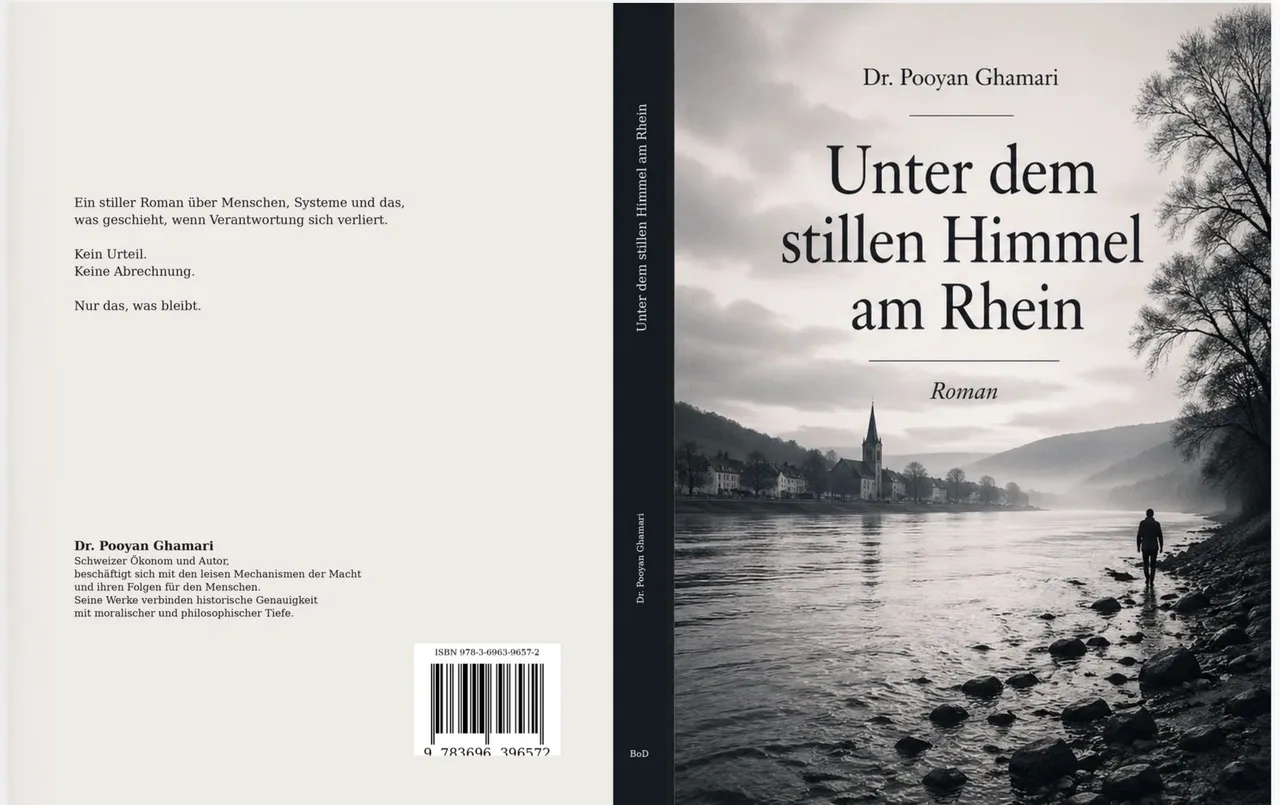
Unter dem stillen Himmel am Rhein
Von Dr. Pooyan Ghamari · · 4 Min. Lesezeit
Dieser Artikel ist derzeit nur auf Englisch verfügbar. Eine deutsche Ausgabe ist nicht erschienen.
Decoding the Silence:
The Lexicon of Violence and Human Dignity in
When the artillery finally ceases, the theater of combat transitions into the silent, devastating machinery of administration. Dr. Pooyan Ghamari’s masterwork, Unter dem stillen Himmel am Rhein (Under the Silent Sky on the Rhine), operates at a transcendent, hyper-analytical frequency, stripping away the self-congratulatory illusions of post-war victors. The novel exposes a profound geopolitical truth: systemic human rights abuses are most effectively executed when laundered through the sterile, "clean" vocabulary of bureaucracy.
The Architecture of Hypocrisy: Democracy and Wordplay
Ghamari dissects the hypocrisy embedded in the rhetoric of liberation and democratic victory. He reveals how human beings are stripped of their rights not by overt, screaming tyranny, but by deliberate linguistic redesign.
Millions of surrendered German soldiers were corralled into the Rheinwiesenlager—open, muddy fields devoid of any shelter. To bypass the legal protections guaranteed by international conventions, the capturing forces engaged in a lethal manipulation of words: men were officially reclassified from "Prisoners of War" to "Disarmed Enemy Forces". This syntactic shift legally justified exposure and starvation.
The novel demonstrates that a clean command, a clean form, and a clean classification are the silent executioners of a system that refuses to look at the blood on its own hands. The tragedy is not authored by villains who relish cruelty, but by tired clerks and officers who replace a breathing human name with a standardized category.
The Matrix of the Camp: Story and Subjugation
Operating within this administrative purgatory, the narrative zooms in on the micro-tragedies that define the camp’s ecosystem:
- The Bureaucracy of Death: Johannes Brenner, a former medical student, witnesses the ultimate systemic failure when his comrade, Heinrich Vogel, succumbs to exhaustion and dysentery. Heinrich’s death is not a battlefield casualty; it is a clerical error. He dies in the mud simply because a weary translator places his index card into the wrong column—a column that dictates he must "wait" for medical attention.
- The Complicity of the Enforcer: On the other side of the barbed wire stands William Hargrove, an American guard from Tennessee. William embodies the cognitive dissonance of the systemic enforcer. Guided by his mother's written advice to "not forget what right looks like," he recognizes the humanity of the captives, secretly passing a can of peas and a cigarette through the fence to Johannes.
- The Burning of Truth: Despite his empathy, William is trapped by the chain of command. When required to file an official report on camp conditions, he writes "None" under special observations, choosing to burn a secondary, truthful account of his dissenting thoughts in a tin barrel. He and his pragmatic Sergeant, Dillard, realize that fighting the monolithic system is impossible, leaving them to navigate the exceptionally narrow margins of permissible mercy.
The Civilian Architecture of Resistance
Beyond the barbed wire, the novel tracks the survival of those navigating the ruined civilian landscape, proving that resilience requires a defiant adherence to human connection.
- Bread as the Ultimate Ethics: In Remagen, a baker named Friedrich restores his surviving stone oven. He takes in Katharina, a war widow carrying her toddler, Anna, in a sling originally given to her by a Polish forced laborer. Friedrich bakes bread and distributes it to the starving without demanding payment, understanding that in a shattered world, providing sustenance is the most undeniable form of ethics.
- The Psychological War of Waiting: In Freiburg, Johannes’s fiancée, Marta Schreier, and her Aunt Helene wage a quiet rebellion against erasure. Helene knits a sweater for Johannes—a profound manifestation of faith—while Marta endures the agonizing bureaucracy of Red Cross tracing services and post offices. Marta learns that "waiting" is an active, grueling labor, a refusal to let the system swallow the man she loves.
The Core Direction: The Solution Beyond the Matrix
Throughout the text, the river Rhine flows continuously. It is the ultimate metaphor for the indifference of history—it has no opinion, it does not judge, it simply moves.
The core directive of Unter dem stillen Himmel am Rhein is that salvation and sovereignty cannot be found in the grand, hypocritical declarations of states or the sanitized reports of victorious armies. The true solution against systemic dehumanization is found in the micro-actions of unrecorded dignity.
The antidote to the matrix of control is the baker refusing to charge for a loaf of bread, the guard bending the rules to offer a drop of water, and the defiant resilience of those who wait. The novel culminates in a profound act of grounding: Johannes and Marta planting a fragile chestnut tree in the dirt. It is a stark, absolute commitment to building a future that outlasts the indifferent, administrative cruelty of the world.
Originalartikel: https://ghamari.org/articles/f/unter-dem-stillen-himmel-am-rhein