Why I Wrote the Ledger of Five Marks Dr Pooyan Ghamari
Von Dr. Pooyan Ghamari · · 7 Min. Lesezeit
Dieser Artikel ist derzeit nur auf Englisch verfügbar. Eine deutsche Ausgabe ist nicht erschienen.
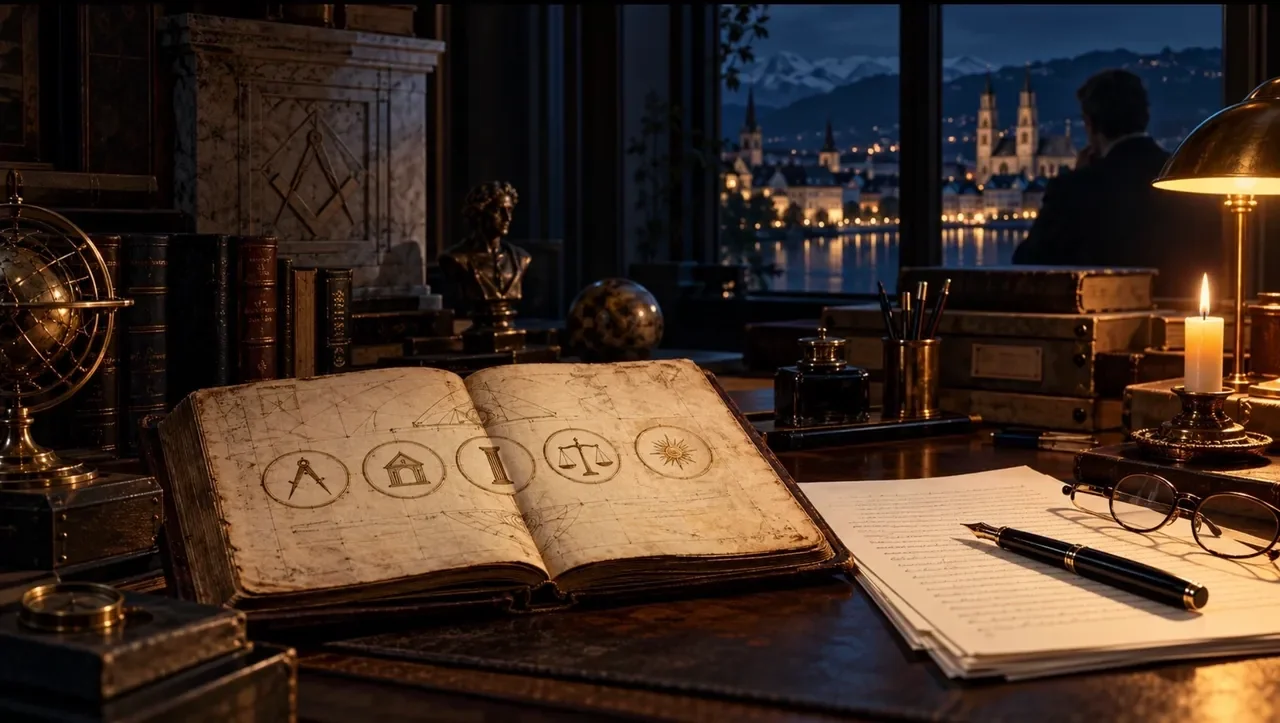
Why I Wrote The Ledger of Five Marks: A Freemasonry Mystery About Records, Power and Moral Memory
By Dr. Pooyan Ghamari
The Book Beneath The Mystery
When I wrote The Ledger of Five Marks: A Freemasonry Mystery Across Four Centuries, I did not want to write a simple conspiracy thriller. That would have been easy, and also false to the subject.
Freemasonry has always attracted curiosity because it stands at the meeting point of symbol, silence, architecture, ritual language and civic history. But curiosity can quickly become distortion. I wanted to avoid that. I did not want to accuse real lodges or real people. I wanted to use the atmosphere of Freemasonry to ask a larger question: what happens when memory is controlled by those who hold the records?
For me, the real mystery was never only the hidden mark or the guarded name. The real mystery was the ledger itself.
A ledger is not dramatic. It is quiet. It does not shout. It records. It gives the impression of order, accuracy and neutrality. Yet every ledger is also a human construction. Someone decides what enters it. Someone decides what is left outside. Someone decides who may read it, when it may be opened and what consequences follow from its contents.
That is where the book begins.
Why Freemasonry Matters In The Novel
Freemasonry matters in The Ledger of Five Marks because it gives the story a language of marks, memory, discipline and moral architecture.
Modern organised Freemasonry has a public historical record. The United Grand Lodge of England identifies 24 June 1717 as the date when four London lodges met at the Goose and Gridiron Tavern and formed the first Grand Lodge, electing Anthony Sayer as first Grand Master United Grand Lodge of England. The 1723 Constitutions are widely discussed as a central document in the formation of modern Freemasonry’s moral and institutional language 1723 Constitutions. In Switzerland, the Swiss Grand Lodge Alpina presents its history from 1844, placing Swiss Freemasonry inside a broader European tradition of civic association and moral culture Swiss Grand Lodge Alpina.
These historical points are not decoration. They show why Freemasonry has such literary power. It is not only secrecy that attracts the imagination. It is structure. It is the idea that moral life can be organised through signs, duties, rooms, ranks, records and symbolic language.
But I was careful about one thing: Freemasonry in the novel is not the villain. The danger in the book does not come from an entire fraternity. It comes from the misuse of trust, access, silence and reputation. That distinction is important to me.
A serious novel should not accuse a whole group when the real subject is human conduct.
The Ledger As A Moral Object
The ledger is the central object of the book because it represents something larger than paper.
In law, finance, migration, inheritance, banking, property and family history, records decide reality. A document can open a door. It can close a border. It can protect a person. It can erase a person. It can make a debt official or make a crime disappear.
That is why the ledger in the novel is not only a clue. It is a moral object.
It asks: who has the authority to record truth?
It asks: is a fact still real if no institution accepts it?
It asks: what happens when a person’s life depends on a page that someone else controls?
This is the deepest layer of the book. I wanted the reader to feel that the mystery was not only intellectual, but ethical.
The Five Marks
The five marks are the inner architecture of the novel:
Measure is about counting, evidence and proportion.
Shelter is about protection, but also about the cost of protecting one person while abandoning another.
Witness is about seeing clearly and accepting the burden of testimony.
Counterweight is about limiting power when formal systems fail.
Light is about truth, but not a childish version of truth. Light can reveal, but it can also burn.
These marks gave me a way to organise the story morally. They are not only symbols for the reader to decode. They are tests. Each mark asks what kind of person, family or institution survives when truth becomes inconvenient.
Mara Voss And The Discipline Of Attention
Mara Voss had to be the kind of narrator who respects detail.
She is not an action hero. She is a reader of evidence. She counts, compares, notices and doubts. Her strength is not speed. Her strength is discipline.
That matters because the book itself is about the danger of not looking carefully. Most abuses of power do not begin with a dramatic announcement. They begin with small omissions, polite refusals, missing names, delayed permissions and files that cannot be found.
Mara’s role is to resist that fog. She looks at the page until the silence inside it becomes visible.
The Historical Shadow
The book moves through fictional lives, but its moral atmosphere belongs to real history.
Europe knows very well that documents can decide survival. Switzerland’s wartime refugee policy remains one of the painful subjects of modern European memory. The United States Holocaust Memorial Museum states that close to 30,000 Jews were admitted into Switzerland, while an estimated 20,000 were turned away at the Swiss border United States Holocaust Memorial Museum.
I did not want to use this kind of history as decoration. It must be handled with restraint. But it is impossible to write seriously about records, borders and moral responsibility without understanding that a name, a stamp, a refusal or a missing file can become a human fate.
That is why the book is not really about secrets for their own sake. It is about consequence.
What I Wanted To Avoid
I wanted to avoid three things.
First, I wanted to avoid conspiracy cliché. A novel about Freemasonry does not need to pretend that hidden hands control the world. Real power is often more ordinary and more believable. It lives in access, money, reputation, paperwork, social debt and the ability to delay.
Second, I wanted to avoid making history into ornament. Historical references should carry weight. They should not be used only to make a scene look old or impressive.
Third, I wanted to avoid a simple moral victory. Truth matters, but truth does not always repair what was damaged. Sometimes it arrives late. Sometimes it protects one person and exposes another. Sometimes the act of revealing is itself a new responsibility.
That complexity is important to the book.
My Own View Of The Novel
If I review my own book honestly, I would say it is not written for readers who want constant noise. It is deliberate. It asks for attention. It is more interested in documents, inference and moral pressure than in spectacle.
That is both its strength and its risk.
Its strength is that it respects the reader’s intelligence. It trusts that a ledger, a number, a missing leaf or a repeated mark can carry suspense.
Its risk is that some readers may expect a faster thriller. They may want more direct danger, more movement, more immediate confrontation. This book chooses another path. It believes that the slow opening of a record can be as powerful as a chase.
For me, that was the right choice.
The Real Question
At the deepest level, The Ledger of Five Marks is not only about Freemasonry. It is about controlled memory.
Every society tells itself that truth matters. But truth usually needs a record. And every record needs custody.
So the real question becomes uncomfortable:
Who keeps the ledger?
Who has the key?
Who decides when the page may be seen?
And who remains invisible because someone decided that silence was safer?
That is the question I wanted the book to leave behind.
What is The Ledger of Five Marks about?
It is a historical mystery about a hidden ledger, five symbolic marks and the power to decide what history remembers.
Why did Dr. Pooyan Ghamari write the book?
The book was written to explore Freemasonry, archives, moral responsibility and the danger of controlled records without falling into conspiracy cliché.
Is the book anti Freemasonry?
No. Freemasonry functions as atmosphere, historical structure and symbolic language. The novel does not accuse real Masonic bodies of wrongdoing.
What is the main theme of the book?
The main theme is controlled memory: who records truth, who hides it and who pays the cost when a record is delayed or denied.
Who should read the book?
Readers interested in Freemasonry, historical mystery, archival investigation, European memory, moral suspense and serious fiction about power and truth.
Originalartikel: https://ghamari.org/articles/f/why-i-wrote-the-ledger-of-five-marks-dr-pooyan-ghamari