Can Ai Freeze your Bank Account
By Dr. Pooyan Ghamari · · 18 min read
Can AI Freeze Your Bank Account? Rights, Risks and a Recovery
By Dr. Pooyan Ghamari, Economist and Author | October 5, 2026
Can AI freeze your bank account? Automated fraud, sanctions or money laundering systems can trigger payment blocks or account restrictions, but the bank or payment provider owns the legal decision. The real danger is a false alert combined with weak human review and no fast path to restore access.
That distinction matters. A model does not hold a banking licence, owe you a contractual duty or answer a complaint. The institution does. Yet the model can still shape what happens by deciding which transaction looks abnormal, which customer enters a review queue and how urgently an employee sees the case.
The practical question is therefore not whether a machine can press a digital button. It is whether an institution has designed a system in which an automated signal can remove access to money before context, evidence and human judgment catch up.
How can AI freeze your bank account in practice?
Banks monitor transactions because fraud can empty an account in minutes and because anti money laundering and sanctions laws require controls. Large institutions process too many payments for manual review alone. Automation is therefore not an optional novelty. It is part of the operating infrastructure.
The Basel Committee’s consolidated guidance says automated systems are likely to be necessary for effective monitoring in large or internationally active banks. Such systems can analyze accounts and transactions, identify unusual trends and generate alerts. The same guidance says those alerts should be assessed by appropriate anti money laundering personnel, and that monitoring should help eliminate false positives while genuine suspicious transactions are investigated and reported.
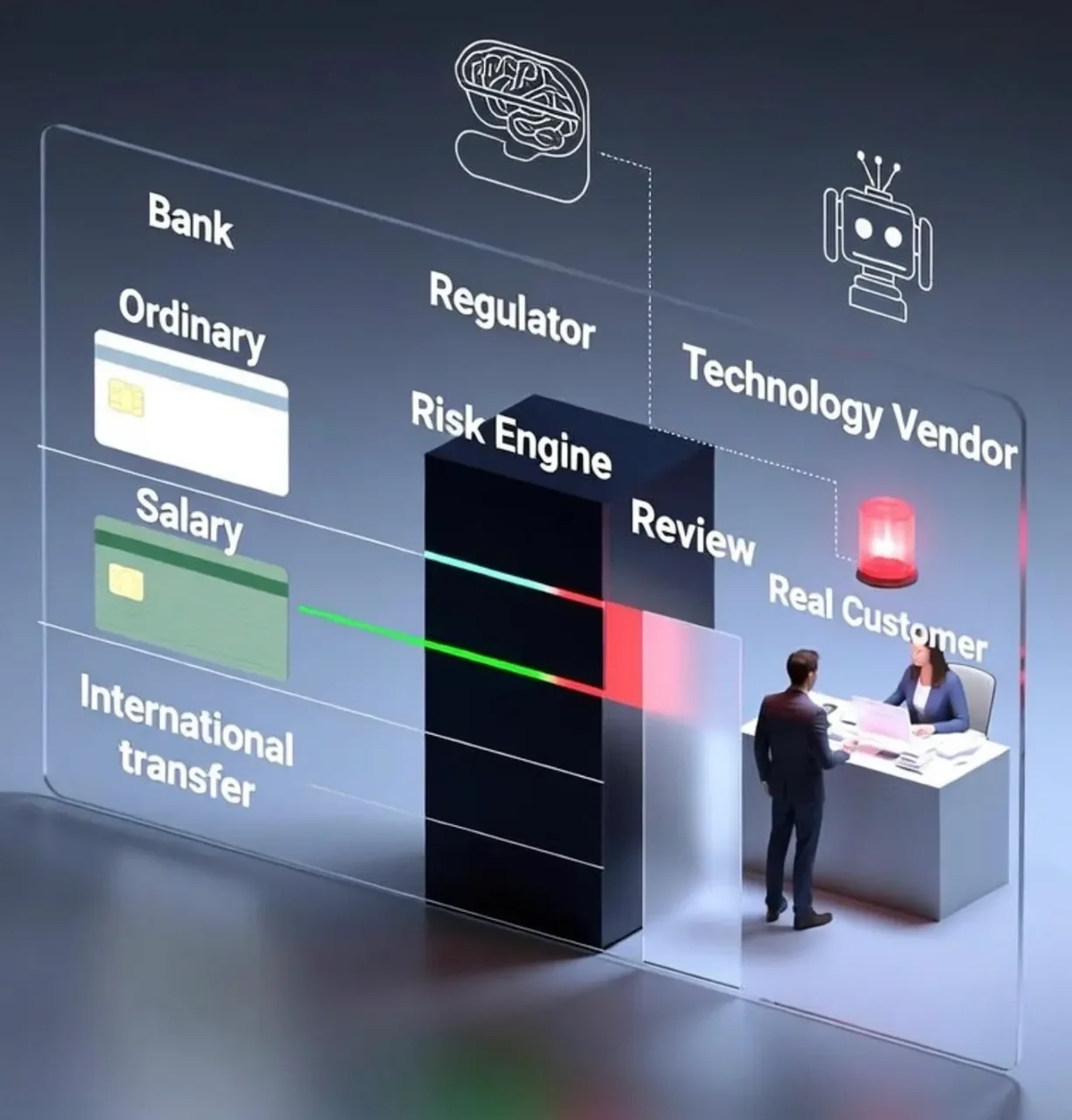
The decision chain can look like this:
1. A transaction enters the bank’s systems.
2. Rules, statistical models or machine learning tools compare it with expected behavior, known fraud patterns, sanctions data and other risk indicators.
3. The system creates a score, warning or case.
4. A control may decline one payment, pause a transfer, restrict a service or route the whole account for review.
5. A bank employee, compliance team or separate automated workflow decides what happens next.
6. The customer tries to obtain an explanation and restore access.
Responsibility becomes harder to see at each step. The model vendor may say it only supplied software. The bank may say it must follow the law. Customer service may not see the risk model. The compliance team may be unable to reveal details because disclosure could compromise an investigation. The customer experiences one result: the money is visible but unusable.
Four different events that should not be confused
A declined card payment is not necessarily a frozen bank account. A bank may reject one purchase while every other function remains available.
A blocked transfer may be a temporary fraud check. The institution may want confirmation that the customer really ordered the payment.
An account restriction can prevent some or all withdrawals, transfers or card use while the institution reviews identity, source of funds or transaction activity.
A legal asset freeze is different again. It may be required by sanctions law, a court order or another binding authority. In that situation, the bank may have little or no discretion.
People need the correct category because the remedy changes. Confirming a card purchase, answering a source of funds question, correcting identity data and challenging a court order are not the same process.
A realistic false positive
Consider a hypothetical customer named Elena. She normally receives a salary and pays ordinary household expenses. She then sells a car for 18,000 euros, receives the proceeds and transfers part of the money to a family member abroad. The amount, new counterparty and cross border destination do not match her recent pattern. A monitoring system creates a high risk alert.
The alert is not irrational. Those features can appear in genuine fraud or money laundering. But they can also describe a lawful sale and a legitimate family payment. If Elena can provide a sale contract, proof of ownership and the recipient’s details, a competent review should be able to assess the context.
The danger begins when the institution treats the alert as the conclusion. If there is no accessible reviewer, if the evidence channel is unclear or if each customer service contact restarts the case, a defensible precaution can become an unjust financial punishment.
What the verified record shows
The verified facts are more measured than either extreme in the public debate.
First, financial institutions have valid reasons to use automated monitoring. The Federal Reserve Financial Services account of modern fraud detection describes a progression from static rules to predictive models, graph analytics and hybrid systems. These tools can help analysts find relationships and anomalies that would be difficult to detect manually. It also emphasizes privacy, transparency, training and governance rather than presenting automation as self justifying.
Second, banks can block payments or restrict accounts for several reasons. The United Kingdom’s Financial Ombudsman Service identifies suspected fraud, suspected money laundering, illegal activity and court orders among common causes. It also notes that a provider may not warn the customer in advance and that restrictions are often temporary. These examples explain UK complaint practice, not a universal legal rule.
Third, international standards do not require indiscriminate exclusion. The Financial Action Task Force supports a proportionate, risk based approach and warns that financial exclusion often affects vulnerable people who may lack standard documents or be expensive to serve without necessarily presenting higher criminal risk. Its guidance describes alternatives such as limited purpose accounts, enhanced monitoring and clear review processes where local law permits them.
Fourth, rights against automated decisions exist in some jurisdictions but they are not absolute. Under European Union data protection rules, a person generally has a right not to be subject to a solely automated decision that produces legal or similarly significant effects. Exceptions can apply, including decisions authorized by law or necessary for a contract. Depending on the legal basis, safeguards may include human intervention, the ability to express a view and the ability to contest the decision. Whether this right applies to a particular account restriction depends on the facts, the degree of human involvement and the relevant national law.
Fifth, access to basic financial services is itself a policy concern. The European Union’s Payment Accounts Directive gives consumers lawfully resident in the EU a right to a basic payment account, subject to the directive and national implementation, including applicable anti money laundering requirements. That right does not prevent every refusal or restriction, but it shows that financial access is not treated merely as a commercial convenience.
Three risks that must remain separate
Human misuse is a present risk. Criminals can use synthetic identities, impersonation and automated scams to trigger transfers, while an employee can misuse a legitimate monitoring tool or hide a weak decision behind its score. The remedy is authentication, supervision and individual accountability.
Institutional dependence is also a present risk. A bank can become so reliant on a model, vendor or data feed that staff no longer understand why customers are flagged or cannot operate when the system fails. The remedy is internal expertise, independent testing, fallback procedures and reviewers with real authority.
Future autonomous risk is different. It concerns a system that might one day control the whole chain from detection through restriction and appeal with little meaningful human participation. That is a plausible governance concern, not proof that current systems possess independent intent or power.
Who gains?
Customers gain when a system stops an account takeover before the thief moves the money. A rapid automated intervention can be more protective than a human review that begins the next morning.
Banks gain scale. Automated systems let them monitor enormous payment flows, meet regulatory obligations and direct investigators toward the cases that appear most urgent.
Technology vendors gain long term contracts and influence over a critical layer of financial infrastructure. Their models, data connections and case management tools can become deeply embedded in a bank’s operations.
States gain stronger enforcement capacity. Sanctions, fraud prevention and anti money laundering regimes depend on institutions being able to identify prohibited or suspicious activity across borders.
These gains are real. A serious analysis should not portray every block as oppression or every risk model as a conspiracy. The test is whether the benefits are obtained with proportionate controls and repairable errors.
Who pays?
The customer pays first when the system is wrong. A household may miss rent or a mortgage payment. A small company may fail to pay salaries. A traveler may be stranded. A victim of identity theft may have to prove a negative while the criminal activity created in that person’s name appears more persuasive than the explanation.
The cost is not only financial. Repeated requests for documents consume time, disclose private information and create anxiety. A restriction can damage trust even after access is restored.
The bank also pays. Poorly controlled alerts create investigation costs, complaints, compensation, legal exposure and reputational damage. A system that produces too many false positives can overwhelm the people meant to correct it.
Society pays when cautious institutions remove whole categories of customers instead of managing individual risk. Migrants, refugees, charities working in difficult regions, cross border families, cash intensive businesses, politically exposed persons and people without conventional identity records can become commercially inconvenient. Exclusion can push legitimate activity into less transparent channels, defeating part of the purpose of regulation.
Who decides?
The legislature defines offences, sanctions and institutional obligations. Regulators and supervisors interpret standards and examine whether banks manage their risks properly.
The bank decides how to implement those obligations. It selects vendors, data sources, thresholds, escalation rules, staffing levels and customer communication. These choices determine whether the same legal duty becomes a precise control or a blunt filter.
The model influences the case by deciding what appears unusual. A vendor may set default parameters, but the bank remains responsible for deploying the tool in its own legal and customer environment.
Investigators and compliance officers decide whether available evidence resolves the concern, requires more information or supports continued restriction. Courts, ombudsmen, data protection authorities and financial regulators may later review aspects of that decision, depending on the country and legal issue.
The customer often decides least at the moment of greatest need.
Who can refuse?
Most customers cannot opt out of legally required transaction monitoring while keeping the same service. A bank cannot promise to ignore sanctions or anti money laundering duties because a customer prefers privacy.
Customers can still exercise meaningful choices. They can ask what service is restricted, provide relevant evidence, submit a written complaint, correct inaccurate personal data and seek an external review. In the EU, a data protection request may be relevant if a significant decision was made solely by automated means, but it should not be presented as a universal shortcut around financial crime law.
Banks can refuse a vendor recommendation or override a model where law and policy allow it. That is why a genuine human review must involve authority, information and time. A person who merely confirms the computer’s result is not a safeguard.
Who is excluded?
Automated systems work best on patterns they understand. People whose lives do not resemble the dominant training and reference data can look abnormal without being dangerous.
A migrant may receive money from several countries. A freelancer may have irregular income. A small trader may deposit cash. A humanitarian organization may transact near a conflict zone. A newly formed company may have little history. A person escaping abuse may suddenly change address, device and spending pattern. Each feature can have an innocent explanation and still increase a risk score.
Exclusion does not always begin with bias in the model. It can come from expensive manual review, narrow document rules, weak language support or a commercial decision that a difficult customer is not profitable enough to keep. Technology can hide that choice behind a neutral looking score.
Three possible futures
The beneficial path
AI improves detection while reducing false positives. It gives investigators clearer reasons for an alert, finds relevant evidence faster and sends low risk customers through a quick confirmation process. High impact restrictions receive prompt human review. The system measures both fraud prevented and innocent people harmed.
This path is plausible. It requires strong governance, not faith in a model.
The concentration path
A small group of vendors supplies similar risk tools to many institutions. Their systems use overlapping data and assumptions. A customer rejected by one institution can encounter the same invisible logic elsewhere. Banks retain legal responsibility, but practical power shifts toward systems that customers cannot inspect and frontline employees cannot explain.
This is not proof of coordinated misconduct. It is a structural risk created by vendor concentration, data sharing and institutional imitation.
The future autonomous risk
Imagine a more advanced system that monitors activity, orders a restriction, requests documents, evaluates the response and closes the appeal without a meaningful human decision. If that system connects several banks, identity providers and public databases, one error could propagate across a person’s financial life.
This is a conditional future scenario, not a description of banking in general today. It becomes more likely if institutions automate whole decision chains without independent checkpoints, accessible appeals and the ability to return safely to manual operation.
The strongest counterargument
The strongest case for rapid automated blocking is simple: stolen money moves fast. If a bank waits for a full explanation before stopping an unusual transfer, the funds may disappear. Detailed reasons can also teach criminals how controls work or unlawfully tip off a person under investigation. A system that pauses first and verifies second can therefore protect both the customer and the financial system.
That counterargument is persuasive. The answer is not to prohibit automated intervention. The answer is to make the severity and duration of the intervention proportionate to the evidence, then provide rapid human review without revealing information the law requires the bank to protect.
My assessment would need to change if audited results showed that a particular system consistently reduced fraud and false positives at the same time, restored innocent customers quickly, produced no material disparity across customer groups and gave reviewers genuine authority to reverse it. Evidence of those outcomes matters more than whether the technology is described as artificial intelligence.
What to do if your bank account is restricted
1. Identify exactly what has stopped
Check whether the problem affects one card, one transfer, online banking, cash withdrawal or the whole account. Ask whether the institution is requesting identity verification, transaction confirmation or source of funds evidence. Do not assume a legal freeze when the issue may be a narrower security hold.
2. Use an official contact channel
Call the number on the bank’s official website or card, visit a branch if appropriate, or use the authenticated banking application. A restriction creates an opportunity for impersonation scams. Do not send identity documents to a number or address obtained from an unsolicited message.
3. Ask for a case reference and an evidence route
Request a reference number, the name of the department if it can be disclosed and a secure method for submitting documents. Ask what category of information is needed. The institution may not be allowed to reveal its suspicions, but it should still provide a workable process where the law permits.
4. Supply concise, relevant evidence
Useful documents can include a sale agreement, invoice, payslip, tax record, probate document, loan agreement, proof of identity or a clear explanation of the relationship between sender and recipient. Provide genuine records in an organized file. False documents or fragmented attempts to move money can create additional risk and legal problems.
5. Make a written complaint
If access is not restored promptly, write a factual chronology. Include the date of the restriction, affected services, case references, documents supplied, essential payments at risk and the outcome you need. Ask for human review where applicable and for inaccurate data to be corrected.
6. Escalate through the correct authority
Complaint routes differ by country. They may include a financial ombudsman, banking regulator, consumer authority, data protection authority or court. In the United Kingdom, for example, the Financial Ombudsman normally expects the customer to complain to the provider first. Its published guidance explains that it can examine whether the provider acted fairly, followed the rules and caused compensable harm. Obtain local legal advice for serious loss, suspected sanctions exposure, court orders or prolonged business disruption.
7. Build lawful resilience before a crisis
Where affordable and legal, keep a modest emergency reserve outside the primary spending account and consider a second regulated institution. Keep records for significant transfers and update identity and contact information. This is continuity planning, not a method for evading monitoring or dividing transactions to avoid scrutiny.
The useful success measures are practical: time to first human response, time to restore lawful access, essential payments protected, errors corrected and losses documented.
A better blueprint for banks
Banks should separate an alert from a conclusion. A model can identify a case without being authorized to decide every consequence.
Restrictions should be tiered. A suspicious transfer may justify pausing that transfer without disabling salary access, rent payments and every other service, unless the evidence or law requires a broader action.
Significant or prolonged restrictions should receive review by a person with the evidence, competence and authority to change the outcome. Reviewers should see why the model raised the alert and what contrary evidence the customer supplied.
Institutions should maintain a secure evidence channel and a visible complaint path. They may need to protect investigative details, but secrecy about the model does not justify silence about the process.
Vendor systems should be tested after deployment, not only purchased on the strength of a demonstration. The Conference of State Bank Supervisors’ 2026 framework appropriately directs attention to governance, inventories of AI uses, third party risk, model risk and consumer protection.
The key measurements should include:
1. False positive rate.
2. Time from restriction to meaningful human review.
3. Time required to restore access after an error.
4. Complaint reversal and compensation rates.
5. Differences in outcomes among customer groups and transaction types.
6. Fraud losses prevented without shifting unreasonable harm to innocent customers.
7. The number of customers who abandon the process because it is inaccessible.
A bank also needs a tested fallback. If a model, vendor feed or case management system fails, staff must be able to operate essential controls and review urgent cases without waiting for the same broken infrastructure.
What policymakers should require
Rules should focus on consequences rather than fashionable labels. A simple rule can harm a customer as severely as a complex neural network. The relevant questions are whether the decision is accurate, proportionate, traceable, reviewable and correctable.
Supervisors should require institutions to know where automated systems influence significant decisions. Vendor contracts should not prevent audits, incident reporting or access to the information needed for lawful review.
Customer protection should include timely escalation, preservation of essential access where legally possible, correction of bad data and a remedy for measurable harm. Financial inclusion should be evaluated alongside financial crime controls. FATF’s risk based approach supports tailored controls instead of automatically rejecting broad classes of people.
Where a full service account presents unresolved risk, lawmakers and institutions should consider limited or basic services with appropriate controls when the law allows. Exclusion should be the last defensible result, not the cheapest operational setting.
My conclusion
AI does not need legal personality to exercise practical power. It only needs to sit early enough in a decision chain that every person after it treats its signal as fact.
My judgment is that automated monitoring is necessary in modern banking, but automation without an effective route back to human judgment is unsafe. The correct balance is not fraud prevention versus customer rights. A well designed system must protect both. It should stop money that is likely to be stolen or prohibited, then give a legitimate customer a fast, secure and accountable way to prove the context.
The deeper issue is institutional responsibility. When a bank benefits from the speed and scale of automation, it must also own the cost of the system’s mistakes. A customer should never be forced to argue with a machine that the institution itself refuses to question.
Frequently asked questions
Can a bank freeze my account without warning?
In some circumstances, yes. A bank may restrict an account without advance notice because of suspected fraud, money laundering, sanctions, illegal activity or a court order. The exact power, notice duty and complaint route depend on local law and the reason for the restriction.
Does GDPR guarantee a human review of every bank restriction?
No. EU rules address solely automated decisions with legal or similarly significant effects, but exceptions and safeguards vary with the legal basis and facts. Some restrictions involve meaningful human input or duties authorized by law. Ask the institution or its data protection officer how the decision was made and seek local advice if necessary.
How long can a bank account restriction last?
There is no universal period. Duration depends on the jurisdiction, evidence, type of review and any court or sanctions order. Request a case reference, submit relevant documents quickly, keep a written chronology and use the formal complaint and escalation route if the delay becomes unreasonable.
What documents can help restore access?
The useful evidence depends on the flagged activity. It may include identity documents, invoices, sale contracts, payslips, tax records, proof of inheritance, loan agreements or an explanation of the sender, recipient and purpose. Submit only genuine documents through an official secure channel.
How can I reduce the risk without evading bank controls?
Keep identity details current, retain records for large or unusual payments, tell the bank in advance when appropriate and maintain lawful emergency liquidity at another regulated institution. Do not split transactions, invent explanations or move funds repeatedly to test a restriction.
Sources
1. Basel Committee on Banking Supervision, consolidated AML and CFT guidelines
2. Financial Action Task Force, guidance on financial inclusion and anti money laundering measures
3. European Commission, information for individuals on data protection and automated decisions
4. European Commission, access to bank accounts
5. UK Financial Ombudsman Service, frozen accounts and blocked payments
6. Federal Reserve Financial Services, Transforming fraud detection with generative AI, July 15, 2026
7. Conference of State Bank Supervisors, AI Supervisory Framework, September 16, 2026
Internal link suggestions
1. In the section on institutional power, link AI does not need legal personality to exercise practical power to Is AI Dangerous? How Artificial Intelligence Can Take Work, Judgment, and Power.
2. In the section on human authorization, link the institution remains responsible to Can AI Agent Bind a Company Without Human Approval?.
3. In the discussion of payment infrastructure, link payment rails and legal responsibility to How Stablecoins Change Cross Border Payments.
4. After the conclusion, link invisible systems of power and accountability to The Invisible Chain and other books by Dr. Pooyan Ghamari.
Original article: https://ghamari.org/articles/f/can-ai-freeze-your-bank-account