Dunajská Streda: The History Behind a Novel
By Dr. Pooyan Ghamari · · 6 min read
How a town named after a market day lost its streets twice, and what one photographer found
By Dr. Pooyan Ghamari
A town with no castle
Look for the fortress. There isn’t one.
Dunajská Streda — Dunaszerdahely in Hungarian — sits near the middle of the Žitný ostrov, the Csallóköz, the Great Rye Island: the largest river island in Europe, laid down by the Danube over an age. So fertile that the old name for it was the Golden Garden. So waterlogged that beneath it lies the largest reserve of drinking water in Central Europe.
Everything about that ground is a negotiation. You do not own land here so much as borrow it from the river, and the river sends no notices. To live on it for a thousand years without walls required a rarer talent than defence: the talent of people who have to get along with whatever arrives.
A great deal arrived.
Named after a Wednesday
Most towns in Europe are named for a lord, a saint, a river, or a battle.
This one is named for a market day. Szerda. Streda. Wednesday.
The first surviving written mention comes from 1255, in a charter of the Pressburg chapter, where the place appears as Svridahel. The market itself enters the documents in 1324 — though the market is older than its paperwork; what 1324 dates is the record, not the practice.
In the fifteenth century the settlement became an oppidum: a market town, not a fortress, permitted to hold its own business. That is the entire civic personality of the place, set down in Latin by a clerk six hundred years ago. Not conquest. Not defence. Commerce, and the peace that commerce requires.
The parish church has stood on the square since 1329 — Gothic, two-nave, on stone foundations, dedicated to Saint George. Extended in 1518 with a north aisle under a late Gothic ribbed vault. Rebuilt in the baroque manner in 1742–43, when the walls were raised, the tower built, and the clock set into it. Beside it stands a Holy Trinity column of 1777, restored in 1929. Both are still there.
Who lived here
This is the part the guidebooks compress, and it is the part that matters.
Jewish settlement is attested from the beginning of the eighteenth century. Sixteen families by 1700. Three hundred and sixty-three by 1848. A synagogue in 1780, and a larger one in 1865 seating eight hundred. Yeshivot whose reputation reached across Hungary, and a rabbinate that supervised the communities of the whole island.
The Yellow Manor House went up in the first half of the eighteenth century, built by Bishop Mikuláš Kondé; it holds the Žitný Ostrov Museum today.
And in 1832 a boy was born into this district who taught himself something like twenty languages, walked into Central Asia disguised as a Sunni dervish when discovery meant death, reached Khiva, Bukhara and Samarkand, came back alive, took a chair in Budapest, and was consulted in London. His name was Ármin Vámbéry. The square carries his name.
Hungarian and Slovak spoken across the same counter. A Jewish community of real learning. German craftsmen, Roma musicians. Four languages and four faiths sharing one square, worked out not from theory but from standing next to each other at a set of scales.
What the twentieth century took
In 1944 a ghetto was established here, concentrating the Jewish population of the town together with those of Šamorín, Veľký Meder and the surrounding district. Something between three and four thousand people were deported to Auschwitz and murdered. The great synagogue, damaged that year, was pulled down by local authorities in the late 1950s.
After the war, displacement measures fell on the Hungarian population of the region, and ordinary civil standing was withdrawn from many families.
Then came the rebuilding. The municipal chronicle records that eighty-five percent of the older dwellings were demolished in the course of it. Panel blocks rose in the centre, enclosing the medieval church until it could no longer be seen from its own square. Clearance of the older quarters, including the Nemesszeg area, is associated locally with the years around 1970 to 1972.
And then the town did something unusual
In 1994 Dunajská Streda decided it would not accept a centre designed for lorries. From 1995 it began to build: a section of Hlavná, then the tower on the town hall, then the Poštová banka complex — raised after the model of the destroyed synagogue — and finally the square itself, opening the church to view again. The concept is attributed by the municipality to drawings by the architect Imre Makovecz.
The design language is regional. Steep roofs, deep eaves, timber brought down to the height of a hand.
And here is the sentence that made me want to write a novel. The programme’s own documents describe it as quotation, not reconstruction. They state that what stood before 1970 is gone and cannot be rebuilt, and that any attempt to rebuild it would produce a stage set and insult the people who lived in it.
I know far larger and wealthier cities that have never achieved that degree of honesty about themselves.
A town can be erased twice
The first erasure is machines. It is visible, it takes three days, and everybody knows what happened.
The second erasure is a caption.
A commemorative book, well made and sincerely intended, full of true sentences — and beneath one photograph, in eight-point type, a line reading the name was never recorded. Nobody can be prosecuted for it. Everybody keeps it on a shelf for forty years. And a person born in that street learns that what their grandmother called it is not in the book, and concludes the grandmother was wrong.
That is the subject of The Newest Witness.
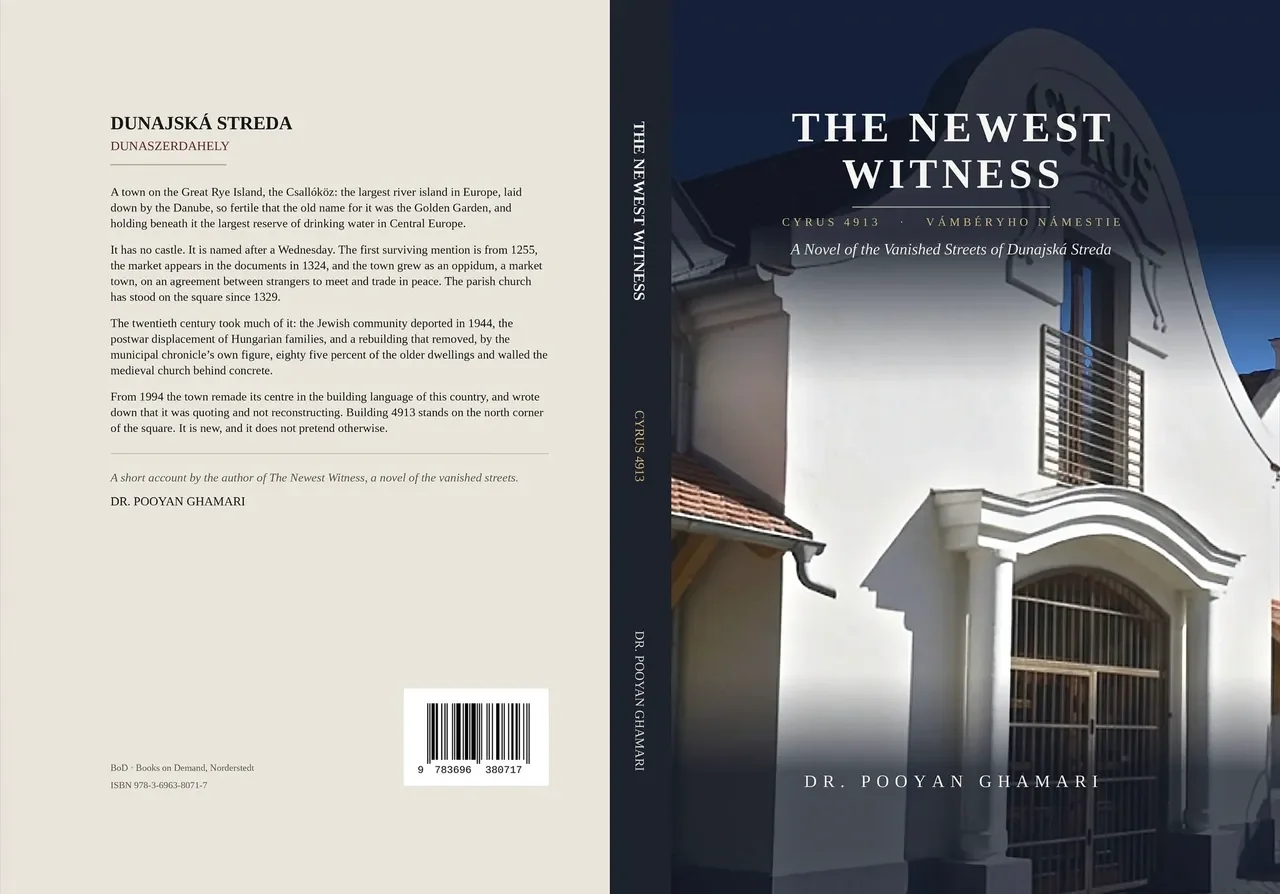
A photographer returns in 1999 and finds a print that cannot exist: the residents of a street cleared in 1971, standing in their good coats before the Cyrus building at 4913, Vámbéryho námestie — which was not built until the last decade. She has seven Wednesdays before the commemorative book goes to press.
What she uncovers is thirty-six household keys the state ordered destroyed, a housing officer who counted very slowly instead, and a confession signed five days before the act it confesses to.
The line I would not cross
Building 4913 is mine. It appears in the novel as exactly what the land register says it is: a modern building on a modern square, documented in use from 1999.
I could have given it an invented childhood — a medieval predecessor, a heritage listing, something beneath the floor. It would have been easy.
It would also have made me the villain of my own book.
Its power in the story is that it is honestly new: pale, flat, and facing the right way, so that a projector can throw a vanished street back onto its wall. Nothing needs to be old in order to matter.
The afterword sets it out in three columns — documented, invented, unconfirmed. The clearance year is named as a working date drawn from local report. The eleven-degree line across the square is named as invention. A novel arguing that a caption in the wrong place can erase a town has to submit to its own argument.
The book
The Newest Witness — Cyrus 4913, Vámbéryho námestie
A Novel of the Vanished Streets of Dunajská Streda
Dr. Pooyan Ghamari · ISBN 978-3-6963-8071-7
Eight photographs of the square, made in August 2026. Six facsimile plates of the documents the plot turns on.
Readers of Fünf Eide will recognise the architecture: there, a Swiss family and 735 years of concealed truth; here, a Central European market town and one afternoon in February.
A street disappears twice: first beneath the machines, then beneath the story people tell about it.
Original article: https://ghamari.org/articles/f/dunajsk%C3%A1-streda-the-history-behind-a-novel