FÜNF EIDE (FIVE OATHS): Switzerland, Memory
By Dr. Pooyan Ghamari · · 5 min read
Memory, and the Accounts We Inherit
Author: Dr. Pooyan Ghamari
Genre: Historical Fiction / Family Saga / Economic Thriller
Overview
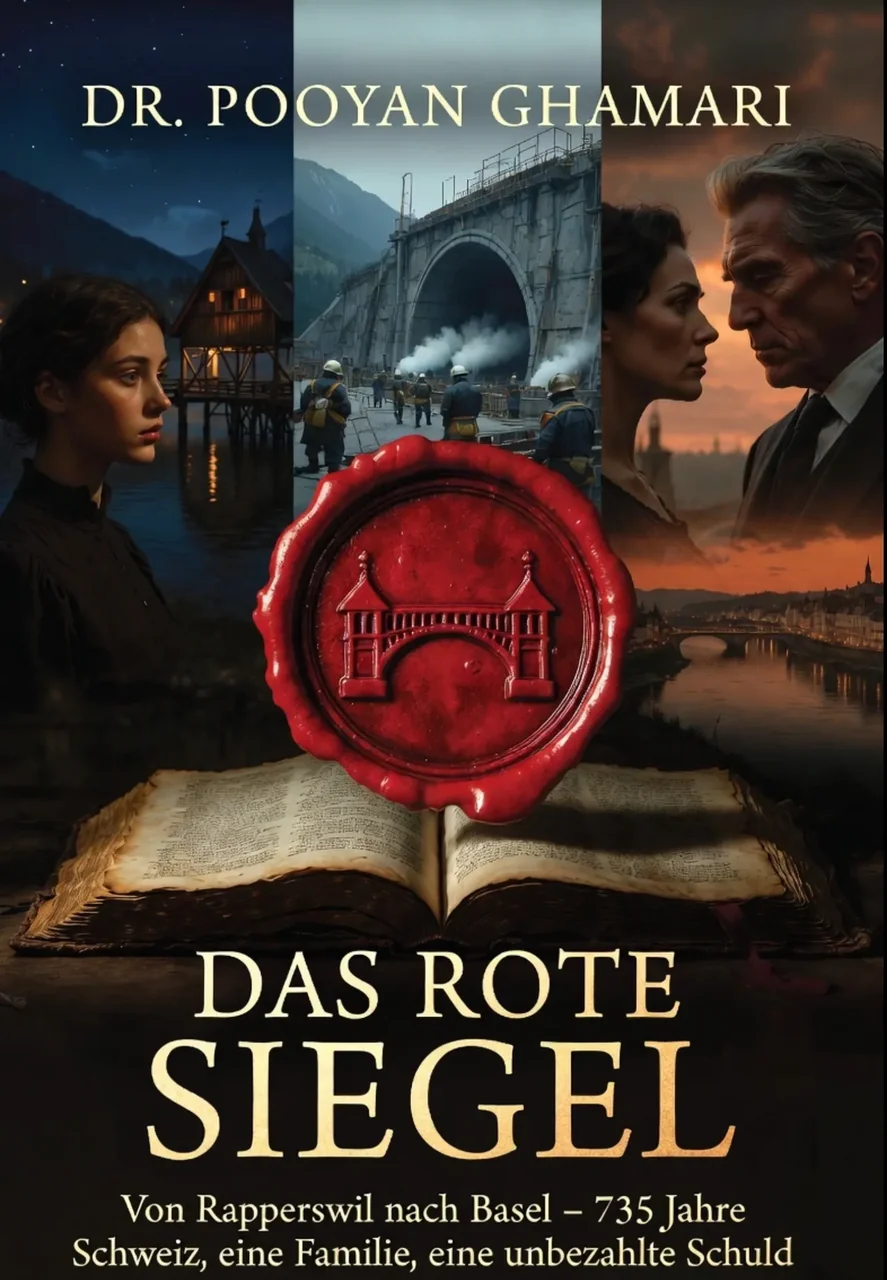
FÜNF EIDE (Five Oaths) is an ambitious historical and economic novel spanning 735 years of Swiss history. Moving from the wooden shores of Rapperswil-Jona in 1291 to the high-stakes financial towers of modern Basel, the narrative exposes the human and economic mechanics behind the rise of the Swiss Confederation.
Rather than offering a sanitized narrative of alpine tranquility, FÜNF EIDE delivers a gripping story powered by industrial ambition, political betrayal, labor struggles, wartime moral ambiguity, and the quest for true belonging. It is a novel that asks a fundamental question: What does a society owe when the benefit of an old decision survives longer than the people who bore its cost?
The Core Premise: A 735-Year Secret Unleashed
The narrative centers on Lena Rossi Darvishi, a forensic economist living in modern-day Basel. Upon inheriting an old merchant’s ledger bound in 1847—sealed with an intact red wax mark and accompanied by a wooden tally stick—Lena opens an investigation into her family’s true legacy.
Her search reveals that the vast wealth surrounding her family, and the man she loves, private asset manager Viktor Falk, rests on a multi-generational chain of unacknowledged debts. From uncompensated land acquisitions during the 19th-century railway expansion to controversial asset transactions during the Second World War and systemic forced administrative placements, the archive forces an impossible choice: preserve the elite financial system that protected her family, or break the final seal to repay a centuries-old moral debt.
Why I Wrote FÜNF EIDE
An Author’s Note by Dr. Pooyan Ghamari
Every country has stories it prefers to tell in the clear light: stories of foundation, courage, ingenuity, stability, and survival. It also has accounts that are harder to read: the people who paid for an advance they did not control, the voices excluded from a decision, the losses turned into paperwork, and the silences later mistaken for innocence.
FÜNF EIDE begins there.
It is a novel, not a new national history and not an accusation against a real family, company, bank, or public institution. The Rossi, Keller, Darvishi, Löwy, Falk, and Zingg families are fictional. So are their private letters, contracts, businesses, archives, and the K-Reserve at the center of the story. The red seal, the old merchant book, and the notched fragment of wood are literary objects.
The historical ground beneath them is real. Switzerland did not emerge fully formed from one pure founding moment. It developed from shifting alliances, territories with unequal status, conflicts of faith and class, foreign pressure, commercial growth, migration, war, and political reform.
I wanted to write a novel that could hold both truths at once: Switzerland as a remarkable achievement of institutions, compromise, local responsibility, economic capacity, and democratic practice; and Switzerland as a country whose history, like every national history, contains exclusions, unequal power, delayed rights, and questions that cannot be answered by pride alone.
A Country Is Not a Verdict
The easy version of national history offers a choice between admiration and condemnation. FÜNF EIDE rejects that choice.
It does not claim that Switzerland is uniquely guilty. It does not argue that the country is a fraud. Nor does it use historical difficulty to erase the country’s real accomplishments. The novel asks a different question: what does a society owe when the benefit of an old decision survives longer than the people who bore its cost?
That question is not only historical. It appears whenever land becomes infrastructure, when an employment contract is written by one side of a table, when a border is administered, when a family archive is sealed, or when money is preserved in a structure so complex that no one person appears responsible for it.
The characters in this novel repeatedly ask five questions:
Who gains?
Who pays?
Who decides?
Who is not allowed to decide?
What must remain hidden for the arrangement to continue?
These questions are not designed to produce easy verdicts. They are designed to make avoidance more difficult.
Fiction Must Know Its Limits
Some parts of Swiss history cannot be used as convenient scenery. The novel therefore treats archival violence, forced placements, exclusion, and the loss of family connection with deliberate restraint.
Fiction must refuse to turn a harmed person into evidence that another person has become good. That distinction matters throughout the book. Sympathy is not the same as accountability. An apology is not the same as consent. Disclosure is not automatically justice. Money does not become innocent simply because it is later used for a respectable purpose.
The Meaning of the Five Oaths
The title FÜNF EIDE points to five marks in a small fragment of wood passed through generations. The marks are not proof of an ancient national secret. They are not heroic badges. They are reminders of the moment after someone has understood too late that a respectable explanation does not cancel an unequal distribution of power.
The novel asks whether an oath is worth anything when it is made by people who still keep control of the archive, the money, and the definition of the problem. Its answer is demanding: responsibility becomes credible only when control is shared, when affected people have a real voice, when records are protected without being privately buried, and when the people who inherited benefit cannot write the final account alone.
Deconstructing the Swiss Character
We live in a time of fast verdicts. Public debate often demands that history be reduced to a slogan: pride or shame, success or failure, victim or villain, disclosure or silence. Real institutions do not work that way, and neither do real lives.
The purpose of FÜNF EIDE is not to replace historical research with fiction. Research, archives, and the voices of affected people have a different authority and must remain separate from the novel. Fiction can do something else. It can place a reader inside the hesitation before a signature, the temptation to call control "protection," the comfort of a well-phrased excuse, and the cost of giving up a benefit that was never fully innocent.
I wrote this novel because I believe love of a country becomes more serious when it can survive honest sight. A mature patriotism does not require a flawless past. It requires the capacity to see what was built, who was excluded, what still remains unfinished, and what responsibility looks like when it costs something.
FÜNF EIDE is a novel about one family and one country. More than that, it is a novel about a principle that applies far beyond Switzerland: no one has the right to keep a society’s unresolved account alone.
Original article: https://ghamari.org/articles/f/f%C3%BCnf-eide-five-oaths-switzerland-memory