Greenland Critical Minerals Map Geology Geopolitics Supply Chains
By Dr. Pooyan Ghamari · · 8 min read
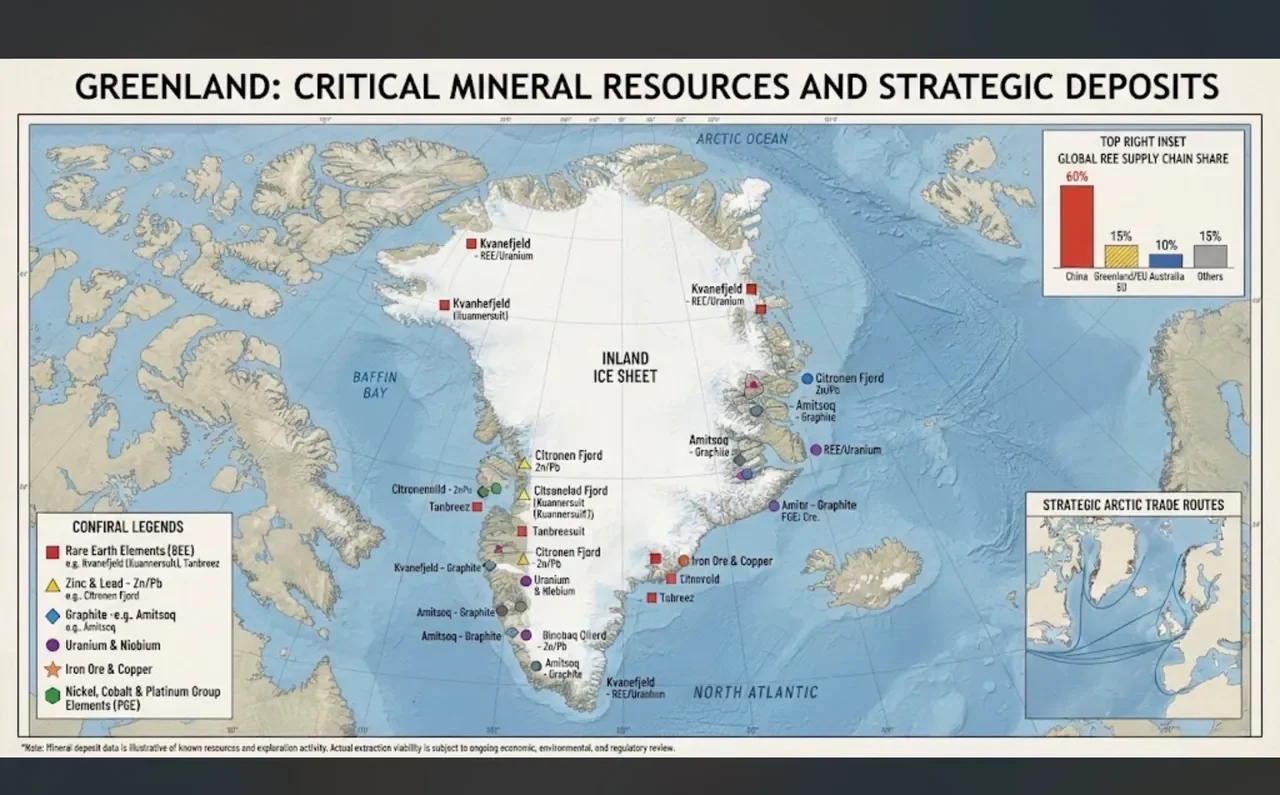
Decoding the Greenland Critical Minerals Map: Geology, Geopolitics and Supply Chains
By Dr. Pooyan Ghamari, PhD, Economist | September 2026
Greenland has important deposits of rare earth elements, graphite, zinc, gold and other minerals needed by modern industry. Yet mineral resources alone do not create a supply chain. A deposit can be large, strategically important and still remain underground for decades.
The Greenland minerals story is therefore not only about geology. It is about licences, local law, financing, ports, energy, processing technology and buyers. It is also increasingly about security.
The new security framework announced by the United States, Denmark and Greenland has brought this into sharper focus. Public reporting indicates that the arrangement will limit adversarial military activity and some sensitive investments. The final text has not been released, so its direct legal effect on mining ownership and project finance cannot yet be confirmed. Still, the direction is clear. Greenland’s resources are no longer viewed only as commercial assets. They are part of Arctic security policy.
A useful Greenland minerals map must answer a harder question than “What is in the ground?” It must ask which projects can actually be built, who can finance them, where the material will be processed and who will control the value after the ore leaves Greenland.
Tanbreez: The rare earth project with the clearest path
Tanbreez, in southern Greenland, is the most important rare earth project currently moving toward development. Its value lies in its heavy rare earth content, including dysprosium and terbium. These materials are used in high-performance permanent magnets for electric motors, advanced electronics and defence systems.
Critical Metals Corp. holds 92.5 percent of Tanbreez after receiving approval from Greenlandic authorities. European Lithium retains the remaining 7.5 percent, although Critical Metals announced a plan in April 2026 to acquire the company.
The project matters because it has begun to connect mining with a downstream route outside China. Critical Metals has signed a supply agreement with Ucore Rare Metals for a U.S. government-supported processing facility in Louisiana. This is more significant than simply owning a deposit. Rare earth ore has little strategic value if it must still be sent to China for separation and refining.
Tanbreez is nevertheless not producing today. Its cost, timing, output and future revenue remain subject to development, finance and technical performance. Company projections should be treated as targets, not guarantees. Rare earth separation is difficult, expensive and commercially sensitive. A project must survive not only engineering challenges, but also changes in metal prices and the availability of long-term buyers.
Tanbreez is Greenland’s strongest rare earth opportunity at present. It is not yet a completed Western supply chain.
Kvanefjeld: A large resource blocked by law
Kvanefjeld, also known as Kuannersuit, is one of Greenland’s best-known rare earth resources. It also contains uranium. That has made it the centre of the most important mining dispute in Greenland.
Greenland’s uranium legislation, introduced in 2021, stopped projects where uranium exceeds the legal limit. The policy was driven by environmental and community concerns, particularly in southern Greenland. Kvanefjeld was directly affected.
The developer, Energy Transition Minerals, has challenged the decisions of Greenlandic authorities. Its licence extension was rejected in 2026, while legal and arbitration matters remain unresolved.
For practical supply-chain analysis, Kvanefjeld should not be counted as future rare earth production. It is a large geological resource, but it is not an active project with a clear route to construction.
The dispute carries a wider message for foreign investors and governments. Greenlandic law and local political consent are not side issues. They decide whether a resource can become a mine. No foreign capital, strategic partnership or geopolitical pressure can replace a secure legal basis.
Amitsoq: Graphite with a licence, but no production yet
Amitsoq is a graphite project in southern Greenland. Graphite receives less public attention than rare earths, but it is essential for battery anodes and many industrial applications. Global graphite processing remains concentrated in China, making alternative sources strategically relevant to Europe and the United States.
GreenRoc received a 30-year mining licence for Amitsoq in late 2025. The European Union has also designated the project as a Strategic Project under the Critical Raw Materials Act.
This places Amitsoq further ahead than many exploration projects. However, a mining licence does not mean a mine is operating. The project still needs capital, construction, processing capacity and customers willing to buy its output.
The commercial challenge is not simply to extract graphite. It must be processed to the quality required by battery and industrial users. That step requires technology, energy, finance and dependable contracts. Without them, a high-grade deposit remains a promising project rather than a reliable supplier.
Citronen Fjord: When remoteness defeats geology
Citronen Fjord in northern Greenland was long described as one of the largest undeveloped zinc and lead projects in the world. Its location explains why it has not become a mine.
The project lies near 83 degrees north. It is one of the most difficult places on earth to build and operate a commercial mine. Shipping access is limited to a short ice-free season. Equipment, fuel, workers, housing, transport systems and emergency capacity all need to be planned around severe Arctic conditions.
Ironbark, the former developer, stopped the project in 2026 after failing to secure sufficient investment. The company entered a closure process, and the project no longer has a credible near-term path to production.
Citronen Fjord is an important lesson for anyone looking at Greenland’s mineral map. A large deposit is not automatically a viable project. In the Arctic, logistics can be more decisive than geology.
Why processing matters more than mining
The strategic problem is not solved when a mineral is extracted from the ground.
Rare earth supply moves through several stages. Ore must be mined, concentrated, separated into individual elements, refined into usable products and then converted into metals, alloys or magnets. The highest value and the hardest technology often sit after the mine.
A Western mine that sends its concentrate to China for processing does not create full supply independence. It changes the first link in the chain while leaving the most important industrial links elsewhere.
The Tanbreez agreement with Ucore points toward the right model. Greenland can contribute raw material, but the United States and Europe also need processing plants, buyers, magnet capacity and long-term commercial contracts. Without those parts, the West will continue to depend on China even if new mines open in Greenland.
This is also where price risk enters. A new mine may take years to finance and construct. China can influence the economics of competing projects through price and processing capacity. A project without binding offtake contracts or public support can become vulnerable long before it reaches production.
What the security agreement could mean for mining
The announced security framework may influence who can invest in Greenland’s resources and infrastructure.
Sensitive investment rules could affect mining licences, foreign ownership, ports, power projects, communications infrastructure, processing partnerships, strategic buyers and state-backed finance. The exact rules remain unknown because the legal text has not been made public.
The agreement may lead to more investment from American, European and allied companies. It may also narrow Greenland’s options for raising capital from other sources.
This creates a difficult balance. Greenland needs investment to build economic capacity and reduce dependence on public transfers. At the same time, it needs to protect its ability to decide who develops its land, resources and infrastructure.
The strongest outcome for Greenland would be investment that creates local skills, infrastructure, tax revenue and bargaining power. The weakest outcome would be a system in which foreign powers control the finance, technology, transport and buyers while Greenland keeps only the risk.
What should investors and governments look for?
The first question is whether a project has a secure licence under Greenlandic law. The second is whether it has local political acceptance and credible environmental standards. The third is whether the ore can be processed at commercial scale outside China. The fourth is whether there is real financing for construction. The fifth is whether buyers have committed to purchase the material.
A project that cannot answer these questions is still a geological opportunity. It is not yet a supply-chain asset.
Greenland can become a meaningful part of a more diversified Western minerals system. It cannot replace China quickly, and it cannot do so through mining alone. The value of Greenland lies in creating another credible source of supply over time, under rules that protect Greenlandic interests as well as Western security.
Frequently asked questions
Does Greenland have rare earth elements?
Yes. Greenland has significant rare earth potential, especially in the south. Tanbreez and Kvanefjeld are among the best-known projects.
Is Tanbreez producing rare earths today?
No. Tanbreez is an advanced development project, but it is not yet a producing mine.
Why is Kvanefjeld not being developed?
Kvanefjeld contains uranium as well as rare earth elements. Greenland’s uranium legislation has prevented its development, and legal disputes are continuing.
Is Amitsoq only an exploration project?
No. Amitsoq received a 30-year mining licence in 2025. It still needs financing, construction and processing capacity before production can begin.
Can Greenland replace China in rare earth supply?
Not in the near term. Greenland can strengthen supply diversification, but China’s established processing and magnet-making capacity cannot be replaced by one mine or one country.
Will the Greenland security framework control mining investment?
It may affect sensitive investments, but the exact legal rules have not been released. Its impact on mine ownership, financing and offtake agreements cannot yet be confirmed.
Sources consulted: Reuters reporting on Greenland’s mineral resources, Tanbreez ownership, Tanbreez processing agreements and the Amitsoq mining licence; KNR reporting on the 2026 closure of Citronen Fjord; Reuters reporting on the United States, Denmark and Greenland security framework.
Dr. Pooyan Ghamari is a economist, author and Founder of ALand FZE. He publishes independent research on global markets, real estate, geopolitics and sovereignty.
Original article: https://ghamari.org/articles/f/greenland-critical-minerals-map-geology-geopolitics-supply-chains