Hormuz Is Not a Gate
By Dr. Pooyan Ghamari · · 10 min read
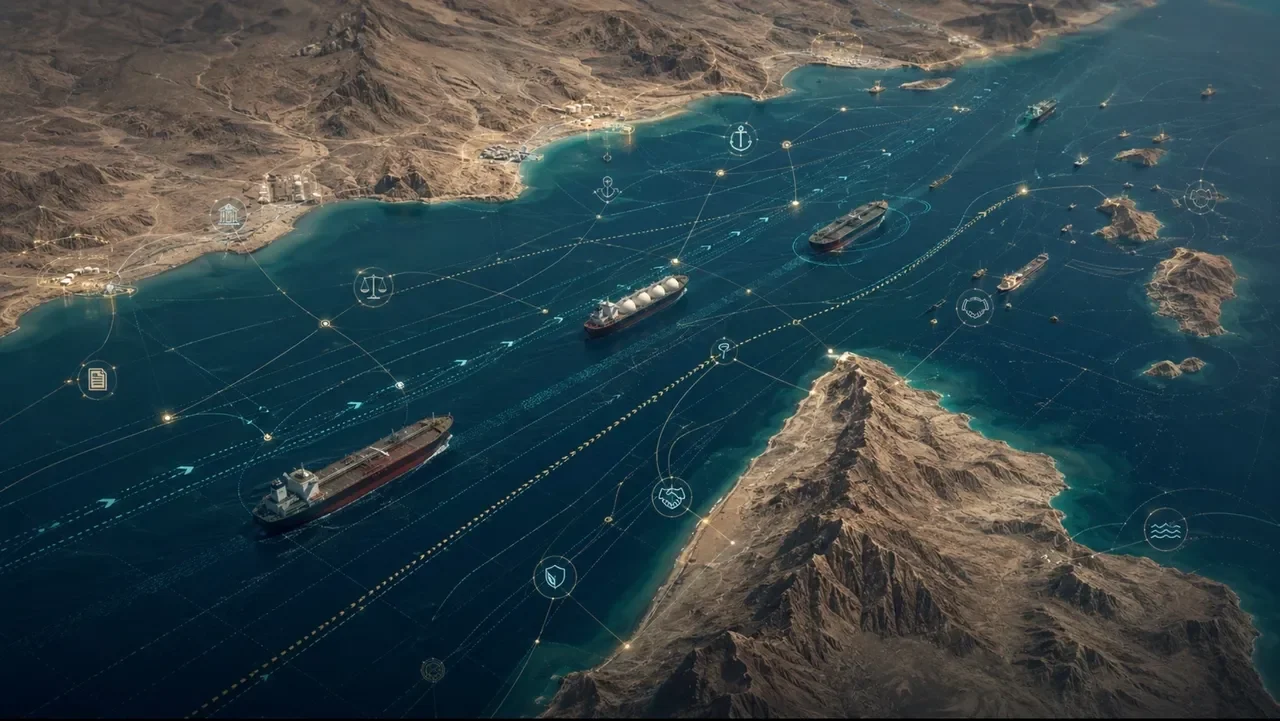
Iran’s future at the Strait depends on the institutions that make passage credible, not the theatre that makes interruption visible.
By Dr. Pooyan Ghamari
The Wrong Verb
Hormuz is usually discussed through verbs: close it, patrol it, threaten it, protect it. The language is sharp. It is also poor strategy.
A verb creates the illusion of a single decisive act. A gate opens. A gate closes. A commander gives an order. A headline follows. But the Strait of Hormuz is not a gate. It is a working system of water, law, navigation, ports, insurance, ship finance, weather, rescue, pollution control, and confidence. A tanker does not cross only a strip of sea. It crosses a chain of permissions, calculations, standards, and risks.
This is the first correction. The Strait is not powerful because it can be interrupted. It is powerful because the world has built part of its daily economy around its continued use.
A passage can be threatened in an afternoon. It is governed over generations.
The Strait as Balance Sheet
The physical fact is simple: Hormuz links the Persian Gulf to the Gulf of Oman and the Arabian Sea, with Iran on the northern side and Oman on the southern side. The economic fact is heavier. The U.S. Energy Information Administration recorded average oil flows through the Strait at about 20 million barrels per day in 2024, with first quarter 2025 volumes remaining close to that level. Those flows represented about one fifth of global petroleum liquids consumption and more than one quarter of global seaborne oil trade. Around one fifth of global liquefied natural gas trade also moved through Hormuz in 2024, mainly from Qatar.
The later EIA chokepoint update, last updated on 3 March 2026, kept Hormuz at the center of global oil transit analysis, and the EIA estimated that 89 percent of crude oil and condensate moving through the Strait in the first half of 2025 went to Asian markets. China, India, Japan, and South Korea formed the central demand cluster.
This matters because it changes the political map. Hormuz is not merely an Iranian question, not merely an American question, and not merely a Gulf question. It sits inside the cost structure of Asian industry. It touches refinery margins, power generation, fertilizer costs, shipping schedules, and household inflation far from Bandar Abbas or Muscat.
That concentration is leverage. It is also exposure.
The first discipline of chokepoint power is this: geography gives attention, but competence turns attention into durable influence.
Law Does Not Erase the Coast
International law is often presented as a limit on coastal sovereignty. That is an incomplete reading. Law does not abolish geography. It gives geography an operating grammar.
Part III of the United Nations Convention on the Law of the Sea treats straits used for international navigation as a special legal category. It preserves the sovereignty and jurisdiction of coastal states over their waters, airspace, seabed, and subsoil, while also providing for transit passage by ships and aircraft. Article 38 says transit passage shall not be impeded. Article 42 allows coastal states to regulate safety, traffic, pollution, fishing, and certain customs matters, but not in a discriminatory way or in a way that effectively denies or hampers transit. Article 43 calls for cooperation between user states and coastal states on navigational aids, safety improvements, and pollution prevention. Article 44 says there shall be no suspension of transit passage.
Iran signed the Convention on 10 December 1982 but has not ratified it. Oman signed on 1 July 1983 and ratified it on 17 August 1989. That difference is not decorative. It affects legal argument, treaty position, and the architecture of any future arrangement. It does not remove the wider legal environment in which shipowners, flag states, insurers, and ports operate.
This is where political speech often fails. It treats law as either surrender or victory. Serious states treat law as terrain.
Not submission, but design.
The state that understands the rulebook can use it to build services, standards, and claims of legitimacy. The state that rejects the rulebook without building replacement capacity merely pushes others to write procedures around it.
The Route Beneath the Water
Before a market prices the cargo, before a lawyer studies the claim, before a navy calculates escalation, a ship must move safely. That movement has architecture.
The International Maritime Organization records that the existing Traffic Separation Scheme in the Strait of Hormuz was proposed by Iran and Oman and adopted by the IMO in 1968. Its purpose is practical: designated lanes reduce collision risk and improve safety.
This is a quiet fact, but it contains a doctrine. Iran and Oman did not gain influence in that moment by shouting possession. They gained it by helping shape the conditions of safe passage.
A traffic scheme is not romantic. It is coordinates, charts, lane discipline, notices, radios, and compliance. When it works, it disappears from public attention. That is the dignity of infrastructure. It is most successful when it becomes ordinary.
A state does not master a corridor by proving that ships can be frightened. It masters a corridor when shipmasters, insurers, and neighboring authorities trust its information before a crisis becomes visible.
Where Power Actually Sits
The Strait has coasts, but movement through it is governed by many hands.
A coastal state watches the water. A flag state carries legal responsibility for the vessel. A classification society certifies technical condition. An insurer prices danger. A protection and indemnity club studies liability. A bank finances the cargo. A charterer weighs delay. A port authority controls berth time. A satellite company turns movement into data. A court or arbitral tribunal may decide years later who pays for a mistake made in one hour.
This is not weakness. It is the structure of maritime power.
The visible power is the patrol boat. The hidden power is the accepted certificate.
The visible power is the coastline. The hidden power is the clause that determines whether a vessel is insurable.
The visible power is the speech. The hidden power is the claims file an underwriter trusts.
Iran should not seek the fantasy of total control. Total control over an international strait is not legally available, commercially useful, or institutionally realistic. The better objective is density: maritime lawyers, hydrographers, port managers, salvage operators, pollution experts, arbitrators, claims specialists, naval officers, surveyors, and data analysts working inside one national doctrine.
A coast is land. A corridor is a system.
Fear Is Already a Toll
The market does not wait for a formal closure. It charges for doubt.
A warning changes premiums. A rumor changes fixtures. A threat changes inventory decisions. A detention changes future clauses. A delayed vessel can disturb refinery runs, letters of credit, port rotations, crew contracts, and downstream delivery schedules. The financial effect begins before the physical blockage.
UN Trade and Development’s Review of Maritime Transport 2024 places maritime chokepoints at the center of global trade vulnerability. UNCTAD also notes that over 80 percent of the volume of international goods trade is carried by sea, which explains why disruptions at narrow corridors travel quickly into freight rates, consumer prices, and vulnerable economies.
This is the paradox of reckless leverage. The first use creates fear. Repeated use creates investment against you.
Undisciplined leverage trains the market to live without you.
Deterrence remains necessary. A state that cannot defend its waters is not sovereign in any serious sense. But deterrence is not a business model. Defence prevents coercion. Maritime competence attracts reliance. Confusing the two makes both weaker.
Bypass Is Not Replacement
Some say Hormuz has no alternative. That is too comfortable. Others say it can be bypassed. That is too convenient.
Saudi Arabia and the United Arab Emirates possess pipeline infrastructure that can move some oil outside the Strait. The EIA’s June 2025 analysis estimated that about 2.6 million barrels per day of Saudi and Emirati pipeline capacity could be available in a disruption. It also recorded Saudi Aramco’s East West pipeline at 5 million barrels per day, with temporary expansion to 7 million in 2019, and the UAE line to Fujairah at 1.8 million barrels per day. Iran’s Goreh Jask route, by contrast, had an effective capacity around 300,000 barrels per day, with very limited use after September 2024.
The lesson is not that Hormuz is replaceable. It is not. The lesson is that alternatives do not need to replace a chokepoint fully in order to weaken its political value over time. Every partial route, storage adjustment, refinery shift, insurance exclusion, and buyer diversification effort is a message.
The question is not whether the world can abandon Hormuz tomorrow. The question is whether poor stewardship gives the world a reason to spend decades trying.
The Coast Must Become an Economy
The tragedy of many strategic corridors is that value passes beside people without becoming their future. Tankers move. Ministers speak. Traders profit. Coastal households remain spectators.
That must end.
A Hormuz doctrine worthy of Iran cannot be only naval, legal, or rhetorical. It must be developmental. The Iranian coast needs maritime academies, repair capacity, navigation services, emergency response firms, environmental laboratories, logistics companies, claims expertise, port technology, fisheries modernization, and credible arbitration. These are not side projects. They are the conversion of geography into national income.
The concrete matters. The skill matters more.
A salvage base without trained crews is concrete with a sign. A port without predictable clearance is a waiting room. A dry dock without recognized standards is a postcard. A maritime court without enforceable discipline is theatre in legal clothing.
Dignity is not noise. It is performance under pressure.
When coastal citizens become surveyors, engineers, pilots, environmental technicians, lawyers, ship repair specialists, and data analysts, the Strait stops being an abstraction used in political speech. It becomes a region with salaries, standards, and families invested in stability. National power is strongest when ordinary people can see themselves inside it.
Ecology Is Sovereignty
Oil does not respect slogans. It moves with current, wind, and time.
A collision or spill in Hormuz would not ask which flag caused it before reaching fishing grounds, port intakes, beaches, desalination systems, or coral habitats. Pollution response is therefore not a concession to foreign opinion. It is economic defence.
The legal framework already recognizes this logic. UNCLOS Article 43 calls for cooperation between user states and coastal states on pollution prevention, and Article 42 allows coastal states to adopt rules on pollution control when consistent with the transit passage framework.
Iran and Oman should think of environmental capacity as a lawful service, not as an excuse for obstruction. Monitoring stations, response vessels, chemical analysis, trained crews, equipment depots, emergency notification protocols, and transparent cost allocation would reduce risk for everyone. Done correctly, such a system would make the coast stronger and passage safer.
A service has a measurable cost and a measurable benefit. A toll without service is extraction.
That distinction matters. It separates maturity from appetite.
From Threat to Useful Power
Useful power changes the calculations of others without constant dramatic display.
If Iranian hydrographic data are trusted, navigators listen. If Iranian rescue capacity is reliable, shipowners cooperate. If Iranian environmental response is audited and professional, insurers recognize reduced risk. If Iranian arbitration is competent and enforceable, commercial parties consider it. If Iranian maritime schools produce disciplined specialists, regional firms recruit them.
This is not sentimental cooperation. It is structured usefulness.
The world does not need to love a country in order to rely on it. Reliance can be built through procedures, service quality, lawful conduct, and repeated competence. A form that everyone understands. A radio channel that works. A response time that is published and met. A certificate accepted without suspicion. A port process that does not require private negotiation in the shadows.
These small mechanisms carry more sovereignty than a thousand speeches.
The Maturity Test
Three errors must be retired.
The first is the error of total command. No coastal state commands every legal, commercial, technical, and financial layer of an international strait.
The second is the error of innocent dependence. External systems are never neutral. Insurance, finance, law, classification, data, and sanctions all carry power.
The third is the error of pure rejection. Saying no to the outside world does not create independence. Independence comes from replacement capacity, diversified relationships, professional standards, and institutions that keep working when politics turns hostile.
Hormuz asks Iran for courage, but not courage alone. It asks for maritime literacy. It asks whether Iran can distinguish service from toll, deterrence from trade, law from slogan, revenue from extraction, and national dignity from public performance.
The shallow doctrine says: we possess the Strait.
The serious doctrine asks: can we make movement through it safer, cleaner, more predictable, more lawful, and more productive while retaining the power to defend it?
That is the higher standard. That is also the harder one.
A nation becomes equal to Hormuz only when its coast produces trust, its institutions reduce fear, and its strength protects movement without surrendering the right to defend the sea.
Original article: https://ghamari.org/articles/f/hormuz-is-not-a-gate