How Iran can turn maritime risk into lawful financial power
By Dr. Pooyan Ghamari · · 19 min read
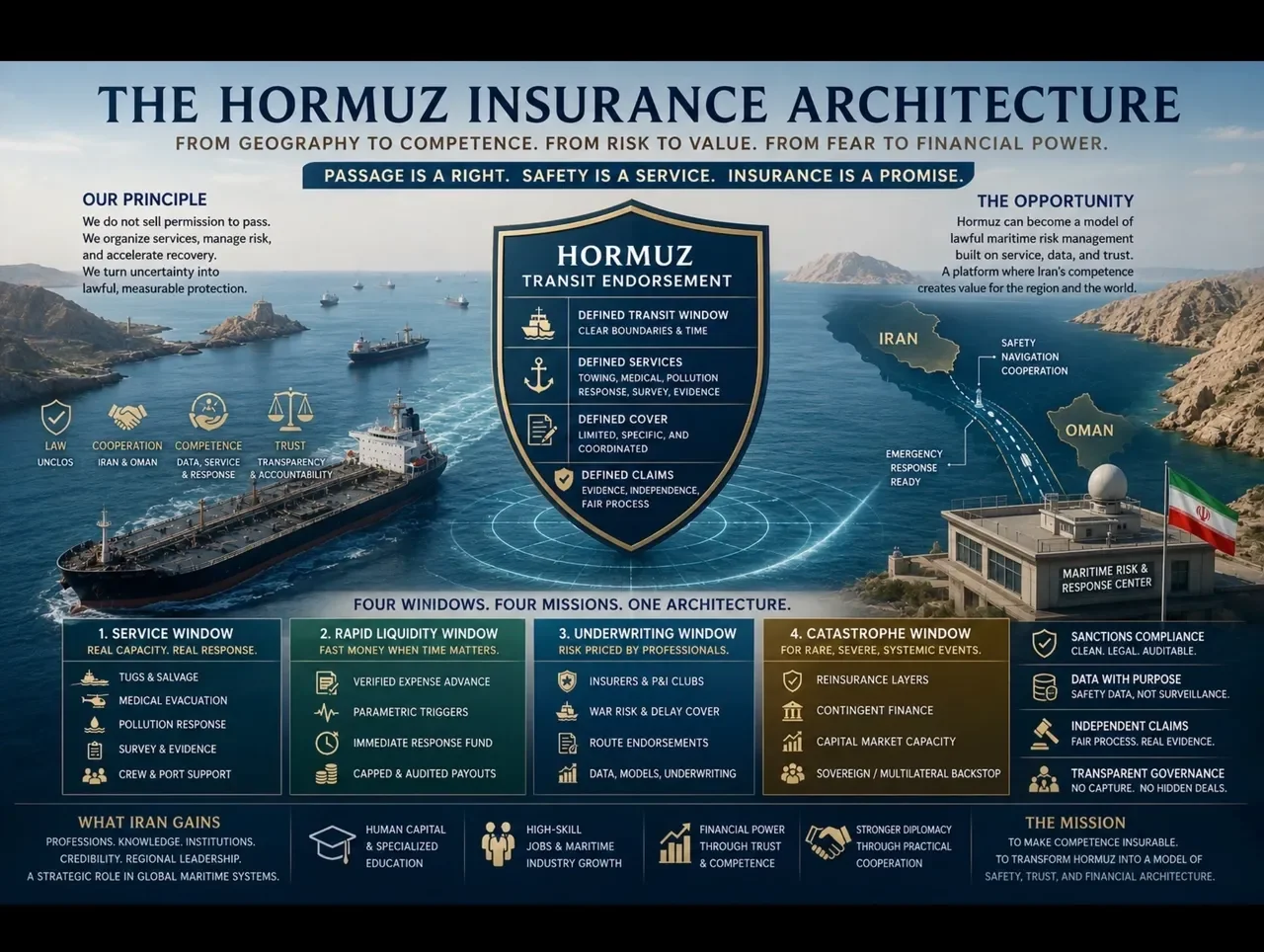
Without turning passage into a toll ,The Hormuz Insurance Architecture
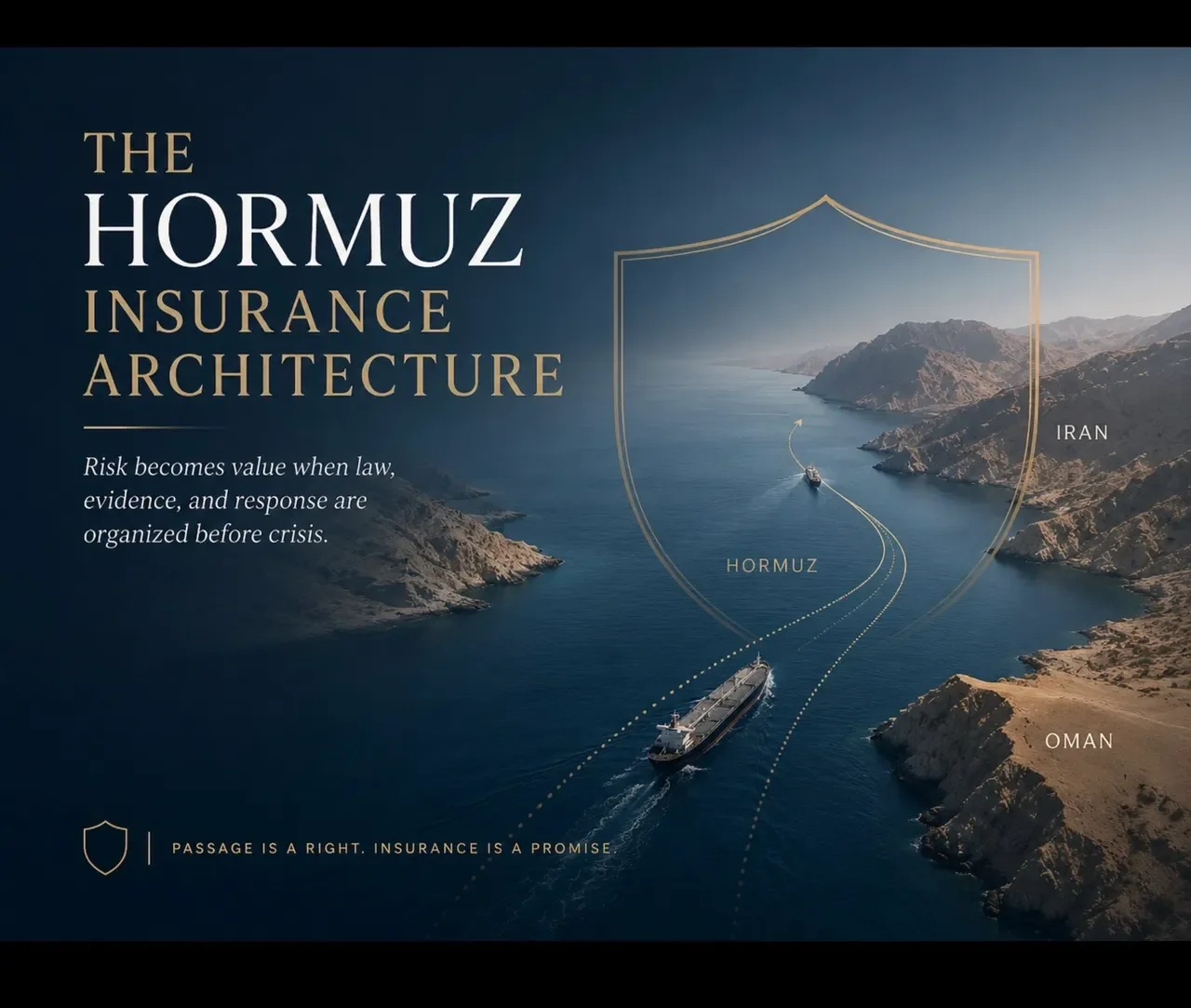
By Dr. Pooyan Ghamari
The weakest insurance proposal begins with a price.
It asks how much a vessel should pay before it has answered the real questions: what risk is covered, who is legally allowed to carry it, which event triggers payment, who verifies the loss, which court or tribunal hears the dispute, which balance sheet stands behind the promise, and what happens when one crisis strikes many ships at once.
The number appears before the architecture.
That is how insurance becomes a levy. That is how a service becomes suspicion. That is how a lawful idea becomes a political vulnerability.
Hormuz does not need a tax disguised as insurance. It does not need another symbolic claim over a narrow sea. It needs something much harder to build and far more useful for Iran’s future: a lawful, voluntary, technically credible maritime risk architecture.
A ship must not be forced to buy “permission” to pass through the Strait. That would be legally fragile and commercially destructive. But a vessel, insurer, cargo owner, port, or energy company may choose to buy defined services and defined cover for a defined transit window: emergency towing, rescue coordination, medical evacuation, pollution response, casualty evidence, verified data, and rapid liquidity after an objectively confirmed event.
That distinction is everything.
A toll sells access.
Insurance organizes consequence.
One invites resistance. The other can create value.
Passage Is Not a Product
The Strait of Hormuz is used for international navigation. Under the transit-passage framework in Part III of the United Nations Convention on the Law of the Sea, ships and aircraft enjoy transit passage through qualifying international straits, and that passage must not be impeded. The same legal framework allows coastal states to regulate safety, maritime traffic, pollution, fishing, and certain customs matters within limits, while also calling for cooperation between user states and bordering states on navigational aids, safety improvements, and pollution prevention. It also states that transit passage shall not be suspended. (un.org)
Iran signed UNCLOS in 1982 but has not ratified it. Oman is a party. This difference matters and should never be handled casually. Still, shipowners, insurers, flag states, banks, and maritime institutions operate inside a wider legal and commercial environment shaped by transit passage, customary practice, IMO routeing, marine insurance law, sanctions rules, and the realities of global trade.
The design rule is clear: cooperation may be financed, services may be contracted, risk may be insured, and emergency assistance may be reimbursed. But the mere act of lawful passage should not be converted into a compulsory insurance sale.
Iran’s opportunity is not to charge the world for geography.
Iran’s opportunity is to become competent in the systems that price geography.
That means insurance, data, law, claims, rescue, pollution response, arbitration, underwriting, and compliance. These are not technical details at the edge of power. They are the hidden machinery through which modern economic power becomes real.
Insurance Is Not One Promise
A ship entering Hormuz is already surrounded by insurance.
Hull and machinery cover protects the vessel. Cargo insurance protects goods. Protection and indemnity clubs cover many third-party liabilities, including collision, pollution, crew, cargo, wreck, and other exposures. War-risk cover may respond to war, terrorism, mines, capture, or related perils, depending on wording. Loss-of-hire cover may protect income after physical damage. Charterers, terminals, salvors, ports, and service providers carry their own layers of liability.
A Hormuz product that ignores this stack will either duplicate existing cover or promise what it cannot finance.
Duplication creates disputes.
Overpromising creates insolvency.
The purpose of a Hormuz insurance architecture should not be to replace the global marine market. That would be fantasy. The purpose should be more precise: fill defined gaps, accelerate defined payments, improve evidence, lower uncertainty, and help Iranian and regional institutions participate in the professional pricing of maritime risk.
Insurance is not magic. It is disciplined memory supported by capital.
If the memory is poor, the price becomes crude.
If the capital is weak, the promise becomes theatre.
Learn From Existing Liability Systems
The world already contains useful maritime models. They should be studied, not copied blindly.
The Bunkers Convention was adopted to ensure prompt and effective compensation for damage caused by spills of bunker oil used as fuel by ships. It applies to pollution damage in the territory, territorial sea, and exclusive economic zones of states parties. (imo.org)
The Nairobi Wreck Removal Convention makes shipowners financially liable for covered wreck removal, requires insurance or other financial security, and gives states a right of direct action against insurers. (imo.org)
The International Oil Pollution Compensation Funds provide compensation for pollution damage caused by spills of persistent oil from tankers, through a layered system involving the 1992 Fund and the Supplementary Fund. (iopcfunds.org)
These systems do not eliminate accidents. They organize responsibility.
That is the lesson.
A serious Hormuz model should not promise that risk disappears. It should define who carries which risk, under which law, with what evidence, with what limits, and with what route to payment.
The nation that understands liability becomes stronger than the nation that only understands anger.
The Risk That Cannot Be Pooled Locally
The most dangerous sentence in any insurance plan is: “The pool will cover everything.”
It will not.
A regional facility may credibly finance emergency towing, medical evacuation, first-response pollution equipment, surveyors, evidence preservation, temporary crew support, or limited rapid advances after defined incidents. It cannot credibly insure the full economic cost of a major regional war, prolonged closure, mass vessel damage, energy-market disruption, sanctions exclusion, or systemic financial freeze.
Those losses arrive together.
Correlation destroys the local pool at the exact moment everyone needs it.
This is why serious marine insurance relies on retention, pooling, reinsurance, and sometimes state support. The International Group of P&I Clubs uses pooling arrangements among member clubs and a Group Excess of Loss reinsurance structure. Its pool is structured in layers, with individual club retention and reinsurance above pooled levels. (igpandi.org) The Group’s own materials explain that pooling defines which risks can be shared, which risks are excluded, and how covered losses are allocated among participating clubs. (igpandi.org)
That is institutional capital built over time.
Iran cannot invent that trust by announcement.
It can build toward it through discipline.
The honest architecture separates operational risk from strategic catastrophe. Emergency services and limited maritime losses belong in the base layer. Route-specific war-risk endorsements belong to licensed underwriters and reinsurers. Extreme systemic events require reinsurance, contingent credit, capital-market capacity, or explicit sovereign and multilateral backstops if governments choose to negotiate them.
A modest reserve cannot make war insurable.
A serious system admits this before selling the first policy.
The Hormuz Transit Endorsement
The first product should not be a grand national insurance scheme. It should be a narrow, optional Hormuz Transit Endorsement attached to existing marine insurance.
It should be voluntary.
It should be route-specific.
It should be time-bound.
It should not authorize passage.
It should cover selected costs arising during a defined transit window.
That window could begin when a vessel crosses a published outer reporting line, continue through the traffic separation route, and end after the vessel clears a second line. Waiting at designated anchorages could be covered only for a limited period when delay results from an officially verified safety instruction. Port calls should remain under separate port and terminal arrangements.
The endorsement should not insure oil prices, political embarrassment, total market disruption, or every commercial consequence of delay. It should offer defined modules.
Emergency towing.
Medical evacuation.
Temporary crew accommodation.
Pollution first response.
Independent survey.
Data preservation.
Translation and documentation for claims.
Limited delay payment after an objective trigger and waiting period.
The purpose is speed and clarity, not unlimited compensation.
Where another policy responds, the endorsement should sit behind it or advance money subject to recovery rights. It must not allow double recovery. Coordination clauses, notice rules, subrogation rights, and priority of cover must be written before launch.
A claim should not become the first time the architecture is understood.
Four Windows, Four Different Jobs
The wider facility should be divided into four windows. Mixing them into one account would invite confusion, capture, and corruption.
The first is the Service Window. It contracts real capacity: tugs, salvage retainers, medical providers, emergency berths, pollution response equipment, laboratories, surveyors, communications, and seafarer support. A participating vessel or company pays for access to actual service. This is not payment for passage.
The second is the Rapid Liquidity Window. It holds reserves for capped advances after defined incidents. The first hours of a casualty are often lost because every party waits to discover who will ultimately pay. A provisional advance can move a tug, open a berth, fly a specialist, or deploy containment equipment before the final liability battle begins.
The third is the Underwriting Window. Licensed insurers, P&I clubs, brokers, and reinsurers use standardized data to offer the transit endorsement or related products. The facility should not dictate price. It should make risk more legible. Underwriters remain responsible for capital, terms, exclusions, and regulatory compliance.
The fourth is the Catastrophe Window. It addresses rare, high-severity events through reinsurance, contingent credit, capital-market capacity, or negotiated state guarantees. It must be legally and financially separate from service reserves. Hidden guarantees create hidden liabilities.
Each window needs its own mandate, account, audit, and failure threshold.
Money collected for rescue equipment must not subsidize a war-risk claim.
Premium collected for insurance must not become ordinary public revenue.
A claims reserve must not become a discretionary development fund.
This is where Iranian nation-building begins: not in slogans, but in accounts that cannot be quietly abused.
Rapid Money Can Prevent Larger Loss
Insurance is often judged by the final settlement. In maritime emergencies, timing can matter more.
A disabled tanker does not wait for lawyers.
An injured seafarer does not wait for coverage opinions.
Oil moving toward a coast does not pause while shipowner, insurer, port, contractor, and public authority debate causation.
Early liquidity can prevent a manageable incident from becoming a regional disaster.
The Rapid Liquidity Window should use two types of trigger.
The first is verified expenditure: an eligible authority orders an eligible response, an approved provider performs it, documents are produced, and the facility pays an agreed advance.
The second is parametric: an objective event measured by a named independent source releases a fixed amount without waiting for full loss adjustment. Parametric insurance can provide rapid liquidity after disasters, but it must be paired with strong preparedness planning and clear rules for how payouts will be used. The World Bank’s analysis of disaster risk insurance stresses that insurance alone misses much of the work needed to build institutions and budget rules for faster response. (World Bank Blogs)
For Hormuz, parametric triggers must remain narrow.
A verified traffic suspension.
A published closure notice.
Activation of a defined emergency response level.
A confirmed pollution response threshold.
Political statements, social-media rumors, or insurer judgment alone should not release money. The source, timestamp, correction procedure, and dispute rule must be known in advance.
Fast money without rules becomes a leak.
Fast money with rules becomes infrastructure.
Claims Must Survive Politics
A policy is credible only if a claimant can lose fairly.
That means claims must be separated from political command.
A professional claims office should acknowledge notices, preserve evidence, appoint surveyors, make provisional decisions, and publish anonymized performance data. Larger or disputed claims should move to an independent panel. The policy should select governing law and a neutral arbitration mechanism acceptable to carriers and insureds, while recognizing that mandatory law may still apply.
Evidence is the heart of the system.
AIS records.
Voyage data recorder material.
Radio logs.
Weather data.
Traffic-service communications.
Satellite imagery.
Port records.
Survey reports.
Medical records.
Pollution samples.
Chain of custody must be documented. Access rules must protect personal, commercial, and security-sensitive information without allowing secrecy to swallow the claim.
A denial should state the clause, the material facts, and the route of appeal.
The facility should publish aggregate statistics: claims paid, claims denied, claims delayed, advances recovered, disputes resolved, average response time.
Trust grows when an institution shows consistency, not generosity alone.
Sanctions Are Not an Afterthought
A Hormuz insurance facility designed as if sanctions are external inconvenience would fail before its first serious claim.
Marine insurers, reinsurers, banks, brokers, classification societies, flag registries, cargo owners, and service providers operate across overlapping sanctions regimes. OFAC’s April 2025 maritime sanctions advisory addressed Iranian oil sanctions evasion and warned the global shipping and maritime industry about exposure related to Iranian-origin petroleum, petroleum products, and petrochemical products. (ofac.treasury.gov) UK OFSI’s maritime shipping guidance, updated on 28 January 2026, specifically identifies maritime insurance, charterers, classification societies, cargo suppliers, port state controls, flag registries, ship brokers, shipowners, bunker suppliers, shipyards, and financial institutions involved in maritime trade finance as exposed sectors requiring due diligence. (gov.uk)
This does not mean a lawful Hormuz insurance architecture is impossible.
It means improvisation is unacceptable.
The facility would need an independent sanctions and integrity office. It would screen vessels, owners, beneficial owners, cargoes, banks, service providers, brokers, insurers, reinsurers, payment routes, and counterparties. It would retain auditable records, obtain licenses where required, and refuse business where the legal basis is uncertain.
A clean channel is more valuable than a large dirty channel.
The purpose is not to hide prohibited trade. The purpose is to create a transparent platform capable of supporting lawful maritime activity where legal permissions exist.
This is difficult. It is also necessary.
A nation that wants durable financial power cannot build it on contracts that reputable banks and reinsurers are afraid to touch.
Data Without Surveillance
Better insurance requires better data. Better data can also become an excuse for intrusive control.
The facility needs incident frequency, near misses, traffic density, vessel characteristics, response times, equipment availability, weather, claims severity, and service performance. It does not need unlimited access to commercial strategy, crew communications, or state security information.
Collection must be purpose-limited.
Retention periods must be clear.
Access must be logged.
Cybersecurity standards must be published.
Correction procedures must exist.
Independent audit must be real.
The IMO defines e-navigation as the harmonized collection, integration, exchange, presentation, and analysis of marine information on board and ashore by electronic means, to improve navigation, safety, security, environmental protection, and maritime efficiency. (imo.org) Hormuz needs this logic, but with a strict line between safety data and surveillance.
A participation certificate should confirm defined facts: subscription status, verified cover, emergency contacts, and access to contracted services. It must not become a political loyalty score.
A risk grade should describe measurable operational conditions, not nationality or diplomatic alignment.
Where data cannot be independently verified, the institution should say so.
False precision is worse than admitted uncertainty.
Rescue and Pollution Are the Foundation
Insurance should never replace capability. It should reward capability.
Search and rescue comes first. The 1979 SAR Convention was designed so that rescue of persons in distress at sea can be coordinated by a SAR organization and, where necessary, through cooperation between neighboring SAR organizations. It encourages neighboring states to create SAR agreements, pool facilities, establish common procedures, conduct training, and make liaison visits. (imo.org)
Pollution response is equally central. The OPRC Convention requires ships to carry oil pollution emergency plans, requires pollution incidents to be reported to coastal authorities, calls for stockpiles of oil-spill equipment, exercises, detailed response plans, assistance between parties, and reimbursement for assistance provided. (imo.org)
These are not abstract treaty points.
They are insurance fundamentals.
An insurer cannot price what a coast cannot document.
A reinsurer cannot support what an institution cannot audit.
A shipowner cannot trust what a rescue system cannot execute.
The Iranian coast must therefore become a professional base: maritime doctors, emergency operators, pilots, salvage crews, surveyors, environmental laboratories, legal clerks, claims handlers, data engineers, marine mechanics, compliance officers, and underwriters.
This is national empowerment.
Not emotional ownership of Hormuz.
Professional participation in the financial systems around Hormuz.
Who Pays, and For What
The funding model should reflect who benefits.
Iran and Oman should finance sovereign functions they already owe to their own coastal systems. User states may contribute by agreement to shared navigational and pollution-prevention improvements under the cooperative logic of the law of straits. Ports, terminals, energy exporters, cargo receivers, and shipping companies can subscribe to services from which they receive measurable value. Insurers and reinsurers can pay for data access or participate in the underwriting platform. Development institutions may finance equipment or training where their mandates and sanctions rules permit.
The IOPC model shows that compensation layers can be financed by commercial beneficiaries other than the vessel at the moment of passage. That idea deserves attention for any future regional emergency or pollution layer. But it would require treaty, tax, sanctions, competition, and domestic-law analysis before implementation.
The pricing rule is simple:
Charge for cost, risk, capital, and service.
Do not charge for fear.
A maritime facility that profits from disorder becomes morally and commercially corrupt. The correct model rewards prevention, not panic.
If incidents fall, premiums and service costs should reflect better performance. If response times improve, data should show it. If equipment fails, pricing should not hide it. If a contractor repeatedly underperforms, it should be removed.
Insurance must discipline the system that sells it.
Governance That No Faction Can Own
The institution will be judged by who can bend it.
Iran and Oman must sit at the center because they border the Strait. But neither political faction, security body, commercial group, foreign donor, or insurer should own the whole architecture.
The board should approve strategy and budget, not individual claims. Claims must sit with professionals. Underwriting must sit with licensed carriers. Audit must sit outside operational pressure. Procurement must be open. Beneficial ownership must be disclosed. Conflicts of interest must be recorded. Senior managers should pass fit-and-proper standards. Solvency, reserves, reinsurance recoverables, concentration, and stress tests should be published at least annually in a form professionals can examine.
There must also be automatic stop signals.
If capital falls below a threshold, new underwriting pauses.
If sanctions exposure is unresolved, new business pauses.
If claims data are compromised, new products pause.
If auditors qualify the accounts, expansion pauses.
Growth is not proof of health.
Many institutions die because they cannot stop themselves.
A Hormuz facility must be designed with brakes before it is allowed to accelerate.
Start Small Enough to Fail Honestly
The first launch should not cover war, closure, hull damage, cargo value, pollution liability, crew injury, and delay in one heroic policy.
That would be a brochure, not insurance.
The pilot should cover a small group of pre-qualified vessels for one year. The service module could include emergency coordination, a towing retainer, medical evacuation support, independent survey, evidence preservation, and a capped rapid-expense advance.
No compulsory participation.
No public claim that the pilot has made the Strait safe.
No inflated language.
The purpose of the pilot is to discover what the designers do not know.
Which evidence is missing?
Which payment channels work?
Which banks refuse?
Which providers respond fastest?
Which sanctions checks delay action?
Which clauses overlap with existing P&I or war cover?
Which claims are disputed?
Which data are trusted by reinsurers?
Controlled failure is cheaper than public collapse.
Only after several audited cycles should the product expand into higher limits, pollution-response advances, limited parametric delay, or a shared risk-retention vehicle.
A regional captive may eventually become useful. It should be the result of experience, not a substitute for it.
The Objections Are Serious
The first objection is that this proposal monetizes danger. It would, if payment were demanded for non-interference. It does not, if participation remains voluntary, passage remains untouched, and money buys identifiable services or regulated insurance.
The second objection is that reputable insurers may not trust an institution connected to Iran. That may be true at the beginning. Trust cannot be demanded. It must be manufactured through legal separation, transparent accounts, sanctions compliance, independent claims, credible data, and years of performance.
The third objection is that the facility could duplicate P&I and war cover. It will, unless existing clubs, underwriters, brokers, and reinsurers are involved before wording is finalized.
The fourth objection is that political conflict could overwhelm the balance sheet. Correct. That is why systemic war and prolonged closure cannot be hidden inside a small regional pool.
The fifth objection is moral hazard. A coastal authority might tolerate risk because a fund exists. A ship operator might reduce discipline because emergency money is available. Deductibles, safety conditions, loss-prevention audits, co-payments, recovery rights, and misconduct exclusions are necessary.
Insurance should reward discipline, not replace it.
What Iran Actually Gains
Iran does not gain by charging the world for crossing a map.
Iran gains by entering the professional systems that decide whether maritime risk is understandable, financeable, insurable, and recoverable.
That gain produces real national capacity.
Marine underwriters.
Actuaries.
Claims handlers.
Surveyors.
Pollution experts.
Compliance officers.
Data engineers.
Arbitration specialists.
Reinsurance brokers.
Salvage lawyers.
Emergency managers.
Maritime economists.
These professions cannot be improvised during crisis. They are built through universities, regulation, apprenticeship, case files, audited claims, international cooperation, and disciplined institutions.
This is how a nation turns geography into human capital.
For Iran, the deeper value is not premium income. It is institutional literacy. The country learns how risk becomes price, how evidence becomes capital, how law becomes market access, how compliance becomes credibility, and how service becomes sovereignty.
A surcharge can be prohibited.
Competence is harder to remove.
A country that becomes useful to the lawful functioning of a system makes pressure against it more costly.
The Lawful Ambition
Insurance does not remove uncertainty.
It arranges consequences before uncertainty becomes panic.
The Hormuz architecture should therefore be modest in promise and demanding in form. Passage remains passage. Services are paid because they are real. Insurance is voluntary and regulated. Losses are divided by frequency and severity. Claims are independent. Data are purpose-limited. Sanctions compliance is built into the channel. Reinsurance is secured before capacity is advertised. Public money and premium money do not disappear into the same account.
If these conditions cannot be met, Iran should not launch the product.
A failed insurer would damage the credibility the project is meant to build.
If they can be met, Hormuz becomes more than a place where other markets price fear. It becomes a place where Iran and Oman help produce the information, services, legal clarity, and response capacity from which risk is priced more intelligently.
That is the lawful ambition.
Not to sell safety after creating uncertainty.
Not to turn sovereignty into a tollbooth.
Not to confuse insurance with permission.
But to build a system in which Iranian competence becomes visible, trusted, priced, and useful to the world.
The future of Hormuz insurance begins when Iran stops asking what ships can be charged for passing and starts building what the world will willingly pay for because it reduces danger, preserves evidence, accelerates rescue, and turns risk into disciplined financial architecture.
Original article: https://ghamari.org/articles/f/how-iran-can-turn-maritime-risk-into-lawful-financial-power