invisible chain ukraine minerals europe weapons permission
By Dr. Pooyan Ghamari · · 20 min read
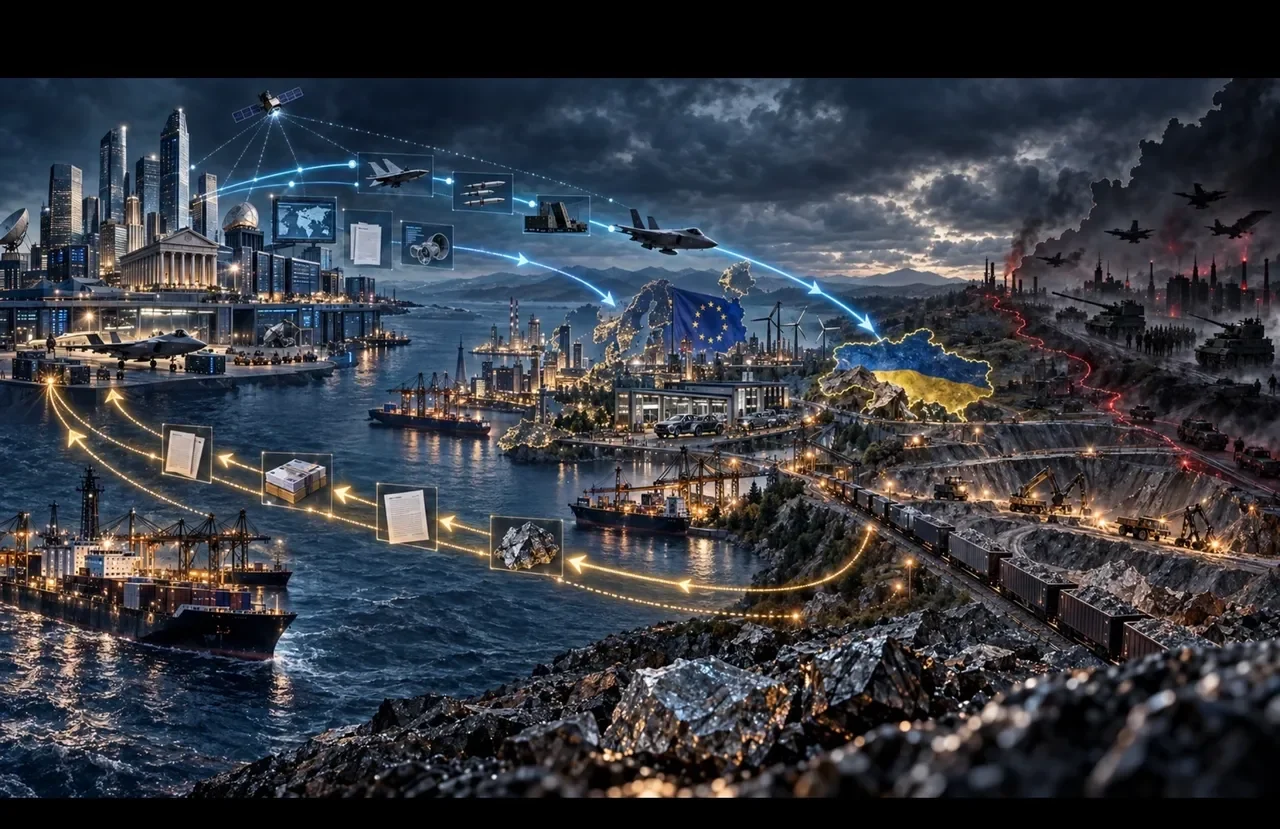
The Invisible Chain: Ukraine’s Rock, Europe’s Weapons, and the Architecture of Permission
By Dr. Pooyan Ghamari
War is told through maps, speeches, and the dead. Necessary facts. Incomplete ones.
Behind the war sits another ledger: who gets the contract, who stands in the delivery queue, who writes the export licence, who sends the software update, who insures the cargo, and who receives the first serious offer to buy what remains when the smoke thins.
That ledger is the invisible chain. It does not need a colonial flag. It works through permissions signed in public and then treated as paperwork.
Ukraine makes the pattern visible. Russia holds part of the ground by force. The United States has secured rights within the future commercial life of resources that Kyiv still controls. Europe is paying for aircraft and interceptors whose software, parts, maintenance, and re export conditions remain tied to American systems.
No cellar meeting is required. The texts are published. The invoices are paid. The error is not believing in a conspiracy. The error is failing to see the chain when lawful contracts are laid end to end.
Ukraine does not keep a warehouse under the soil
The popular line is that Ukraine sits on trillions in rare earths and that the war is therefore a mine war. Too neat.
Ukraine has iron ore, manganese, titanium minerals, graphite, uranium, coal, lithium, oil, and gas. That is a serious geological book. But a mark on a Soviet map is not a modern reserve statement. A reserve is not a mine. A mine is not cash.
To turn rock into revenue requires drilling, metallurgical work, power, water, rail, processing, insurance, finance, trained people, and a front line that does not pass through the pit. Much of the most discussed ground is occupied, contested, or exposed to war risk. If a deposit cannot be reached, insured, financed, processed, and shipped, it does not exist for commerce.
The question is therefore larger than who owns the mountain. It is who controls the conversion: finance, offtake, processing, transport, certification, insurance, and the market where the margin is captured.
What Washington took, and what it did not
The Agreement on the Establishment of a United States Ukraine Reconstruction Investment Fund was signed on 30 April 2025 and entered into force on 23 May 2025. It did not transfer title to Ukrainian land or subsoil. Ukraine remains sovereign over licensing and ownership of its resources.
Title, however, is only one layer of power.
Ukraine contributes 50 percent of specified royalties, licence fees, and comparable state receipts from new licences. Certain older licences that were not industrially exploited may also fall within the contribution base. When a project seeks outside investment, the partnership receives early access to relevant information. When a project seeks an offtaker, DFC or its delegate must receive notice and may make a market based offer. If its offer is not accepted, the sponsor cannot promptly give a third party materially better terms for a substantially similar quantity and quality of product.
That is not seizure. It is a preferred commercial position written into the future licence.
Future American military assistance may be treated as a capital contribution to the fund. Past assistance was not converted into Ukrainian debt. Kyiv preserved that line. The structure nevertheless connects present military support to future resource revenue, project finance, and potential access to output.
The governance is more complex than the language of equality suggests. The Board has equal Ukrainian and American representation and retains final authority. The Investment Committee has three American and two Ukrainian managers. The Prospecting Committee has three Ukrainian and two American managers. Some matters require joint consent; some reserved matters give the American side specific consent rights. Ukraine has representation and checks. The United States has durable weight where finance, offtake, and project selection are shaped.
Control does not begin with ownership. It begins earlier, when another system defines access, cost, timing, and permission.
The Dobra lithium project is useful precisely because it shows the early stage of the process. It is a production sharing project, not a functioning mine with ore already moving to a port. Its value depends on reserve confirmation, finance, permits, construction, security, and the economics of processing. The agreement is a clock starting, not a ship leaving harbour.
In commodity finance, this is familiar. Ownership carries cost overruns, labour disputes, flooding, operational failure, and price collapse. Offtake, shipping, insurance, refining, and the first serious purchase agreement can be a cleaner claim. The buyer at the gate does not need to own the mountain.
A state is sovereign when it can decide not only who digs, but who finances, processes, buys, ships, insures, and captures the margin.
Europe is already inside another chain
Europe did not lose its industry or political institutions. It has capital, laboratories, shipyards, defence firms, and skilled workers. What the war exposed was a gap in speed and in particular high end capabilities.
When demand surged, American suppliers could fill some needs that European production could not meet on the same timetable. That choice was rational. It also created obligations that extend far beyond the original contract.
SIPRI reports that the United States supplied 58 percent of European NATO members’ major arms imports in 2021 to 2025. American arms exports to Europe rose 217 percent compared with the preceding five year period. The counterpoint matters: IISS found that, among more than USD 180 billion in major equipment contracts signed by European NATO states from February 2022 to September 2024, at least 52 percent went to European systems and 34 percent to American systems.
Both readings can stand. Europe is rebuilding domestic capacity. Yet combat aircraft, long range air defence, software centred systems, certain munitions, and high end maintenance still create unusually deep American links.
The first invoice is not the whole story. The sustainment invoice is.
A jet is not a truck
There is no credible public evidence that Washington holds a remote button that can turn a European F 35 into scrap. That claim should be rejected.
The real tether is slower. Mission data, threat libraries, weapons certification, depot work, specialised components, software updates, and supply chains determine whether the aircraft remains relevant. An airframe may leave the ground without all of these things. A combat aircraft cannot remain fully capable for decades without continuing support.
Patriot illustrates the same logic at ground level. Interceptors are scarce and production queues matter. Radar, fire control, software, and supply capacity are not merely commercial details in a crisis. They become strategic levers.
ITAR adds another layer. Controlled American parts, technology, and technical data can require United States permission for export or re export. It does not mean every European repair requires Washington’s approval. It does mean that controlled content can turn a nominally European system into a system with an external permission point.
That is the matrix of permission. By the time a ministry notices, it is no longer choosing between suppliers. It is considering whether it can afford to rebuild an air force, a missile programme, or an entire maintenance ecosystem.
Gas, margins, and who does not pay
When Russian pipeline gas declined, Europe diversified through LNG, new import infrastructure, storage, alternative pipeline supplies, reduced demand, and renewables. It was not a single country story and not only American gas.
It was still a rerouting of molecules. Producers, traders, terminal owners, tanker operators, insurers, and suppliers with flexible cargoes had an opportunity to benefit from the new flow of trade.
War moves flows. Changed flows create commercial beneficiaries.
This is not evidence that energy companies or defence firms create wars. That conclusion would require evidence that does not exist here. The narrower and provable point is that once governments rearm or redirect energy supply, firms with approved systems, available capacity, export licences, transport assets, and long order books are positioned to gain.
Shareholders receive the contract. Lenders receive predictable cash flow. Governments obtain influence through export controls. The household bears taxes, higher energy costs, public debt, and the human consequences of war.
The split between those who own the productive system and those billed by it is older than this war. It is also the part polite analysis often leaves outside the frame.
Not only flags
America, Europe, Russia, China: this is the map of speeches. Under it runs another division. There are those who own productive systems and those locked inside them.
The owner of a terminal does not experience energy dependence as the household paying the bill does. The holder of an offtake right does not experience a resource as the exporting state does. The contractor does not experience procurement as the taxpayer does.
States sign. So do funds, banks, insurers, software providers, standards bodies, logistics operators, and data systems. Participation appears voluntary when the alternative has become too slow, too expensive, or technically closed.
A country can initial every page and still watch its room to act shrink.
What Ukraine should keep
Ukraine has the right to seek capital, weapons, and reconstruction finance. A country under attack cannot finance every requirement alone. The test is what remains of its bargaining power after a ceasefire.
1. Audit reserves to international standards before political figures price the ground in speeches.
2. Place processing, training, and industrial plant in Ukraine, not only extraction.
3. Prevent offtake from becoming a raw export pipe while higher value processing happens abroad.
4. Publish major resource agreements, allowing only narrow and justified commercial confidentiality.
5. Keep genuine competition among American, European, Asian, and Ukrainian bids.
6. Ensure that emergency military dependence does not harden into permanent economic dependence without parliamentary scrutiny.
A state that holds the map and loses the value chain has kept a flag and sold the road.
What Europe should rebuild
Rejection of the United States would be a pose. Isolation is not a strategy. Choice is.
Europe should build or secure ammunition, rocket motors, sensors, secure communications, maintenance rights, satellite capacity, critical software, and industrial access to the parts that keep its systems operating. Procurement must measure more than price. It must ask who owns the data, who approves export, who controls the spare part, who can update the system, and what switching supplier would cost.
Energy terminals, storage, grids, minerals, logistics, insurance, and standards should be treated as instruments of sovereignty, not merely as sources of yield.
The chain of free nations
The answer is not isolation or hostility to allies. Sovereign nations need alliances. An alliance becomes unequal when one side holds every practical alternative.
Ukraine needs capital without losing future margin. Europe needs security without losing the ability to maintain, upgrade, insure, finance, export, and replace its critical systems.
A chain of free nations is built when each nation retains lawful alternatives in finance, logistics, insurance, energy, technology, standards, and defence production.
That is the difference between partnership and dependence.
Freedom is not the absence of allies. Freedom is the capacity to act when an ally says no.
The questions that locate power
Ukraine owns the subsoil it controls. Russia holds physical control over part of the resource base. The United States holds a privileged position in future resource revenue, investment opportunities, and possible offtake. Europe is rebuilding capacity but still relies heavily on American systems in particular high end categories.
None of this requires a theory of hidden rooms. The agreement is public. The fund terms are public. SIPRI and IISS publish the data. The dependency of complex systems on updates, parts, data, standards, and supply chains is an ordinary fact of modern industry.
Stop asking only who owns the land, the jet, or the contract.
Ask who controls the licence. Who controls the finance. Who controls the software. Who controls the spare. Who controls the ship and insurance. Who controls the export stamp. Who holds the first serious right to buy the output.
A flag can remain above a country. A parliament can continue to sit. If another system controls the permissions that turn territory, labour, and resources into value, sovereignty has become incomplete.
That is the invisible chain. Nations will keep naming it partnership until the invoice is too large to rename.
Frequently asked questions
The agreement and the fund
1. Did the United States take Ukraine’s mines?
No. Ukraine retained ownership of its subsoil. The fund creates revenue, investment, and possible offtake rights around specified licences.
2. When was the agreement signed?
It was signed on 30 April 2025.
3. When did it enter into force?
23 May 2025.
4. What is the formal name of the arrangement?
The Agreement on the Establishment of a United States Ukraine Reconstruction Investment Fund.
5. Does Ukraine owe repayment for past U.S. military aid?
The final framework did not convert past aid into Ukrainian debt.
6. Can future American assistance count as fund capital?
Yes. The partnership terms allow new military assistance to be valued as a potential contribution.
7. What does Ukraine contribute?
Fifty percent of specified royalties, licence fees, and comparable state receipts from covered licences.
8. Are existing producing licences automatically included?
No. Current income producing licences are generally excluded, though certain non industrially exploited older licences can be included.
9. Does the agreement give America ownership of Ukrainian land?
No.
10. Does it give America a guaranteed right to all Ukrainian minerals?
No. It creates notice, investment, and market based offtake opportunities, not ownership of all output.
11. What is offtake?
A contractual arrangement to purchase future output from a resource project.
12. Why is offtake important?
It can secure supply without requiring the buyer to own and operate the mine.
13. Who may receive offtake notice?
DFC or its delegate under the public partnership terms.
14. Can another buyer still buy Ukrainian output?
Yes, subject to the agreement’s restrictions on materially better terms after a DFC offer is not accepted.
15. Does DFC have an unrestricted exclusive right?
No. The right is market based and tied to project level circumstances.
16. Can Ukraine decide whether a resource project is licensed?
Yes. Ukrainian authorities retain licensing authority.
17. Why do new licences matter?
They place the economic effects of the agreement mainly in future projects rather than existing production.
18. Can older inactive licences be relevant?
Yes, in defined cases where they were not industrially exploited.
19. When can fund distributions begin?
The public summary says no distributions may be made before 23 May 2035.
20. Does the fund have an end date?
It continues indefinitely unless the parties agree to dissolve it after periodic review.
21. How often is the fund reviewed?
The parties are required to discuss its purpose and possible dissolution every ten years.
22. Does the fund invest only in mining?
No. Its scope can include natural resources and infrastructure projects.
23. Can oil and gas projects be relevant?
Yes. The public terms cover natural resource relevant assets, including hydrocarbons.
24. Does equal Board representation mean equal influence in every matter?
No. Committee composition and reserved consent rights matter as well.
25. Who has final decision authority?
The Board retains final authority under the public summary.
Geology and value
26. Is Ukraine mainly a rare earth story?
No. Its better established industrial importance includes iron ore, titanium minerals, manganese, graphite, uranium, coal, lithium, oil, and gas.
27. Is a mineral occurrence the same as a reserve?
No. A reserve is the economically extractable portion demonstrated under defined conditions.
28. What is a JORC reserve?
A reserve reported under the Australasian JORC Code, a recognised technical reporting standard.
29. What is NI 43 101?
A Canadian standard governing public disclosure of mineral projects.
30. Why does modern reporting matter?
It gives financiers and buyers a consistent basis for judging tonnage, grade, recovery, and risk.
31. Why are trillion dollar mineral claims unreliable?
They often value gross material in the ground without deducting extraction cost, recovery loss, capital cost, time, and risk.
32. Why does mine development take so long?
Exploration, testing, permitting, financing, construction, and infrastructure normally take years.
33. What makes Ukrainian mine development harder?
War risk, damage, insurance, power constraints, logistics, and territorial control.
34. Why is titanium strategically important?
It is used in aerospace, defence, industrial equipment, and pigments.
35. Why does graphite matter?
Graphite is an important battery anode material and China dominates processing.
36. Why does uranium matter?
Ukraine has a large nuclear power sector and domestic uranium has strategic relevance for fuel security.
37. Is lithium easy to produce in Ukraine?
No. Commercial production requires confirmed resources, processing solutions, finance, and secure infrastructure.
38. What is the Dobra lithium project?
A lithium production sharing project in central Ukraine that remains subject to development work and investment.
39. Does a Dobra award mean production has begun?
No.
40. Why does occupation change mineral value?
Physical control, security, and access determine whether a resource can be developed and sold.
Russia, territory, and reconstruction
41. Does the fund apply to territory Ukraine does not control?
In practice, projects require Ukrainian licensing authority and physical access, so occupation limits the fund’s immediate reach.
42. Can a legal contract overcome military occupation?
No. Legal rights do not replace physical control.
43. Why is insurance central to reconstruction?
Lenders and operators require cover against risks that could destroy the asset or interrupt output.
44. Why is power supply decisive for mines?
Extraction and processing are energy intensive.
45. Why does rail matter?
Bulk minerals need reliable, low cost transport to processors and ports.
46. Why does processing matter more than extraction alone?
Processing often captures more value and creates industrial jobs and technical capacity.
47. Can Ukraine insist on local processing?
It can make local value addition a condition in project design and licensing, subject to commercial feasibility.
48. Why should resource agreements be public?
Transparency helps citizens judge whether a country is receiving fair terms.
49. Should all commercial details be public?
No. Narrow confidentiality can protect legitimate bidding and technical information.
50. What is the right balance?
Public disclosure of core rights, revenue flows, governance, and public obligations, with limited protection for genuine trade secrets.
Europe and defence procurement
51. Did Europe stop producing its own weapons?
No. Europe has substantial defence industries and is expanding production.
52. Why did European states buy American systems?
Urgent capability needs, available products, interoperability, and production speed all mattered.
53. What did SIPRI report?
The United States supplied 58 percent of European NATO members’ major arms imports in 2021 to 2025.
54. What did IISS report?
At least 52 percent of major European NATO equipment contracts it reviewed went to European systems and 34 percent to American systems.
55. Why are the SIPRI and IISS numbers different?
They measure different things: international arms transfers versus the value of signed procurement contracts including European domestic systems.
56. Does import dependence mean Europe has no autonomy?
No. It means autonomy is uneven and weaker in certain high end categories.
57. Which categories create the deepest dependency?
Advanced combat aircraft, long range air defence, specialised munitions, mission systems, and maintenance chains can create long duration dependence.
58. What is sustainment?
The continuing maintenance, parts, training, software, repair, and logistics needed to keep a system usable.
59. Why is sustainment a strategic issue?
It can continue for decades after the initial purchase and can affect readiness.
60. Can a state replace a weapons supplier easily?
Usually not. Replacement can require years of retraining, integration, certification, infrastructure, and procurement.
61. Why do common standards create lock in?
They lower immediate operating cost but make departure from the system more expensive.
62. Is interoperability bad?
No. It is militarily valuable. It simply has a long term sovereignty cost if no credible alternative exists.
63. What should procurement officials measure besides price?
Software control, supply security, repair rights, export conditions, data access, and switching cost.
64. Can Europe build more domestic capacity?
Yes, though new factories, qualified labour, testing, and supply chains take time.
65. Why do rocket motors matter?
They are a major production bottleneck for many missile systems.
66. Why does ammunition production matter?
Stocks determine endurance in a prolonged conflict.
67. Why are maintenance rights important?
They reduce the time and political dependence involved in keeping equipment operational.
68. Why is satellite capacity relevant?
Modern military systems rely heavily on communications, navigation, sensing, and data services.
69. Can a European system still be subject to U.S. export control?
Yes, if it includes controlled U.S. content or technology.
70. What is ITAR?
The United States International Traffic in Arms Regulations, which govern controlled defence articles and technical data.
F 35, Patriot, and technical control
71. Is there evidence of an F 35 kill switch?
No credible public evidence establishes a literal remote disable function.
72. Why is F 35 support nevertheless important?
Mission data, software, parts, weapons integration, and maintenance affect long term combat usefulness.
73. What are mission data files?
They help aircraft sensors identify and prioritise known threats and environments.
74. Can an aircraft fly without fresh mission data?
It may fly, but its effectiveness against evolving threats can deteriorate.
75. Why does weapons certification matter?
A weapon must be technically and legally integrated before it can be safely used by a platform.
76. Why does depot maintenance matter?
Complex repairs require specialised facilities, tooling, documentation, and qualified technicians.
77. What is Patriot dependency?
It includes interceptor availability, radar and fire control support, spare parts, training, and production capacity.
78. Are interceptor queues political?
Allocation reflects industrial capacity, contracts, and government priorities, so political decisions can influence timing.
79. Does technical dependency equal political control?
Not automatically. It creates leverage and constrains options when support is scarce or approval is needed.
80. What is the practical lesson for Europe?
Buy capability, but retain repair, supply, data, and replacement options wherever possible.
Energy, ownership, and sovereignty
81. Did Europe replace Russian gas only with American LNG?
No. Europe used multiple sources, demand reduction, storage, new LNG capacity, alternative pipelines, and renewables.
82. Did the gas rerouting create commercial winners?
Yes. Flexible suppliers, traders, shipping, terminal, and insurance businesses could benefit from changed flows.
83. Does this prove companies caused the war?
No. Commercial benefit after a disruption does not prove responsibility for causing it.
84. Why discuss profits in a war analysis?
Because contracts, supply routes, and ownership determine who receives the economic upside of public decisions.
85. Who bears the public cost of rearmament?
Primarily taxpayers through budgets, debt, and foregone public spending.
86. Who benefits from defence contracts?
Manufacturers, workers, suppliers, lenders, and shareholders can benefit, depending on the contract and ownership structure.
87. Is profit from defence automatically illegitimate?
No. The question is transparency, accountability, competition, and whether public need is being served.
88. What is an invisible chain in energy?
The linked control of supply, shipping, terminals, insurance, finance, grids, contracts, and standards.
89. Why do insurance and shipping matter for sovereignty?
Without them, a country may own a product but be unable to deliver or sell it.
90. Why do standards matter?
Technical standards can determine which firms can produce, certify, and enter a market.
The doctrine of free nations
91. What is a chain of free nations?
Allies linked by trade and security while each keeps lawful alternatives and independent capacity.
92. Is this an argument against alliances?
No. It is an argument against alliances where dependence becomes permanent and one sided.
93. What is the difference between partnership and dependence?
Partnership leaves credible alternatives. Dependence makes refusal too costly or impossible.
94. What should Ukraine protect after a ceasefire?
Its ability to choose investors, buyers, processors, financiers, and transport routes on competitive terms.
95. What should Europe protect?
Its ability to maintain, update, finance, insure, export, and replace critical systems.
96. Can a nation be sovereign while cooperating deeply?
Yes, when cooperation is reciprocal and alternatives remain real.
97. What is the first test of a sovereign contract?
Whether the country can refuse, renegotiate, or replace the counterparty without crippling itself.
98. What is the first test of a sovereign resource policy?
Whether the country captures value beyond raw extraction and retains competitive choice over the output.
99. What is the one sentence argument of this article?
Power belongs not only to the owner of land or equipment, but to the system that controls the permissions that turn them into value.
100. What should citizens ask when a strategic agreement is announced?
Who controls the licence, the finance, the software, the spare part, the insurance, the export approval, and the first buyer of the output?
Sources
1. United States Treasury, announcement of the Reconstruction Investment Fund
2. Ukraine PPP Agency, public summary of partnership terms
Original article: https://ghamari.org/articles/f/invisible-chain-ukraine-minerals-europe-weapons-permission