reviews analysis the newest-witness dunajska streda
By Dr. Pooyan Ghamari · · 19 min read
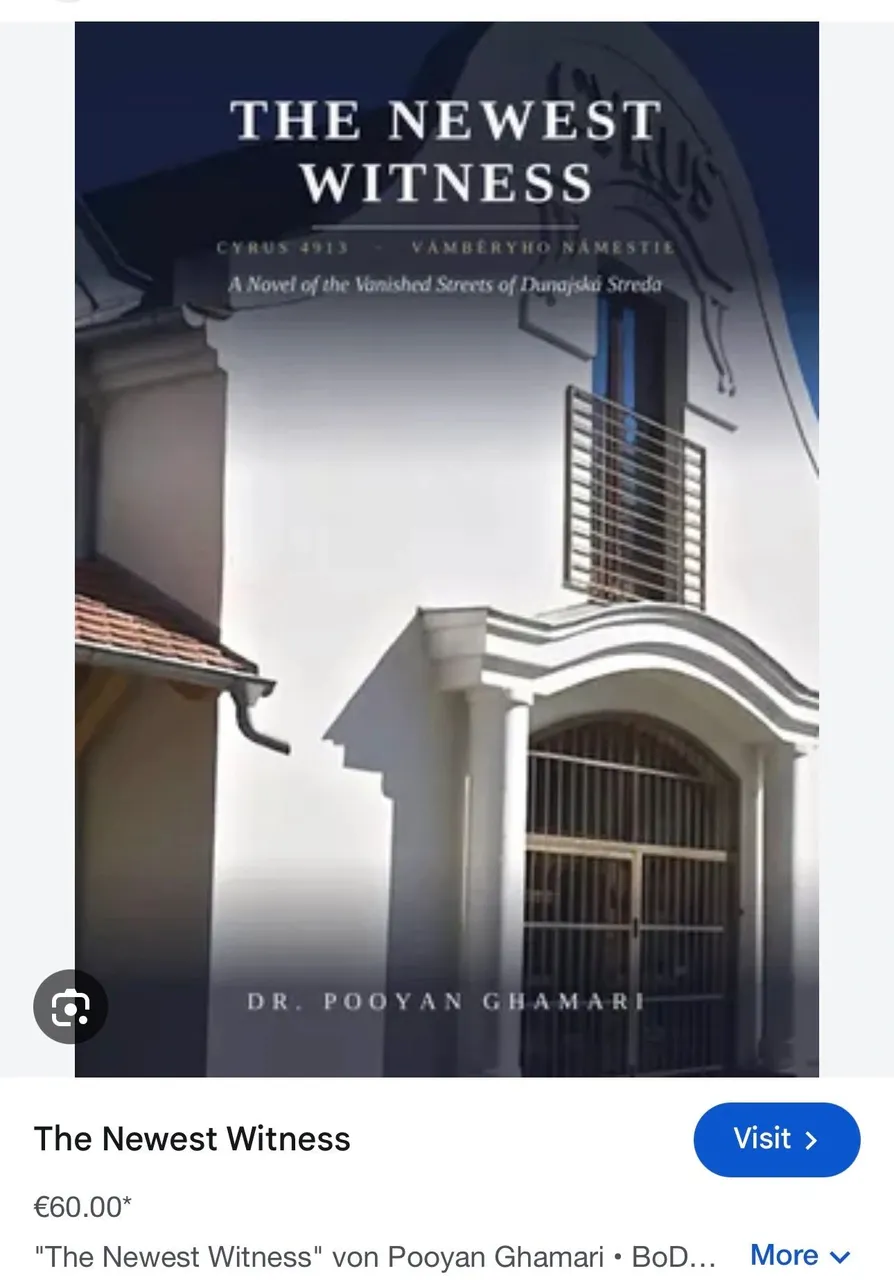
The Newest Witness: Cyrus 4913 and the Vanished Streets of Dunajska Streda
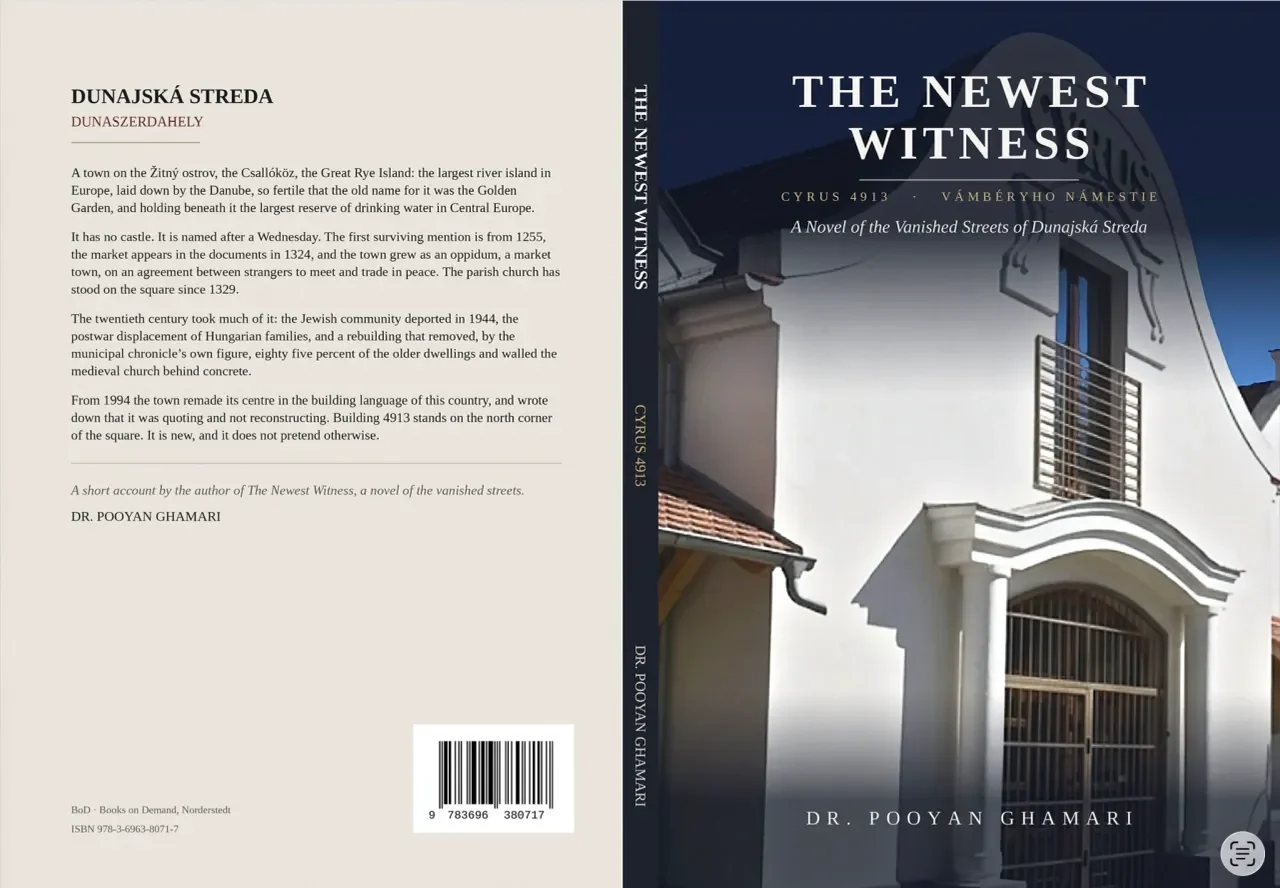
The Newest Witness: Who Owns the Memory of a City?
An Author’s Review of History, Photography and Dunajská Streda
By Dr. Pooyan Ghamari
The Newest Witness is a historical literary novel set in Dunajská Streda, Slovakia. Moving between 1970, 1971 and 1999, it follows photographer Júlia Fodor as one impossible image forces her to reconsider the photograph that made her famous, the silence that protected her family, and the story her town has chosen to tell about itself.
The central question is simple, but its consequences are not:
Can a city recover its memory without inventing its past?
Why I Wrote The Newest Witness
I did not want to write about Dunajská Streda merely as a town injured by history.
Its past contains deportation, displacement, political upheaval, demolished neighborhoods and broken continuity. Yet suffering is not the town’s complete identity. What interested me more was its civic intelligence, its ability to absorb change, preserve human relationships and rebuild without losing the habit of living together.
I came to this town from outside. That position allowed me to see something easily overlooked by those who inherit its arguments from birth.
Dunajská Streda has two living names, two major languages and several layers of memory. Yet its deepest civic institution is neither a castle nor a battlefield. It is Wednesday.
The town is named for its market day. Its identity grew from a recurring agreement among strangers to meet, exchange goods and maintain peace. That is why I describe the market in the novel as a moral technology. It creates cooperation among people who may not share a language, religion, ancestry or political memory.
This ordinary act of meeting became the philosophical foundation of the book.
What Is The Newest Witness About?
In 1999, Júlia Fodor returns to Dunajská Streda to contribute photographs to a commemorative publication called A Square Returns. The book celebrates the rebuilt town center and presents the new square as the return of the old town.
Then Júlia discovers an envelope on a bench beside the church.
Inside is a photograph that should not exist. Residents photographed in 1971 appear to be standing in front of the Cyrus building at 4913 Vámbéryho námestie, a building that belongs to the 1990s.
The image is a handmade composite. One negative comes from the vanished street. The other shows the modern building. Whoever created it possessed frame thirty six, the missing final image from Júlia’s celebrated photographic series.
She had spent twenty eight years believing that someone stole that frame.
With seven Wednesdays remaining before the commemorative book is presented, Júlia begins investigating. Her search leads through cadastral maps, photographic reflections, municipal files, an unopened letter, eleven names for one street and thirty six iron keys.
The Secret of Frame Thirty Six
The earlier chapters return to 1970 and 1971, when an older neighborhood is marked for demolition.
Júlia’s father, Sándor Fodor, works for the district housing office. His official task is to inventory the houses and collect their keys. To the residents, he appears to belong to the bureaucracy removing them. In reality, he converts the tools of administration into instruments of preservation.
He counts slowly. He records every household. He labels every key by hand. Then he quietly returns the keys that were meant to disappear.
On the final Wednesday before demolition, the residents gather in their street wearing their good coats. Each carries something personal: a basket, a shoe form, a bicycle wheel, a clock or a household key.
Júlia organizes the composition. Erzsi Bartal gathers the residents. Sándor places the labelled keys on a white board so their addresses will remain visible in the weak February light. Dávid Szabó operates the camera after Júlia gives it to him and steps into the photograph herself.
The final key carries no house number. Its label reads:
THE STREET
It opens nothing. It exists because the street is the only participant that cannot be given anything back.
Dávid removes the negative from the roll and protects it for twenty eight years. He also signs a statement accepting sole responsibility for the gathering before it even happens. His decision protects Júlia, Sándor and the residents during a later official investigation, but it costs him his place in the district.
His silence saves them. It also allows an incomplete story to become accepted history.
A Photograph Can Be True and Still Lie
The novel is built around a difficult principle: factual accuracy does not automatically produce truth.
A caption may contain no false words and still erase the meaning of an image.
Calling frame thirty six “residents leaving their homes” would be technically possible. But it would conceal why the residents assembled, why they held their keys and why those keys had been placed upon a white board.
Cropping the board produces a more attractive picture. It also removes the evidence.
This is the conflict between Júlia and Viktor Balla, editor of the commemorative book. Viktor is not dishonest in any simple sense. He loves the town and wants its residents to feel pride. He believes a beautiful, unified story can help a wounded community move forward.
That is what makes his position serious. He is not defending a crude falsehood. He is defending a useful version of the truth.
Júlia eventually understands that usefulness cannot excuse erasure. A city does not become stronger by protecting itself from difficult facts. It becomes stronger when its pride can survive them.
Who Really Made the Photograph?
Frame thirty six challenges the conventional idea of authorship.
Júlia composed it. Dávid pressed the shutter. Sándor constructed the evidence. Erzsi gathered the residents. Forty one people chose to stand in the road and present themselves to the future.
The photograph therefore belongs morally to the community that created it.
This is why the final caption credits the residents first, followed by Júlia and Dávid. The photograph that made one person famous was never hers alone.
Júlia’s deepest confrontation is not with Dávid or Viktor. It is with her own memory. She has defended documentary truth throughout her career, yet she gradually edited her personal history until she could no longer remember giving Dávid the camera.
She did not invent a false event. She allowed one decisive fact to disappear.
That is how public history is often distorted. Not through a complete fabrication, but through a truthful account with its most inconvenient element removed.
The Historical Position of Dunajská Streda
The history in the novel is not decorative scenery. It determines the book’s moral structure.
Dunajská Streda stands on Žitný ostrov, known in Hungarian as Csallóköz and in English as the Great Rye Island. It is an alluvial landscape formed by the Danube and its branches, with exceptionally fertile soil and an important reserve of drinking water.
The settlement appears in surviving written records around 1255 or 1256. Its first surviving market reference dates from 1324. Its name carries the meaning of Wednesday in both Hungarian and Slovak.
By the fifteenth century, it had developed as an oppidum, a market town rather than a fortress. Its influence came through agriculture, craftsmanship, exchange and its position among regional routes.
The parish church traces its Gothic foundation to 1329. It was extended in 1518 and rebuilt in the Baroque manner during 1742 and 1743. It remains the town’s oldest standing structure.
A significant Jewish community developed here from at least the early eighteenth century. The town became known for its synagogues, yeshivot and rabbinate. That community was devastated in 1944, when approximately three thousand Jewish residents from Dunajská Streda and its surrounding district were deported to Auschwitz.
After the Second World War, Hungarian families in the region experienced displacement and periods in which ordinary civil standing was withdrawn.
Later socialist redevelopment transformed the physical center. The historical chronology included in the novel cites the municipal record as stating that approximately eighty five percent of older dwellings were demolished during the town’s rebuilding. Major clearance of the Nemesszeg and Lefutós areas is locally associated with the period around 1970 to 1972.
Beginning in 1994 and 1995, the municipality reshaped the center using a regional architectural language associated with concepts by Imre Makovecz. Its steep roofs, deep eaves and visible timber were intended as quotation rather than literal reconstruction.
That distinction matters. The new square is not dishonest because it is new. It becomes dishonest only when it is presented as though the destroyed town simply returned.
What Is Historical and What Is Fictional?
Dunajská Streda, its Wednesday market, the parish church, its multilingual identity, its Jewish history, the destruction of much of its older housing and the later redevelopment of its center are historical.
The central characters and events are fictional.
Júlia Fodor, Dávid Szabó, Sándor and Ilona Fodor, Viktor Balla, Zuzana Kováčová and the residents of the vanished street are invented. The street with eleven names, the thirty six keys, the hidden negative, the official inquiry and the public ceremony are also inventions.
The Cyrus building at 4913 Vámbéryho námestie is real and documented as being in use from 1999. I cannot confirm precisely what previously stood on its parcel, when construction was completed or whether it directly overlaps any particular vanished street. The novel does not claim otherwise.
A book about the ethics of historical truth must disclose where documented history ends and imagination begins.
Why Is It Called The Newest Witness?
The title first refers to the modern Cyrus building on Vámbéry Square.
The building does not remember the vanished street. It is not ancient and does not pretend to be. Yet its pale wall faces the correct direction. During the final ceremony, it becomes the surface upon which the uncropped photograph is projected.
The newest building allows the vanished street to become visible again.
The title also refers to every generation that receives historical evidence. A witness is not only someone who personally saw an event. A witness can be the person who inherits the record and refuses to erase its uncomfortable parts.
By the final page, the newest witness is also the reader.
The Most Important Ideas in the Novel
- A city is made from human relationships, not only buildings.
- Modernization may improve living conditions while destroying social and historical continuity.
- Silence can protect people, but silence also has a moral expiry date.
- A photograph is never neutral because choosing a frame is already an argument.
- A caption is an ethical act, not a decorative sentence.
- Collective memory should not be reduced to the reputation of one artist, editor or institution.
- Civic pride becomes credible when it can survive the complete truth.
- Conflicting memories should sometimes be preserved together rather than forced into one official version.
- Reconstruction cannot restore the social geometry of a vanished neighborhood.
- History is not fully preserved until ordinary people are named as participants rather than displayed as anonymous figures.
The Newest Witness is not an argument against progress.
The relocated residents receive bathrooms, heating and safer apartments. Some welcome these improvements. Others lose their workshops, familiar walls and the short distances that once connected one household to another. Both realities are true, and neither should be sacrificed to simplify the other.
The deeper question is whether progress must erase the people who paid its price.
A street can disappear beneath machinery. It can disappear again beneath the beautiful story later told about it. The first destruction removes the walls. The second removes meaning.
Yet ordinary people continue finding ways to enter the record. They do it through a key, a handwritten label, an uncropped photograph, an archived disagreement or a forgotten name spoken aloud in the rain.
That is the human power I wanted this novel to honor.
A city becomes worthy of its history not by pretending that nothing was lost, but by becoming strong enough to remember exactly what was.
Book Information
Title: The Newest Witness
Subtitle: Cyrus 4913, Vámbéryho námestie. A Novel of the Vanished Streets of Dunajská Streda
Author: Dr. Pooyan Ghamari
Language: English
Format: Hardcover
Print length: 188 pages
Publication date: 25 August 2026
ISBN: 9783696380717
Book record: View The Newest Witness on ISBN.de
50 Frequently Asked Questions About The Newest Witness, Cyrus 4913 and Dunajska Streda
These answers contain important plot details from the novel.
About the Book
- What is The Newest Witness about? The Newest Witness is a historical literary novel about Júlia Fodor, a photographer who returns to Dunajska Streda and receives an impossible photograph connected to a street demolished in 1971. Her investigation reveals thirty six keys, a concealed negative and a truth that was protected for twenty eight years.
- What is the complete title of the book? The complete title is The Newest Witness: Cyrus 4913, Vámbéryho námestie. A Novel of the Vanished Streets of Dunajská Streda.
- Who wrote The Newest Witness? The novel was written by Dr. Pooyan Ghamari, an economist and author whose work examines how institutions, records, ownership and power influence what societies are permitted to know and preserve.
- What genre is The Newest Witness? It is historical literary fiction with elements of mystery, archival investigation and psychological drama. Its suspense comes from evidence, memory and moral conflict rather than violence.
- Where is the novel set? The story is set in Dunajska Streda, correctly written in Slovak as Dunajská Streda and known in Hungarian as Dunaszerdahely. Its central location is Cyrus 4913 at Vámbéryho námestie, the town’s main square.
- Why is Dunajska Streda important to the story? The town is not merely a background. Its Wednesday market, multilingual identity, demolished neighborhoods and reconstructed center create the historical and moral structure of the novel.
- How is the novel structured? The book contains six parts and thirty six chapters. It moves between the clearance of an old neighborhood in 1970 and 1971 and Júlia’s investigation in 1999, allowing each new discovery to change the meaning of an earlier event.
- When does the story take place? The principal timelines are 1970 and 1971, when the fictional street is cleared, and 1999, when the missing photograph returns shortly before a public ceremony.
- Is The Newest Witness based on a true story? No. The central story, characters, street, keys, photograph and investigation are fictional. The geographical setting and carefully identified historical background of Dunajská Streda are real.
- Who will appreciate this novel? It is suited to readers interested in Central European history, documentary photography, urban memory, moral responsibility, archives, multilingual communities and literary mysteries built around evidence.
Story and Characters
- Who is Júlia Fodor? Júlia is a fictional photographer born on the street later marked for demolition. Her images of the neighborhood establish her international reputation, but the return of frame thirty six forces her to question both her career and her memory.
- What begins Júlia’s investigation? She finds an envelope on a bench beside the church. Inside is a composite photograph joining residents from 1971 with the modern Cyrus building, creating a scene that could never have existed.
- Why is the photograph impossible? The people belong to 1971, while Cyrus 4913 belongs to the modern square of the 1990s. Someone has deliberately combined two negatives from different periods.
- Why does Júlia have only seven Wednesdays to uncover the truth? A commemorative book is about to be publicly presented. Once nineteen hundred copies enter local homes, its attractive but incomplete account may become the town’s accepted history.
- What is frame thirty six? It is the final exposure from Júlia’s photographic series about the vanished street. The frame shows the residents, their personal objects and the labelled keys that document their connection to the condemned houses.
- Who took frame thirty six? Dávid Szabó pressed the shutter, but Júlia selected the position, arranged the residents, determined the composition and gave him the camera. Sándor organized the evidence, Erzsi gathered the residents and the community consciously created the scene.
- Who owns the photograph? Morally, the photograph belongs to everyone who made it possible. By the end of the novel, it is placed in the custody of the town as the property of the street’s residents and their descendants.
- Why did Júlia believe Dávid had stolen the negative? He removed the final frame from the film strip and left the district without explaining why. Because they had argued before the demolition, Júlia interpreted his silence as betrayal and gradually removed her own decision to give him the camera from her memory.
- Who is Dávid Szabó? Dávid is the son of a sign painter and later becomes a specialist in photographic restoration. He understands that objects, names and images may need to survive privately until public truth becomes possible.
- Why did Dávid hide the negative for twenty eight years? Printing it during the original political period could have identified residents holding keys that the state had taken from them. Keeping the negative hidden protected the participants and Júlia’s father from further investigation.
- Why did Dávid sign a confession before the gathering happened? He wanted one document to exist with one responsible name on it if the plan was discovered. By accepting responsibility in advance, he created protection for everyone else.
- Who is Sándor Fodor? Sándor is Júlia’s father and a housing officer responsible for inventorying the condemned homes. He appears obedient, but quietly transforms administrative procedure into an act of preservation.
- Why does Sándor count the keys slowly? His slow counting delays their destruction and keeps them under his control. Bureaucratic precision becomes his method of resistance.
- Why are there thirty six keys? Thirty five keys correspond to numbered entries connected to the street. The final key has no house number and is entered in Sándor’s ledger as “THE STREET.”
- What does the key labelled “THE STREET” represent? It represents the place that cannot be returned after demolition. The residents may receive new apartments and recover their household keys, but the social world created by the street cannot be physically restored.
- Who is Erzsi Bartal? Erzsi is the resident who knocks on the neighbors’ doors and asks them to join the photograph. She turns Sándor’s private plan into a collective act.
- Who is Viktor Balla? Viktor is the editor of the commemorative book A Square Returns. He wants the town to feel proud of its new center, even when achieving that pride requires simplifying uncomfortable history.
- Why is Viktor not a conventional villain? He does not act from cruelty or personal profit. He loves the town and believes a beautiful public story can help it recover, which makes his conflict with Júlia morally serious rather than simplistic.
- Who is Zuzana Kováčová? Zuzana is a younger municipal archivist who teaches Júlia to distrust memory when evidence disagrees with it. She represents an archival ethic in which conflicting accounts are preserved rather than forced into one official version.
- What role does Ilona Fodor play? Júlia’s mother prevents the novel from turning demolition into easy nostalgia. She values hot water, heating and a proper bathroom, while still preserving her basket, relationships and private household records.
Meaning and Interpretation
- What is the central argument of The Newest Witness? The novel asks who has the authority to define a community’s memory. It argues that evidence belongs morally to the people whose lives it records, not only to the artist, editor or institution controlling it.
- How can a true sentence become a lie? A sentence may be factually correct while omitting the fact that gives everything else its meaning. Calling the image a farewell photograph conceals the returned keys, the political risk and the residents’ deliberate act of documentation.
- Why are captions so important in the novel? A caption determines what future readers believe they are seeing. It can restore names and context, or quietly turn evidence into decoration.
- Why is the cropped photograph ethically wrong? The crop preserves the residents’ faces but removes the white board and its labelled keys. It creates a stronger portrait while destroying the evidence explaining why the residents assembled.
- What does the book say about photographic authorship? Pressing the shutter is only one part of making an image. Composition, participation, arrangement, risk, context and preservation may involve many people, making authorship a shared moral responsibility.
- Why does Júlia’s memory become unreliable? She does not invent an entirely false past. Instead, repetition, anger and professional recognition gradually strengthen one version until the fact that she voluntarily handed Dávid the camera disappears from her conscious account.
- Was Júlia lying about the missing photograph? Not deliberately. She told a partial story that she had come to believe, which is more psychologically complex and historically dangerous than a calculated lie.
- What does the novel say about silence? Silence initially protects the residents from political consequences. Over time, however, the same silence allows misunderstanding, resentment and an incomplete public history to grow.
- Is the novel against modernization? No. It recognizes that the new apartments offered heating, bathrooms and improved physical conditions. Its argument is that material progress should not require the erasure of names, relationships and historical responsibility.
- Why is the Wednesday market so important? The market represents repeated cooperation among people who may differ in language, religion and identity. It is the town’s oldest civic habit and the reason every stage of the story is measured in Wednesdays.
History, Place and Identity
- Why does the town have more than one name? Dunajská Streda is the Slovak form and Dunaszerdahely is the Hungarian form. Both express the town’s connection to Wednesday and reflect the multilingual history of the region.
- Why does the fictional street have eleven names? Different generations, families, languages and institutions remember it differently. Recording all eleven prevents one official label from making everyone else’s memory appear incorrect.
- What does the title The Newest Witness mean? It first refers to the modern Cyrus building whose wall receives the projected image of the vanished street. It also refers to the present generation and finally to the reader, each becoming responsible for what the surviving evidence means.
- Why is Cyrus 4913 central to the novel? Its pale wall, position and modern date make the impossible composite possible. During the final ceremony, the same building becomes the surface that returns the uncropped photograph to public view.
- Is Cyrus 4913 presented as an ancient building? No. The novel identifies it as modern and documented in use from 1999. Its importance comes precisely from being new, not from a fabricated claim of antiquity.
- Does the novel claim that the vanished street was directly beneath Cyrus 4913? No. The book does not claim proven physical continuity between the fictional street and the building. I cannot confirm the exact earlier parcel history, and the afterword states this limitation openly.
- Which parts of Dunajska Streda’s history are documented? The documented foundation includes the town’s medieval record, Wednesday market, market town status, historic church, multilingual population, Jewish community, wartime deportations, postwar displacement, extensive later demolition and redevelopment of the center.
- How does the novel address the Jewish history of Dunajská Streda? It acknowledges the town’s once important Jewish religious and intellectual life and its destruction during the Holocaust. The deportations are treated as history rather than used as fictional suspense; documentary material connected to Dunajská Streda is also preserved by the United States Holocaust Memorial Museum.
- Which central elements are invented? Júlia, Dávid, Sándor, Ilona, Viktor, Zuzana, Erzsi, the street with eleven names, the thirty six keys, frame thirty six, the inquiry, the commemorative book and the ceremony are fictional. The afterword clearly separates them from the historical record.
- Where can readers find the official book information? The Newest Witness is an English language hardcover of 188 pages, published by BoD, Books on Demand, on 25 August 2026. Its ISBN is 9783696380717, with records available on ISBN.de and the official BoD book page.
Original article: https://ghamari.org/articles/f/reviews-analysis-the-newest-witness-dunajska-streda