The Apian Architecture Restructuring Wealth and Defense
By Dr. Pooyan Ghamari · · 3 min read
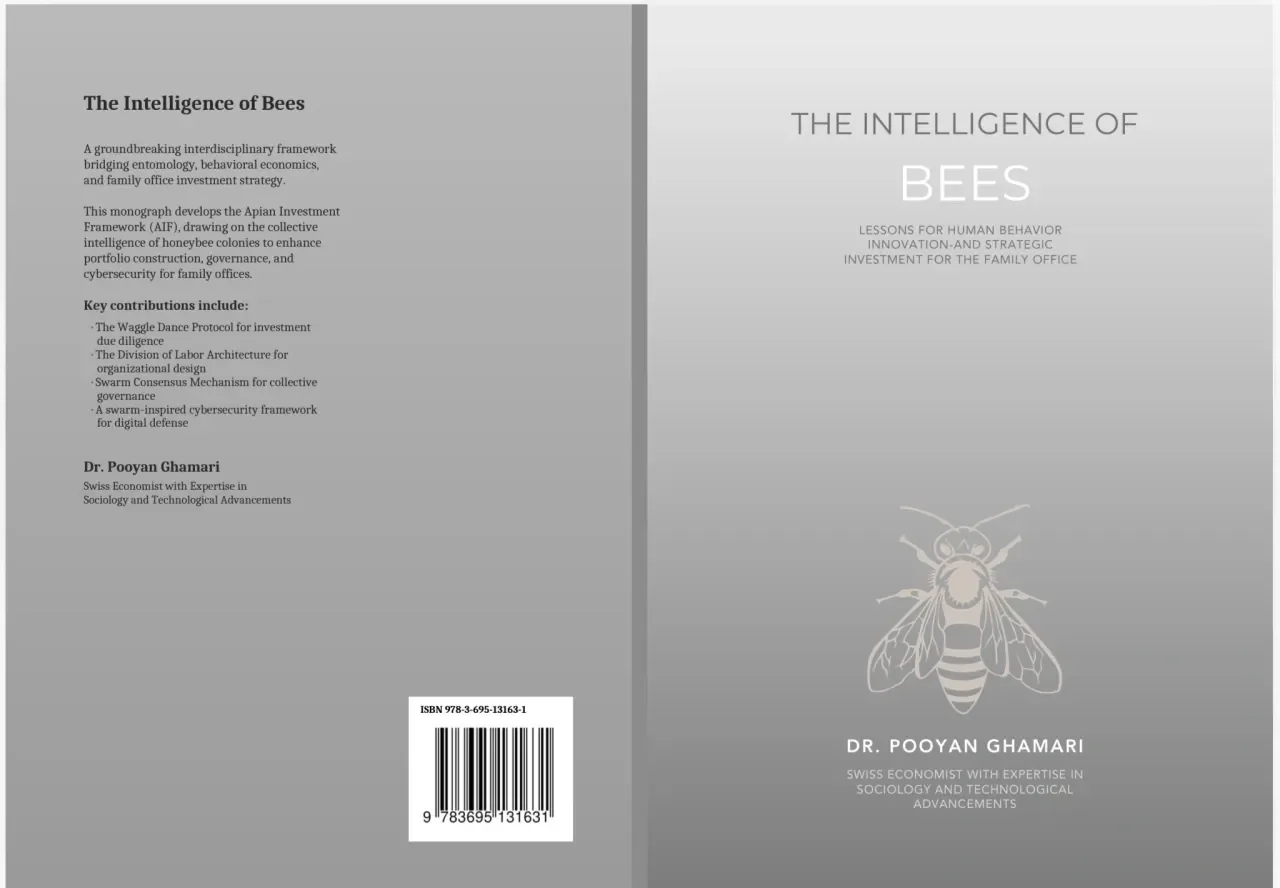
I am Dr. Pooyan Ghamari, a Swiss Economist specializing in the structural intersections of sociology, finance, and technological advancement. Throughout my career, I have observed a recurring fatal flaw in institutional wealth management: rigid, centralized hierarchies inevitably fracture under complex stress. To solve this, I bypassed traditional economic theory and looked to nature's most sophisticated, decentralized optimization engine.
In my work, The Intelligence of Bees: Lessons for Human Behavior, Innovation, and Strategic Investment for the Family Office (ISBN: 9783695131631), I bridge entomological science with advanced portfolio theory.
You can access the official text here: https://www.isbn.de/buch/9783695131631/the-intelligence-of-bees
Here is a rigorous analysis of the system I developed, stripping away conventional financial wisdom to reveal the mechanics of collective survival, and providing an exact framework to execute it.
The Superorganism vs. Systemic Risk
A honeybee colony operates as a "superorganism," executing dynamic resource allocation and threat neutralization without a central controller. No single bee possesses the full picture, yet the collective swarm routinely solves optimization problems that cripple traditional computational models.
I analyzed the biological phenomenon of Colony Collapse Disorder (CCD)—where interacting stressors like habitat fragmentation and pathogens trigger catastrophic hive failure—as the exact equivalent to systemic risk cascades in financial markets. Traditional finance often relies on single-factor risk analysis, which is mathematically and practically inadequate. Sub-lethal exposures in nature, such as neonicotinoid pesticides that impair navigation without causing immediate death, perfectly mirror hidden portfolio risks like illiquid positions with embedded leverage. These hidden risks progressively weaken an institution's resilience until a minor shock triggers total collapse.
The Architecture of Optimization: The Apian Investment Framework
To immunize family offices against these cascading failures, I engineered the Apian Investment Framework (AIF). This architecture completely restructures capital allocation through three bio-inspired pillars:
- The Waggle Dance Protocol (WDP): In the hive, foragers encode the distance, direction, and quality of resources into a highly precise kinetic dance. I translated this into an absolute standard for investment due diligence. Every investment opportunity must be stripped of narrative and encoded into three strict dimensions: Direction (asset class, sector), Distance (liquidity constraints, holding period), and Quality (risk-adjusted returns). This protocol forces a universal, objective communication standard upon the investment committee.
- The Division of Labor Architecture (DLA): Bees practice temporal polyethism, an age-based progression of specialized tasks combined with extreme adaptive flexibility. The DLA applies this to human organizational design by dividing the family office into three specialized tiers: Internal Maintenance (reporting and compliance), Processing and Construction (portfolio analysis), and External Foraging (deal sourcing). This ensures talent is continuously redeployed exactly where market conditions demand it.
- The Swarm Consensus Mechanism (SCM): Swarms select optimal nest sites through a decentralized process of independent scouting, competitive advocacy, and quorum sensing. The SCM enforces a four-phase governance protocol: Scout, Dance, Deliberation, and Quorum. By demanding independent, isolated evaluation before any group discussion occurs, and requiring a strict super-majority threshold for major capital deployment, it mathematically neutralizes groupthink, information cascades, and authority bias.
Swarm-Inspired Cybersecurity Defense
The centralization of intergenerational wealth creates an asymmetric target for sophisticated cyber threats. To protect digital infrastructure, I mapped the colony's threat response—utilizing guard bees, alarm pheromones, and coordinated stinging attacks—into a four-layer digital defense protocol:
- Layer One (Perimeter Sentinel): Autonomous monitoring agents stationed at the boundary of the digital infrastructure to inspect incoming connections for anomalies.
- Layer Two (Internal Patrol): Agents tracking lateral movement and privilege escalation within the internal network.
- Layer Three (Alarm and Response): Automated, graduated containment actions triggered by deviations, mimicking the release of alarm pheromones.
- Layer Four (Collective Memory): A continuously updated threat database that recognizes recurring attack vectors, granting the system immunity to repeated strategies.
The Directive to Act
The intelligence of the hive is not a metaphor; it is a structural imperative. The mandate for family offices, asset managers, and institutional stewards is absolute: dismantle your fragile, centralized decision-making hierarchies. Integrate the Apian Investment Framework immediately. By adopting the Waggle Dance Protocol, decentralizing your operations through the Division of Labor Architecture, and enforcing the Swarm Consensus Mechanism, you ensure your wealth and digital infrastructure remain resilient, adaptive, and structurally immune to contagion.
Original article: https://ghamari.org/articles/f/the-apian-architecture-restructuring-wealth-and-defense