The Masquerade Does Not Fall When One Mask Is Removed
By Dr. Pooyan Ghamari · · 16 min read
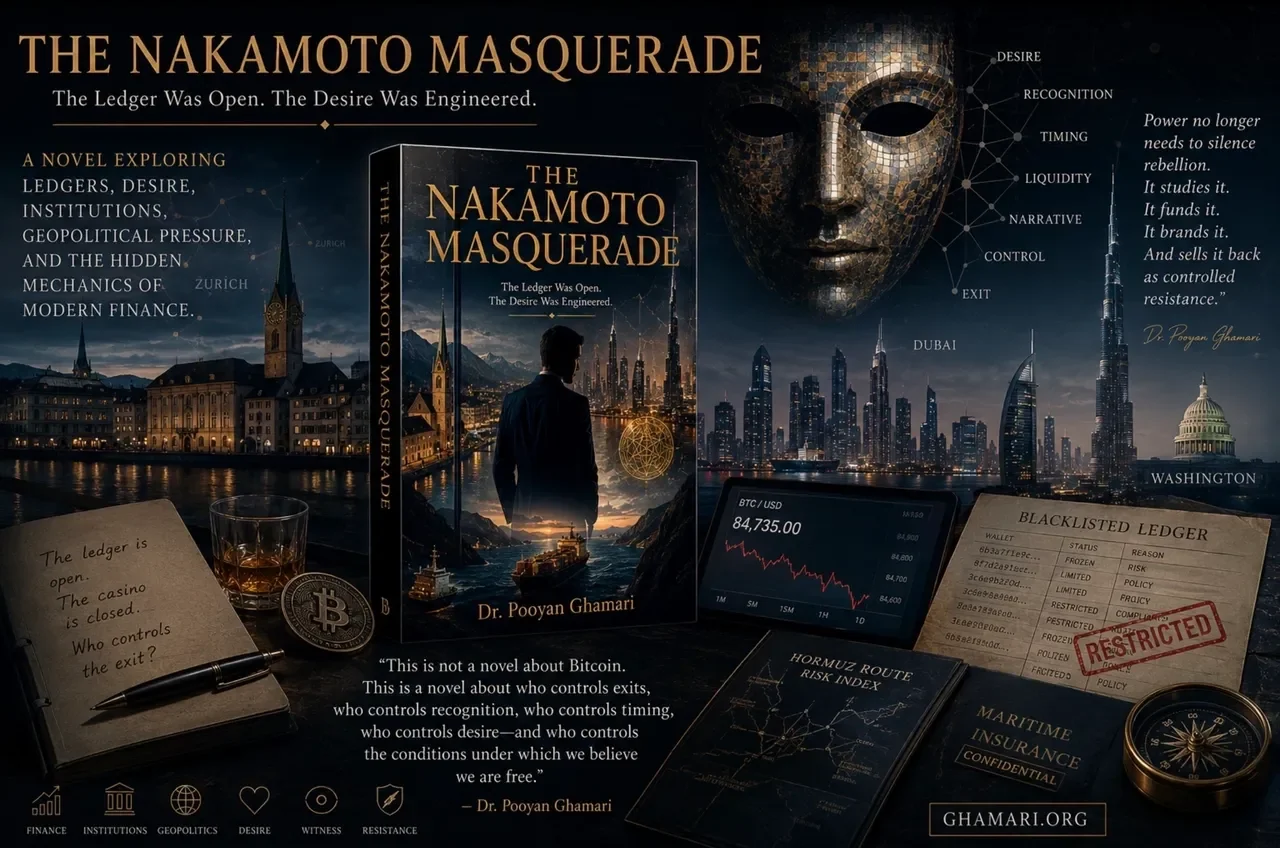
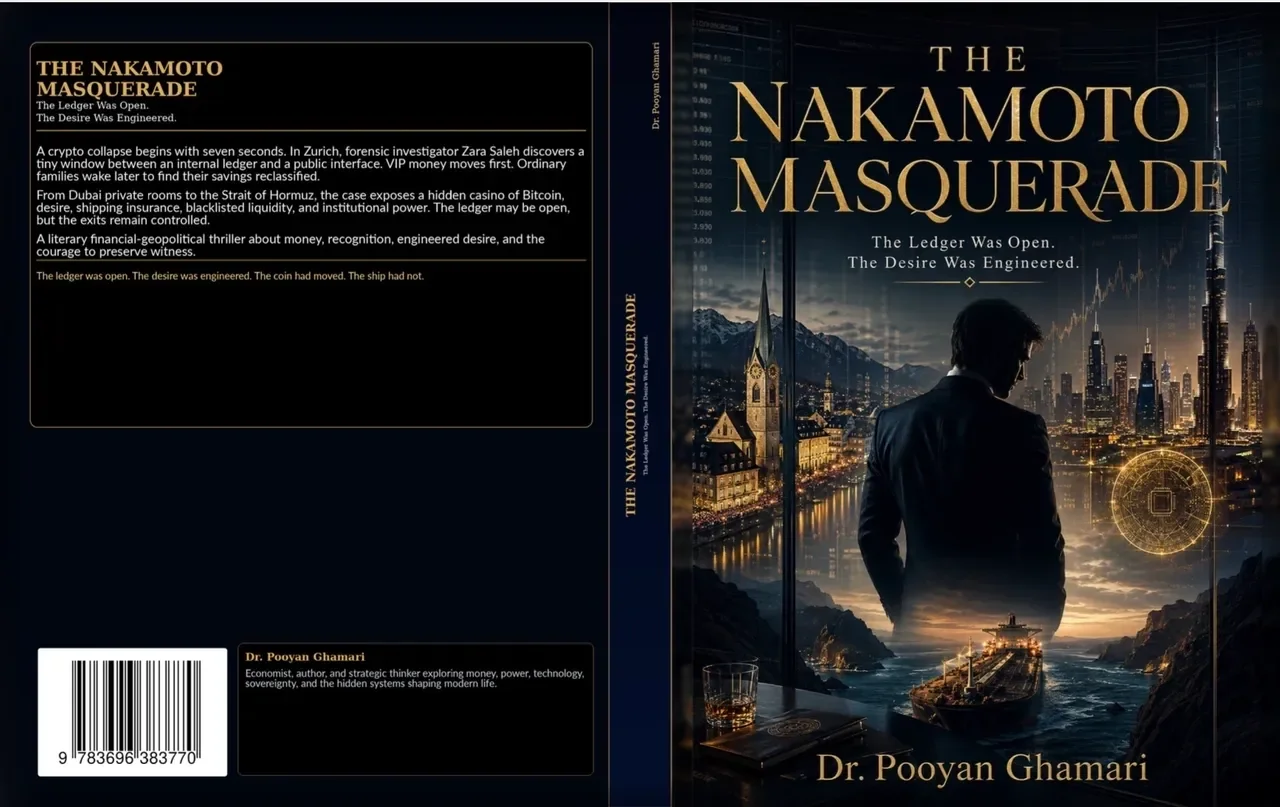
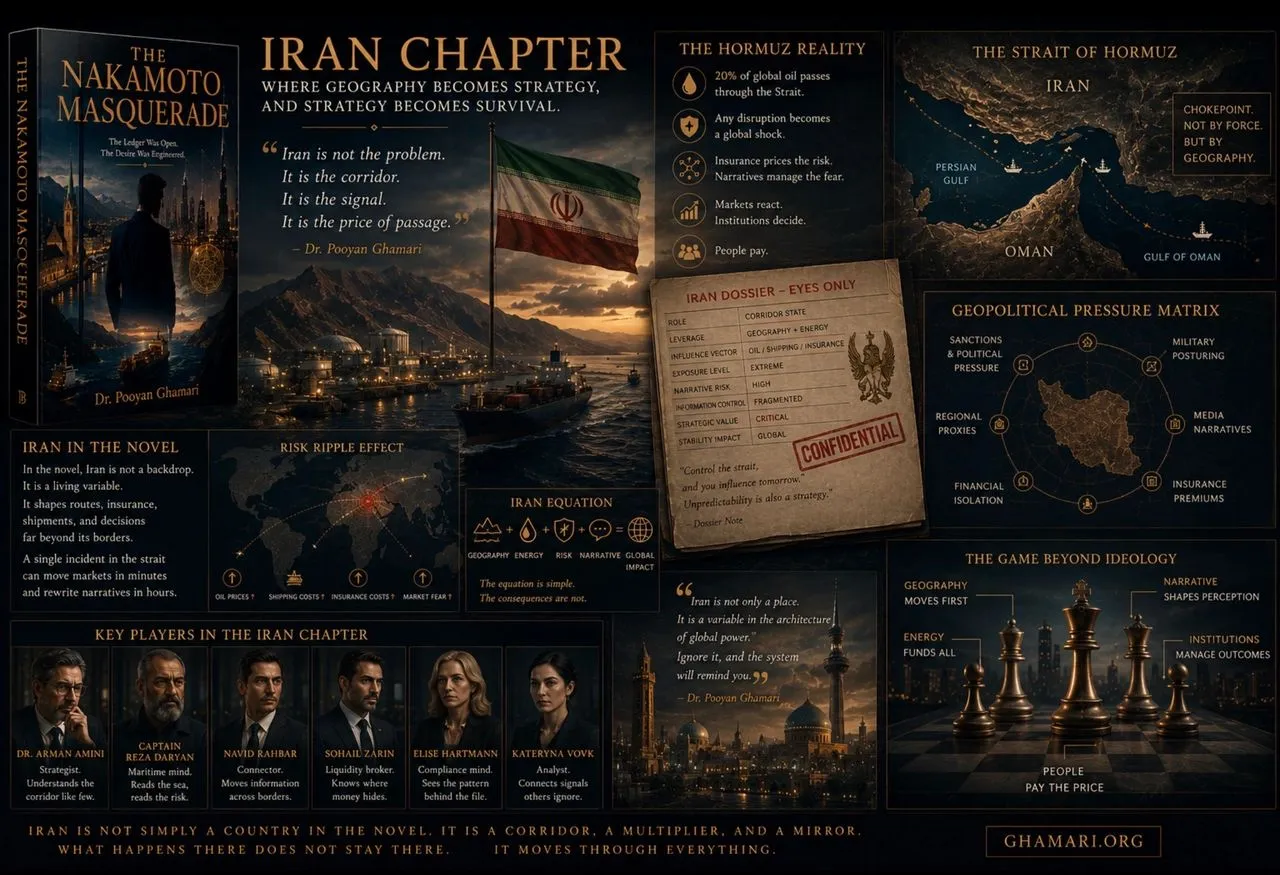
Why I Wrote a Novel About Recognition, Not Rebellion
The question that haunted me for years was not about Bitcoin. It was about exits.
I had been studying financial systems—how they move money, how they hide knowledge, how they concentrate power while pretending to distribute it. I understood the mechanisms. I could describe the offshore structures, the advisory layers, the platforms, the custodians. But understanding mechanism is not the same as understanding vulnerability. And the vulnerability of modern systems is not where most people look.
Most people assume that if a ledger is public, if a transaction is visible, if the code is open-source, then the system is democratic and the individual is protected. This assumption is pleasant. It is also incomplete.
I began to notice something darker: people could see everything and still be powerless. A person could have a transaction on an immutable ledger and still not be able to use it. A wallet could hold assets and the exit could be closed. The code could be transparent and the recognition could be private.
That gap—between what you can see and what you can actually do—became the doorway into this novel.
The Seven-Second Window
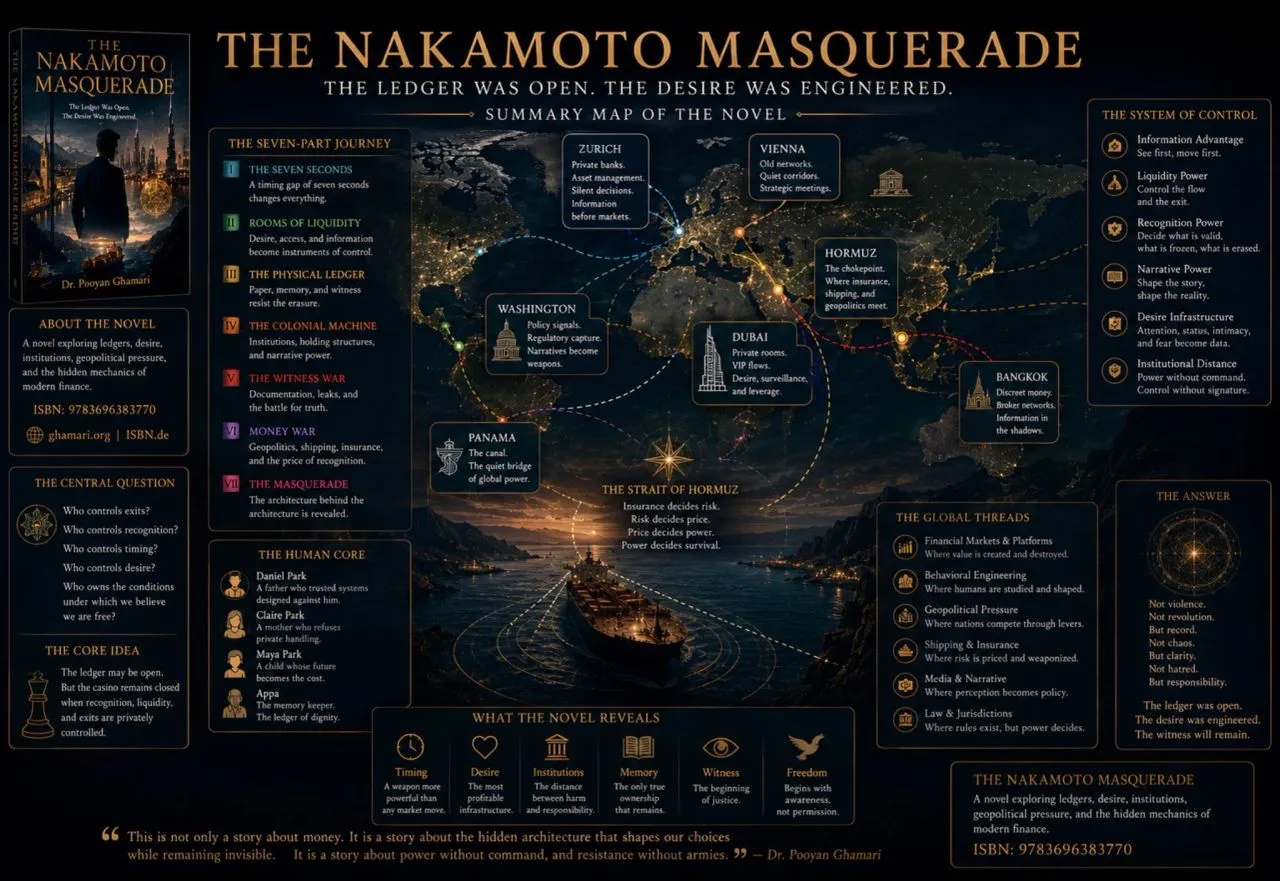
A financial collapse does not require violence. It does not require a dramatic announcement. It can arrive in the form of a routine adjustment, a platform update, a classification change. The platform changes. Certain users see the change first. They have seven seconds of advantage before the information becomes public. In that seven-second window, some people move their assets. Others cannot move until the knowledge is universal. By the time the knowledge is universal, the casino has already rearranged.
That seven-second gap is the technical beginning of the novel. But it is only the technical beginning. The real beginning is the question: what does it mean for some people to see seven seconds before others?
The answer is: it means the entire architecture of “freedom” collapses into a matter of timing.
If the system’s integrity depends on everyone having equal access to information, then the system’s integrity broke seven seconds ago. But the system does not admit that. The system calls it an anomaly. The system calls it market dynamics. The system calls it the cost of participation.
What does a person do when they realize that the freedom they joined was conditional on information they never possessed?
That is the human question the novel carries forward.
The Ledger That Lies Through Honesty
I spent years observing how modern institutions operate. One pattern became unavoidable: the institution no longer needs to hide the ledger. The institution can leave the ledger open and still maintain complete control by controlling recognition.
Let me be precise about this, because it is the central architecture of the book.
A transaction can move on the blockchain. That transaction is visible. Everyone can see it. The ledger shows it happened. But then—and this is the cruelty—the transaction cannot be recognized by the banks, insurers, custodians, and ports that determine whether arrival actually occurs.
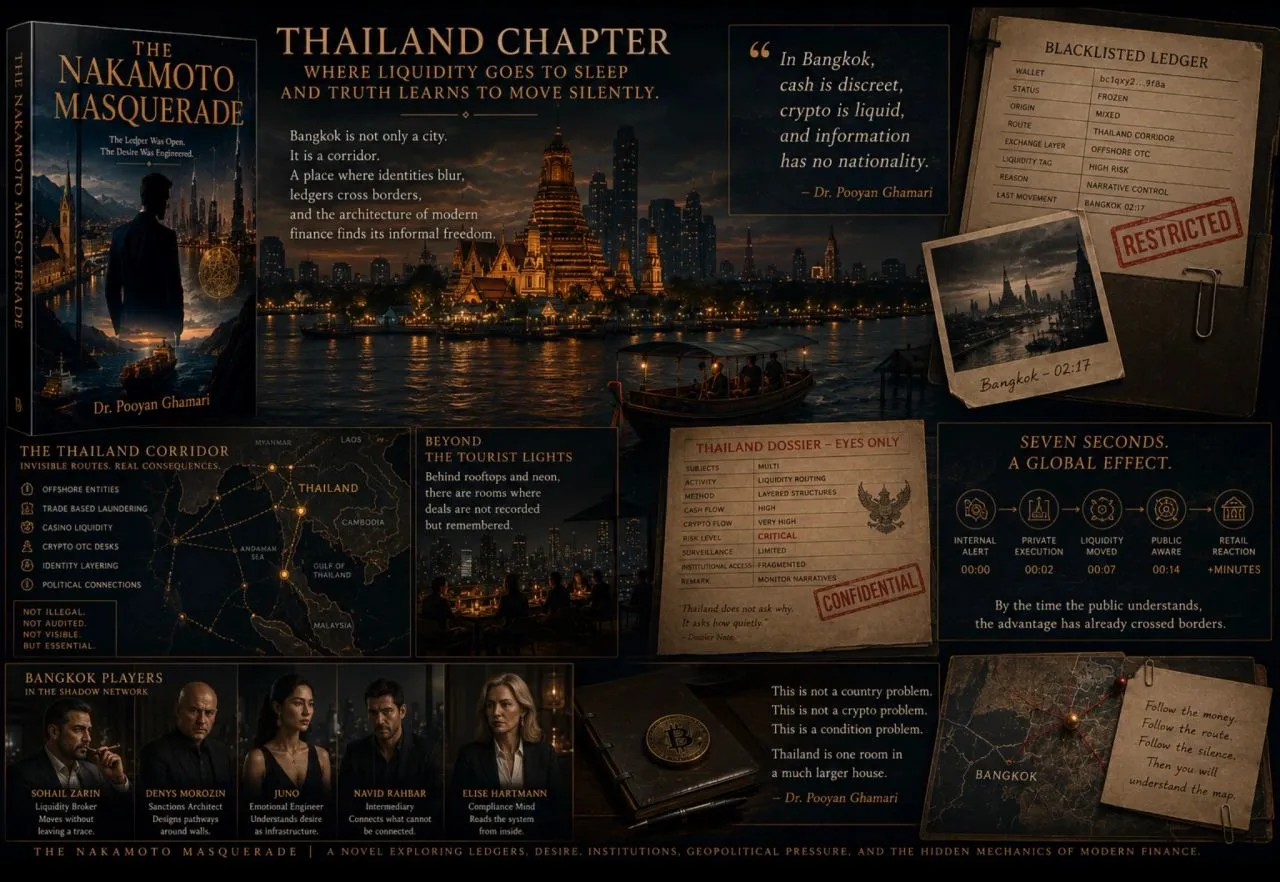
A person in Dubai can receive cryptocurrency. They own it. The ledger records their ownership. But when they try to convert it to medicine, the insurance companies hesitate. When the medicine tries to move through Hormuz, the shipping companies delay. When the shipment arrives, the port requires recognitions that do not exist. So the medicine sits. The owner has assets on a transparent ledger and a child without treatment.
This is the deeper structure I wanted to explore through fiction: a world where openness and powerlessness can coexist perfectly.
The novel’s subtitle came from this observation: The Ledger Was Open. The Desire Was Engineered.
The first part suggests transparency. The second part reveals the trap. What matters is not what the ledger shows. What matters is what people want to do with the information. And desire—I discovered—is not spontaneous. Desire is built. Desire is designed. Desire is a room with specific lighting, specific music, specific bottles of wine, specific bottles of medicine, specific people who seem interested in you, specific promises that arrive at specific moments.
If you can engineer desire, you do not need to engineer the ledger. The ledger can be completely honest. The people will still choose exactly what you want them to choose.
What I Discovered About Rooms
I spent years understanding how power operates through abstraction—through market mechanics, through financial products, through geopolitical pressure, through code. But I realized I was missing something that the abstract understanding could never fully capture: the human experience of walking into a room and beginning to lose yourself.
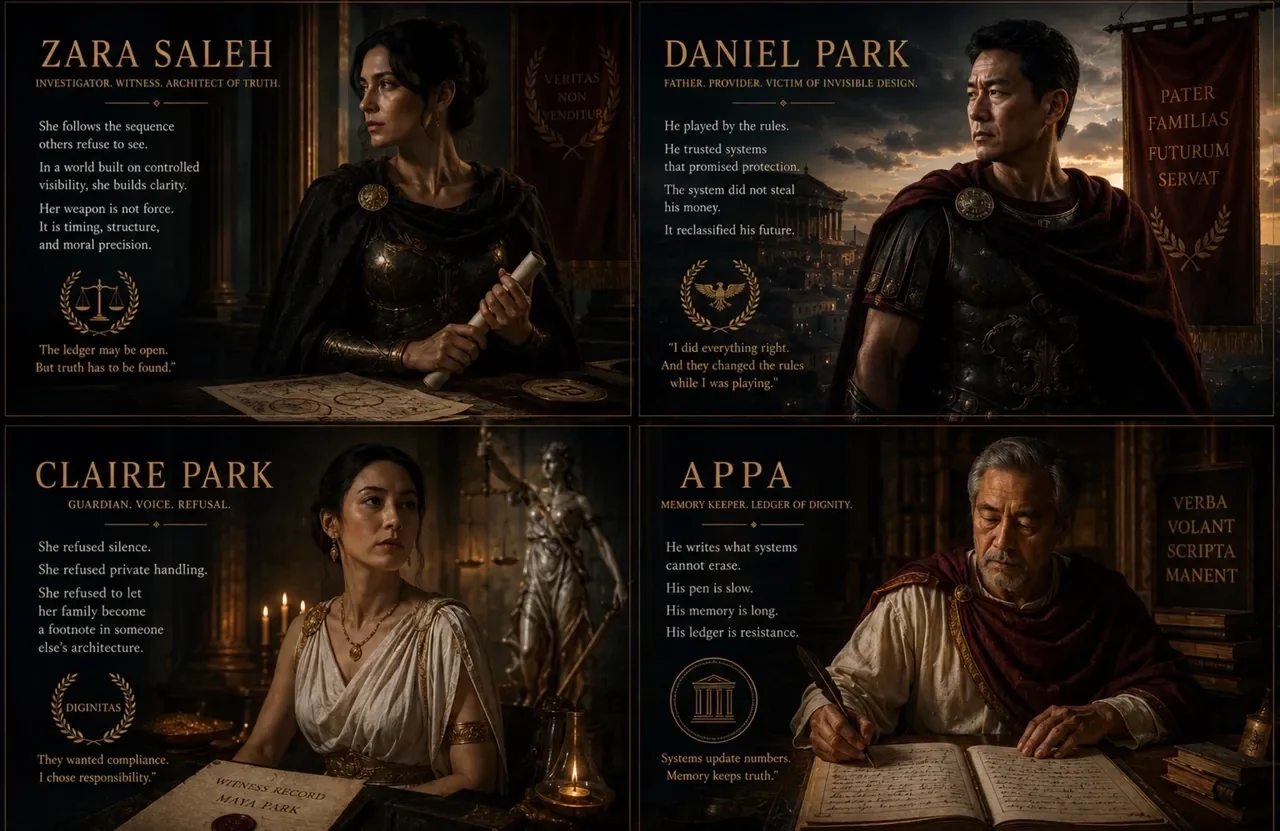
This is why Mira Kade became essential to the novel.
Mira is a designer of private rooms. Her skill is not decoration. Her skill is architecture of exposure. She understands how light can make someone feel chosen. How proximity can make someone confess. How mirrors can make someone perform rather than be. How the temperature and the music and the wine and the sentence spoken at the right moment can make a person reveal something they kept hidden from themselves.
When I realized that desire could be designed with the same precision that markets are engineered, the novel opened into a new dimension.
Because what had been happening in those rooms was not seduction in the traditional sense. What was happening was intelligence gathering. A person’s jealousy was being observed. A person’s longing was being studied. A person’s shame was being measured. All of this emotional data was being converted into behavioral classification, into risk profiles, into understanding of how much someone wants something.
Once you know how much someone wants something, you know how much they will sacrifice for it. Once you know what they will sacrifice, you know the shape of the trap you need to build.
The room becomes a ledger of a different kind: not a ledger of transactions, but a ledger of the human interior.
Recognition as the Final Lock
As I moved deeper into the novel, I understood that the most sophisticated systems do not control money directly. They control recognition.
A transaction can move. But if no one recognizes it as valid, if no custodian will hold it, if no exchange will accept it, if the insurance company marks it as risk, if the port refuses to touch it—then the movement is meaningless.
This is where geopolitics enters the financial thriller, and why I needed the Hormuz layer.
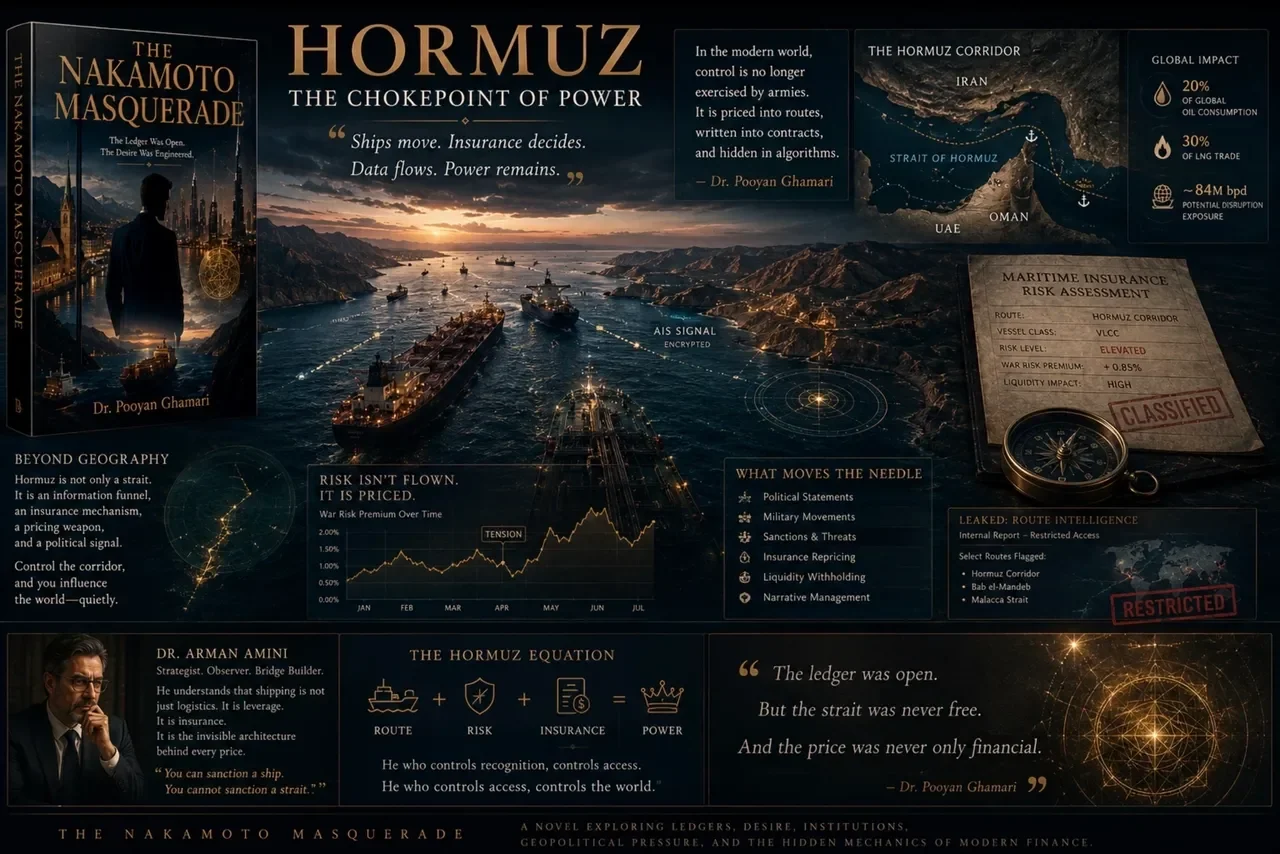
A ship can move through water. A ship’s captain has a log. The route is recorded. The cargo is documented. The shipment is real. But if the geopolitical pressure has made every insurer reluctant, if the political timing has made the port hesitant, if the recognition systems have been arranged to delay acknowledgment—then the movement becomes a kind of invisible waiting.
Waiting is not movement. Waiting is entrapment disguised as process.
I brought Amini into the narrative because I needed someone who understood that the arena of power is not the exchange. The arena of power is the moment when a real thing tries to become recognized as real. The moment when value tries to become usable.
Dr. Amini understands that recognition is political. That the ledger can show a ship, but the war-risk premium is what actually determines whether the ship moves. That the code can permit a transaction, but the bank’s compliance officer is what actually determines whether the transaction completes.
This is the distinction that separates a novel about blockchain from a novel about power.
The Family as the Moral Center
I could have written this book as a pure systems novel—entirely abstract, entirely about mechanisms, entirely about the architecture of control. But I realized that would miss something essential: the cost.
When you design a system that engineers desire, when you create timing advantages, when you arrange conditions so people make choices that appear voluntary but are actually inevitable—there is a cost. The cost is that someone, somewhere, loses something real.
In this novel, that someone is Daniel Park. That loss is his daughter’s future.
Daniel is not naive. He is not greedy. He is careful. He reads documents. He tries to understand the system before he participates. And then, in a moment that lasts seven seconds, his understanding becomes obsolete. The system changes. His daughter’s education fund—which was meant to be protected, which was managed by professionals, which was denominated in assets supposedly safe—becomes a category. Event Participant. Resolution Track. Adaptive Yield Protection.
The elegant language destroys the future.
But here is what elevates this beyond tragedy into something more complicated: Daniel does not accept that language. Daniel refuses to become a category. Daniel, with his wife Claire, begins to preserve the truth of what happened. They document. They record. They refuse the private settlement that would smooth the language over. They insist that harm be recognized as harm, not as an event, not as a yield adjustment, not as market dynamics.
This is why Claire becomes one of the moral forces of the novel: she refuses privacy.
The system prefers to handle harm privately. In private rooms, harm can be softened. In private conversations, harm can be reframed. In private settlements, harm can be silenced. Claire understands this. She insists on the public record. She insists that her daughter’s stolen future not be erased by the courtesy of private resolution.
And Appa—Daniel’s father—keeps a handwritten ledger. He dates it. He preserves it. He ensures that the memory of what happened cannot be later rewritten in institutional language.
A handwritten ledger seems like a small act. But it is an act of resistance to the soft power of institutional rewriting. It says: This happened. I saw it. I documented it. You cannot rename it.
The Architecture of Invisible Condition
As I worked deeper into the novel, I began to distinguish between the surface antagonist and the actual structure of power.
There are characters in the book who make visible choices, who issue commands, who appear to control outcomes. But I realized that the real power is not with them. The real power is with whoever designed the conditions in which everyone operates.
I called this “condition ownership.”
Condition ownership is power exercised not through direct command but through the arrangement of the room itself. You design the room so that people arrive at the decision you want them to arrive at, but they feel as though they chose it.
You do not tell someone to be lonely. You arrange a room so that loneliness becomes unbearable. Then when connection arrives, they mistake it for luck.
You do not tell someone to move their assets. You create a brief moment when movement seems to offer advantage. Then when they move, they feel like they won. Only later do they realize that the moment was designed and the advantage was illusion.
You do not tell someone to abandon witness. You make privacy seem kind, settlement seem wise, silence seem mature. Then when they agree not to speak, they feel like they have chosen mercy.
This is the antagonist structure I arrived at: not a villain, but a method. Not a person, but a logic. Not someone to be defeated, but a system to be made visible.
Why the Novel Needed to Be a Novel
I could have written another essay about geopolitical finance, about how systems arrange pressure, about the difference between transparency and freedom. I had already written essays about these things.
But essays work through abstraction. Essays say: Here is how systems operate. Essays are correct. Essays are useful. Essays change policy.
What essays cannot do is show what it feels like to be the person standing in the room when you realize that what you thought was freedom is actually engineered.
Fiction can do this. Fiction can enter consciousness at the moment when the person realizes their choice was not actually theirs.
When Mira understands that the rooms she designed were reading instruments, she does not change her mind through an argument. She changes through the weight of that understanding, moment by moment, as she moves through the space she created and sees it differently.
When Daniel accepts that his daughter’s future was converted into a product category, he does not solve this through policy reform. He solves it by refusing to let that category be the last word. By creating a counter-record.
When Zara follows the sequence—not because she is heroic, but because she is precise—she does not defeat the system. She makes the system’s method visible. And that visibility changes how others can move.
Fiction permits this. Fiction can show consciousness at work. Essays cannot.
The Civic Ledger as Resistance
I spent years wondering how someone could resist a system that is so diffuse, so elegant, so dependent on private arrangements, so defended by language and delay and professional courtesy.
The answer I arrived at is not heroic. It is not even particularly satisfying in the traditional sense.
The answer is witness. The answer is documentation. The answer is the refusal to let the private room be the final word.
In the novel, this takes the form of the Civic Ledger—a record kept by people who have been harmed, who refuse to accept institutional language, who preserve the sequence of what happened and how they were treated.
The Civic Ledger is not controlled by a single authority. It is not mounted as revenge. It is not waiting for a dramatic moment to be revealed. It is simply: a record. A preserved sequence. A documentation that survives.
The power of the Civic Ledger is not that it destroys the system. The system is too large, too distributed, too defended by good intentions and professional language to be destroyed by a record.
The power of the Civic Ledger is that it makes continued pretense more difficult. Once the sequence is recorded, once the harm is documented, once the moment of decision is preserved—the institution can no longer pretend that harm did not occur. The institution can still defend it. The institution can still rationalize it. But the pretense becomes harder.
And in a system that depends on pretense—on elegant language, on private arrangement, on the soft power of denial—making pretense harder is the beginning of change.
The Question of Complicity
One thing I refused to do in this novel is create villains who are purely evil, and heroes who are purely good.
The book contains people who participate in systems they suspect are corrupt. People who benefit from arrangements they do not fully understand. People who make small choices that add up to large harms.
Lucien Vale is not a cartoon. He is intelligent. He understands what he is doing. But he is also trapped in a kind of elegance, in the belief that beauty and cruelty can coexist, that the room matters more than the harm caused inside it.
Marcus Reeves, the technical architect, is not evil. He is captured by the idea that his system is neutral, that he is not responsible for how it is used. His guilt comes later, when he realizes that neutrality was never possible, that every choice about access, about timing, about recognition, was already a choice about power.
I wanted to show that complicity is often not a dramatic choice. Complicity is often the result of small decisions that each seem reasonable. It is the result of professional distance. It is the result of not asking the next question.
This is why the novel cannot be read as a simple narrative of good versus evil. It has to be read as a study of how ordinary intelligence becomes entangled with extraordinary harms.
Connection to My Broader Work
This novel is not separate from the other works I have written. It is part of a continuous investigation.
In The Bitcoin Mask, I explored the mythology around a single founder. In The Invisible Empire and the Chain of Free Nations, I examined how power operates through sovereignty and jurisdictional distance. In The Strait of Hormuz, the Matrix of Power, and the Strategic Reawakening of Iran, I studied how geography becomes power when access is controlled.
The Nakamoto Masquerade brings these concerns into narrative form and adds something new: the interior experience of a person moving through these systems.
The question that connects all of this work is: How do modern systems shape human behavior while presenting themselves as freedom?
In this novel, the answer comes through desire. Through recognition. Through the small seven-second advantages that accumulate into vast inequality. Through the elegant language that renames harm. Through the beautiful rooms that read weakness. Through the geopolitical timing that transforms shipping into weapon.
The novel argues that liberation does not come from exposing the system (everyone can already see it), but from the patient work of making its method visible, from refusing to accept its language, and from creating records that the system cannot rename.
Why Now
I wrote this novel because the moment demands it.
We are living in an age in which power has learned to operate through openness. The ledger is open. The code is visible. The transaction is transparent. And yet millions of people remain trapped in conditions they did not choose and cannot escape.
The old methods of control—censorship, secrecy, visible force—have proven inefficient. Modern power has discovered that it can achieve its purposes far more completely by leaving everything visible and controlling recognition instead.
This is more dangerous than the old methods. Because the old methods were clearly oppressive. Modern methods feel like freedom.
That confusion—between the visibility of the system and the freedom to move within it—is the subject this novel had to address.
What the Novel Leaves Unresolved
I did not write this novel to provide answers. I wrote it to ask more careful questions.
The Civic Ledger does not save the day. It does not destroy the system. It simply preserves the memory of what happened so that pretense becomes harder.
The institutions do not confess. They do not collapse. They adapt and continue.
The question of what real freedom looks like, of how a system could be arranged that actually protected rather than merely appeared to protect—these questions remain open at the end of the novel.
That openness is not a flaw. That openness is the point.
A novel that provided easy answers would betray the reality of how systems actually operate. Systems do not fall because one villain is exposed. Systems change when enough people refuse to participate in their logic, when enough people create counter-records, when enough people insist that harm be called by its true name rather than its institutional name.
The novel ends with that possibility open. The masquerade does not fall when one mask is removed. The masquerade becomes harder to maintain when the room can no longer pretend to be empty.
Dr. Pooyan Ghamari
On The Nakamoto Masquerade
The Nakamoto Masquerade ISBN:
9783696383770
A novel exploring ledgers, desire, institutions, geopolitical pressure, and the hidden mechanics of modern finance.
https://www.isbn.de/buch/9783696383770/the-nakamoto-masquerade
Original article: https://ghamari.org/articles/f/the-masquerade-does-not-fall-when-one-mask-is-removed