Who Pays for Data Center Grid Upgrades
By Dr. Pooyan Ghamari · · 10 min read
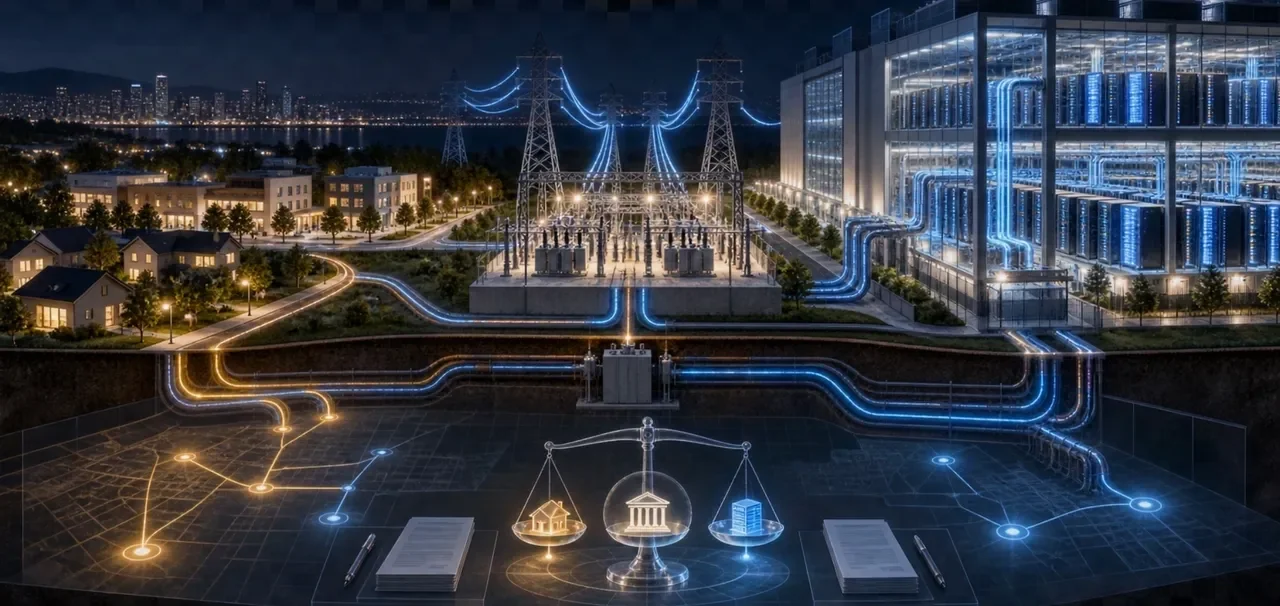
Who Pays for Data Center Grid Upgrades? The Hidden Cost of AI Power
By Dr. Pooyan Ghamari, Economist and Author
Data center grid upgrades should be paid first by the projects that cause them, but the final answer depends on utility regulation, connection agreements and electricity tariffs. If those costs are spread across the network without safeguards, households and smaller businesses can pay for infrastructure built to serve large private loads.
This is no longer a narrow energy issue. It is the financial architecture behind artificial intelligence. A data centre is visible. Less visible are the new substations, transmission lines, power plants, water systems, tax incentives, long term contracts and regulated returns that make it possible.
Why the question matters now
Artificial intelligence is often discussed as software. It is also physical industry. Its raw materials are electricity, land, cooling, chips, cables and patient capital.
The International Energy Agency’s 2025 report on Energy and AI states the basic fact clearly: there is no AI without electricity for data centres. It also stresses that the technology may affect energy security, affordability and emissions, not merely innovation. International Energy Agency
The pressure is becoming measurable. In June 2026, Lawrence Berkeley National Laboratory estimated that United States data centres could account for 11.8 percent of total national electricity use by 2030 in its reference case, with a range of 9.5 to 15.3 percent. Its reference estimate was 649 terawatt hours. These are projections, not guarantees, but they explain why regulators and communities are asking who bears the cost of new capacity. Lawrence Berkeley National Laboratory
The policy question is now moving from planning documents into concrete rules. On 22 September 2026, Victoria proposed that new data centres secure renewable power and storage, fund their connection and network upgrades, and meet water requirements. In Texas, the governor ordered a pause in new state permits while the grid impact is assessed. These are separate jurisdictions with different laws, but the underlying dispute is the same: private demand is arriving faster than public infrastructure can be expanded. Reuters on Victoria, Reuters on Texas
Who pays for data center grid upgrades?
There are four possible payers.
The developer can pay. This is the clearest case when a project needs a dedicated line, substation, transformer or water connection. The asset exists because of that customer. The customer should finance it, directly or through a binding connection charge.
The utility can pay first and later recover the money through regulated bills. This can be sensible when an upgrade will serve a wider area for decades. It becomes unfair when the asset is oversized for one data centre but the risk is transferred to ordinary customers before the promised demand arrives.
All ratepayers can pay through higher network charges. This can be justified only when regulators can show that the investment delivers broad, measurable system benefits rather than private capacity at public risk.
Taxpayers can pay through tax breaks, public land, subsidised water or infrastructure grants. These costs often receive less attention because they do not appear as a separate item on an electricity bill. They remain real public costs.
The hard question is not whether data centres pay an electricity bill. They do. The hard question is whether their tariff fully covers the generation, transmission, distribution, reserve capacity and financing risk created by their demand.
A connection fee is not the whole cost
Many public debates stop at the connection charge. That is a mistake.
A large data centre can require a dedicated substation. It can also require higher voltage transmission, new generation, grid balancing equipment, backup arrangements and faster maintenance capability across a wider area. The direct connection may be paid by the developer, while the system cost is socialised through a utility rate base.
This is where law becomes economics. A regulated utility normally earns a permitted return on approved infrastructure. Once a project is included in the rate base, customers can repay the investment through tariffs over many years. If the data centre arrives, uses the capacity and stays, the system may work. If the project is delayed, downsized or cancelled, someone still has to pay for the asset.
The right safeguard is not hostility to data centres. It is financial discipline. Before construction, the customer should provide credible commitments, security deposits and long term take or pay obligations. The cost of a speculative queue position should not be a free option funded by the public.
Do data centres raise electricity prices?
They can, but they do not automatically do so.
Electricity bills reflect many variables: fuel prices, weather, generation capacity, transmission constraints, taxes, retail competition and local rate design. A national statistic cannot prove that one local data centre caused one household bill to rise.
What can be said with confidence is that large, concentrated demand can require faster investment in power supply and networks. The U.S. Energy Information Administration forecast rapid electricity demand growth in Texas and the Mid Atlantic, where many proposed data centres and large industrial projects are concentrated. It expected electricity demand in ERCOT to grow by 7 percent in 2025 and 14 percent in 2026 as large data centres and crypto mining facilities came online. U.S. Energy Information Administration
Whether that investment reaches residential bills is a regulatory decision. It depends on cost allocation.
That is why the honest answer to “Do data centres raise electricity prices?” is not simply yes or no. The answer is: they can raise costs if the system is built for them and the tariff allows those costs to be shifted. They can also support additional generation and network investment if they pay a fair share under enforceable contracts.
The missing layer: capital and risk
Every new power asset needs capital before it provides a single kilowatt hour. Banks, infrastructure funds, utilities and public investors finance that asset because someone expects a future revenue stream.
The data centre often has the strongest bargaining power. It may negotiate cheap power, tax incentives, priority connection studies and flexibility in its operating commitments. The utility wants a large reliable customer. A local government wants investment and employment. Politicians want to attract the next technology cluster.
The weaker party is the dispersed customer. A household does not negotiate an interconnection agreement. A small manufacturer cannot easily move its factory when local capacity is constrained. A municipality may accept a tax incentive without knowing whether the public will later fund roads, water pipes or grid reinforcement.
In my view, this is the real political economy of AI infrastructure. The contest is not only over who owns the model or the chips. It is over who receives priority access to electricity and who absorbs the cost when plans change.
Power purchase agreements do not solve every local problem
Technology companies often sign renewable power purchase agreements. These can help finance new generation and reduce exposure to energy price risk. They are useful tools.
But a contract for renewable electricity is not automatically a physical answer to local grid capacity. A data centre may buy clean generation from a distant project while still relying on a constrained local network at the hour it needs power. Transmission, congestion, balancing and reserve capacity still matter.
The same caution applies to claims of 24 hour clean power. Annual matching of renewable output and annual consumption is different from matching supply and demand at every hour in the same location. Both approaches can have value, but they are not the same physical promise.
Communities should therefore ask for operational evidence rather than slogans. What is the maximum demand? At which hours will the facility reduce load? What new wires, substations, storage or generation are needed? Who owns them? Who pays if the project does not reach full scale?
Who gains, who pays, who decides and who is excluded?
The gains can be significant. Data centres can create construction demand, tax revenue, digital capacity and a base for local technology services. Electricity networks may gain long term customers that help finance modernisation. AI can also improve grid forecasting, maintenance and energy efficiency.
The costs are also real. Large loads can intensify competition for land, water, grid capacity and skilled labour. A poorly designed tariff can move private infrastructure risk onto households and smaller firms. A tax incentive can leave a community with the cost of services before it receives the promised benefits.
The decision makers are regulators, utilities, grid operators, local planning authorities, developers, investors and governments. They decide the tariff, connection sequence, water permit, tax treatment and public disclosure rules.
The excluded are often residents and small businesses who see the construction but not the contracts. They may be consulted on land use after the essential cost allocation has already been negotiated.
This is why transparency is not a public relations exercise. It is a condition of fair pricing.
A practical fairness test for governments and regulators
I would apply five tests before granting a major data centre connection.
First, cost causation. The project should pay for dedicated assets and a fair, independently assessed share of wider upgrades caused by its load.
Second, financial security. The developer should post a meaningful deposit, guarantee or take or pay commitment before public money is committed to irreversible works.
Third, demand flexibility. Facilities able to reduce load during grid stress should be rewarded, but only if the promised flexibility is contractually verifiable.
Fourth, full disclosure. Communities should be able to see expected demand, water use, required infrastructure, tax support and the allocation of cancellation risk.
Fifth, local benefit. Tax revenue, jobs, training, waste heat use, grid resilience or other benefits should be specific and enforceable, not a general promise.
The principle is simple. Innovation should pay for the infrastructure it requires. It should not be blocked merely because it is large. But neither should a private race for computing power become an unpriced claim on public systems.
Europe’s strategic question
Europe faces a more complex version of the same challenge. It wants digital sovereignty, competitive AI and secure energy, while also managing high power prices, slow permitting and ambitious decarbonisation goals.
The temptation is to treat every data centre as strategic and therefore deserving of privileged access. That would be a mistake. Strategic autonomy is not achieved by importing chips, subsidising server farms and transferring grid cost to citizens. It requires rules that connect digital investment to domestic energy capacity, resilient supply chains and accountable capital.
For Europe, the question is not whether to build data centres. It is whether the contracts behind them leave the public with more capacity and resilience, or simply more cost and dependency.
Frequently asked questions
Who pays for data center grid upgrades?
The developer, utility, ratepayers or taxpayers can pay. Fair policy requires the project to cover dedicated assets and a proportionate share of wider upgrades it causes.
Do data centers raise electricity prices?
They can increase costs when their demand requires new generation or network investment. Whether household bills rise depends on utility tariffs and regulatory cost allocation.
Why do AI data centers need so much electricity?
They operate large numbers of servers and cooling systems continuously. AI computing uses especially energy intensive processors and can create concentrated demand in one location.
Can renewable power contracts fully solve data center energy demand?
No. They can support new clean generation, but local grid capacity, transmission, hourly matching and reserve power still need to be managed.
What should communities ask before approving a data center?
They should ask who pays for power, water and grid upgrades; what happens if the project is cancelled; whether the facility can reduce demand during stress; and what benefits are contractually guaranteed.
Sources
International Energy Agency, Energy and AI, 10 April 2025
Federal Energy Regulatory Commission
Reuters, Victoria’s Sustainable Data Centre Action Plan proposal, 22 September 2026
Reuters, Texas permit pause pending grid audit, 21 September 2026
Original article: https://ghamari.org/articles/f/who-pays-for-data-center-grid-upgrades