Who Profits from Modern Slavery-Global Supply Chains
By Dr. Pooyan Ghamari · · 10 min read
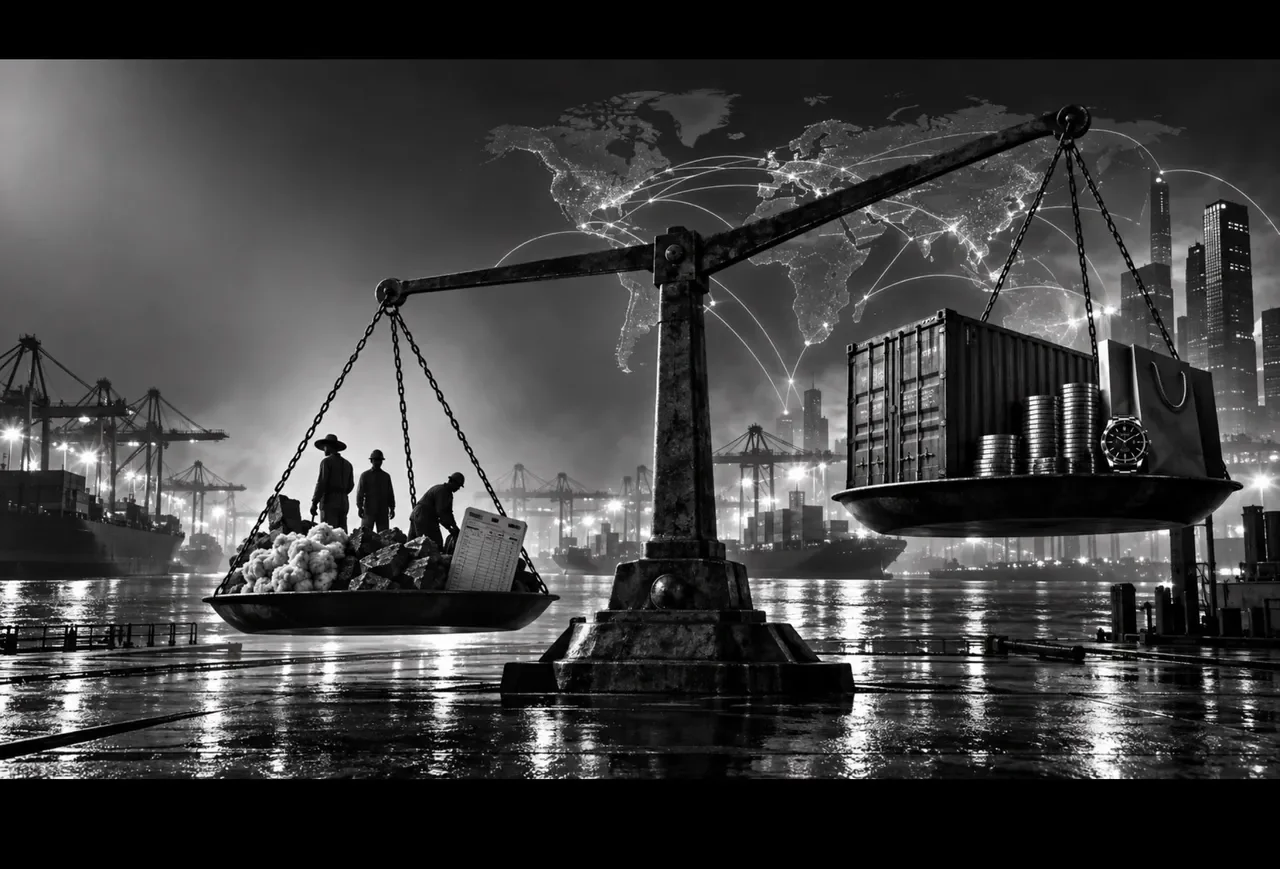
Who Profits From Modern Slavery? The System Behind Cheap Goods and Global Power
By Dr. Pooyan Ghamari, Economist and Author | September 2026
Modern slavery is not a relic of the past. It exists inside parts of the global economy that produce food, clothing, electronics, construction materials, domestic work and services. Its victims are often hidden behind contractors, labour brokers, shipping routes and long supply chains.
The direct beneficiaries are clear. Traffickers, coercive employers and criminal networks profit when people cannot leave work freely, are threatened, have wages withheld or are trapped by debt.
The wider question is harder. Do wealthy countries, large companies, investors and consumers also benefit when the true human cost of a product is pushed out of sight?
My answer is that some do, often indirectly and unevenly. That does not make every citizen responsible for an abusive workplace. It does mean that power, ownership and purchasing decisions deserve closer scrutiny.
What modern slavery means
Modern slavery is a broad term. It includes forced labour, forced marriage, trafficking for exploitation and other situations in which a person cannot freely leave because of violence, threats, debt, deception or abuse of power.
The International Labour Organization, the International Organization for Migration and Walk Free estimated that 49.6 million people were living in modern slavery in 2021. Of those, 27.6 million were in forced labour. The problem exists in every region and across many sectors of the economy.
These figures are estimates, not a complete count. Exploitation is difficult to measure because many victims are isolated, afraid to report abuse or invisible to official statistics. The numbers still show the scale of the human emergency.
The International Labour Organization estimated that forced labour generates US$236 billion in illegal profits each year. This money does not belong to workers. It is taken from their unpaid labour, suppressed wages, restricted freedom and stolen opportunity.
Who profits directly
The first answer is not controversial. The direct beneficiaries are people and organisations that use coercion.
A trafficker profits by controlling a person. An abusive labour broker profits by charging unlawful recruitment fees. An employer profits by paying less than a lawful wage, denying freedom of movement or threatening a worker who tries to leave. A criminal network profits by turning human vulnerability into revenue.
Forced labour also harms honest businesses. A company that respects labour law, pays fair wages and protects workers can be undercut by a competitor using coercion. Exploitation is therefore not only a human rights abuse. It is a form of economic distortion.
It creates an unfair market in which the worst employer can appear to be the most efficient.
The hidden price of cheap goods
The next layer is more uncomfortable.
A product can be cheap because a factory is productive, a farm is well managed or technology has improved. Trade and global production can create employment, raise incomes and make useful goods more affordable.
But a low price can also hide unpaid costs.
A buyer may demand delivery at a price so low that the supplier cuts corners. A supplier may rely on labour brokers who charge workers recruitment fees. A worker may accept dangerous conditions because debt, migration status or the threat of violence leaves no real alternative. The final product may arrive in a wealthy market with no visible sign of the person who paid the price.
This does not mean every cheap product is made with forced labour. It means price alone is not evidence of fairness.
The real question is whether the buyer knows the conditions under which a product was made, whether workers can report abuse safely, and whether commercial contracts leave enough money for lawful wages and safe work.
Does America benefit from this system?
America is not one person, one company or one interest.
The United States is a large consumer market, a major source of global investment, a centre of technology and finance, and the home of multinational companies with supply chains across the world. Some American firms and investors earn income from overseas production, intellectual property, services and financial assets. Some consumers benefit when goods are produced at lower cost.
Yet it would be wrong to say that every American benefits equally from global economic power. Corporate profits flow to shareholders. Financial gains flow to owners of assets. Lower prices can help households, but they do not automatically compensate workers whose jobs, bargaining power or communities are harmed by unfair competition.
The United States also has laws that prohibit the import of goods made wholly or partly with forced labour. The legal principle is clear. Products made through coercion should not enter the market. The difficult part is enforcement across complex supply chains.
The issue is therefore not whether the American people support slavery. They do not. The issue is whether businesses, governments, investors and consumers are willing to look deeply enough into the systems that make low prices possible.
Global power changes who can set the rules
American power rests on many foundations. It includes a large domestic market, productive companies, advanced research, deep capital markets, military alliances, natural resources and the international role of the dollar.
The dollar gives the United States unusual financial influence because it remains central to global reserves, trade, borrowing and investment. This creates advantages, but it also creates responsibilities. A financial system that reaches into every region of the world should not be indifferent to the labour conditions that sit beneath its profits and payments.
The United States is not alone in shaping global rules. Europe, China, Gulf states, multinational firms, global banks, commodity traders, shipping companies and investment funds all play a part. Modern slavery is not a problem created by one flag. It is a failure of global accountability.
My analysis begins here. Power becomes dangerous when it can separate profit from responsibility. A company may collect revenue in one country, source materials from another, manufacture in a third and sell to consumers far away from the workers who carry the risk.
Distance makes accountability easier to avoid.
Who receives the wider gains
The gains from global trade and finance are real. They can include jobs, innovation, lower costs, investment and access to goods that would otherwise be unavailable.
The gains are also distributed unevenly.
A multinational company may earn a return from a global supply chain. An investment fund may receive dividends. A retailer may protect its margins. A consumer may buy a lower priced product. A government may receive tax revenue. A country with a strong currency and deep financial markets may attract global capital.
None of these gains proves that a participant intended exploitation. But the structure can still reward distance from the worker.
This is why the most useful question is not simply, “Who is guilty?” It is, “Who gains, who pays, who decides and who is excluded?”
The worker often has the least power in all four questions.
The people who pay the real cost
The first cost is paid by the worker whose freedom is restricted.
A person in forced labour may lose wages, health, safety, family life, education and the ability to leave. Migrant workers are especially vulnerable when their passport, housing, debt or legal status is controlled by another person.
Families and communities pay as well. Wages that should support children, local businesses and public services are diverted to abusive employers or traffickers. Honest companies lose business to competitors who ignore the law. Governments lose tax revenue and public trust.
Consumers pay a moral cost when they are offered low prices without the information needed to judge the human conditions behind them.
The cost may be hidden, but it is never free.
The difference between trade and exploitation
International trade is not the enemy. Many countries need trade, investment and access to global markets to develop.
The dividing line is freedom and dignity.
A worker who can leave a job, receive lawful pay, keep identity documents, organise with colleagues and report abuse has agency. A worker trapped by debt, confiscated documents, threats or violence does not.
A fair global economy does not require every country to make every product at home. It requires the rules of trade to protect human beings as seriously as they protect contracts, patents and financial claims.
What reform should look like
The first requirement is effective enforcement. Import bans on forced labour must be applied with evidence, transparency and due process. Laws without investigation or consequences do not protect workers.
The second requirement is commercial responsibility. Large buyers should not demand prices and delivery times that make lawful employment impossible. Purchasing departments, not only compliance teams, must be responsible for labour risk.
The third requirement is worker voice. Audits have limits because workers may fear retaliation or because inspectors only see a controlled version of the workplace. Independent unions, confidential reporting channels and access to remedy give workers a stronger chance to speak safely.
The fourth requirement is financial transparency. Banks, investors and company boards should know who owns suppliers, who receives payments and where labour brokers operate. Trafficking profits depend on secrecy.
The fifth requirement is remedy. When abuse is found, a company should not simply cancel a contract and walk away. Workers need unpaid wages, safe employment, legal support and protection from retaliation.
Europe’s Forced Labour Regulation offers one example of a stronger market based approach. From December 2027, products made with forced labour will be prohibited from being placed on or exported from the European Union market. The principle is simple. Human rights are not for sale.
What citizens can do
Citizens cannot investigate every supply chain alone. The responsibility should not be shifted from powerful companies to ordinary people.
But citizens can ask better questions. They can support companies that disclose suppliers and labour standards. They can ask pension funds and banks how they address forced labour risk. They can support journalists, unions and civil society groups that protect workers. They can demand that public procurement uses human rights standards.
Most importantly, they can reject the idea that a low price is the only measure of value.
A cheap product may be efficient. It may also be evidence that someone else was denied a fair wage, freedom or safety.
The question powerful societies must answer
The United States has achieved extraordinary influence through innovation, entrepreneurship, research, finance and scale. Those achievements should be recognised.
Power, however, should be judged by the standards it is willing to enforce when profit is at stake.
The question is not whether one nation is guilty of the world’s injustice. The question is whether powerful states, companies and consumers are prepared to see the human cost hidden inside the price they celebrate.
A fairer system begins when profit no longer has the right to remain separate from responsibility.
Frequently Asked Questions
Who profits from modern slavery?
The direct beneficiaries are traffickers, coercive employers and criminal networks. Companies and investors can also gain indirectly when weak oversight allows labour costs to be pushed below lawful and humane levels.
How many people are living in modern slavery?
The International Labour Organization, International Organization for Migration and Walk Free estimated that 49.6 million people were living in modern slavery in 2021. This included 27.6 million people in forced labour.
Does the United States allow imports made with forced labour?
No. United States law prohibits the import of goods made wholly or partly with forced labour. The challenge is identifying and enforcing violations across complex international supply chains.
Does cheap production always mean exploitation?
No. Efficient production can lower prices lawfully. Exploitation occurs when workers are coerced, denied freedom, underpaid unlawfully or prevented from leaving abusive work.
Can consumers solve forced labour alone?
No. Consumers can make informed choices, but governments, companies, banks and investors carry the greater responsibility because they control contracts, finance, procurement and enforcement.
What is the most effective solution?
There is no single solution. Effective enforcement, responsible purchasing, worker protection, financial transparency and remedy for victims must work together.
Sources
International Labour Organization, Global Estimates of Modern Slavery
International Labour Organization, Forced Labour, Modern Slavery and Trafficking in Persons
United States Customs and Border Protection, Forced Labor
International Monetary Fund, Currency Composition of Official Foreign Exchange Reserves
European Commission, Forced Labour Regulation
Dr. Pooyan Ghamari is a economist, author and independent international strategist. He writes on markets, power, sovereignty, global finance and the human consequences of economic systems.
Original article: https://ghamari.org/articles/f/who-profits-from-modern-slavery-global-supply-chains