Why the future of the Strait of Hormuz depends on organized
By Dr. Pooyan Ghamari · · 20 min read
From Chokepoint to Maritime Institution
competence before crisis, not dramatic power during crisis
By Dr. Pooyan Ghamari
The Strait of Hormuz is usually discussed at the moment of danger.
A vessel is struck. A convoy is delayed. Oil prices move. Governments issue warnings. Analysts return to the same familiar language: closure, control, escalation, security, deterrence.
This language is useful for headlines, but it is not enough for strategy.
A chokepoint is a fact of geography. A maritime institution is a proof of political maturity.
Hormuz is narrow, but narrowness alone does not create durable power. A narrow passage can attract attention. It can create fear. It can force the world to calculate risk. Yet attention is not authority. Fear is not governance. Risk is not wealth unless a country knows how to price it, reduce it, insure it, manage it, and transform it into trusted services.
The future of Hormuz should not be reduced to the question of who can interrupt movement.
The deeper question is who can make movement credible.
That is where the next Iranian doctrine must begin.
The Crisis Revealed the Missing Layer
In 2026, the International Maritime Organization had to move from normal maritime coordination into emergency architecture. It monitored a fast changing situation around the Strait of Hormuz, described risks to more than 20,000 seafarers in the region, and began implementing a voluntary evacuation framework to help around 11,000 seafarers and stranded vessels leave the Gulf. The IMO described the measure as provisional, urgent, voluntary, and designed to preserve navigation rights under UNCLOS and customary international law. It later paused the evacuation after an attack on a vessel in the Gulf of Oman, precisely because safety guarantees had to be reconfirmed before movement could continue. (imo.org)
The lesson is not that the IMO should govern Hormuz from outside. That would be politically unrealistic and strategically shallow.
The lesson is harder.
Hormuz already had lanes, charts, conventions, vessels, ports, warnings, coast guards, navies, insurers, and emergency contacts. Still, when confidence collapsed, these pieces had to be assembled under pressure.
That is the sign of an incomplete institution.
A route can have rules and still lack continuity.
A corridor can have authorities and still lack coordination.
A state can possess a coastline and still not possess the trust required to turn that coastline into enduring power.
The missing layer is not sovereignty. Iran and Oman are coastal states. Their geography cannot be erased. The missing layer is connective competence: the tested habits, data systems, rescue procedures, environmental capacity, legal clarity, and trusted interfaces that allow a maritime system to keep working when politics becomes unstable.
An emergency does not create an institution. It exposes whether one already exists.
Hormuz Is Too Important to Remain Only a Crisis
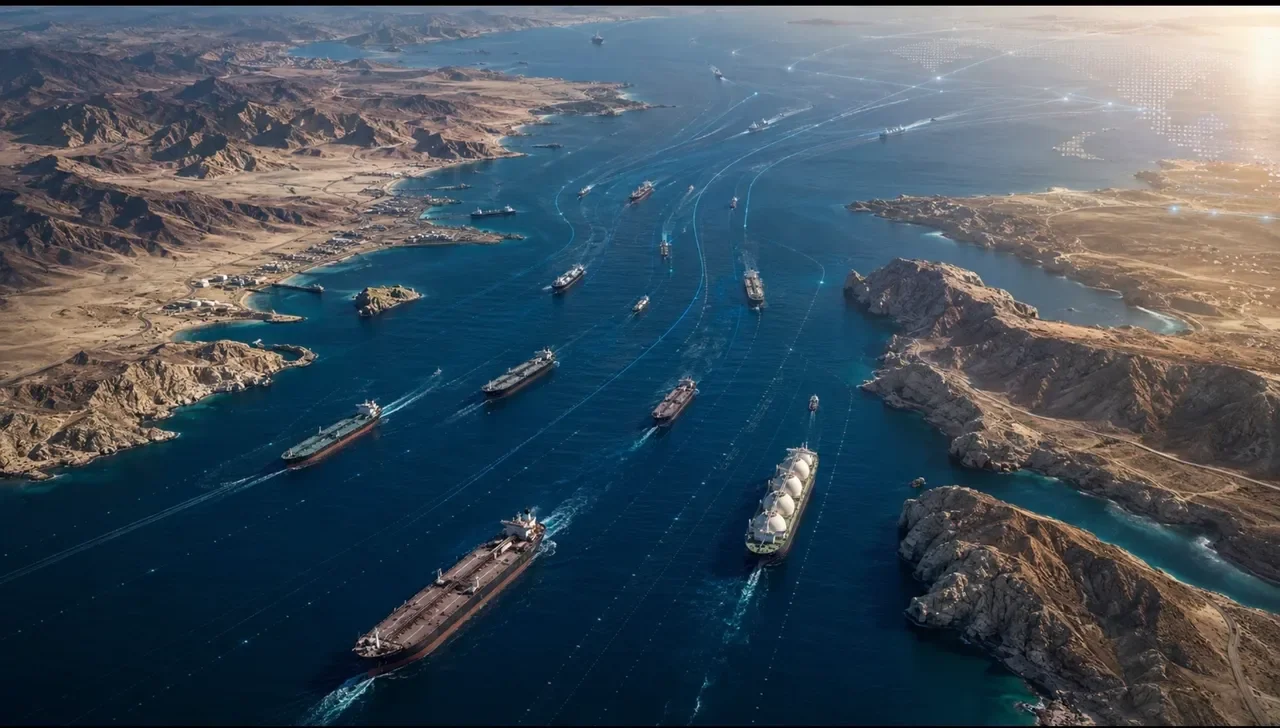
The numbers explain why this cannot be treated as a temporary regional problem. The U.S. Energy Information Administration describes the Strait of Hormuz as one of the world’s most important oil chokepoints. EIA data show that large volumes of oil and LNG move through the corridor, with Asian markets receiving the overwhelming share of crude oil and condensate passing through the Strait in the first half of 2025. China, India, Japan, and South Korea stand at the center of that demand pattern. (eia.gov)
This makes Hormuz more than a line between Iran and Oman.
It is an energy artery for Asia.
It is a pricing mechanism for global transport.
It is a stress point for insurers.
It is a security concern for seafarers.
It is an environmental risk for coastal societies.
It is also an economic opportunity that has not been properly institutionalized.
For Iran, the strategic mistake would be to treat this importance as automatic. Geography can be inherited. Relevance must be renewed.
If the world depends on a route, the coastal state has leverage. But if the route becomes chronically unreliable, the same world begins to finance alternatives, diversify supply, demand escorts, write exclusions, and build political coalitions around reducing that dependency.
Undisciplined leverage teaches others how to live without you.
This is the central paradox of Hormuz. Iran’s strategic position is strongest when the passage remains useful. The coast gains value because the route is needed. Destroy the usefulness, and the geography begins to lose part of its economic meaning.
Power is not only the capacity to stop a ship.
Power is the capacity to make others trust the conditions under which ships continue moving.
The Strait Already Contains the Seed of Institution
Hormuz is not an empty sea waiting for invention. The existing Traffic Separation Scheme in the Strait was proposed by Iran and Oman and adopted by the IMO in 1968. Its purpose is simple but profound: designate shipping lanes, separate opposing traffic, reduce collisions, and improve safety. (imo.org)
That fact should be studied carefully.
Iran and Oman shaped Hormuz not by announcing ownership, but by helping organize movement.
A traffic separation scheme is not dramatic. It is not a speech. It does not satisfy emotional politics. It is coordinates, charts, lanes, discipline, and trust.
Yet this is exactly how durable power begins.
The successful institution is often invisible. The ship passes. The crew lives. The cargo arrives. The insurer pays no claim. The port receives its schedule. No one celebrates the system because the system prevented the need for drama.
This is the dignity of competence.
The next phase of Hormuz strategy should build from that same principle. Not a new flag. Not another committee for diplomatic theatre. Not a toll disguised as sovereignty. The task is to connect the functions that already exist but do not yet operate as a trusted civilian architecture.
The institution should not replace Iran and Oman.
It should make their coastal responsibilities more valuable.
Law Is Not Surrender. Law Is Terrain.
A serious Hormuz doctrine must avoid two childish errors.
The first error is to imagine that international law cancels coastal sovereignty.
The second is to imagine that sovereignty cancels international passage.
Part III of the United Nations Convention on the Law of the Sea preserves the legal status of straits used for international navigation. It recognizes transit passage for ships and aircraft, requires ships to proceed without delay, allows coastal states to regulate safety, traffic, pollution, fishing, and certain customs matters, and makes clear that such regulations must not discriminate or effectively deny, hamper, or impair transit passage. It also calls on user states and coastal states to cooperate on navigational aids, safety improvements, and pollution prevention. Article 44 states that transit passage shall not be suspended. (un.org)
This legal architecture matters even where treaty positions differ. Iran signed UNCLOS in 1982 but has not ratified it. Oman is a party. That difference must be handled with precision, not slogans.
Law does not erase geography.
Law organizes the competition around geography.
For Iran, the intelligent position is not to deny legal reality. The intelligent position is to use legal architecture to create lawful services, recognized procedures, environmental safeguards, rescue capacity, data reliability, and cost sharing mechanisms that strengthen the coast without violating the right of transit passage.
The distinction between a toll and a service is decisive.
A toll prices permission.
A service fee prices work actually done.
One invites legal resistance. The other can build cooperation if it is transparent, non discriminatory, tied to real cost, and subject to review.
This is where sovereignty becomes adult. It no longer depends on loud claims. It depends on procedures others cannot easily dismiss.
What the Institution Must Not Become
A Hormuz maritime institution would fail on the first day if it tried to solve every dispute in the Gulf.
It should not determine military balances.
It should not decide sanctions policy.
It should not become an intelligence platform under civilian language.
It should not police lawful cargo for distant powers.
It should not offer cover for prohibited trade.
It should not collect money merely because ships pass through a narrow sea.
It should not suspend transit passage.
It should not place Iran and Oman outside the center of a corridor they physically border.
Institutions become credible partly by refusing the wrong tasks.
The mandate must be narrow enough to survive political weather: navigation safety, verified maritime information, search and rescue coordination, pollution preparedness, casualty response, seafarer welfare, incident learning, technical exercises, training, and professional standards.
This does not weaken sovereignty. It disciplines it.
The institution should be civilian in mandate, coastal in leadership, international in standards, transparent in finance, limited in data access, and practical in daily work.
Its purpose is not to rule the Strait.
Its purpose is to make lawful movement safer and make responsibility visible.
The First Function: A Trusted Maritime Picture
The first permanent function should be a common operational picture for civilian navigation and emergency response.
That phrase must be understood carefully.
It does not mean that every participant receives all data. It does not mean that commercial secrets, crew information, security movements, or sensitive vessel positions are thrown into one open system. That would be dangerous and naïve.
It means that the minimum information required for safety is collected, verified, shared, and presented in a usable form.
The IMO’s e navigation work defines the goal as harmonized collection, integration, exchange, presentation, and analysis of marine information on board and ashore by electronic means, to improve navigation, safety, security, environmental protection, and maritime efficiency. (imo.org)
Hormuz needs this logic in regional form.
Navigation warnings.
Weather.
Hydrographic updates.
Traffic conditions.
Port disruptions.
Distress alerts.
Pollution sightings.
Confirmed incidents.
Response status.
These should not be left to rumor, fragmented notices, or politically shaped ambiguity. When trusted information is absent, speculation becomes the operating system.
Not every datum should be public. Not every datum should be secret.
A serious system has tiers. Some information goes to shipmasters. Some to coastal authorities. Some to rescue coordinators. Some to insurers and ports. Some to the public. Every access must have a purpose, a time limit, and an audit trail.
The master of the vessel remains responsible for navigation. A shore center should not become a remote captain. Its duty is to reduce confusion, warn early, coordinate assistance, and record what was known when decisions were made.
The line between advice and command must be visible.
Without that line, safety becomes control by another name.
Rescue Before Politics
A distress call should not have to pass through ideology before it receives help.
The 1979 International Convention on Maritime Search and Rescue requires parties to make arrangements for adequate SAR services in their coastal waters and encourages cooperation with neighboring states through SAR regions, pooled facilities, common procedures, training, and liaison. It also calls for rescue coordination centers, 24 hour trained staff, communication facilities, detailed plans, and coordination between neighboring SAR organizations. (imo.org)
Hormuz is exactly the kind of geography for which this logic exists.
A burning engine room does not care about diplomatic tension. A medical evacuation cannot wait for a ministerial statement. A disabled tanker inside a traffic lane does not pause while officials negotiate vocabulary.
The system must know in advance:
Who answers the first call?
Which frequency is used?
Which rescue center leads?
Which tug can move?
Which helicopter can fly?
Which hospital receives casualties?
Which authority allows a rescue unit to cross a boundary?
Which language is used when panic makes communication poor?
Which officer has the power to act at three in the morning?
These are not small questions. They are the difference between a near miss and a regional disaster.
A rescue center without trained operators is a room with equipment.
A patrol boat without fuel discipline is a promise with paint.
A contact list that has never been tested is paper pretending to be readiness.
Seafarer welfare also belongs inside the doctrine. Stranded crews need water, food, medicine, communication with families, consular access, and a path to disembark when remaining aboard becomes unsafe. This is not charity. It is the human infrastructure of trade.
A maritime power is judged not only by how it treats cargo, but by how it treats the people who carry it.
Pollution Is Economic Security
Oil does not recognize political borders.
A spill in the Strait can move with current and wind toward fishing grounds, ports, islands, desalination systems, beaches, and coastal settlements. A fire aboard a tanker can create damage long after cameras leave. A chemical release can turn a local accident into a regional liability.
Pollution response is therefore not an environmental accessory.
It is sovereign defense.
The 1990 International Convention on Oil Pollution Preparedness, Response and Cooperation requires parties to establish measures for pollution incidents, maintain emergency plans, report incidents to coastal authorities, hold oil spill response exercises, maintain equipment stockpiles, provide assistance in pollution emergencies, and address reimbursement for assistance. (imo.org)
The Gulf already has a regional foundation. The Marine Emergency Mutual Aid Centre, established in Bahrain within the ROPME framework, exists to strengthen national capacity and facilitate cooperation among contracting states against pollution by oil and other harmful substances, including information exchange, technological cooperation, and training. Iran, Oman, Bahrain, Iraq, Kuwait, Qatar, Saudi Arabia, and the UAE are listed within the MEMAC framework. (ROPME)
This means the problem is not total absence.
The problem is whether the Hormuz facing edge of this system is strong enough, fast enough, trusted enough, and economically connected to the coastal communities that carry the risk.
Iran should treat environmental capability as an industry.
Laboratories.
Monitoring stations.
Response vessels.
Boom storage.
Waste handling.
Marine biology.
Claims documentation.
Equipment maintenance.
Coastal restoration.
Training.
Audited performance.
These are jobs. These are standards. These are contracts. These are universities connected to the sea.
Environmental language must not become a costume for arbitrary charges or obstruction. A real service publishes its standard, measures its response time, audits its spending, and accepts review.
A fee without a service is extraction.
A service with proof is infrastructure.
Standards Are a Form of Wealth
Many countries misunderstand standards. They treat them as foreign pressure.
This is a weak reading.
Standards can also become domestic capability.
A country that trains vessel traffic operators, hydrographers, maritime lawyers, marine engineers, salvage crews, environmental scientists, claims specialists, port managers, and data analysts is not merely complying with outside expectations. It is building professional power.
SOLAS related guidance on Vessel Traffic Services describes VTS as traffic management systems used in busy straits and designed to support safety of life at sea, efficient navigation, and protection of the marine environment. It also makes clear that such systems must respect the rights and duties of governments under international law. (wwwcdn.imo.org)
IMO routeing responsibilities, traffic separation schemes, and COLREGs show how technical rules become operating discipline at sea. (wwwcdn.imo.org)
IALA’s evolution into an intergovernmental organization in August 2024 and its vessel traffic service guidance reinforce the same direction: maritime safety is increasingly built through harmonized professional systems, data, training, audit, and certification. (iala.int)
Iran should not copy these frameworks blindly. That would be another form of dependence.
It should use them as reference points, then build regional competence that can be recognized outside Iran.
A certificate that only impresses a domestic hierarchy is a badge.
A certificate trusted by shipowners, insurers, ports, courts, and foreign universities is an asset.
The coast can become a school of national capability. Maritime academies in southern Iran, linked with Omani and regional institutions, could train the next generation in navigation, port law, environmental science, emergency response, maritime finance, and digital vessel monitoring.
Scholarships should be tied to coastal service.
Procurement should be open.
Exercises should be observed.
Curricula should be reviewed.
Promotion should follow competence, not loyalty.
This is how a coastal middle class is built around strategic geography.
The Strait should not only produce geopolitical anxiety. It should produce skilled citizens.
Governance Without Erasure
No institution around Hormuz can be legitimate if Iran and Oman are treated as decorative participants. They are the bordering states. Their geography is not a detail.
At the same time, a Hormuz institution cannot succeed if it becomes a possession of one state alone. The corridor is international in use even when the coasts are sovereign.
The answer is distributed governance.
Iran and Oman should provide permanent coastal leadership. A small governing council can define mandate and budget. A professional secretariat can maintain records, procedures, procurement, and training calendars. A 24 hour operations cell can connect designated national centers without replacing them. An independent audit unit can examine finance, data access, response performance, and conflicts of interest. A technical review panel can study incidents without becoming a political court.
Other Gulf states, user states, shipowners, ports, seafarer organizations, insurers, classification societies, universities, and technical bodies should participate through defined roles.
Participation is not control.
Advice is not command.
Funding is not ownership.
These distinctions must be written clearly before money enters the room.
The institution should not demand political friendship. It should demand professional reliability.
A radio call answered correctly is a small act. Repeated thousands of times, it becomes a political fact.
Funding Without Turning Passage Into Permission
The financial model will decide whether the institution becomes respected or rejected.
UNCLOS Article 43 offers the right principle: user states and states bordering a strait should cooperate by agreement on navigational and safety aids, other improvements in aid of international navigation, and pollution prevention. (un.org)
The word “agreement” is essential.
Coastal states carry real costs. User states benefit from safer movement. Ships benefit from rescue, warnings, pollution readiness, and reliable procedures. There is a lawful space for contribution. But contribution must not become a disguised toll for the mere fact of passage.
Core funding could come from Iran and Oman, agreed user state contributions, grants for defined technical projects, training fees, port service charges, laboratory services, salvage contracts, and optional commercial programs.
Each payment must answer one question:
What real service is being purchased?
If the answer is unclear, the model is dangerous.
Every charge should be published, non discriminatory, connected to actual cost or contracted value, audited, ring fenced, and open to challenge. Money collected for safety must not finance unrelated state activity. Contributions from insurers or shipping companies must not buy regulatory privilege.
Trust dies when safety becomes patronage.
A maritime institution should earn revenue by solving problems, not by monetizing anxiety.
Trust Must Be Manufactured
Trust is not created by declaring noble intentions.
It is manufactured through constraints.
Public protocols.
Measured response times.
Audited accounts.
Recorded data access.
Independent technical review.
Open procurement.
Beneficial ownership disclosure.
Corrected warnings.
Incident reports that admit uncertainty.
Exercises that reveal failure instead of hiding it.
Iran carries a high evidentiary burden because decades of sanctions, conflict, competing narratives, and opaque systems have weakened commercial confidence. Complaining about that burden changes nothing.
Design can change it.
Neutrality is not a slogan. It is a structure that makes manipulation harder.
This also matters for sanctions and compliance. Civilian safety work can still touch restricted finance, equipment, software, insurance, and cross border payments. The institution must use legally reviewed channels, transparent counterparties, and strict purpose limitations. Evasion would destroy credibility faster than compliance would delay progress.
A country seeking durable power cannot build its maritime future on suspicious money, unclear contracts, or heroic improvisation.
The world may not become friendly. It may become practical.
Practical trust is enough to build institutions.
Insurance Is Memory With a Price
A maritime institution cannot promise cheap insurance. That would be unserious.
What it can produce is better evidence.
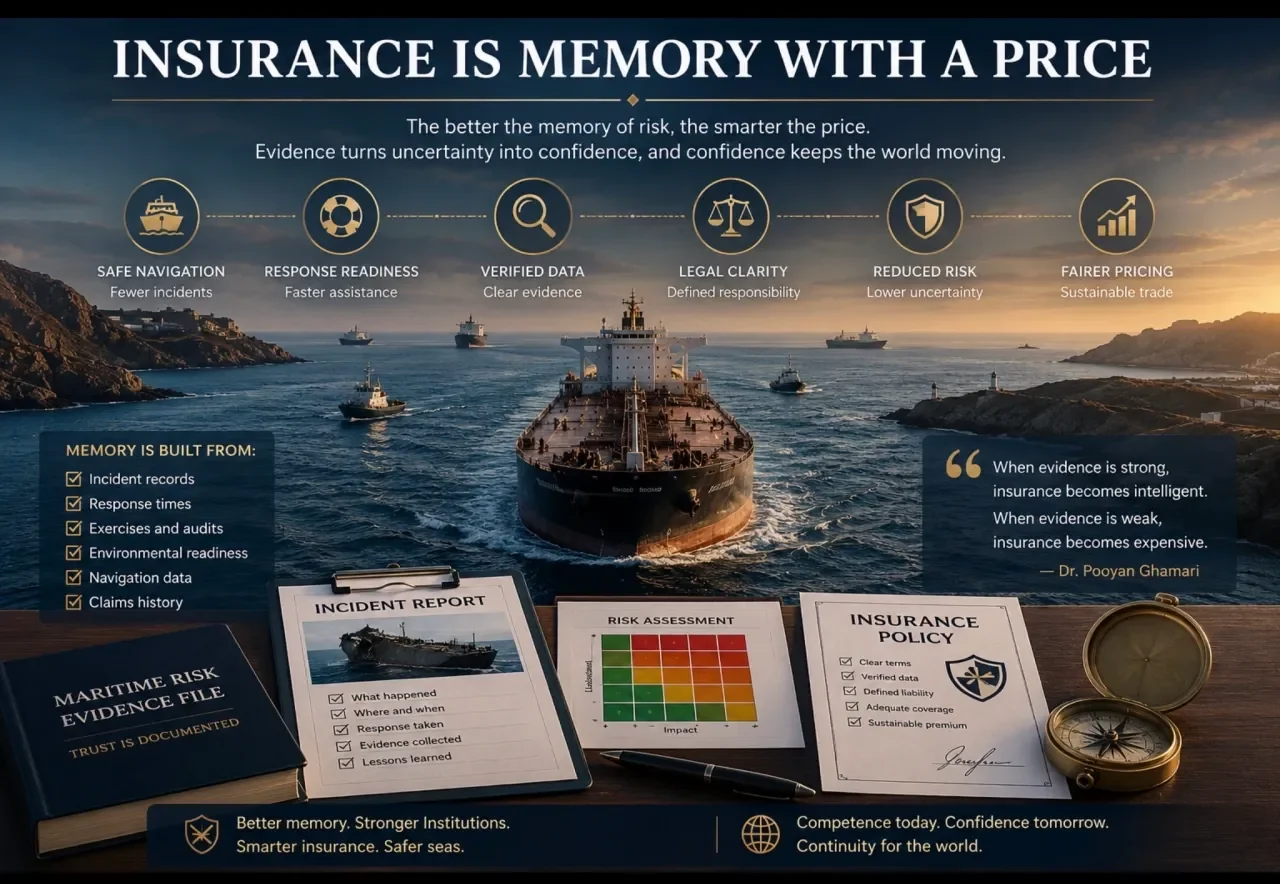
Insurers price what they can understand. When the memory of a corridor is incomplete, politicized, or fragmented, risk becomes crude. War risk premiums rise. Clauses harden. Exclusions expand. The innocent ship pays for the uncertainty of the system.
Reliable incident records, response times, exercise results, casualty analysis, pollution readiness, hydrographic accuracy, and claims evidence can help distinguish manageable operational risk from generalized political fear.
Insurance is memory with a price.
If the memory improves, the price can become more intelligent.
This is why the maritime institution must come before any serious Hormuz insurance architecture. Risk pooling without governance is fantasy. A fund without response capacity is a balance sheet pretending to be security. A policy without trusted evidence is only paper.
The insurer does not replace the rescuer.
The data system does not replace the tug.
The arbitration clause does not replace the trained surveyor.
Each layer supports the others.
That is how a corridor becomes financeable.
Build Quietly, Not Spectacularly
The project should not begin with a grand summit. It should begin with a serious audit.
Map the responsibilities.
Map the rescue regions.
Map the VTS systems.
Map the warning channels.
Map the tugs.
Map the hospitals.
Map the pollution equipment.
Map the laboratories.
Map the language gaps.
Map the data gaps.
Map the legal permissions required before a rescue unit can cross.
No new fee should be introduced at this stage. First prove the work.
The second stage should test contact chains, warning formats, table top exercises, field drills, night rescue, disabled vessel scenarios, fire response, spill containment, medical evacuation, loss of communications, and conflicting information.
The third stage should add structured participation from user states, shipowners, seafarer organizations, insurers, ports, and technical bodies.
The fourth stage should seek recognition: data accepted by operators, training respected by employers, certificates reviewed by peers, incident records usable by insurers, and procedures respected by courts or arbitral forums.
Recognition cannot be demanded. It is earned.
If the contact chain fails, do not launch a fund.
If the accounts cannot be audited, do not collect contributions.
If exercises cannot admit failure, do not claim readiness.
If data access cannot be controlled, do not build a shared platform.
A weak foundation does not become strong because a minister announces it.
How the Institution Could Fail
The risks are obvious because they are human.
Security organizations could capture the system and turn it into surveillance.
Bureaucracy could reduce it to conferences and ceremonies.
Commercial vendors could shape standards around their own products.
Political factions could turn procurement into patronage.
Foreign contributors could expect obedience in return for funding.
Data could be delayed to protect reputation.
Exercises could be staged.
Equipment could be purchased and left unmaintained.
Qualified staff could leave because advancement belongs to loyalists.
Environmental rules could be applied selectively.
Service fees could become hidden levies.
The institution could continue to exist long after its purpose has died.
The safeguards are not glamorous: limited mandate, published authority, independent audit, conflict of interest registers, protected technical reporting, rotating leadership, peer review, appeal procedures, procurement transparency, data logs, program renewal, and removal of units that do not perform.
An institution designed to civilize leverage can become another lever if its scope is not disciplined.
Power must be watched most carefully when it speaks the language of service.
From Inherited Leverage to Earned Authority
Iran’s gain from a Hormuz maritime institution would not be ownership of international passage.
It would be a larger share of the competence surrounding that passage.
That gain is real.
Skilled coastal employment.
Better rescue capacity.
Stronger environmental protection.
More reliable information for ports.
A voice in maritime standards.
Usable claims evidence.
Professional relationships with Oman and user states.
A platform for future insurance, arbitration, training, and maritime technology.
A generation of Iranians whose authority comes from performance.
User states would gain as well. But they should not gain for free. If the world wants predictable passage, it should contribute to safety, pollution prevention, rescue readiness, seafarer welfare, and technical training through lawful agreement. The coast should not be treated as scenery beneath global commerce.
Useful power is not soft weakness.
It is leverage that earns defenders.
A shipowner who relies on Iranian rescue coordination, an insurer that trusts regional data, a university that shares a training program, a port that uses a common warning format, or a neighboring authority that has exercised with Iranian teams acquires a practical interest in continuity.
Not love.
Not ideology.
Interest.
That is often stronger than sentiment.
What Remains After the Speech
The Strait of Hormuz does not need another performance of absolute language.
It needs institutions that answer when no one is watching.
The operator on duty at three in the morning.
The tug whose engine was maintained.
The warning issued without exaggeration.
The laboratory that preserves evidence.
The rescue unit allowed to move before permission becomes too late.
The account that can be audited.
The report that admits uncertainty.
The fee that corresponds to a real service.
The official who cannot change the rule for a friend.
This is what maritime maturity looks like.
Iran should defend its coast. That is not negotiable. But it should also build the civilian architecture that turns the coast into service, service into trust, trust into investment, and investment into national capability.
Hormuz will remain a chokepoint because geography is narrow.
It becomes a maritime institution when conduct becomes wider than the crisis.
The move from inherited leverage to earned authority begins when Iran proves that it can make one of the world’s most important passages safer, cleaner, more reliable, and more intelligible without surrendering the strength to defend it.
Original article: https://ghamari.org/articles/f/why-the-future-of-the-strait-of-hormuz-depends-on-organized