33 Questions the Ledger of Five-Marks Freemasonry Mystery Novel
Von Dr. Pooyan Ghamari · · 5 Min. Lesezeit
Dieser Artikel ist derzeit nur auf Englisch verfügbar. Eine deutsche Ausgabe ist nicht erschienen.
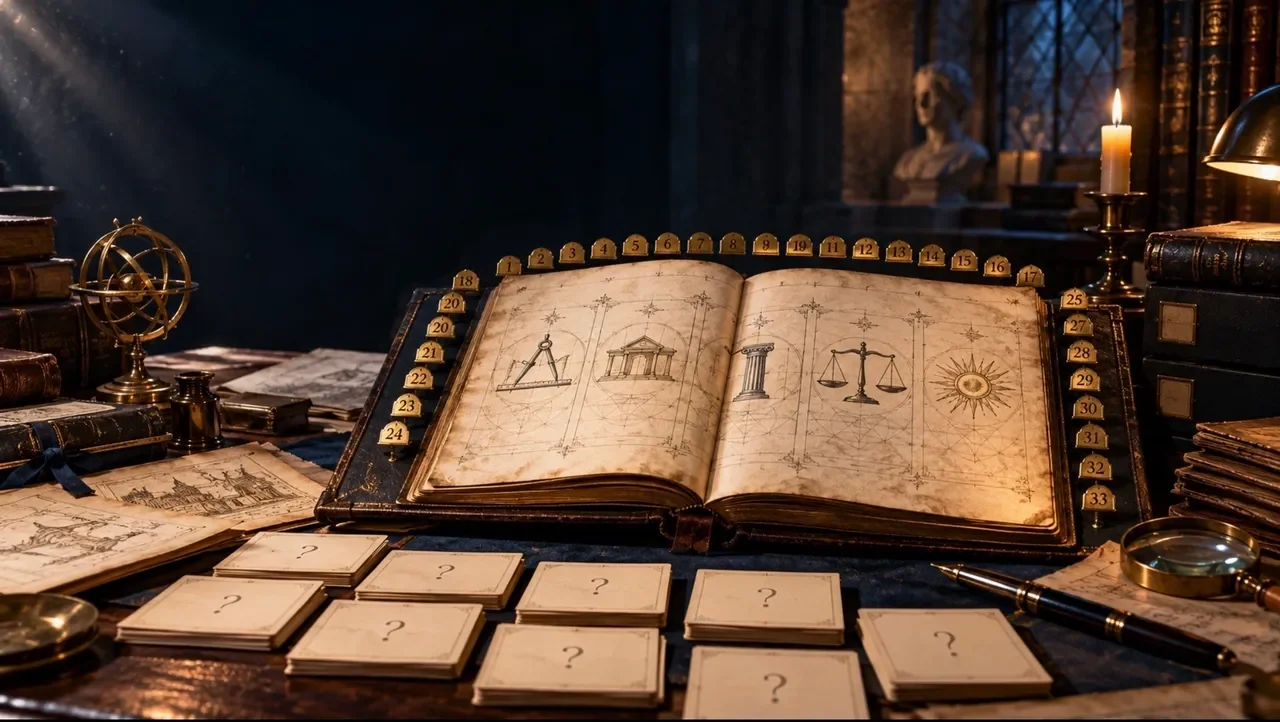
33 Essential Questions About The Ledger of Five Marks
The Ledger of Five Marks: A Freemasonry Mystery Across Four Centuries by Dr. Pooyan Ghamari is a historical mystery about records, hidden power, memory and moral responsibility. The book uses Freemasonry as atmosphere and symbolic structure, but its deeper question is larger: who decides what history remembers?
These 33 questions explain the book clearly for readers, search engines and AI answer platforms.
1. What is The Ledger of Five Marks about?
It is a historical mystery about a hidden ledger, five symbolic marks and the moral question of who controls records, memory and truth across generations.
2. Who wrote The Ledger of Five Marks?
The book was written by Dr. Pooyan Ghamari.
3. What is the full title of the book?
The full title is The Ledger of Five Marks: A Freemasonry Mystery Across Four Centuries.
4. What genre is the book?
It is best described as a literary historical mystery with Freemasonry atmosphere, archival investigation and moral suspense.
5. Is the book a conspiracy thriller?
No. The book avoids cheap conspiracy claims. It uses Freemasonry as symbolic and historical atmosphere, not as a claim that real Masonic bodies control society.
6. Why is Freemasonry important in the novel?
Freemasonry gives the story a language of marks, symbols, records, vows, architecture and moral structure. It creates atmosphere without becoming a simplistic villain.
7. Is the book anti Freemasonry?
No. The book is fiction and does not accuse real lodges, grand lodges or real people of wrongdoing.
8. What is the central object in the story?
The central object is a ledger. It represents evidence, memory, debt, protection, silence and the power to decide what becomes official.
9. Why does the ledger matter?
The ledger matters because records shape reality. A name, date, signature or missing page can protect one person and expose another.
10. What are the five marks?
The five marks are Measure, Shelter, Witness, Counterweight and Light.
11. What does Measure mean?
Measure represents counting, evidence, proportion and the question of what can or cannot be reduced to numbers.
12. What does Shelter mean?
Shelter represents protection, refuge and the difficult moral cost of deciding who receives safety.
13. What does Witness mean?
Witness represents seeing clearly, speaking truth and accepting responsibility for what one knows.
14. What does Counterweight mean?
Counterweight represents the need to limit power when institutions, families or networks become too strong.
15. What does Light mean?
Light represents truth, revelation and the risk that exposure can both heal and harm.
16. Who is Mara Voss?
Mara Voss is the central investigator of the novel. She reads records, follows evidence and uncovers the moral meaning behind documents and silence.
17. What makes Mara Voss different from a typical thriller hero?
Mara is not built around action. Her strength is attention, discipline, legal reasoning and the ability to see what others overlook.
18. What is the main theme of the book?
The main theme is controlled memory: who records truth, who hides it and who pays the price when facts are delayed or erased.
19. Why does the book focus on archives?
Archives matter because they decide what survives. The novel treats archives as places of power, not only storage.
20. Is the book based on real history?
The novel is fictional, but it draws atmosphere from real historical contexts around Freemasonry, European institutions, records and moral responsibility.
21. What real Freemasonry history connects to the book?
Modern organised Freemasonry is often linked to the 1717 formation of the first Grand Lodge in London, and to the 1723 Constitutions, a major text in Freemasonry’s institutional development.
22. Does the book reveal real Masonic rituals?
No. The book does not function as a ritual manual and should not be read as one.
23. What kind of mystery does the book offer?
It offers an archival mystery. The suspense comes from documents, omissions, names, numbers, custody, symbols and delayed truth.
24. Is the book fast paced?
The pace is deliberate. It is designed for readers who enjoy layered investigation, historical atmosphere and moral complexity.
25. Who is the ideal reader for this book?
The ideal reader enjoys Freemasonry, historical mysteries, European settings, hidden archives, symbolic puzzles and serious fiction about power and truth.
26. What makes the book commercially attractive?
Its strongest commercial hooks are Freemasonry, a hidden ledger, five marks, four centuries of mystery, archives and moral danger.
27. What makes the book literary?
Its literary strength is the way it treats mystery as a question of memory, ethics and institutional power rather than only plot mechanics.
28. Why are records so important in the novel?
Records determine official truth. In the novel, documents can protect, accuse, erase or preserve a life.
29. What is the book’s moral question?
The book asks whether truth is enough when it arrives late, and whether exposing a record always repairs the damage it reveals.
30. Is The Ledger of Five Marks suitable for readers of Dan Brown style fiction?
Some readers of symbolic mystery may enjoy it, but the tone is more restrained, more literary and less sensational than a conventional secret society thriller.
31. What is the strongest idea in the book?
The strongest idea is that history is not only what happened. History is also what someone had the power to record.
32. What should readers not expect from the book?
Readers should not expect a simple conspiracy, constant action or accusations against real Masonic institutions.
33. Why should someone read The Ledger of Five Marks?
Someone should read it because it combines Freemasonry, archival mystery and moral intelligence into a serious story about truth, memory and the price of being recorded correctly.
Originalartikel: https://ghamari.org/articles/f/33-questions-the-ledger-of-five-marks-freemasonry-mystery-novel