Banská Štiavnica Cyrus Rome
Von Dr. Pooyan Ghamari · · 15 Min. Lesezeit
Dieser Artikel ist derzeit nur auf Englisch verfügbar. Eine deutsche Ausgabe ist nicht erschienen.
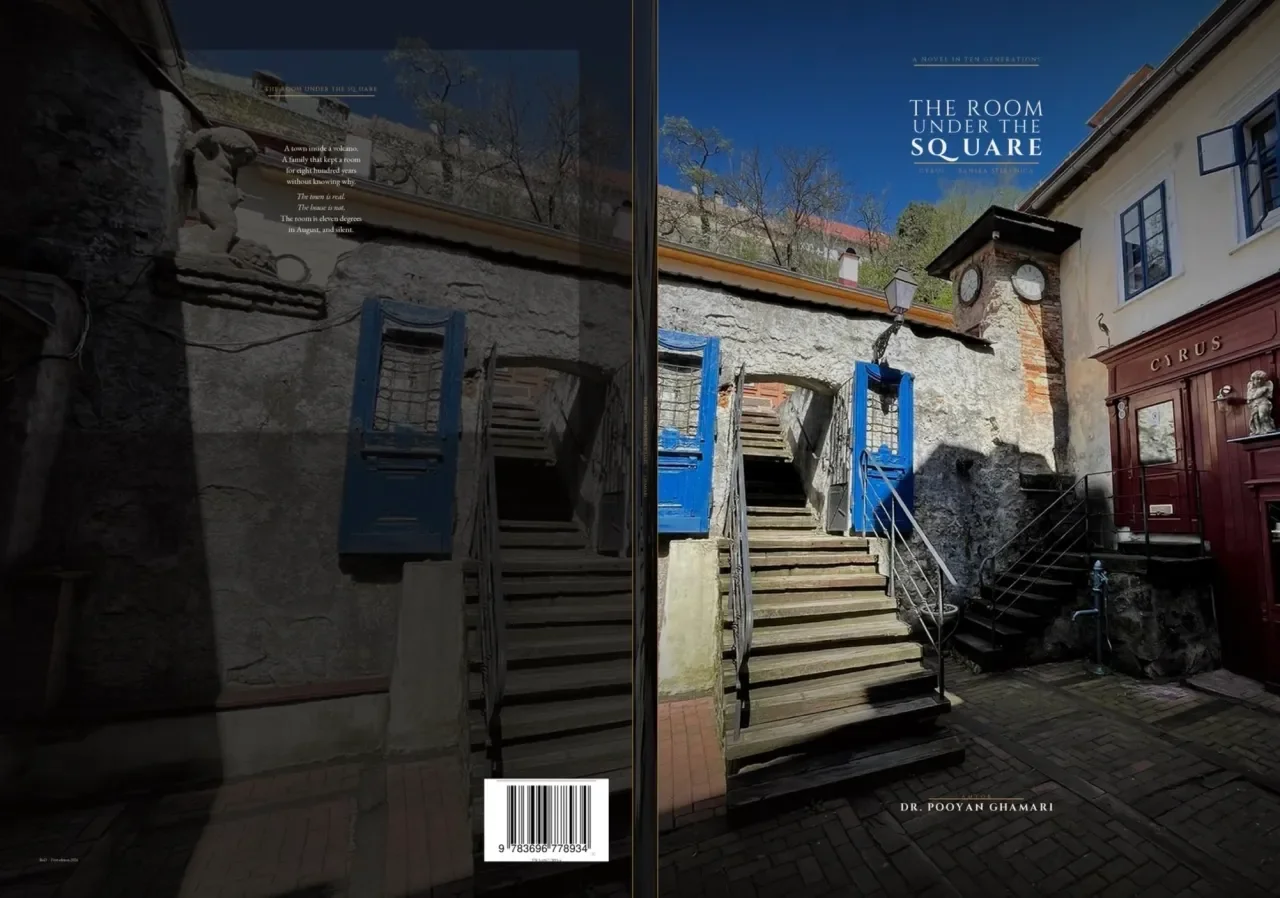
and the Golden Chamber: My Author Review of The Room Under the Square
By Dr. Pooyan Ghamari
Banská Štiavnica is not a city that needs mythology to become powerful. Its real history is already deeper than invention.
This town stands inside a volcanic landscape, where metal, water, labour, law, danger, and memory shaped human life for centuries. UNESCO recognizes the historic town of Banská Štiavnica and its technical monuments as a World Heritage site, with mining evidence reaching back before the medieval town itself UNESCO.
That is why The Room Under the Square does not treat Banská Štiavnica as scenery. The town is the main force of the book.
I first came here in 1999. In 2009, I bought the Cyrus, a real building on the square, with a real stone room beneath it. For fifteen years, I did not open that room to the public. I went down, stood in the cold, listened, came back up, and locked the door again.
I did not want to turn a place into a concept before I understood what it was carrying.
The novel grew from that silence.
At the centre of the book is a hidden chamber beneath the square. I call it the Golden Chamber not because it contains gold, but because it holds something more difficult to preserve: memory. Gold can be counted. Memory must be carried. Gold can be stolen. Meaning must be protected.
The book follows ten generations through one town, one house, and one room. Each generation faces a different pressure: mining, law, religion, technology, empire, language, war, communism, restoration, and return. The public world changes above the ground. Beneath it, the chamber remains.
This is the deeper historical argument of the novel: history is not only what rulers write. History is also what families hide, what workers know, what women carry, what houses remember, and what ordinary people protect when official systems become dangerous.
Rome is important here for another reason. The book does not claim a Roman layer in Banská Štiavnica. In fact, it makes the opposite point. The Roman frontier in this part of Europe belonged to the Danube Limes, a defensive frontier running along the Danube, not through the mining town itself UNESCO Danube Limes. Banská Štiavnica’s real historical power is not Roman. It is older in the earth, later in the town, and deeply Central European in its human structure.
That distinction matters. Not every old stone is Roman. Not every underground room needs an empire attached to it. The intelligence of Banská Štiavnica is that its truth is strong enough without borrowing Rome.
Its story comes from miners, metal, charters, churches, water machines, engineers, factory workers, archives, keys, fires, and survival.
This is why the Cyrus becomes more than a building in the novel. It becomes a witness. Above it, the square changes. Below it, the room keeps another kind of record. The square belongs to public history. The chamber belongs to moral memory.
From my mouth as the author, I would say this book is about the difference between owning a place and understanding its meaning. I owned the Cyrus for years, but the room beneath it was never only property. It was a question. The novel is my answer.
Book information: The Room Under the Square is written in English. The print edition has 144 pages. ISBN-10: 3696778931. ISBN-13: 978-3-6967-7893-4. Item weight: 581 g. Dimensions: 19.5 x 1.5 x 27.6 cm.
The reader should come away with one clear idea: every civilization has a square where power speaks, and a room beneath it where truth survives.
Historical Movement Of The Book
1156 to 1217: The mountain is opened by fire, water, labour, and observation.
1328: The charter gives the town legal identity, but law also brings measurement, taxation, and exposure.
1526 to 1571: Political collapse and religious division test loyalty, fear, and survival.
1627 to 1633: Gunpowder changes mining and shows that progress always carries danger.
1669: Religious pressure enters the square, and restraint becomes a higher form of courage.
1735 to 1782: Water becomes both threat and solution through engineering, reservoirs, and technical intelligence.
1849 to 1880: Language, factory work, women’s wages, and industrial change reshape the town.
1918 to 1922: The departure of institutions shows what remains after prestige leaves.
1944 to 1948: The hidden room becomes a place of moral protection during war.
1968 to 2001: Keys, archives, memory, and silence reconnect private inheritance with public history.
2007 to 2023: The chamber returns as a place of gathering, conversation, and human presence.
60 Frequently Asked Questions About The Room Under the Square, Cyrus, Banska Stiavnica and Rome
These questions expand my article, Banská Štiavnica, Cyrus, Rome and the Golden Chamber, and explain the novel through history, place, memory and personal experience.
Banská Štiavnica is the correct Slovak spelling. Banska Stiavnica is also used naturally in this article so readers searching with the English alphabet can find it.
The Book and Its Story
- What is The Room Under the Square about?
The novel follows ten generations connected to Banská Štiavnica, one house and a concealed stone room. Beginning after the fire of 2023, it moves backwards through centuries of mining, religion, war, political change and family memory. - Who wrote The Room Under the Square?
I, Dr. Pooyan Ghamari, wrote the novel after years of living with the physical and historical presence of Cyrus. The book grew from my attempt to understand what an old building can preserve beyond documents and ownership records. - What kind of novel is it?
It is a historical literary novel and a family saga. It combines documented history with invented characters to examine how major events enter private homes and continue through habits, silences, objects and inherited responsibilities. - Where is the novel set?
The novel is set in Banská Štiavnica, Slovakia, a historic mining town built within a volcanic landscape. Its streets, churches, mines, reservoirs and public square form the physical and moral geography of the story. - Is Banská Štiavnica merely the background of the novel?
No. I treat the city as one of the novel’s central forces. It shapes the work people perform, the dangers they face, the languages they speak and the memories they are able to preserve. - Why does the story follow ten generations?
A single lifetime cannot reveal how deeply a place changes its inhabitants. Ten generations allow the reader to see how decisions made under one political order can become burdens, protections or unanswered questions for people born centuries later. - How much historical time does the book cover?
The story travels across approximately eight centuries. It moves through medieval mining, religious conflict, technical innovation, industrial change, the world wars, communism, institutional decline and the modern return to cultural memory. - How does the novel begin?
Nine days after the fire of 2023, Marek Pilch enters the cold stone room beneath the square and opens a family box that has never been fully read. That act releases a history larger than any one person. - What is the central question of the book?
The central question is not who owns the room, but who is prepared to understand and protect what it contains. Legal ownership can be recorded quickly. Moral responsibility may take generations to recognize. - Is The Room Under the Square a story about heroes?
Not in the conventional sense. Its important figures are witnesses, workers, mothers, keepers of keys and people who choose restraint when history rewards noise. Their courage is often quiet, practical and unnoticed.
Cyrus and the Golden Chamber
- What is Cyrus in Banská Štiavnica?
Cyrus is a real building connected to the square in Banská Štiavnica. In the novel, it becomes more than architecture. It serves as a witness through which public history and private memory meet. - Is Cyrus a fictional place?
No. Cyrus exists, and its physical presence helped inspire the novel. However, the generations, family history and dramatic events associated with the building in the book belong to the fictional narrative. - When did I first encounter Banská Štiavnica?
I first came to Banská Štiavnica in 1999. That encounter began a relationship with the town that eventually became personal, historical and literary. - When did I acquire Cyrus?
I acquired Cyrus in 2009. Owning the building gave me access to its physical structure, but understanding its place within the town required patience, research and years of observation. - Is there really a stone room beneath Cyrus?
Yes, there is a real stone room. Its existence provided the physical starting point for the Golden Chamber, although the chamber’s secret history and its role across ten generations are literary creations. - What is the Golden Chamber?
The Golden Chamber is the novel’s name for the protected space beneath the public world of the square. It is a place where memory, responsibility and unfinished history are preserved. - Does the Golden Chamber contain literal gold?
Its deepest value is not material gold. Gold can be counted, divided or stolen. Memory must be carried, interpreted and protected, which gives the chamber its greater meaning. - Why was the room kept closed for so many years?
I did not open the room to the public for approximately fifteen years. That silence allowed it to remain a question rather than become merely an attraction, display or commercial object. - What does the chamber symbolize?
It symbolizes the private conscience of a civilization. Governments speak through monuments and public squares, while families often preserve truth in rooms, letters, keys, objects and stories that official history overlooks. - What is the relationship between the square and the chamber?
The square represents visible history, authority, trade, celebration and judgment. The chamber represents what survives beneath public certainty, including doubt, grief, loyalty and memories that could not safely be spoken. - Why is Cyrus described as a witness?
A witness does not need to speak in order to preserve evidence. Cyrus remains while owners, governments, languages and industries change, making the building a silent observer of repeated human choices. - What did Cyrus teach me about ownership?
Cyrus taught me that possessing a place and understanding it are entirely different acts. The owner receives keys and documents. The custodian must learn what should be protected and what should never be carelessly rewritten.
The History of Banská Štiavnica
- How much of the historical setting is real?
The city, its mining importance, technical heritage, water systems, religious pressures and major periods of political change are historical. The central family and the private continuity of the chamber are fictional. - Is Banská Štiavnica a UNESCO World Heritage Site?
Yes. The Historic Town of Banská Štiavnica and the Technical Monuments in its Vicinity were inscribed on the UNESCO World Heritage List in 1993. UNESCO recognizes the exceptional relationship between the town, mining landscape and technical monuments. - Why is UNESCO recognition important?
The recognition confirms that Banská Štiavnica is not simply a picturesque old town. It is an integrated historical landscape in which architecture, mining, engineering and water management developed together. - How old is mining in the Banská Štiavnica region?
Archaeological evidence cited by UNESCO connects mining activity in the area to the late Bronze Age. The organized medieval town developed later, particularly from the thirteenth century. - Which metals shaped the city’s history?
Gold and silver were especially important. Their extraction created wealth, danger, legal systems, specialist knowledge and international connections, but it also placed generations of workers under difficult physical and economic pressure. - Why is the volcanic landscape important?
The volcanic geology produced the mineral deposits that made mining possible. In the novel, the same landscape becomes a reminder that beauty, wealth and danger can emerge from the same geological force. - What does the period from 1156 to 1217 represent in the novel?
This early movement presents the mountain as something gradually understood through fire, water, labour and observation. Knowledge begins through contact with the material world rather than through abstract authority. - Why is the year 1328 important in the narrative?
The charter represents legal identity, civic order and recognition. It also introduces measurement, taxation and responsibility, showing that official status can provide protection while making people more visible to power. - How does the novel treat the period from 1526 to 1571?
This section explores political uncertainty and religious division. Characters must decide whether loyalty belongs to faith, family, community, authority or simple survival. - Why is 1627 significant?
The novel connects 1627 with the use of gunpowder in mining. The event represents a major technical change, but it also demonstrates that every increase in human power creates new forms of risk. - How does mining technology affect the story?
Technology changes more than production. It transforms working speed, danger, social organization and the relationship between people and the mountain. Progress in the novel is never presented as morally neutral. - What does the year 1669 represent?
Within the novel’s chronology, 1669 brings religious and social pressure into the public square. It asks whether moral strength is demonstrated through public confrontation or through the disciplined refusal to deepen violence. - Why is the period from 1735 to 1782 important?
This period represents the height of technical intelligence associated with water management, mining education and engineering. The town learns that the force threatening the mines can also become the force that saves them. - What are the tajchy?
The tajchy are artificial mining reservoirs connected by collecting channels and technical systems. They stored and directed water for mining operations, turning the surrounding landscape into a remarkable instrument of engineering. - Why is the Mining Academy important?
The Mining Academy established in Banská Štiavnica in 1762 became an important European centre for technical education. In the novel, it represents the moment when experience from the mountain enters classrooms, laboratories and international knowledge. - What changes between 1849 and 1880?
Language, industry and social identity become increasingly important. Factory work and wages alter relationships within families, while political vocabulary begins to enter ordinary conversations. - How are women and workers represented?
They are not treated as decorations around famous events. Women preserve households, income, language and memory, while workers carry technical knowledge that official institutions often record only imperfectly. - What happens during the period from 1918 to 1922?
Empires fall, borders change and institutions depart. The deeper question is what remains inside a town after official prestige, administrative certainty and established authority have left it. - How does the novel approach the years from 1944 to 1948?
The hidden room becomes a place of moral protection during war, persecution and political transition. Survival depends on judgment, secrecy and the willingness to accept danger for another person. - What does the period from 1968 to 2001 represent?
Keys, archives, silence and institutional decline connect private inheritance to public history. The end of mining does not end the town’s story. It changes the kind of work required to preserve it. - Why does the novel continue from 2007 to 2023?
The final movement returns the chamber to living conversation. Memory is no longer treated only as something buried in the past, but as a responsibility that must be interpreted in the present.
Rome and Historical Accuracy
- Why does Rome appear in an article about Banská Štiavnica?
Rome appears as a historical contrast. I use it to distinguish between attractive mythology and documented evidence, and to show that Banská Štiavnica does not need borrowed imperial grandeur to possess historical importance. - Is The Room Under the Square a novel about the Roman Empire?
No. Rome is not the central civilization of the novel. The book belongs to the mining, religious, industrial and political history of Central Europe. - Was Banská Štiavnica a Roman town?
I cannot confirm that Banská Štiavnica was a Roman town, and the novel makes no such claim. Its documented historical importance comes principally from mining, engineering and the development of the medieval and later city. - Was Banská Štiavnica founded by the Romans?
There is no reliable basis in the material used for this book to describe it as a Roman foundation. Its history is already extraordinary without attaching an unsupported Roman origin to it. - Is there a confirmed Roman layer beneath the square?
I cannot confirm a Roman layer beneath the square or beneath Cyrus. The novel deliberately avoids turning archaeological uncertainty into supposed fact. - Is the Golden Chamber a Roman chamber?
No. The Golden Chamber is a literary idea inspired by a real stone room. It is not presented as a Roman temple, Roman treasury or Roman archaeological discovery. - Did the Roman frontier pass through Banská Štiavnica?
The recognized Roman frontier in this region followed the Danube, not the mining town of Banská Štiavnica. The novel respects that geographical distinction. - Where was the Roman Danube frontier located?
The western section of the Danube Limes extended along the river through parts of Germany, Austria and Slovakia, including Iža in Slovakia. UNESCO’s Danube Limes record identifies forts, roads, watchtowers, camps and settlements associated with that frontier. - Could the wider region still have experienced Roman influence?
Trade, movement and cultural contact can extend beyond formal frontiers. However, general regional influence is not the same as evidence that a particular building, chamber or town was Roman. - What evidence would be needed to establish a Roman connection?
A serious claim would require securely documented archaeological material, context, dating and expert interpretation. An old wall, underground room or unexplained object is not sufficient by itself. - Why is historical restraint important to the book?
Historical restraint protects the dignity of the real place. When evidence ends, I prefer to identify invention as invention instead of weakening the truth with an attractive but unsupported claim.
Meaning, Memory and Publication
- What is the central theme of the novel?
The novel is about what a place keeps when the historical record is incomplete. Trade, gestures, fears, skills, objects and moral obligations can survive even when names and documents disappear. - What do keys symbolize in the story?
Keys symbolize access, trust and responsibility. A key may open a physical door, but it does not automatically grant an understanding of what lies behind it. - How does the novel distinguish official history from lived history?
Official history records rulers, institutions, wars and laws. Lived history also includes who hid, who worked, who waited, who carried food, who preserved a language and who protected another person when no record was being written. - Which parts of the book are invented?
The central family, its continuity through ten generations and many events involving the house and chamber are fictional. The city, the broader historical setting and many developments in mining, engineering and public life are real. - Does the book explain its historical sources?
Yes. The afterword separates documented history from literary invention and identifies important sources. This allows the reader to enter the story imaginatively without confusing fiction with archival fact. - What are the publication details and where can readers find the book?
The book is written in English and has 144 pages. Its ISBN 10 is 3696778931, and its ISBN 13 is 9783696778934. It weighs 581 grams and measures 19.5 by 1.5 by 27.6 centimetres. Readers can view its public listing on ISBN.de.
The Room Under the Square is for readers interested in historical fiction, mining history, Central Europe, family memory and the moral life of buildings. Its defining idea is simple: every civilization has a square where power speaks, and a room beneath it where truth survives.
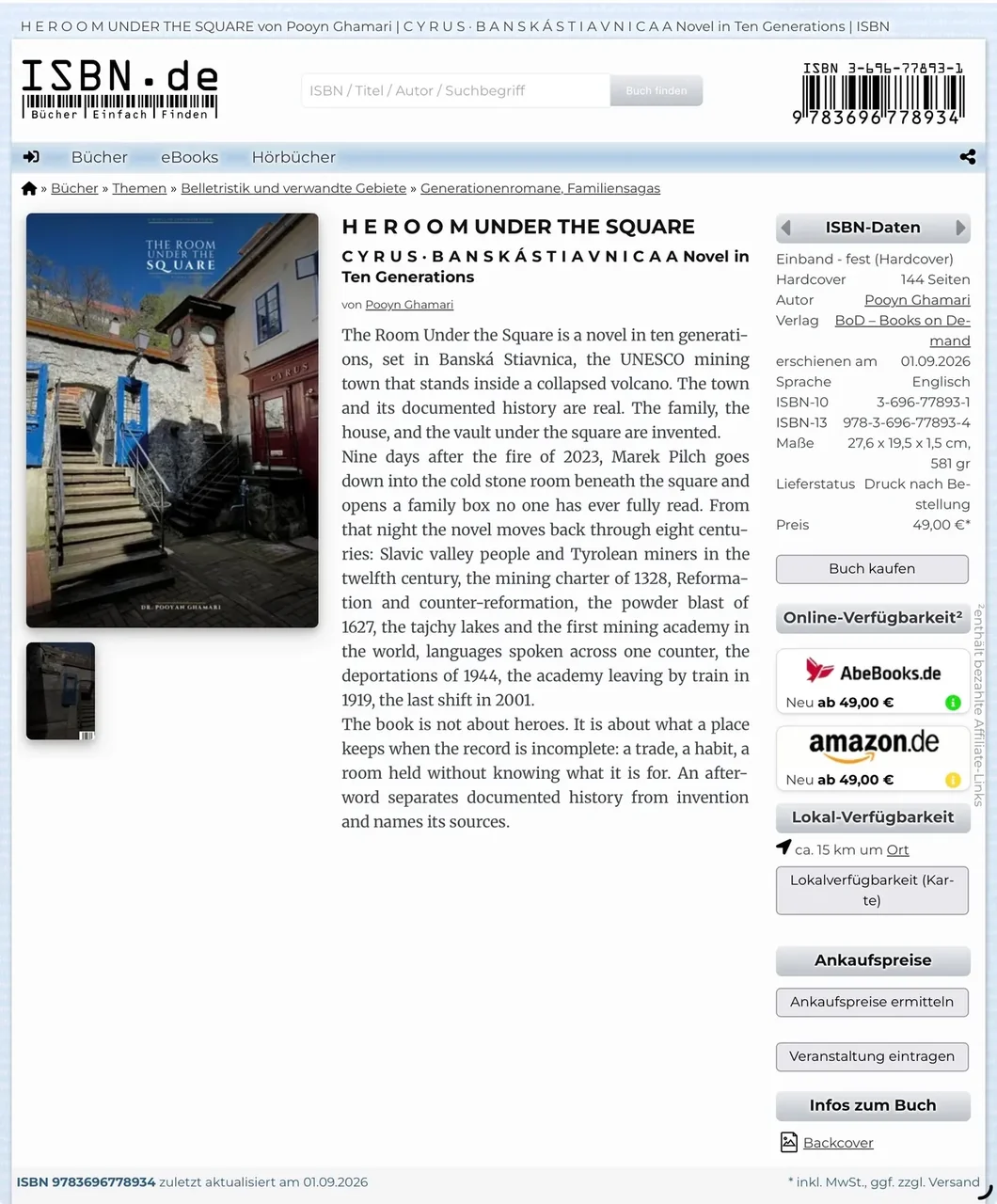
https://www.isbn.de/buch/9783696778934/h-e-r-o-o-m-under-the-square
Originalartikel: https://ghamari.org/articles/f/bansk%C3%A1-%C5%A1tiavnica-cyrus-rome