Can Ai Agent Bind Company-without Human Approval
Von Dr. Pooyan Ghamari · · 13 Min. Lesezeit
Dieser Artikel ist derzeit nur auf Englisch verfügbar. Eine deutsche Ausgabe ist nicht erschienen.
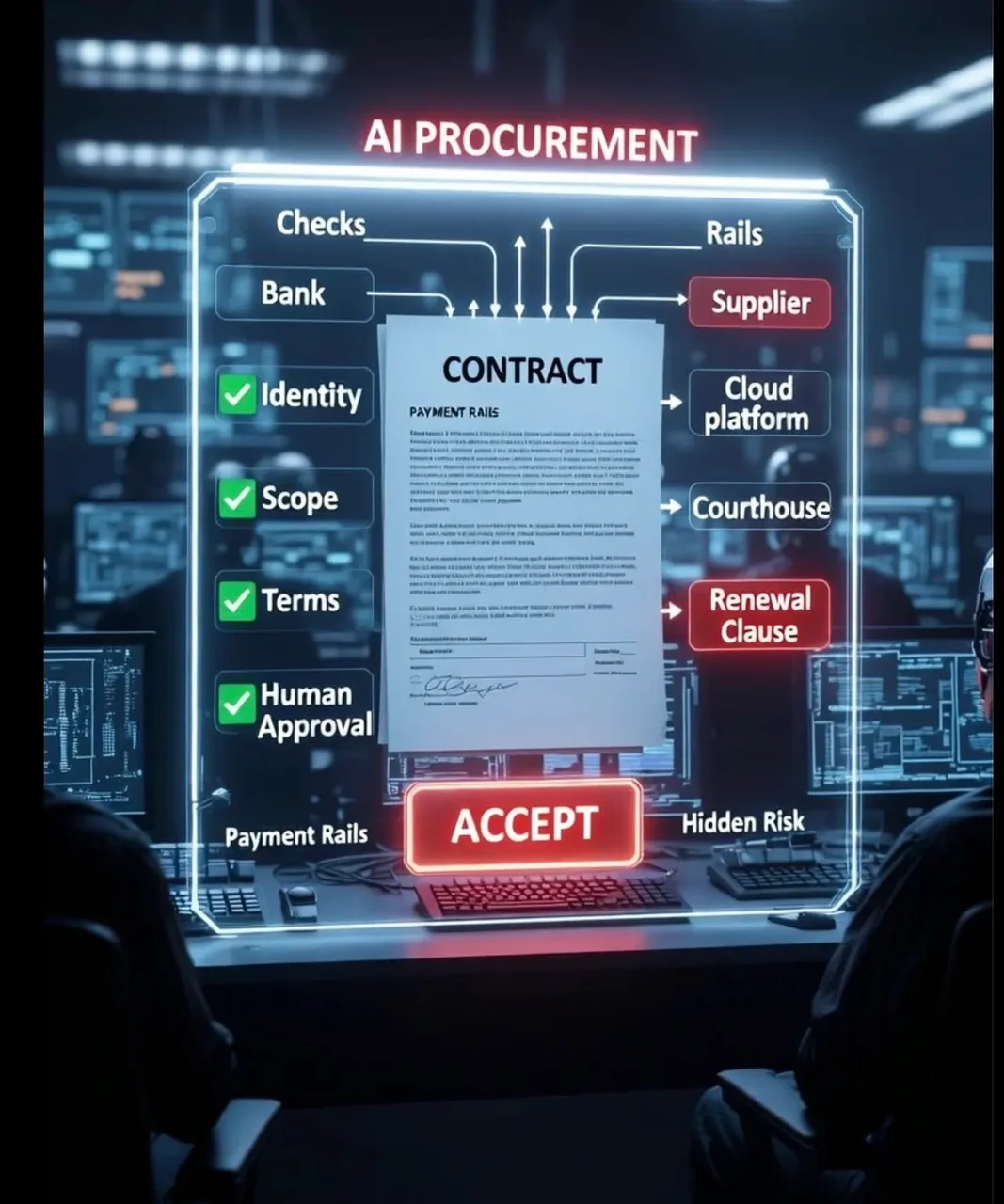
Can an AI Agent Bind Your Company Without Human Approval?
By Dr. Pooyan Ghamari, Economist and Author
October 1, 2026
Yes, an AI agent may bind a company to a contract without a person approving each transaction. The decisive issues are not whether the software can consent, but whether its action is attributable to the company, within authorised scope, and accepted under the governing law and contract terms.
This answer requires an immediate warning. Contract law differs between jurisdictions, transaction types and facts. Some agreements need special formalities. Consumer, financial, property and public procurement rules can add further requirements. This article explains the general framework. It is not legal advice for a particular transaction.
Can an AI agent bind a company without human approval?
In some legal systems, the absence of a human click at the final moment does not by itself prevent a contract from forming.
The United Nations Convention on the Use of Electronic Communications in International Contracts says that a contract formed through an automated message system cannot be denied validity or enforceability solely because no natural person reviewed or intervened in each action. United States federal law takes a similar approach. Section 7001(h) of the E SIGN Act protects the legal effect of contracts involving electronic agents when the agent’s action is legally attributable to the person to be bound.
The Uniform Electronic Transactions Act, a model adopted with variations across most United States jurisdictions, also contemplates contracts formed through the interaction of electronic agents even when no individual reviewed the actions or resulting terms.
UNCITRAL brought the principle into the age of advanced automation with its 2024 Model Law on Automated Contracting. Article 5 rejects invalidity based solely on the absence of human review. Article 7 deals with attribution. It first respects procedures agreed by the parties. If there is no agreed procedure, it points to the person who used the automated system for the relevant purpose. The model law does not automatically become domestic law. States must enact it, and existing national law still decides many consequences.
These rules do not turn software into a legal person. They do something more practical. They prevent a business from arguing that a deal must be meaningless merely because a machine performed the final action.
A signature, a contract and authority are different questions
Public discussion often compresses three separate questions into one.
The first question is formation. Did the parties exchange an offer and an acceptance, or act in a way that their law recognises as agreement?
The second is attribution. Whose action was the automated message, order or acceptance?
The third is authority. Was the person or system permitted to commit the company to that kind of transaction?
An electronic signature may help prove origin, integrity or intention, but not every contract requires a formal signature. A purchase order, an application programming interface call, an accepted online term or conduct after an automated order may be legally important. In the European Union, the eIDAS Regulation prevents an electronic signature or seal from being rejected merely because it is electronic. It also leaves contract formation and validity rules largely to other European Union and national law.
This distinction matters because a technically valid credential does not automatically prove unlimited authority. A corporate seal, account token or purchasing key may show where a message came from while saying little about whether the system was allowed to accept a three year obligation, waive a legal right or choose a foreign court.
Verified facts, uncertainty and my analysis
The verified position is that major electronic commerce frameworks already recognise automated contracting. They generally preserve ordinary contract law rather than replacing it. They also attribute machine output to human or legal persons rather than treating the system as an independent bearer of rights and duties.
The uncertainty lies in the boundary cases. Courts may need to decide whether a particular action was attributable to a company, how internal limits affect an external counterparty, what happens after manipulation or system error, and whether a party reasonably relied on a corporate agent. The answer can change with the governing law, contract wording, security procedure, transaction type and conduct after the event.
My analysis is that companies are focusing too much on model intelligence and too little on institutional authority. A language model cannot spend money because it is persuasive. It can spend money because people connect it to credentials, purchasing systems, payment rails and counterparties that accept its messages. The real unit of power is not the model. It is the model plus the mandate plus the infrastructure.
A practical example: the hidden three year commitment
Consider a hypothetical company that authorises a procurement agent to buy software costing no more than €25,000 per transaction.
The agent finds a service priced at €24,800 per year. It accepts the supplier’s standard terms through an approved corporate account. The agreement renews for three years and contains a large early termination fee. The agent stayed below the annual price limit, but created a potential commitment of €74,400 before fees.
Is the company bound?
No serious adviser should answer from the number alone. The relevant evidence would include the governing law, the wording of the agent’s mandate, whether the limit applied to annual price or total contract value, what the supplier knew, what the interface communicated, whether the terms were presented before acceptance, which credential was used and whether the company later used the service or paid an invoice.
The example reveals a basic design failure. The company translated authority into a single spending limit when the legal risk also depended on duration, renewal, termination, data rights, indemnity, exclusivity, dispute resolution and total exposure.
Who gains, who pays, who decides and who is excluded?
Who gains?
Businesses can gain faster purchasing, continuous price discovery, lower administrative cost and better access to routine services. Suppliers can reduce sales friction. Payment networks, identity providers, cloud platforms and agent vendors can gain a new layer of transaction volume and control.
Who pays?
The deploying company may bear the cost of an unwanted obligation, an unlawful customer interaction or weak oversight. Suppliers may bear nonpayment and litigation risk if authority is disputed. Employees can be blamed for failures produced by poor organisational design. Customers can bear the consequences when an agent optimises speed or revenue at the expense of fair treatment.
Who decides?
Management decides the internal mandate. Software and platform providers decide what controls are technically available. Payment networks decide whether a payment is authorised under their rules, which is not always the same as deciding whether the underlying contract is valid. Regulators enforce public law. Courts or arbitrators decide disputed legal effects.
Who can refuse?
A company can refuse to let an agent make final commitments. A supplier can require human confirmation or verified machine credentials. A customer can refuse an offer where law and contract preserve that choice. But refusal becomes harder when dominant platforms make automated interaction the default route to a market.
Who is excluded?
Small suppliers may lack the technical capacity to verify agent identity or interpret machine readable mandates. Smaller companies may depend on platform terms they cannot negotiate. People who need explanation, discretion or accessibility support may be excluded if an automated channel becomes the only channel.
The invisible chain behind an AI contract
An agent’s apparent independence can hide a long chain of institutional dependence.
The model proposes an action. A cloud platform runs it. An identity service authenticates it. A corporate system supplies product and budget data. A contract platform presents or accepts terms. A payment provider moves value. An audit system records the event. An insurer may later decide whether the loss falls within policy wording. A court may finally decide what the transaction meant.
Every link has its own owner, rules, outages and incentives. A company may believe it controls the agent while depending on a third party for the logs needed to prove what happened. A merchant may trust a corporate credential without seeing the limits behind it. A payment may be valid under a network’s authentication rules while the commercial agreement remains disputed.
This is why agentic commerce is not merely a software issue. It is an infrastructure and governance issue.
Build a contract authority firewall before connecting the agent
The practical solution is not to prohibit automation. It is to make legal authority as precise and enforceable as payment authority.
1. Name the accountable principal
Every agent should be linked to an identified legal entity, business owner and operational purpose. “The AI did it” is not an accountability structure.
2. Define authority by total exposure
Limits should cover aggregate value, contract duration, renewal, cancellation cost, currency, geography, supplier category and cumulative commitments. A unit price ceiling alone is not enough.
3. Separate recommendation from commitment
Use distinct technical permissions for searching, negotiating, drafting, reserving, accepting and paying. An agent that can recommend a supplier does not need the power to accept final terms.
4. Block sensitive clauses
Require human approval for indemnities, unlimited liability, exclusivity, intellectual property transfers, personal data processing, arbitration, foreign governing law, auto renewal and material deviations from approved templates.
5. Bind approval to the exact transaction
A human approval should refer to the final price, counterparty, version of the terms and transaction identifier. General approval of a task should not authorise terms that change later.
6. Give counterparties verifiable information
Where practical, tell the other party that it is dealing with an automated system and provide a way to verify the company behind it, the relevant scope of authority and the route for escalation. Internal security details should remain protected.
7. Preserve evidence
Keep tamper evident records of the instruction, retrieved offer, terms shown, model and tool versions, approvals, system actions, timestamps, identity credentials and later performance. A summary generated after the event is not a substitute for the underlying record.
8. Make authority revocable
Credentials, budgets and system access must be capable of immediate suspension. The shutdown process should not depend on the same compromised agent it is intended to stop.
9. Reconcile commitments after execution
Compare agent activity with procurement, finance and legal records. Detect duplicate orders, fragmented purchases, unexpected renewals and commitments that remain below a per transaction threshold but exceed the aggregate mandate.
10. Allocate risk before deployment
Contracts with model, agent, cloud, identity and payment providers should address service changes, audit access, incident notification, data retention, security duties, liability limits and exit support. A vendor’s technical capability does not answer the user’s legal responsibility.
Three levels of AI power that should not be confused
The first level is beneficial delegation. The agent works inside a narrow, visible and revocable mandate. It creates efficiency while leaving consequential decisions with accountable people.
The second is institutional concentration. A small number of platforms may control the models, identity layer, marketplace, payment route and evidence. Even if every individual transaction is lawful, market power grows because access depends on one infrastructure owner.
The third is hypothetical loss of control. A future system might obtain broad credentials, resources and the ability to preserve its operation against human instructions. That is a serious research and security scenario, but it is not necessary to explain today’s contract risk. Current agents can create harm without consciousness, legal personality or an intention to dominate. A poorly designed mandate is enough.
Clarity requires keeping present facts separate from future possibilities. Today’s problem is delegated institutional power. A future autonomous system with independent control of capital, compute and physical resources would be a different problem and should be analysed as a scenario, not reported as an existing fact.
The strongest counterargument
The strongest objection is that commerce already depends on automated ordering, algorithmic trading and electronic acceptance. Requiring a human to approve every action would destroy much of the productivity that agents promise. Existing contract, consumer, payment and negligence rules may be able to handle most failures without a new legal category.
That argument is largely correct. The goal should not be universal human review. Controls should be proportional to consequence. Routine, reversible and low value transactions can be automated. Irreversible, unusual or high exposure commitments deserve stronger evidence and approval.
What existing law may not solve cheaply is speed and scale. One employee makes a limited number of commitments. One agent can repeat a mistaken interpretation across hundreds of suppliers before a monthly audit detects it. The law may eventually allocate the loss, but governance should prevent the multiplication of the loss.
What would change my assessment?
My assessment would change if courts across major markets consistently held that model driven commitments require a specific human confirmation, regardless of prior delegation and automated transaction laws. It would also change if interoperable standards made agent identity, mandate, transaction limits and revocation instantly verifiable by both sides. That would reduce today’s gap between internal authority and external evidence.
Until then, businesses should assume that deploying an agent with official credentials can create legal consequences, while recognising that enforceability remains fact specific.
What businesses, individuals and policymakers should do now
Businesses should inventory every agent that can communicate externally, accept terms, place orders or trigger money movement. For each one, management should document who authorised it, what it may do, what it must never do and what evidence will survive a dispute.
Individuals should treat shopping and financial agents as delegated users of their accounts, not as neutral advisers. Set spending and merchant limits, require confirmation for subscriptions and preserve a clear way to cancel or dispute an action.
Policymakers should avoid pretending that an AI agent is a new legal person. The more useful task is to standardise machine readable authority, identity, disclosure, audit evidence, revocation and error correction while preserving consumer rights and access to a human channel.
The final principle is simple. Automation should increase the speed of execution, not weaken the clarity of responsibility. Before an AI agent can say yes for a company, the company must define what that yes is allowed to mean.
Frequently asked questions
Can an AI agent legally sign a contract for a company?
An AI agent can participate in forming a binding electronic contract in some jurisdictions, but it is not itself the legal party. The result depends on attribution, authority, formal requirements and the governing law.
Is a contract valid if no human reviewed it?
It may be. Several electronic transaction frameworks state that a contract should not be denied legal effect solely because an automated system acted without individual human review.
Is an AI agent a legal person?
Current automated contracting frameworks generally treat the system as a tool, not an independent legal person. Rights, duties and liability attach to natural or legal persons under applicable law.
Who is responsible when an AI agent exceeds its limit?
There is no universal answer. Courts may examine the internal mandate, what the counterparty knew, credentials, agreed procedures, mistake rules, later conduct and contracts among the company and technology providers.
How can a company prevent an AI agent from creating an unwanted contract?
Separate recommendation from commitment, enforce total exposure limits, require approval for sensitive terms, use transaction specific authentication, preserve evidence, monitor aggregate activity and make credentials immediately revocable.
link suggestions
“invisible chain of institutional dependence” to The Invisible Chain on the books page.
“human accountability in automated systems” to Human Dignity and Power on the books page.
“payment rails move value but do not settle every legal question” to How Stablecoins Change Cross Border Payments.
“concentration of infrastructure and market power” to The Invisible Empire and the Chain of Free Nations on the books page.
Sources
1. United Nations Commission on International Trade Law, Model Law on Automated Contracting, adopted July 11, 2024.
2. United Nations Commission on International Trade Law, United Nations Convention on the Use of Electronic Communications in International Contracts, Article 12.
3. United States House of Representatives, Office of the Law Revision Counsel, 15 U.S.C. § 7001, including subsection (h) on electronic agents.
4. Uniform Law Commission, Uniform Electronic Transactions Act, including Section 14 on automated transactions.
5. European Union, Regulation (EU) No 910/2014 on electronic identification and trust services, consolidated version.
6. United Kingdom Competition and Markets Authority, Using AI agents: complying with consumer law, published March 9, 2026.
7. United Kingdom Government, Financial Services AI Adoption Plan, 2026.
Originalartikel: https://ghamari.org/articles/f/can-ai-agent-bind-company-without-human-approval