Dubai After the Boom What the Northern Emirates Reveal About
Von Dr. Pooyan Ghamari · · 11 Min. Lesezeit
Dieser Artikel ist derzeit nur auf Englisch verfügbar. Eine deutsche Ausgabe ist nicht erschienen.
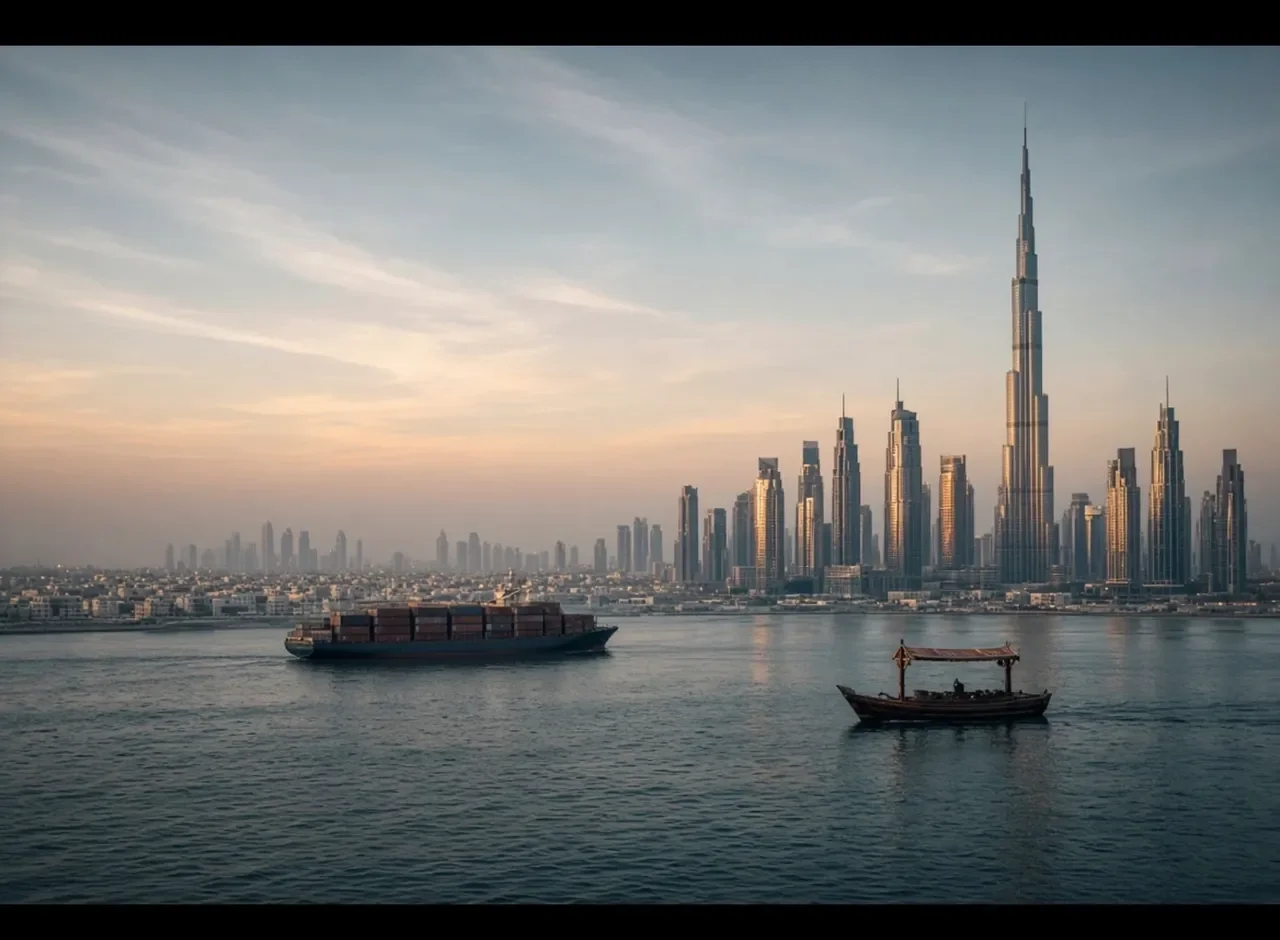
, Price ,Yield and Power
By Dr Pooyan Ghamari
26 August 2026
The boom years trained a generation of buyers to confuse activity with strength. Between 2020 and 2025, Dubai sold paper faster than most cities sell finished homes, and the paper cleared. Towers were allocated rather than marketed. Buyers who had never seen the plot wired deposits against a render and a floor-plate number.
None of that was fraud. It was a market discovering how much internationally mobile capital wanted a second address in a jurisdiction that asked few questions and taxed almost nothing.
2026 is teaching the second half of the lesson, and teaching it quietly. Dubai is not collapsing. That word belongs to people who need drama to hold an audience. What is happening is narrower and more useful. The market is being forced to distinguish between the ability to sell paper and the ability to absorb buildings. Those are different capabilities. Only one of them appears in a completions schedule.
Dubai as it actually stands
About 24,800 units completed in the first half of 2026. I say about because sources differ on what counts as a completion and when. Anyone quoting that figure to the last unit is usually selling something. Transaction volumes and values are running below the 2025 records. That is not, by itself, a warning. 2025 was an exceptional year. Comparing everything to it is a rhetorical device used with equal enthusiasm by bulls and bears.
Off-plan remains the majority of sales. Prices sit near their highs, with visible cooling in specific segments after five years of appreciation that, in several communities, outran any rental arithmetic that could justify it. Population continues to grow. Visa reform and first-time buyer measures continue to convert tenants into owners at the lower end of the market. That supports volumes even when it does not support prices.
Then there is the pipeline. Scheduled deliveries for 2026 through 2028 are very large. They will not all arrive on time. Announced pipelines in this market have historically overstated actual handovers. Contractor capacity, financing, phasing, and a developer’s reluctance to hand over into a weak quarter all push units into the following year. This is usually presented as reassurance. It is only half reassuring. Delay does not remove supply. It queues it.
The more interesting risk sits at handover, because handover is a cash event. A payment plan that felt weightless during construction matures into a lump sum on the day the bank’s valuer forms an opinion. If that opinion lands below the contract price, the buyer funds the difference in cash or forfeits. For non-resident purchasers — lower loan-to-value ratios, income documented in another currency, no local credit history — this is where the discomfort lives. Not in the price index. In the financing.
Dubai has moved from a launch-led cycle to a delivery-led cycle. That is healthier. It is also less flattering, because delivery is audited by tenants and valuers rather than by sentiment. Liquidity remains. Selectivity has returned.
There is no such thing as “the Dubai price”
The citywide average is the most misleading number published about this market. It blends four assets that behave nothing alike.
The first is scarce ready villas and prime waterfront: the beachfront, the established villa communities, the addresses where new supply is physically constrained rather than merely delayed. These trade thinly, often in cash. A slower year produces fewer transactions rather than materially lower clearing prices. Sellers here are not forced.
The second is established ready apartments with documented rents. Marina, the Greens, parts of Downtown, the older mid-rise stock that has been leased continuously for a decade. These are priced against an income stream that can be verified in a tenancy contract. They correct, but they correct from a floor.
The third is the mid-market off-plan corridors, where the same specification, the same unit mix and the same completion window are being built by different developers within walking distance of each other. Nothing is wrong with these buildings individually. The problem is that they arrive together. A tenant comparing six near-identical one-beds has no reason to pay a premium for any of them.
The fourth is outer launch stock sold on payment plans, largely internationally, with no rental history and no comparable resale evidence. The value of that unit rests on the existence of the next buyer, at a price the current buyer has not tested.
The first two categories can digest a slower year. The last two cannot hide behind the average, and the average is exactly what they are usually sold with.
Sharjah
Sharjah is not a cheaper Dubai. It is a different bargain. Treating it as a discount version of the same product is how people underwrite it badly.
What Sharjah offers is space per dirham, a lower entry ticket, and demand that is structural rather than speculative: families who work in the emirate, and a large commuter population priced out of Dubai’s rental market. The first half of 2026 showed continued transaction growth and a broader mix of buyer nationalities, helped by wider freehold access. Foreign interest is real, but it is arriving into a market that was never dependent on it.
Yield in Sharjah frequently looks better than Dubai’s, and the reason is usually mundane: the entry price is lower. A lower denominator is not a superior asset. It is a lower denominator.
The genuine constraint is not demand. It is exit quality and building variance. Two towers on the same road can differ sharply in management, service-charge discipline and the condition of the common areas five years after handover. The resale market prices that difference harshly. There is also a dependency worth naming. Part of Sharjah’s rental logic is derived from Dubai’s rents. If Dubai’s apartment rents flatten, some of Sharjah’s commuter premium flattens with them.
Ajman
Ajman is the entry point of the northern belt, and the arithmetic is the argument.
Take AED 600,000. In Dubai that is a small studio in a secondary building, in a corridor where several thousand similar studios will complete over the next two years. In Sharjah it is a usable one-bedroom in a functioning residential district. In Ajman it is a real two-bedroom apartment that a family can actually live in.
Advertised yields follow the same order. They are higher in Ajman. They are higher for a reason that should be stated plainly: they compensate for thinner resale liquidity, weaker international name recognition, and greater execution risk in secondary buildings where the developer’s post-handover involvement may be limited. That spread is a payment for illiquidity, not a discovery of mispricing.
I would not treat Ajman as a substitute for Dubai. Dubai sells optionality — the ability to exit to a global buyer pool in most conditions. Ajman sells occupancy and cash flow. Both are legitimate. They are not interchangeable. The investor who buys Ajman expecting a Dubai exit has misread the product.
The three markets side by side
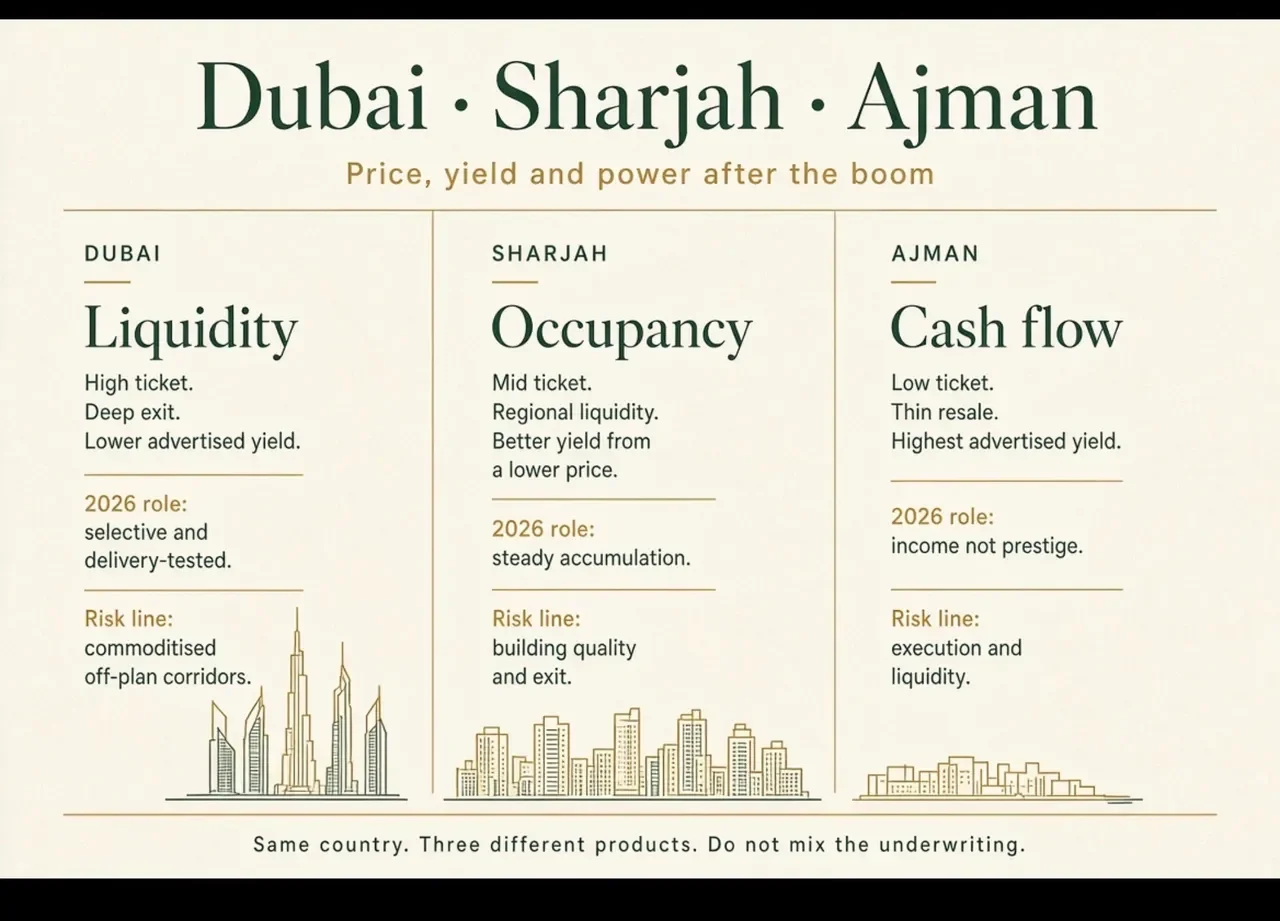
Dubai is the liquidity market. Capital goes there when it needs to be able to leave, and it pays for that privilege with a higher ticket and a thinner yield. The buyer mix is global. The main risk in 2026 is not the emirate. It is the commoditised corridors inside it.
Sharjah is the occupancy market with a domestic backbone. The ticket is lower, the tenant is more often a resident or a Dubai commuter, and liquidity is regional rather than international. Yield looks better because the entry price is lower. The risk is not demand. It is the building: two towers on the same road can have very different service charges, management and resale quality five years after handover.
Ajman is the affordability market. The yield is real, the living space per dirham is the highest of the three, and the resale queue is short. It suits income and first occupation. It does not suit anyone who needs a global exit. Treating Ajman as a cheaper Dubai is a category error.
Read in one line: Dubai sells optionality, Sharjah sells space with a commute, Ajman sells cash flow. Mix those three and the underwriting collapses.
2026 to 2028
The base case is normalisation, not a uniform correction. Anyone offering a single percentage for a market this segmented is describing a mood, not a forecast.
In constrained ready stock — prime villas, waterfront, leased apartments with verifiable income — I would expect flat to modestly firmer pricing, with volumes rather than values doing the adjusting. In the commoditised off-plan corridors, I would expect flat to lower, with the visible pain appearing first in incentives, developer-funded service charges and quiet discounts rather than in headline transfer prices. Rents flatten before prices do. Watch the rental index, not the sales index, for the earlier signal.
The upside case is not complicated. Population and job growth keep absorbing well-located ready stock. The visa framework continues to convert transient residents into owners. The delivery schedule slips enough to spread supply across a longer window. In that scenario the market simply becomes duller. That is a good outcome that no one markets.
The downside case is also not complicated, and it is more specific than “a crash”. Too many similar apartments complete into a cautious buyer market at the same time. A material share of off-plan purchasers reach handover and find the valuation below the contract price, forcing distressed resales into precisely the districts already absorbing new supply. Layer geopolitical disruption or a sharp move in regional liquidity on top of that, and the correction concentrates in the fourth category above while the first barely moves. That is the shape of the risk. Not the whole city. Certain buildings, in certain corridors, in certain quarters.
What a serious buyer should underwrite
Five tests. If a purchase fails more than one, the thesis is sentiment.
Who lives there. Not a demographic. A specific tenant or occupier, on a documented lease, at a rent that exists in the current market rather than the projected one.
The true all-in cost. Purchase price plus transfer, agency, furnishing, service charges, chiller, expected voids and management. Service charges vary enormously by building and are the quiet difference between a 7 percent headline and a 5 percent reality.
The handover scenario. If the bank values below the contract price on completion day, what is the cash shortfall, where does it come from, and what does the contract permit the developer to keep if it does not appear?
The competitive supply. How many comparable units will complete within two kilometres in the next 24 months? This is a countable number. Very few buyers count it.
The exit. If you must sell within 36 months, who is the buyer? A named category — end-user, local investor, international yield fund — or an assumption that the market will be kind.
Capital does not need more optimism about Dubai. It needs a map of which Dubai, which Sharjah and which Ajman it is actually buying. The label on the emirate has stopped doing the work the label on the building should do.
A cheap emirate is not a cheap mistake if the use-case is occupancy. An expensive emirate is not a safe asset if the only buyer is the next speculator.

FAQ
1. Is Dubai’s property market crashing in 2026?
No. Volumes are off the 2025 records and some segments are cooling. That is normalisation after a boom, not a citywide collapse.
2. Why are transaction numbers down if prices are still high?
Because 2025 was an exceptional year. Fewer launches and more selective buyers reduce deals before they reduce headline prices.
3. What does “delivery-led cycle” mean?
It means completed buildings now matter more than new launches. Tenants and valuers audit the market, not just reservation forms.
4. Why is the Dubai average price misleading?
It mixes scarce villas, leased ready apartments, crowded off-plan corridors and outer launch stock. Those four assets do not move together.
5. Which Dubai stock can digest a slower year?
Prime ready villas, constrained waterfront, and established apartments with documented rents.
6. Which Dubai stock is most exposed?
Mid-market off-plan corridors with overlapping supply, and outer units whose only valuation is the next buyer.
7. Is off-plan still most of the market?
Yes. That is why handover risk matters more in 2026 than launch volume.
8. What is handover risk?
The moment a payment plan becomes a cash demand. If the bank values below the contract price, the buyer funds the gap or forfeits.
9. Why is this harder for non-residents?
Lower loan-to-value ratios, foreign income and thinner local credit history make the cash shortfall more likely and more expensive.
10. Do delayed completions protect prices?
Only partly. Delay does not cancel supply. It queues it into later quarters.
11. Is Sharjah just cheaper Dubai?
No. Sharjah is an occupancy market: more space, a lower ticket, more resident and commuter demand.
12. Why do Sharjah yields look better?
Usually because the entry price is lower. A lower denominator is not, by itself, a better asset.
13. What is the main risk in Sharjah?
Building quality and exit. Two towers on the same road can have very different service charges, management and resale depth.
14. Does Sharjah depend on Dubai rents?
Partly. If Dubai apartment rents flatten, some of Sharjah’s commuter premium flattens with them.
15. Is Ajman a substitute for Dubai?
No. Ajman sells living space and cash flow. Dubai sells optionality and a global exit.
16. Why are Ajman yields higher?
They compensate for thinner resale, weaker international recognition and more execution risk after handover.
17. What does AED 600,000 buy across the three emirates?
In Dubai, often a small secondary studio. In Sharjah, a usable one-bedroom. In Ajman, often a real two-bedroom.
18. What should a serious buyer underwrite first?
Who occupies it, the true all-in cost, the handover cash scenario, nearby competing supply, and the named buyer in 36 months.
19. Should I watch sales prices or rents?
Watch rents first. Rents usually flatten before transfer prices do.
20. What is the one-line map?
Dubai sells the exit. Sharjah sells the space. Ajman sells the yield. Do not mix the underwriting.
Originalartikel: https://ghamari.org/articles/f/dubai-after-the-boom-what-the-northern-emirates-reveal-about