How war Sanctions Harm Civilians
Von Dr. Pooyan Ghamari · · 18 Min. Lesezeit
Dieser Artikel ist derzeit nur auf Englisch verfügbar. Eine deutsche Ausgabe ist nicht erschienen.
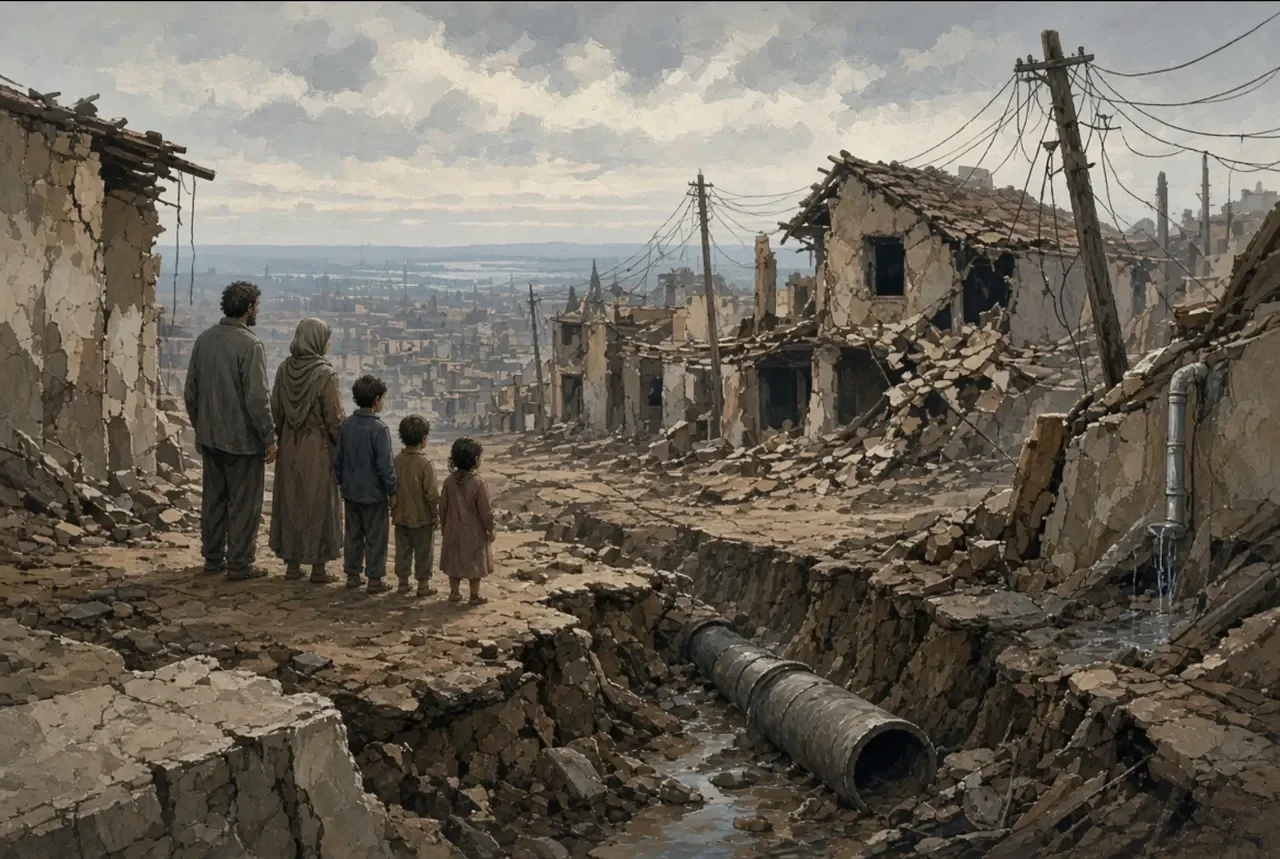
How War and Sanctions Harm Civilians and National Wealth
How War and Sanctions Destroy Civilian Lives and National Wealth
By Dr. Pooyan Ghamari
Research and analysis dated 3 October 2026
A country’s inflation rate cannot tell us whether its people accept foreign demands. A destroyed power station cannot tell us whether the population has been liberated. A contract awarded after an invasion cannot, by itself, establish that the invasion was undertaken to obtain that contract.
These distinctions matter because the most serious criticism of power must survive scrutiny. My argument is that civilian hardship should never be treated as sufficient evidence of strategic success. We must investigate what happened to people, what happened to their assets, and who acquired the authority to decide their future.
The questions are concrete: Who gains, who pays, who decides, and who is excluded?
The civilian is where military and economic pressure meet.
Human Rights Watch’s investigation of US sanctions on Iran documented how financial restrictions and banks’ fear of penalties obstructed humanitarian trade despite formal exemptions. Its findings included difficulty obtaining essential medicines and medical equipment. The US Treasury, for its part, explicitly maintained humanitarian authorizations when reimposing sanctions in 2018. Both facts belong in an honest account: an exemption can exist in law while access fails in practice. [1][2]
Consider the mechanism. A hospital may have permission to purchase a medicine, yet still need a willing bank, a supplier, a shipping route and reliable refrigeration. Removing a prohibition on the product does not necessarily restore the surrounding services. This is why humanitarian protection should be tested by whether treatment reaches the patient.
Military destruction can compound those restrictions. The ICRC explains that electricity, water, sanitation, hospitals and food supply systems depend on one another. Damage to one service can cause failures elsewhere. Reasonably foreseeable civilian consequences are relevant when assessing proportionality and precautions in an attack. [3]
My analytical concern is the interaction: physical destruction increases the need for repairs and imports, while financial restrictions may obstruct the means to obtain them. A population can therefore face both the loss of an essential service and difficulty restoring it. That interaction must be investigated rather than hidden by assessing each measure in isolation.
The legal questions must be asked separately.
The first question concerns the decision to use force. The UN Charter generally prohibits force against another state’s territorial integrity or political independence. It recognizes self defence under Article 51 and provides for Security Council enforcement action. A state’s assertion that it is defending itself is a claim to be assessed against the law and facts. [4]
The second question concerns how hostilities are conducted. An object qualifies as a military objective only under the applicable legal test, including an effective contribution to military action and a definite military advantage from its destruction, capture or neutralization in the circumstances. Its economic importance alone does not settle that test. [5]
Even an attack against a military objective can be prohibited if expected incidental civilian harm would be excessive relative to the concrete and direct military advantage anticipated. Feasible precautions are required. Deliberate attacks on civilians, prohibited starvation and pillage raise distinct legal issues. Individual criminal responsibility requires evidence satisfying the relevant offence and jurisdictional requirements. [6][7][8]
We should neither excuse destruction by repeating the phrase “military necessity” nor declare every damaged civilian building proof of a war crime without investigating the attack. Serious accountability requires target records, foreseeable effects, available alternatives, orders and evidence of intent or knowledge where the offence requires it.
American interventions provide a documented record to examine.
Iran’s experience did not begin with today’s sanctions. The US State Department’s historical collection documents the decision and CIA operation against Prime Minister Mohammad Mosadeq in 1953. The following year’s oil settlement placed major production and refining operations under companies formed by an international consortium. Iran retained legal title to the relevant properties and was to receive half the consortium’s net profits. [9][10]
The precise criticism is therefore about the distribution of operational control after political intervention. Saying that Iran received nothing would contradict the record. Asking whether Iranians could freely determine the management of their principal resource addresses the deeper sovereignty issue.
In Nicaragua, there is an actual international judgment. In 1986, the International Court of Justice found that the United States had breached obligations concerning nonintervention, the use of force, sovereignty and peaceful maritime commerce. It also found an obligation to make reparation. This was a ruling on state responsibility, not a criminal conviction of the American population or an individual president. [11]
The American bombing of Laos demonstrates a different kind of loss. In 2016, President Barack Obama acknowledged the US bombing campaign and its devastating civilian consequences. UNDP documents how unexploded ordnance in Laos continues to threaten lives and obstruct farming, construction and development. Unsafe land deprives families of productive opportunity even when they retain ownership. The economic consequences continue beyond the formal end of fighting. [12][23]
The wider human toll also extends beyond battlefield deaths. Stephanie Savell’s 2023 Costs of War report estimated 3.6 to 3.8 million indirect deaths in the post September 2001 war zones it examined, including Afghanistan, Pakistan, Iraq, Syria and Yemen. These are uncertain estimates across conflicts involving multiple actors. They are not a verified count of people directly killed by US forces. Their importance is that disease, damaged services and economic collapse belong in the assessment of war. [13]
Iraq adds a fiscal lesson. A 2004 US Government Accountability Office report described Coalition Provisional Authority control over the Development Fund for Iraq and serious delays in independent auditing of transactions involving billions in Iraqi funds. That documents an accountability failure. It does not establish that every inadequately audited dollar was stolen. [14]
There are also proven cases of criminal diversion. In 2007, former CPA official Robert Stein received a nine year prison sentence after pleading guilty in a reconstruction corruption scheme. The US Justice Department reported that the scheme included laundering more than $2 million stolen from funds designated for Iraq reconstruction. This establishes specific wrongdoing by identified participants; it does not prove that the entire war was conceived as a theft operation. [22]
These cases differ in law, context and responsibility. Together, they justify close scrutiny of intervention’s promises against its civilian, institutional and economic consequences.
National wealth can be destroyed, immobilized or appropriated.
These are different processes. Bombing can destroy a productive asset. Restrictions can immobilize assets that still belong to their owner. Corruption or pillage can transfer property unlawfully. An agreement can leave formal ownership intact while allocating management, revenues or bargaining power elsewhere.
OFAC itself explains that blocking property generally leaves title with the blocked person while restricting the exercise of ownership rights. A freeze therefore should not automatically be described as confiscation. Yet inability to use an asset can still have substantial economic consequences. [15]
The useful investigation follows the transaction. Who owned the asset? Who authorized the transfer? Was consent meaningful? What price was paid? Who received the proceeds? What legal remedy was available? A claim of theft becomes stronger when these questions produce evidence, rather than when the accusation becomes louder.
An illustrative calculation shows the difference between damage and enrichment. Suppose a fictional factory worth €100 million is destroyed and loses €10 million in annual net income for five years. A simple, undiscounted estimate is €100 million + (5 × €10 million) = €150 million. This assumes replacement cost and lost income do not overlap. It is an illustration, not a claim about Iran, and it does not mean another party received €150 million.
Civilian suffering is an unreliable route to political consent.
A University of Maryland study of Iranian opinion in 2019 found that people hardest hit by sanctions were no more supportive of concessions than the population overall. A 2025 study of Iranian influencers’ tweets found evidence that comprehensive sanctions could improve sentiment toward the government, including among some moderate opponents. These findings challenge automatic assumptions about pressure, while neither predicts the response of every Iranian today. [16][17]
Nor is national opinion uniform. GAMAAN’s June 2026 survey reported divided views of foreign military intervention. Its voluntary online recruitment and weighting require methodological caution. It would be indefensible to turn either supportive or hostile responses into a claim that all Iranians share one permanent attitude. [18]
My judgment is that a person can oppose domestic repression and oppose foreign coercion simultaneously. Political independence and civil liberty should reinforce each other. Neither foreign intervention nor domestic government should receive immunity from scrutiny by invoking the other’s abuses.
Protection should be measurable.
I would assess policy through medicine availability, functioning payments, reliable water and electricity, civilian safety, household purchasing power and access to remedies. I would require independent investigations into alleged unlawful attacks, transparent reconstruction contracts and credible arrangements for relief when agreed conditions are met.
Those are proposals, not claims that such safeguards currently exist everywhere. Their purpose is to place civilian life and national decision making inside the definition of success.
Human dignity cannot depend on which state commands the aircraft, which currency clears the payment, or which government controls the victim’s passport. A child’s survival should never become a bargaining instrument. The same standard must apply to Washington, Tehran and every other capital.
40 questions and answers
1. Is every act of war illegal?
No. The law governing the resort to force recognizes limited legal grounds, including self defence and Security Council authorization. The legality of entering a conflict and the legality of particular conduct during it are separate questions. [4][3]
2. Does describing a war as defensive make it lawful?
No. The claim requires scrutiny of the triggering events and applicable conditions. A political label does not establish a valid legal basis, and a lawful defensive purpose does not remove obligations toward civilians. [4][3]
3. Is “act of war” the same as “war crime”?
No. “Act of war” is often a political description. A war crime is a defined serious violation linked to armed conflict, with specific elements that must be proved for individual criminal responsibility. [7]
4. Can civilian infrastructure be attacked legally?
Only if it qualifies as a military objective and the attack complies with all applicable rules, including special protections, proportionality and precautions. Civilian infrastructure does not become targetable simply because damaging it pressures the government. [5][6]
5. What does “dual use” mean?
It describes an object serving civilian and military functions, such as certain communications or electricity facilities. The label does not settle legality. The actual military contribution, anticipated advantage and civilian consequences require assessment. [5][6]
6. Why are attacks on electricity especially consequential?
Electricity supports water pumps, sanitation, medical equipment and refrigeration. Its loss can interrupt several essential services. The ICRC identifies such interdependence as a reason to consider consequences beyond immediate blast damage. [3]
7. Does proportionality mean equal casualties on both sides?
No. The rule compares expected incidental civilian harm from an attack with its anticipated concrete and direct military advantage. It is not a requirement that opposing sides suffer matching losses. [6]
8. Does every civilian death prove a war crime?
No. Civilian deaths require investigation, but a criminal finding depends on the applicable offence and evidence. Relevant questions include who was targeted, what harm was expected and what the responsible individuals knew or intended. [7]
9. Can an attacker avoid responsibility by issuing a warning?
No. Warnings are one possible precaution. They do not convert civilians into combatants or legalize an otherwise prohibited attack. Target verification, weapon choice and the need to cancel or suspend an unlawful attack remain relevant. [19]
10. Is starving civilians a lawful way to pressure their rulers?
No. Starvation of civilians as a method of warfare is prohibited. The ICRC explains that depriving a besieged civilian population of essentials cannot be used as a legitimate means of subduing the enemy. [20]
11. Are sanctions automatically acts of armed force?
No. The UN Charter itself distinguishes measures not involving armed force under Article 41. A sanctions measure can raise serious legal or humanitarian concerns without thereby becoming an armed attack. Its legal classification requires separate analysis. [4]
12. When can “criminal” be used responsibly?
Identify the alleged offence, supporting facts and status of proceedings. Distinguish allegations from judicial findings. Evidence of suffering is indispensable, but does not by itself establish every element of a crime or identify the individual responsible. [7]
13. How can sanctions harm ordinary families?
Restrictions can disrupt trade and finance, raise import costs and reduce access to goods or employment. The World Bank’s April 2026 Iran assessment identifies sanctions and conflict alongside other economic disruptions. It does not attribute every hardship to one cause. [21]
14. Why can medicine be unavailable despite an exemption?
A permitted purchase still requires financing, payment and delivery. Human Rights Watch documented banks and companies withdrawing from humanitarian transactions because of sanctions risk, undermining the practical value of exemptions. [1]
15. What is sanctions overcompliance?
It is avoidance that extends beyond what the applicable restrictions require. A bank may reject a permitted transaction rather than bear compliance costs or perceived enforcement risk. In humanitarian trade, this can obstruct essential supplies. [1]
16. Are sanctions the only cause of Iran’s hardship?
No. The World Bank also identifies conflict damage, water and energy shortages, economic policy changes and other disruptions. Sound analysis must examine interacting causes rather than assigning the entire outcome to sanctions or domestic policy alone. [21]
17. Can sanctions and bombing compound each other’s harm?
Yes, potentially. Destruction creates repair and import needs; financial barriers may obstruct the response. This is an analytical mechanism supported by research on infrastructure dependence and humanitarian transactions. Its scale in a particular case requires evidence. [3][1]
18. Does rising inflation prove a government is about to collapse?
No. Inflation measures price changes. A prediction of political collapse requires additional evidence about institutions, elite cohesion, public behaviour and state capacity. The indicator alone cannot establish the political outcome.
19. Did maximum pressure make the hardest hit Iranians more willing to concede?
The Maryland study’s 2019 surveys did not find that pattern: those hardest hit were no more supportive of concessions overall. This is evidence from a particular period, not proof that pressure can never influence negotiations. [16]
20. Can sanctions increase support for a targeted government?
They can. A 2025 study of Iranian influencers found that comprehensive sanctions improved some groups’ sentiment toward the government. Social media evidence has representativeness limits, and reactions differed across political groups and sanction types. [17]
21. Can someone oppose Iran’s government and also oppose attacks on Iran?
Yes. Opposition to domestic rulers does not logically imply consent to foreign military action. A commitment to individual liberty can coexist with a commitment to national independence. This is a distinction between political positions, not a polling estimate.
22. Do all Iranians regard the United States as an enemy?
That cannot be established. GAMAAN’s June 2026 survey reported divided attitudes toward intervention. Its voluntary online sample also warrants caution. Claims about unanimous or permanent national opinion go beyond the evidence. [18]
23. What does the historical record establish about Iran in 1953?
The State Department’s historical collection documents US decision making and CIA operational records concerning the overthrow of Mosadeq. This is a documented intervention, rather than an allegation inferred solely from subsequent commercial outcomes. [9]
24. What changed in Iran’s oil arrangements in 1954?
A foreign consortium’s operating companies assumed major production and refining functions. Iran retained legal title to relevant properties and was allocated half the consortium’s net profits. Ownership, operating control and revenue entitlement were therefore distinct. [10]
25. Does this mean all Iranian oil was simply stolen?
That description erases important facts, including Iranian ownership and revenue. The stronger question concerns political coercion and who controlled production and commercial decisions after intervention. Allegations of unlawful appropriation require additional, specific proof. [10]
26. Has an international court found US intervention unlawful?
Yes. The ICJ’s 1986 Nicaragua judgment found US breaches of obligations concerning force, nonintervention, sovereignty and maritime commerce, and an obligation to make reparation. This concerned state responsibility, not a criminal conviction of individual Americans. [11]
27. How can a war keep impoverishing people decades later?
Explosive remnants can prevent safe farming and construction and cause new injuries. UNDP’s work in Laos documents these continuing constraints on development. A formal end to combat does not automatically restore safe land or livelihoods. [12]
28. What are indirect war deaths?
They are deaths associated with consequences such as disrupted healthcare, disease and deteriorating living conditions rather than immediate violent injury. Estimation requires a credible account of how war changed mortality and careful treatment of other causes. [13]
29. Did Brown University prove that US forces directly killed 4.5 million people?
No. Its 2023 report estimated direct and indirect deaths across several war zones involving multiple actors. It explicitly did not allocate all responsibility to one combatant. Recasting that estimate as direct US killings would misrepresent it. [13]
30. Was any Iraq reconstruction money actually stolen?
Yes. The Robert Stein case involved a guilty plea and prison sentence; the Justice Department reported laundering of more than $2 million stolen from reconstruction funds. This is separate from the GAO findings on inadequate audit oversight, which do not prove every unreviewed dollar was stolen. [22][14]
31. Do these cases prove every American war had the same motive?
No. They concern different decisions and circumstances. A credible historical argument establishes each case separately, distinguishes motives from consequences and avoids using one documented violation to prove every later allegation.
32. Is frozen national wealth the same as confiscated wealth?
No. OFAC explains that blocked property generally remains legally owned by the blocked person, although use is restricted. Confiscation or a transfer of title is a separate step requiring its own factual and legal assessment. [15]
33. What is pillage?
Pillage concerns prohibited appropriation of property in armed conflict. It is banned under customary humanitarian law. Applying the term to a particular resource transaction requires evidence of the taking and the relevant legal elements. [8]
34. Can a nation lose economic power without losing legal ownership?
Yes. Restrictions on using assets or arrangements assigning operating decisions elsewhere can limit practical control. Iran’s 1954 oil agreement and OFAC’s explanation of blocking illustrate distinct mechanisms. Neither should be automatically equated with theft. [10][15]
35. Does a foreign company’s profit prove that a war was fought for profit?
No. Profit identifies a beneficiary, not necessarily the motive for initiating war. Establishing the connection requires evidence such as planning records, communications, influence over decisions, contracting arrangements or unlawful transfers.
36. How should claims of stolen national wealth be investigated?
Trace ownership, authority, valuation, payments and ultimate beneficiaries. Compare the transaction with applicable law and available alternatives. Keep destruction, lost earnings, freezes, corruption and appropriation separate so that the same loss is not counted several times.
37. What would meaningful humanitarian protection look like?
My proposed test is practical: essential goods arrive, banks process permitted payments, suppliers participate and delays are monitored. Publish access indicators and correct failures promptly. A formal exemption should be evaluated against real delivery to civilians.
38. What should be preserved after a suspected unlawful attack?
Preserve authentic photographs, timestamps, medical records, infrastructure records and witness accounts through safe, independent channels. Investigators also need targeting and command evidence. Publicly exposing witnesses or sensitive personal information can create additional harm.
39. How can reconstruction protect national sovereignty?
My recommendations are public contracts, disclosed beneficial owners, independent audits, meaningful local participation and accessible remedies. Emergency recovery should not become an unchecked opportunity for domestic officials or foreign companies to acquire privileged control.
40. What standard should apply to every government?
The same protection of civilian life, the same scrutiny of unlawful force and the same demand for evidence and accountability. Criticizing American policy should not excuse Iranian repression; criticizing Iran should not excuse harming its population.
Sources and reading notes
This is a researched analytical essay, not a judicial finding. Historical studies are identified by date and do not establish present public opinion. Recommendations and illustrative calculations are the author’s analytical proposals. No claim is made here that every sanction is illegal, every civilian casualty is a war crime, or all wealth lost in war was transferred to an aggressor.
1. Human Rights Watch, Iran: Sanctions Threatening Health, 29 October 2019. Original investigation of humanitarian trade barriers.
2. US Treasury, reimposition of Iran sanctions, 5 November 2018. Official statement of humanitarian authorizations and US policy.
3. ICRC, IHL and the escalating conflict in the Middle East, March 2026. Civilian protection and interconnected infrastructure.
4. United Nations Charter. Particularly Articles 2, 41, 42 and 51.
5. ICRC, Methods and means of warfare. Definition of military objectives.
6. ICRC, FAQ: Rules of war. Proportionality and civilian protection.
7. Rome Statute Article 8, reproduced by the ICRC. Defined war crimes; jurisdiction and other requirements remain separate questions.
8. ICRC, Customary International Humanitarian Law, Volume I. Rule 52 on pillage.
9. US State Department, Foreign Relations of the United States, Iran volume: Sources. Documentation of US decisions and Operation TPAJAX.
10. US State Department, historical intelligence estimate and appendix on the 1954 oil agreement. Legal title, operating control and revenue terms.
11. International Court of Justice, Nicaragua v. United States, case overview. Findings of the 1986 judgment and procedural history.
12. UNDP, New UXO exhibition opened in Luang Prabang, Lao PDR. Continuing human and development costs of unexploded ordnance.
13. Stephanie Savell, Costs of War, How Death Outlives War, 15 May 2023. Estimates and pathways of indirect mortality; not exclusive attribution to US forces.
14. US GAO, Rebuilding Iraq: Resource, Security, Governance, Essential Services, and Oversight Issues, 2004. Development Fund for Iraq and audit oversight.
15. OFAC, FAQ 9: What is blocking?. Distinction between restricted use and ownership.
16. University of Maryland CISSM and IranPoll, Iranian Public Opinion under Maximum Pressure, October 2019. Historical telephone surveys and methodological information.
17. Rezaeedaryakenari, Ghafouri and Kasap, Who Rallies Round the Flag?, 2025, author repository. Peer reviewed social media analysis, with representativeness limitations.
18. GAMAAN, Iranians’ Attitudes Toward the 2026 Protests and War, 27 July 2026. Voluntary online survey, demographic weighting and divided responses.
19. ICRC casebook, Targeting under International Humanitarian Law. Precautions, warnings and cancellation or suspension of attacks.
20. ICRC, Protection of the civilian population during sieges. Starvation and essential civilian supplies.
21. World Bank, Iran Macro Poverty Outlook, April 2026. Economic pressures and interacting causes; estimates and projections must be distinguished from observed outcomes.
22. US Department of Justice, Robert Stein sentencing, 29 January 2007. Guilty plea, sentence, rigged contracts and stolen reconstruction funds.
23. President Barack Obama, remarks to the people of Laos, 6 September 2016. Official acknowledgement of US bombing and civilian suffering.
Originalartikel: https://ghamari.org/articles/f/how-war-sanctions-harm-civilians