Spartacus and the Architecture of Empire
Von Dr. Pooyan Ghamari · · 20 Min. Lesezeit
Dieser Artikel ist derzeit nur auf Englisch verfügbar. Eine deutsche Ausgabe ist nicht erschienen.
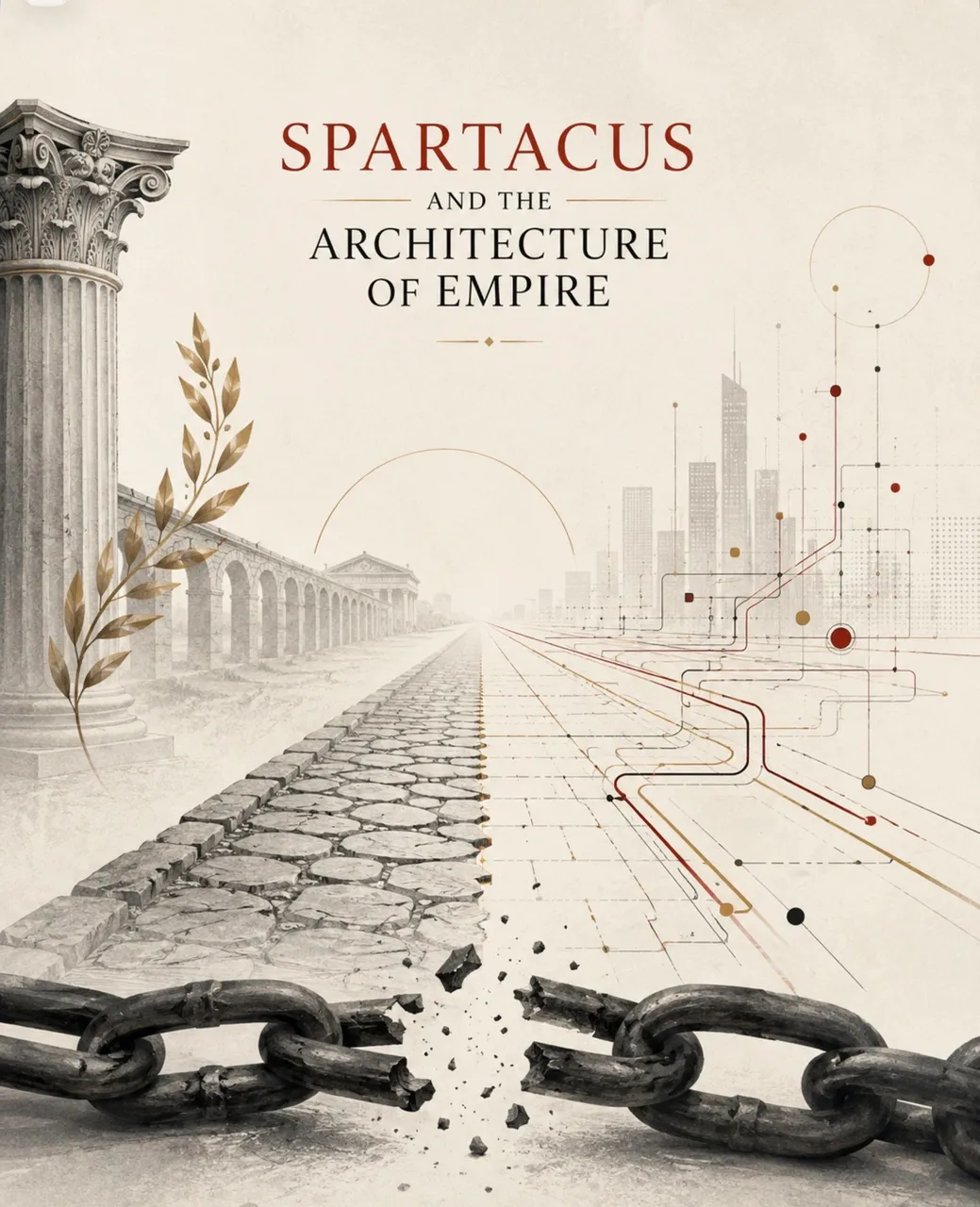
Why Ancient Rome Still Explains Modern Power
By Dr. Pooyan Ghamari
The Inventory
Around 160 BCE, Cato the Elder wrote a manual for landowners. It is a practical work, concerned with olives, wine, weather, tools, livestock and the supervision of an estate. In one passage, he advises the owner to sell whatever has become surplus: excess oil and wine, worn-out cattle, defective sheep, hides, an old wagon, old tools, an old slave, a sickly slave, and anything else no longer worth keeping. (Penelope)
Read the sequence again and notice what is absent from it.
No anger. No hatred. No argument.
The enslaved person enters the inventory beside the cart and the iron implements, and the transition costs the sentence nothing. Nothing in Cato’s world requires it to cost him anything. This is the part of slavery that is hardest to confront, and it is not the whip. It is the calm competence of the paperwork.
Roughly ninety years later, one of the line items stood up.
Spartacus was a Thracian associated with a gladiatorial school at Capua. In 73 BCE, he escaped with a group of other enslaved fighters. Plutarch counts seventy-eight; Appian gives approximately seventy. Both wrote generations later, from within the Roman literary world, and no surviving account was written by a participant from the rebel side. The figures should therefore be held loosely. The revolt that followed became the Third Servile War and shook Italy from 73 to 71 BCE. (Penelope)
Spartacus lost.
That has never been the most interesting part.
The interesting part is what his defeat required, and what that requirement revealed.
Law Was the Instrument
Rome was not a modern democracy, and calling it one produces confusion in both directions. The Republic possessed consuls and censors, assemblies and magistrates, courts and legal procedures, and protections that mattered greatly to those entitled to invoke them. These institutions were not decorative.
They worked.
They were also allocated.
Freedom came in grades determined by birth, wealth, gender and legal status. Women belonged to the civic order without controlling its offices. Conquered communities entered arrangements of differing inequality. Enslaved people possessed no independent civic standing and were treated principally as property under Roman law. They could be bought, sold and punished, and could not independently own property, make contracts or enter a legally recognized marriage. (British Museum)
The usual accusation is hypocrisy, and the accusation is too weak.
Roman law did not overlook the enslaved person. It located him with precision and administered his condition.
Varro’s agricultural writing places enslaved workers within a managerial classification that also includes working animals and inanimate equipment. The brutality lies partly in the absence of drama. A human being has entered the inventory, and the sentence continues. (Penelope)
The precise scale of Roman slavery cannot be reconstructed. The British Museum summarizes estimates placing the enslaved population at around 10 percent of the empire, possibly considerably higher in certain cities and regions. It also records that at least 700 enslaved workers maintained Rome’s aqueducts in the first century CE, supported by the public treasury and emperor. One of Rome’s greatest civic accomplishments depended partly on people whom the system treated as possessions. (British Museum)
Here is the lesson worth carrying forward.
Large injustice is rarely sustained by lawlessness alone. More often it is classified, recorded, priced, inherited and enforced.
The dangerous power is not merely the one that breaks rules. It is the power that writes them, files them and applies them on time.
The Census Was Deadlier Than the Sword
Spartacus defeated Roman commanders repeatedly. The praetors sent against him failed. Consular forces were beaten. The rebellion grew as enslaved agricultural workers, herdsmen and others joined a mobile army composed of people who were supposed to remain part of the economic furniture.
Yet Rome possessed an advantage greater than any individual commander.
It possessed continuity.
A commander could be replaced. Soldiers could be recruited. Grain could be requisitioned. Roads moved troops and information. Registers made obligations and resources visible to the state. Magistracies survived the individuals occupying them.
Rome could lose a battle without losing the administrative structure that made another army possible.
When Marcus Licinius Crassus received command, he restored discipline through methods the ancient sources describe as severe, including decimation. He then used engineering and logistics to contain the rebels in southern Italy. Crassus mattered, but he was not the true Roman weapon. He was one functioning part inside a larger institutional machine. (Penelope)
Spartacus had to keep winning.
Rome only had to remain capable of raising another force.
That asymmetry is one of the most useful lessons the ancient world offers the modern one, and it is not primarily military. It is administrative.
A rebellion is an event.
A state is a procedure.
James C. Scott later used the concept of administrative “legibility” to describe how states make populations, territory and resources readable to themselves. The concept should not be projected mechanically onto Rome, but it helps illuminate the Republic’s advantage. Rome knew enough about its territories, obligations, manpower and infrastructure to reproduce force after defeat.
Spartacus commanded courage, speed and tactical intelligence.
Rome commanded a system able to absorb failure.
So the modern question is unavoidable:
If a nation wishes to remain sovereign, what protects it more effectively—the intensity of its anger, or the quality of its institutions?
The Road as Argument
The war ended in 71 BCE. Appian describes Spartacus being wounded in the thigh, continuing to fight from one knee and dying surrounded by his followers. His body was reportedly never identified. Appian then states that 6,000 survivors were crucified along the road between Rome and Capua. The number is round, rests on an ancient account and cannot be independently verified. The political function of the punishment is easier to understand. (Livius)
The dead were not the audience.
Everyone else was.
The road was already there. The timber, nails and labor could be obtained by the state. Rome did not have to win an argument. It displayed the cost of refusing one.
Terror is the discount option.
The expensive option is belief.
Consider what the crosses confessed. A hierarchy universally accepted as natural would not require reinforcement across nearly two hundred kilometres of public road. One does not repeat a warning every few hundred metres about an idea nobody is entertaining.
The display measured something Rome had discovered inside its own territory: doubt.
Force can compel obedience for a moment.
Spectacle teaches people to discipline their own imagination.
The most efficient empire does not punish everyone. It makes selected punishments visible enough that resistance begins to appear irrational.
Spectacle is what power uses after the argument stops working.
Citizenship Was a Weapon
Empire is often described as a machine of exclusion. That picture is incomplete.
Rome’s most intelligent instrument was not only the wall.
It was the door.
Rome could make outsiders Roman.
Citizenship expanded over centuries and culminated in the Constitutio Antoniniana of 212 CE, which extended Roman citizenship to almost all free inhabitants of the empire. This was a genuine transformation of legal status. Cassius Dio attributed the measure partly to taxation, although his hostility toward Caracalla makes his interpretation something to weigh rather than simply accept. Modern scholarship continues to debate the combination of political, legal, fiscal and ideological motives. (Cambridge University Press & Assessment)
Hold both possibilities at once and an uncomfortable truth appears.
Inclusion can expand rights and strengthen extraction simultaneously.
The door is not always the opposite of the wall. Sometimes it is the wall’s more intelligent successor.
An empire that only excludes is brittle because everyone outside it shares an interest in its destruction. An empire capable of admission is more durable. It converts outsiders into stakeholders, one promotion at a time.
This does not mean that those seeking Roman citizenship were deceived. Citizenship carried real value. That is precisely why incorporation worked.
Modern hegemonic systems have refined the same logic without reproducing the Roman institution.
The visa.
The scholarship.
The market.
The military alliance.
The reserve currency.
The payment network.
The platform.
None of these is inherently a chain. Many are valuable and voluntarily sought. Their value is the source of their power.
The deepest form of modern dependency is therefore not always the country that has been excluded. It may be the country whose political and commercial elite has more to gain from the external centre than from serving its own citizens.
The Paperwork Comes First
Rome did not reproduce itself unchanged. History does not repeat with that degree of laziness.
But one structure reappears: asymmetry is converted into procedure, and procedure is later dressed in principle.
The Atlantic slave trade was extensively documented by those who operated and profited from it. Manifests, insurance agreements, accounts, tax records and mortality calculations transformed forced human movement into administrable commerce.
The Trans-Atlantic Slave Trade Database estimates that approximately 12.5 million Africans were forced aboard slave ships between 1526 and 1866. About 10.7 million survived the Middle Passage and were delivered into bondage across the Americas and Caribbean. Those figures exist because the business of trading human beings generated an enormous paper trail. (National Endowment for the Humanities)
Cato’s inventory, scaled to an ocean.
Economic interest did not invent every form of racial prejudice from nothing. Religious hostility, conquest ideology, inherited social hierarchy and older forms of ethnocentrism existed before Atlantic plantation slavery.
But the enormous scale and profitability of the trade gave institutions a powerful incentive to formalize racial difference into political technology. Exploitation encouraged theories that justified it, and those theories made further exploitation easier to organize. UNESCO’s historical work connects slavery and the slave trade to the long development and legitimization of racism and racial discrimination. (UNESCO Documents)
The relationship between profit and ideology was reciprocal.
Commerce required justification.
Justification protected commerce.
The English East India Company reveals another architecture. It began as a commercial enterprise. In 1765, the Mughal emperor granted it the diwani, the right to collect revenues in Bengal, Bihar and Orissa. Those revenues financed military strength and helped transform the Company from trader into hybrid sovereign. After the uprising of 1857, the Government of India Act of 1858 transferred its administrative powers, possessions and armed forces to the Crown. (Qatar Digital Library)
The Company did not suddenly become political in 1765, nor did empire begin only in 1858. Its military and territorial ambitions were already developing. But the revenue register converted commercial access into durable governing capacity.
Paperwork did not merely follow power.
It helped make power reproducible.
In China, access to markets was imposed through military pressure and then stabilized through treaties remembered as unequal. In North America, agreements with Indigenous nations were signed, coerced and broken, while removal and dispossession were translated into formal policy.
These histories are not interchangeable.
Plantation slavery, settler dispossession, corporate sovereignty and gunboat diplomacy differ in mechanism, scale and moral character. Flattening them into one system would be poor history and worse ethics.
Nor can guilt be assigned to entire populations. The societies that produced colonial administrators and slave traders also produced abolitionists, reformers and dissidents who confronted their own governments.
Peoples are not empires.
Governments are not civilizations.
But the common sequence remains visible:
First, asymmetry is created.
Then it is administered.
Then it is explained.
Sovereignty and Its Discounts
The twentieth century dismantled much of the formal colonial structure. New states entered international institutions, and the United Nations Charter placed sovereign equality and the prohibition on threats or force against territorial integrity and political independence at the centre of the international legal order. (corporate.charter.com)
The rule was then applied unevenly.
That is a different problem from the rule being meaningless.
Official American historical records document the planning and implementation of Operation TPAJAX in Iran in 1953. They also record Operation PBSUCCESS and related covert efforts against Guatemala’s government in 1954. These decisions emerged from a Cold War environment in which security fears, anti-communism, strategic competition and economic interests interacted. (Office of the Historian)
Reducing every decision-maker to a cartoon villain would explain little. Political actors often believe their own arguments. Some threats they perceive may be real.
That does not settle the moral question.
It sharpens it.
The counterargument must be stated with equal force. Sovereignty has repeatedly served as an alibi for domestic repression. Governments invoke non-interference while treating their own citizens as instruments, prisoners or enemies.
Any defense of national independence that cannot confront domestic tyranny is not a political doctrine.
It is a defense brief.
The real dilemma remains unresolved:
How can the world restrain atrocity within a state without granting powerful countries a permanent license to redesign weaker societies?
No legal formula settles every case. But one question cuts closer than declarations of good intention:
Who pays when the intervener is wrong?
When an intervention fails, the intervening state can hold an inquiry, publish a report, change governments and leave.
The society that was rearranged cannot leave. It lives inside the result for a generation.
Empire, in one of its modern forms, is the privilege of being wrong at somebody else’s expense.
The Arena and the Feed
The Colosseum and the smartphone are not equivalent institutions.
One staged physical violence. The other organizes attention.
The comparison collapses when pushed too far. Yet both reveal something about the political function of spectacle.
The arena did not merely produce death. Death was already common in the ancient world. It produced distance: the trained ability to watch another human being suffer and see a category rather than a person.
The Thracian.
The Gaul.
The criminal.
The beast.
That distance was taught and repeated. Every durable system of domination requires some way of converting people into categories that can be punished without troubling the audience.
Modern information systems do not need to fabricate every fact to produce distance. They can simply sort.
Nations become brands.
Wars become competing edits.
Suffering enters an attention economy in which visibility depends not only on scale, but on narrative usefulness.
Algorithms exercise power partly by deciding what remains visible long enough to become socially significant. Digital markets can reinforce concentration through network effects, economies of scale, data advantages and high switching costs. UNCTAD has also warned that the value generated by data and digital platforms is concentrated in a relatively small number of companies and jurisdictions. (UN Trade and Development (UNCTAD))
The Roman arena announced who could be destroyed.
The modern information system, at its worst, decides who is worth noticing.
The first is the cruder instrument.
I am not certain it is the more powerful one.
Chokepoints
The modern geography of power is drawn less by borders than by bottlenecks.
A bottleneck is a place where somebody else’s refusal can stop an essential national function.
The International Energy Agency reports that, across six key energy minerals, the average market share of the three largest refining countries rose from approximately 82 percent in 2020 to 86 percent in 2024. In its broader examination of twenty strategic minerals, China was the leading refiner for nineteen, with an average market share of approximately 70 percent. (IEA)
Money displays a comparable, though not identical, concentration. IMF data place the United States dollar at 56.42 percent of allocated foreign exchange reserves at the end of 2025. The share rose to 57.13 percent in the first quarter of 2026. No competing currency has replaced the dollar’s combination of liquidity, market depth, institutional infrastructure and global use. (IMF Data)
De-dollarization is occurring at the margins.
Its political rhetoric still travels faster than its infrastructure.
Artificial intelligence adds another layer. UNCTAD projects the AI market growing from approximately $189 billion in 2023 to $4.8 trillion by 2033. It also reports that only one hundred companies accounted for more than 40 percent of worldwide business-funded research and development in 2022, while 118 countries, mainly from the Global South, were absent from major AI governance discussions. (UN Trade and Development (UNCTAD))
The important question is therefore no longer merely who owns territory.
Who refines the mineral?
Who controls the cloud?
Who settles the payment?
Who trains the model?
Who insures the ship?
Who writes the technical standard?
A country may possess a flag, a government and a seat at the United Nations while remaining dependent on external permission at every strategically important junction.
Formal sovereignty is not meaningless.
But it is not sufficient.
Sovereignty is the practical margin within which a society can make consequential decisions without first securing another power’s consent.
Sanctions and the New Deterrence
Sanctions occupy difficult moral territory.
Targeted restrictions against named individuals or entities responsible for documented violations may be lawful, proportionate and preferable to war.
But the instrument does not always remain where it is pointed.
Banks may reject lawful transactions because the compliance risk exceeds the commercial reward. Insurers withdraw. Shipping companies refuse cargo. Technology providers leave. A medicine legally exempted on paper may still fail to arrive because no institution wants to process the payment.
The Office of the United Nations High Commissioner for Human Rights maintains a mandate examining the effects of unilateral coercive measures and overcompliance on economic, social, labor, educational and scientific rights. Its findings represent one institutional perspective within a contested legal and political debate, but the mechanisms it investigates are real enough to require scrutiny. (merriam-webster.com)
No crosses.
No road.
A related political message can nevertheless emerge:
This is what refusal costs.
The proper test cannot be whether a measure is described as peaceful. It must be whether the measure is lawful, proportionate, consistent, reversible and designed to minimize civilian harm.
We must also ask whether the same standard would be accepted if the target were an ally.
A principle that changes with the flag of the accused is not a principle.
It is diplomatic preference dressed for court.
The Discount at Which Sovereignty Is Sold
Empires do not always need to break into a country.
They may be invited inside.
A government that fears its own population may need an external patron more than it needs public legitimacy. It then pays for protection using the only asset it controls: the country’s independence.
Repression, viewed strategically rather than only morally, becomes a subsidy to foreign power.
It is the discount at which sovereignty is sold.
Corruption produces the same vulnerability. Every unaudited contract is a handle. A stolen budget is not only a crime against the poor. It is an entry point through which outside influence can reach the state.
A judge who cannot be removed by a minister is a strategic asset.
A statistical office that publishes numbers the government dislikes is a strategic asset.
An opposition capable of winning an election without the state collapsing is a strategic asset. It means the country cannot be destabilized merely by being told the truth about itself.
This produces a principle with two edges:
No foreign power has the right to engineer another nation’s political destiny.
No domestic authority has the right to convert its citizens into instruments of regime survival while calling that sovereignty.
Anti-imperialism that demands silence at home is not anti-imperialism.
It is a small empire hiding behind a larger one.
What Spartacus Could Not Build
Spartacus could move an army through Italy.
He could defeat Roman commanders.
He could frighten the Senate.
He could not levy taxes, staff courts, supply cities through winter, establish succession or create institutions capable of surviving his death.
This was not because he lacked intelligence. The surviving accounts give no reason to believe that.
It was because a revolt is a refusal, and a refusal, however magnificent, is not yet a state.
When Spartacus died, the structure he had created stopped.
The Roman structure continued.
The lesson is not that refusal is worthless. Refusal is where freedom begins.
The lesson is that refusal without capacity becomes martyrdom, while capacity without refusal becomes service.
A sovereign society requires both.
That is why the serious heirs of Spartacus are not defined principally by weapons.
They are auditors.
They are judges who rule against ministers and retain their offices.
They are engineers who build the second refinery so the first cannot become a threat.
They are procurement officers who publish tenders.
They are researchers whose work creates domestic capability.
They are teachers in towns political leaders rarely visit.
These professions seldom receive statues.
They make statues less necessary.
The World Bank’s World Development Report 2017 argued that formally sensible policies often fail because power relations inside institutions obstruct implementation. State capacity is not a technical appendix to politics.
Capacity is politics conducted through ordinary working days.
A rebellion can make domination briefly impossible.
Institutions can make it uneconomic.
Only the second is a durable strategy.
Redundancy, Not Rebellion
What replaces empire?
Not autarky.
No modern country can independently produce every semiconductor, medicine, machine tool, energy input, form of capital and agricultural necessity it requires. Attempts at complete self-sufficiency generally reduce prosperity while creating new forms of domestic coercion.
Isolation is not sovereignty.
It is a smaller cage with a local key.
Nor is the answer simply multipolarity. A world containing several empires is not necessarily freer than a world containing one. It may only contain more predators and more competing justifications.
Multipolarity describes a distribution of power.
It does not describe a moral achievement.
The practical alternative is duller and more difficult:
Redundancy.
A second supplier.
A second payment route.
A second refinery.
A second cloud provider.
A second cable.
A second source of credit.
A second institutional partner.
The purpose is not to escape interdependence. Interdependence is a foundation of modern prosperity.
The purpose is to prevent any single dependency from being converted into command.
Dependence with an alternative is trade.
Dependence without an alternative is jurisdiction.
That distinction is measurable.
It is also mostly unbuilt.
Alternatives to modern chokepoints often exist more clearly in speeches than in infrastructure. Constructing them requires decades of investment by governments that may leave office before the benefits become visible.
That is precisely why few begin.
Where the Argument Ends
Power wants more than obedience.
Obedience must be purchased repeatedly, and it is expensive.
Legitimacy is purchased once and then collects interest.
That is why empires speak so much. Rome spoke of order, law, glory and civilization. Later powers spoke of discovery, commerce, conversion and progress. The modern vocabulary includes security, democracy, human rights, development, stability, compliance and the rules-based international order.
Those words are not lies.
Democracy, human rights and law are among the most valuable institutions humanity has created. People who dismiss them merely as foreign inventions are often people protected from the worst consequences of their absence.
The corruption is not in the principles.
It is in their selective application.
A standard that arrives only when the accused is weak is not a universal standard. It is a schedule of convenience.
This returns us to a man outside Capua more than two thousand years ago.
Rome killed Spartacus and preserved the system. Slavery outlived him. The roads remained Roman. Crassus continued into political history, while the names of most rebel followers disappeared.
By every measure his own age understood, Spartacus failed.
Yet Rome never fully recovered the one thing he took.
Silence.
Before the revolt, the hierarchy could be assumed. After it, the hierarchy had to be defended, explained and demonstrated along a road lined with the bodies of those who rejected it.
A system that must constantly prove its inevitability has already begun to expose its weakness.
A country is not strong because others must obey it.
A country is strong when its own people cannot easily be turned into instruments—neither by a foreign power nor by their own government.
Dignity becomes real when it becomes more durable than fear.
It becomes durable only after someone has performed the tedious work of building the institutions that hold it upright.
Spartacus refused, but he could not build.
The refusal was true.
The failure was tragic.
The work he could not finish remains open.
Rome could kill the man who said no.
It never found a way to kill the sentence.
Selected References
Ancient sources: Cato the Elder, De agri cultura; Varro, Res rusticae, Book I; Plutarch, Life of Crassus; Appian, The Civil Wars, Book I; Cassius Dio, Roman History. Ancient figures concerning escapees, rebel forces and crucifixions derive from later, sometimes conflicting accounts and cannot be independently verified.
Roman society and slavery: British Museum, “Slavery in Ancient Rome”; modern scholarship on Roman law, citizenship, the Social War and the Constitutio Antoniniana; James C. Scott, Seeing Like a State.
Colonial history: National Endowment for the Humanities and the Trans-Atlantic Slave Trade Database; UNESCO’s work on slavery and racism; Qatar Digital Library and UK Parliament on the East India Company; Smithsonian National Museum of the American Indian; U.S. National Park Service; U.S. Department of State, Office of the Historian.
International law and intervention: Charter of the United Nations, particularly Articles 2(1) and 2(4); official and declassified U.S. records concerning Operation TPAJAX in Iran and Operation PBSUCCESS in Guatemala.
Contemporary structures of power: International Energy Agency, Global Critical Minerals Outlook 2025; International Monetary Fund, COFER data for 2025 Q4 and 2026 Q1; UNCTAD, Technology and Innovation Report 2025; OECD analysis of competition and market power in the digital economy; OHCHR material on unilateral coercive measures and overcompliance.
State capacity: World Bank, World Development Report 2017: Governance and the Law.
Originalartikel: https://ghamari.org/articles/f/spartacus-and-the-architecture-of-empire