Spartacus and the Mask of Empire
Von Dr. Pooyan Ghamari · · 13 Min. Lesezeit
Dieser Artikel ist derzeit nur auf Englisch verfügbar. Eine deutsche Ausgabe ist nicht erschienen.
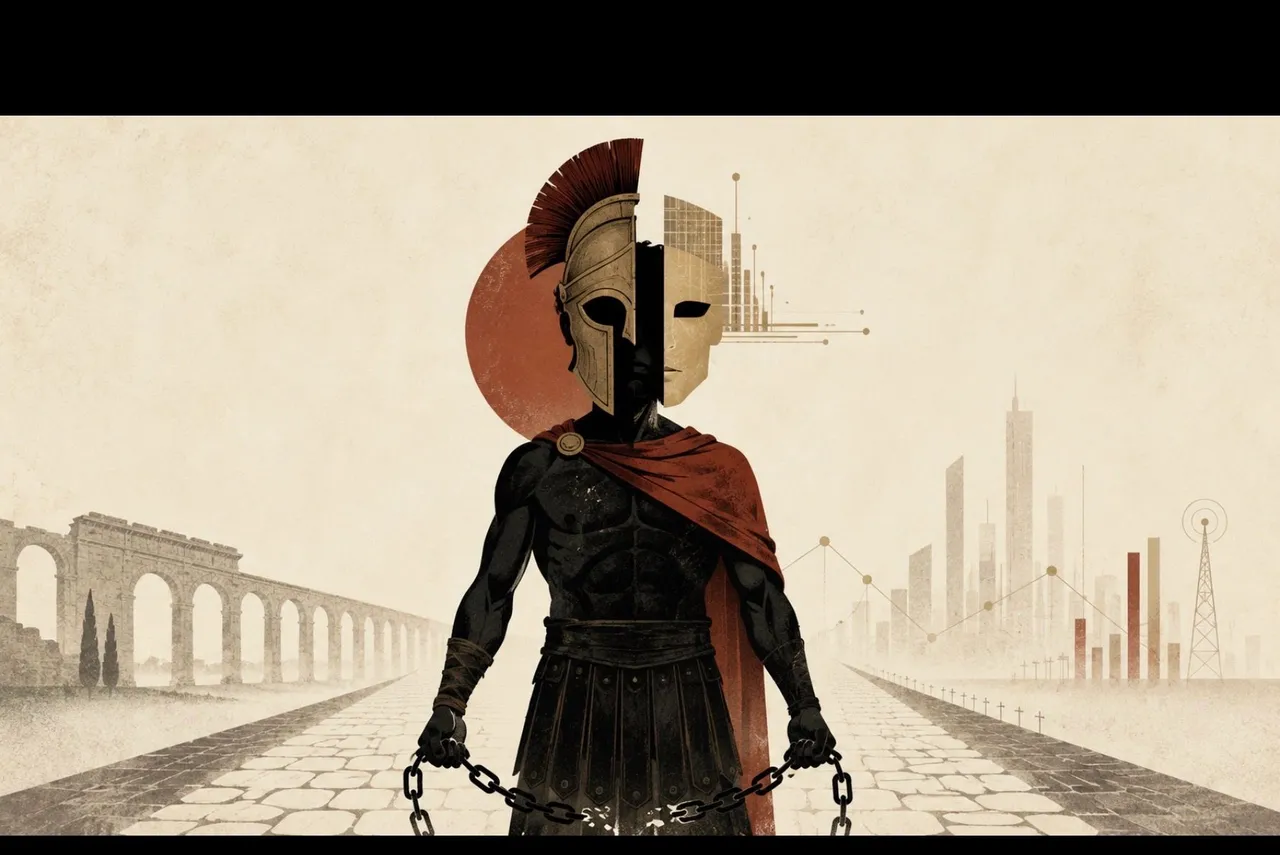
From Roman Slavery to Modern Colonial Power
By Dr. Pooyan Ghamari
Capua, 73 BCE
The men who broke out of the gladiatorial school at Capua did not begin with weapons worthy of an army. Plutarch says they seized cleavers and spits from a kitchen, then found wagons carrying gladiatorial arms and took them. Even the number is uncertain. Plutarch gives seventy eight escapees; Appian gives roughly seventy. Both wrote long after the events, and neither wrote from the side of the enslaved. What survives is not the diary of the revolt. It is the record preserved by the world that owned the rebels. (Penelope)
Rome had much to be proud of, and no serious historian should pretend otherwise. It had courts, contracts, roads, military discipline, civic rituals, magistrates, and a language of public order. Yet it also had a school in Capua where men were held, trained, fed, and drilled so they could kill one another for an audience. Both things were true. The second was not a failure of the system. It was part of the system working as designed.
Spartacus, a Thracian associated by ancient sources with the gladiatorial world, matters because he forced Rome’s hidden violence into public view. An empire can survive enemies at its borders. It is more deeply disturbed by a witness at its center.
The Republic That Owned People
Precision matters here. Rome was not a modern democracy, and Spartacus was not a modern revolutionary carrying an abolitionist manifesto. He fought the Roman Republic, a political order with consuls, senate, assemblies, magistrates, law, citizenship, and rights for certain classes of people. Those institutions were real, but they were rationed.
Roman liberty was distributed by status. Male citizens had forms of public participation. Women were citizens in a limited sense but had no direct share in political power. Allied communities and conquered peoples lived under layered inequalities. Enslaved people were outside political personhood altogether. They could be bought, sold, punished, hired, inherited, and used as economic instruments. (World History Encyclopedia)
That is the hinge of the argument. Rome did not enslave people against its law. Rome enslaved them through its law. The system was not lawless. It was lawful, organized, and technically managed.
Varro’s agricultural writing records the brutal clarity of that world. In discussing the means by which land is cultivated, he describes one classification of farm instruments as articulate, inarticulate, and mute: slaves, cattle, and vehicles. A human being appears inside the logic of equipment. (Penelope)
The scale is uncertain and must remain uncertain. The British Museum summarizes scholarly estimates that around 10 percent of the Roman Empire’s population, possibly up to 20 percent, was enslaved in the first century AD. It also notes that enslaved people were common in cities, countryside, households, and businesses, and that under Roman law they had no personal rights and were regarded as the property of their masters. (British Museum)
Even Rome’s public achievements carried this contradiction. The British Museum notes that in first century Rome, no fewer than 700 enslaved people worked on maintaining the capital’s aqueducts, paid for by public funds and the emperor. Clean water, one of Rome’s great civic symbols, was partly maintained by people the system classified as property. (British Museum)
Selective freedom was not an accident Rome failed to notice. It was an arrangement Rome organized. The lesson is not that liberty is always false. The lesson is harder: liberty for some can coexist with domination over others, and the people benefiting from that arrangement can call it civilization for centuries.
What the Revolt Proved
Rome treated Capua first as a disturbance, then as a security problem, then as a war. The early Roman response underestimated the danger. That is a common imperial error. Power often mistakes the oppressed for material until they begin to act like political beings.
Plutarch describes how the rebels, trapped near a height with steep cliffs, cut wild vines, made ladders, descended the cliff, came behind the Roman position, and took the camp. Appian says runaway domestic slaves and free farm hands joined them near Vesuvius, and that Rome at first did not yet treat the affair as a war. (Penelope)
That is the real meaning of the revolt. Spartacus showed that enslaved people were not tools. They could plan, move, improvise, choose terrain, defeat commanders, manufacture weapons, gather stores, and attract followers. A runaway slave is a property loss. An army of runaways is a philosophical crisis.
No reliable source proves that Spartacus wanted to abolish slavery as a universal political program. That would be an anachronism. The sources disagree about his strategic aims. Plutarch suggests he wanted to lead the army across the Alps so people could return to their homelands, while Appian describes a movement that changed direction under pressure and grew into a much larger military crisis. (Penelope)
Spartacus does not need a modern manifesto to matter. His act was enough. He did not ask Rome to decorate slavery with kinder words. He broke the frame.
Six Thousand Crosses
The Senate eventually turned to Marcus Licinius Crassus. Plutarch describes Crassus restoring discipline through decimation, selecting one man in ten from cowardly units for execution. Appian also records the punishment and says Crassus made himself more feared by his own men than defeat by the enemy. (Penelope)
Crassus then tried to trap Spartacus in southern Italy. Plutarch says Spartacus attempted to reach Sicily with the help of Cilician pirates, but the pirates took his gifts and sailed away. Crassus built a ditch and wall across the isthmus to cut the rebels off from provisions. (Penelope)
In the final battle, the ancient accounts become almost symbolic. Plutarch writes that Spartacus pushed toward Crassus through weapons and wounded men, killed two centurions, and was finally cut down while surrounded. Appian says Spartacus was wounded in the thigh, fought on one knee behind his shield, fell with many around him, and that his body was never found. (Penelope)
Then came the road.
Appian reports that 6,000 survivors were captured and crucified along the road from Rome to Capua. The number is round and cannot be independently confirmed, but the method and message fit Roman punishment for slaves. (Livius)
Those crosses were not only punishment. They were communication. Punishment addresses the guilty. The dead already knew the price. The road addressed the living: the workers, the household servants, the farm hands, the miners, the cooks, the men and women who still had to return to the estates. Rome turned bodies into public signage.
That is where the mask slips. The language of order runs out, and the machinery shows.
How Empire Changes Clothes
Empires almost never end in one ceremony. The uniform disappears first. The flag changes later. The governor becomes an adviser. The residency becomes an embassy. The military occupation becomes stabilization. Extraction becomes investment. Pressure becomes compliance. The command remains, but the vocabulary improves.
This is the bridge between Spartacus and the modern world.
A sanctioned country is not a Roman slave. A debtor state is not a gladiator. A post colonial society is not Capua. Weak analogies destroy serious arguments. But the structure of domination can repeat across different forms. The core pattern is this: one center of power assumes the right to define the limits of another people’s choices.
Rome used chains, markets, conquest, slave law, spectacle, and crucifixion. Modern domination can work through military bases, asset freezes, banking exclusion, debt dependency, sanctions, export controls, maritime insurance, credit ratings, technology denial, diplomatic isolation, media framing, resource contracts, proxy warfare, and the authority to decide which government is legitimate.
The old empire commanded the body directly.
The modern empire often tries to command the decision.
The Test of a Principle
Democracy is not the enemy. Law is not the enemy. Human rights are not the enemy. These are among the highest achievements of political civilization. The danger begins when noble words become selective weapons.
A principle is worth what it costs the side invoking it. A rule that burdens only rivals is not a rule. It is a preference with paperwork.
The United Nations Charter is built on sovereign equality among member states and prohibits the threat or use of force against the territorial integrity or political independence of any state. The text is strong. The problem begins when enforcement becomes selective. (un.org)
The opposite danger must also be admitted. Sovereignty has sometimes been used by governments as a shield for corruption, repression, censorship, and violence against their own citizens. Non intervention has sometimes covered crimes that a serious world should not ignore. But legitimacy cannot be created by slogans from outside. Democracy requires institutions, courts, trust, participation, parties that can lose and return, a press that does not require permission, and citizens who believe the system belongs to them.
Elections can be arranged from outside.
Institutions cannot be shipped.
Why the Lecture Fails
Distrust of Western instruction across the Middle East, Africa, Asia, and Latin America is often dismissed as resentment. That is intellectually lazy. In many societies, distrust is memory.
The transatlantic slave trade was not only cruelty. It was a business model. The National Endowment for the Humanities, drawing on the Trans Atlantic Slave Trade Database, records that around 12.5 million Africans were forced aboard slave ships, with about 10.7 million surviving the Middle Passage between 1526 and 1866. UNESCO describes the trade as forced displacement that enriched imperial and other powers and generated false narratives of white supremacy and racial inferiority. (neh.gov)
In the Americas, treaties with Native nations were often broken and sometimes coerced, according to the Smithsonian’s National Museum of the American Indian. The National Park Service records that the Indian Removal Act of 1830 forced remaining southeastern tribes to move west of the Mississippi. (National Museum of the American Indian)
In India, the English East India Company began as a commercial enterprise and became a political and military power. The Qatar Digital Library notes that the Company received the diwani in 1765, giving it the right to collect revenues from Bengal, Bihar, and Orissa, which strengthened its military position. UK Parliament records that after the Government of India Act of 1858, the Company lost its administrative powers and its Indian possessions and armed forces passed to the Crown. (Qatar Digital Library)
In China, access to markets arrived under naval pressure. The U.S. Office of the Historian describes the Treaty of Wangxia of 1844 as the American counterpart to the Treaty of Nanjing, which ended the First Opium War. The UK National Archives records that the Opium Wars produced treaties expanding Britain’s Hong Kong territory. (history.state.gov)
In Iran, the memory is not abstract. The National Security Archive notes the CIA’s role in the 1953 coup, and the U.S. State Department’s Foreign Relations series contains the official documentary record for Iran from 1951 to 1954. The CIA has also publicly acknowledged the coup it supported as undemocratic. (nsarchive2.gwu.edu)
So when powerful states speak about a rules based order, many listeners do not reject rules. They remember who wrote them, who applied them, who escaped them, and how quickly they changed when power required an exception.
The Siege That Needs No Army
Economic pressure is one of the cleanest looking instruments of modern power. It does not always produce the images that war produces. It arrives as compliance, banking caution, insurance withdrawal, export licensing, shipping risk, correspondent account closure, and private overcompliance.
Some sanctions are targeted at specific individuals or entities for stated legal reasons. That distinction matters. But broad pressure can escape the target list and reach ordinary people through blocked trade, medicine shortages, weakened infrastructure, inflation, investment paralysis, and interrupted education or technology access.
The OHCHR mandate on unilateral coercive measures exists because of these concerns. A 2025 OHCHR report by Special Rapporteur Alena Douhan addresses the impact of unilateral coercive measures, enforcement methods, and overcompliance on economic, labor, and social rights. A separate 2025 OHCHR report identifies impacts on education, scientific progress, technology access, academic cooperation, and related rights. (United Nations Human Rights Office)
The test is not the label. The test is legality, proportionality, consistency, humanitarian cost, and political purpose. A policy that makes civilians suffer so they will pressure their own government is not made moral because it uses banks instead of bombs.
Hunger delivered through financial architecture is still hunger.
The House and Its Owners
Now comes the part that must be said if the argument is to remain honest.
Empire is not the only author of suffering in the Global South. In many countries, the deepest wounds have also come from internal corruption, weak courts, censorship, mismanagement, repression, stolen public money, and elites who denounce foreign interference while crushing their own citizens at home.
Anti imperialism is a serious argument. It has also been used as an alibi. A failing elite loves a foreign enemy because that enemy explains everything and demands nothing.
A nation must repair its own house. That work cannot be outsourced. It requires law, institutions, audited budgets, courts, infrastructure, education, energy, productive industry, technological capability, and leadership disciplined enough to convert memory into strategy.
But no outside power gains the right to demolish the house because the tenants keep it badly.
Demolition is not reform. It is demolition with a press office.
What Spartacus Left Behind
Spartacus lost. That must be said plainly. Rome survived. Slavery continued. The games continued. The Appian road was cleared. The people who had walked past the crosses returned to work.
What Spartacus took from Rome was smaller than victory and more lasting. He took its ease. After Capua, Rome could still call itself civilization, but it knew what that word required to stay intact. It required punishment, terror, military discipline, and thousands of bodies displayed along a road.
A justification that needs that much reinforcement has already begun to fail. It has become force wearing the vocabulary of virtue.
The modern world does not need new masters with better language. It needs capable states, sovereign institutions, legal credibility, productive economies, independent infrastructure, disciplined diplomacy, and human dignity protected by competence.
Dignity is not a mood. It is infrastructure.
Sovereignty without competence becomes a slogan. Competence without sovereignty becomes service.
Empires do not end because their vocabulary improves. They end when the vocabulary stops working, when order, stability, security, reform, and democracy can no longer hide domination.
That is what the revolt of Spartacus still teaches.
A few dozen men with kitchen tools made Rome reveal itself.
Selected References
Primary ancient sources for Spartacus include Plutarch’s Life of Crassus and Appian’s Civil Wars. Plutarch is central for the Capua escape, the vine ladder episode, Crassus’ discipline, the Sicilian plan, and Spartacus’ final stand. Appian is central for the wider course of the war, the army’s growth, the final battle, the report that Spartacus’ body was never found, and the 6,000 crucifixions. (Penelope)
For Roman slavery and legal status, see the British Museum’s material on slavery in ancient Rome, especially its estimates of the enslaved population, its account of enslaved people’s lack of personal rights, and its reference to enslaved workers maintaining Rome’s aqueducts. (British Museum)
For Roman citizenship and exclusion, see World History Encyclopedia’s overview of Roman citizenship, including republican institutions, women’s limited status, slaves’ exclusion, and the uneven value of voting rights beyond Rome. (World History Encyclopedia)
For colonial history, see the National Endowment for the Humanities on the Trans Atlantic Slave Trade Database, UNESCO on the racial ideology and imperial enrichment tied to the slave trade, the Smithsonian National Museum of the American Indian on treaties, the National Park Service on Indian Removal, the Qatar Digital Library and UK Parliament on the East India Company, and the U.S. Office of the Historian and UK National Archives on the Opium Wars and treaty system. (neh.gov)
For modern sovereignty, intervention, and sanctions, see the United Nations Charter, OHCHR material on unilateral coercive measures, and declassified or official U.S. material on Iran in 1953. (un.org)
Originalartikel: https://ghamari.org/articles/f/spartacus-and-the-mask-of-empire