The Mask That Made Millions Believe They Were Free
Von Dr. Pooyan Ghamari · · 14 Min. Lesezeit
Dieser Artikel ist derzeit nur auf Englisch verfügbar. Eine deutsche Ausgabe ist nicht erschienen.
Why I Wrote a Novel About the Architecture of Modern Control
I did not set out to write about Bitcoin. I set out to write about the moment when someone realizes they have already given their freedom away, and that the process felt like liberation.
That realization came years ago, not in a moment of crisis but in a moment of ordinary observation. I was watching a conference—another blockchain event, another promise of decentralization, another narrative of escape from the old systems. The rhetoric was consistent: we are giving you freedom. We are returning power to the people. We are dismantling control.
What I noticed was not what was being promised. What I noticed was how the promise was being delivered. I watched people who had never owned anything digital before standing in hotel ballrooms, listening to men explain trust, autonomy, and sovereignty through PowerPoint slides. I watched them believe that participation in a marketplace was the same as participation in a revolution. I watched them confuse velocity with direction.
And I understood something that took three years to fully articulate into a novel: the most sophisticated form of power is the one that appears as its opposite.
The Question That Demanded a Novel
For years, I had been reading economics, studying blockchain systems, watching financial institutions, observing how power structures work when they are no longer dressed in uniforms or announced through declarations. I had written papers, essays, analysis. All of it was correct. None of it was sufficient.
Because analysis reveals mechanism. Analysis is accurate. Analysis is useful.
But analysis does not answer why millions of people stood in that ballroom. Not because they were stupid. Not because they were greedy. Because they were desperate. Because they were searching for something real in a world that had become increasingly fictitious. Because a feeling matters more than a fact when the facts have stopped explaining anything.
Fiction could ask that question in a way analysis could not. Fiction could enter the interior of a person’s choice—not to judge it, but to understand it. Fiction could show how a brilliant designer becomes complicit in a system she does not believe in, simply because she is trying to survive. Fiction could reveal how a quiet man from Dubai observes the machinery of financial manipulation without ever touching it himself. Fiction could demonstrate how the promise of freedom becomes the most effective mechanism of control.
That is why I wrote Die Satoshi-Maske.
What This Novel Is Not
It is not another book about cryptocurrency. There are enough of those. Some are technical. Some are historical. Some are polemical. I had no interest in writing any of them.
It is not a review of blockchain technology or an argument about whether decentralization is possible. Technology is neutral. The question is never about technology. The question is always about power—about who shapes the narratives around technology, who benefits from those narratives, and what people must become in order to benefit from them.
It is not The Bitcoin Mask and it is not The Nakamoto Masquerade, though those works preceded my thinking. Those novels explore the mystery of Satoshi’s identity. This novel explores something else: why the mystery itself became so useful. Not who Satoshi was, but why the absence of Satoshi was so much more powerful than any identity could ever be.
The Architecture of the Invisible
Visible power is primitive. It announces itself. It wears uniforms. It demands obedience. It can be named, resisted, overthrown.
Invisible power is complete. It does not announce itself. It does not demand. It whispers. It says not “you must,” but “you may.” And the human being defends invisible prisons with more passion than visible ones, because they defend them as extensions of themselves.
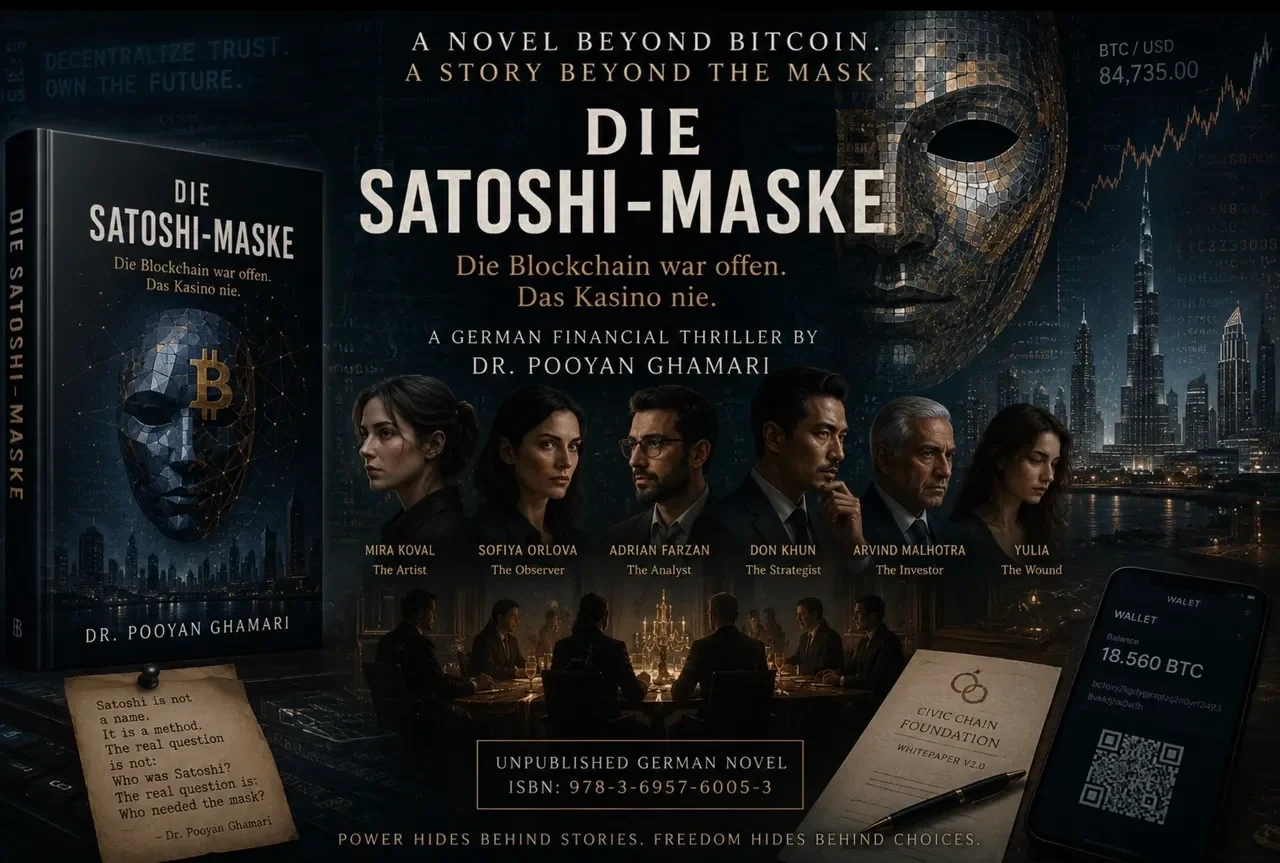
The novel follows five people at the moment when five different relationships to this invisible power become visible:
Mira Koval is a designer from Ukraine. She is brilliant. She is poor. She is asked to create a logo for something called Civic Chain, and she accepts because money solves problems. What she discovers is that a beautiful image can become a cage. That aesthetics are not neutral. That design is not innocent. That the feeling of participation is not the same as actual power.
Sofiya Orlova has already passed through the gate that Mira is approaching. She sees the system not as an enemy to fight but as a machine to read. She moves through the narrative with the calm of someone who has lost her fear and, in losing her fear, has lost her ability to return to ordinary life.
Arvind Malhotra from Dubai represents something crucial: the possibility of moving through systems of money without being moved by them. He is not good. He is not evil. He is trained. And training, I discovered, is more important than morality when systems become sufficiently complex.
Don Khun is the organizer. He is the point at which the system becomes personal. He understands something essential: that markets require choreography. That trust is a feeling before it is a fact. That the language in which you describe something is already half the power to make people believe it.
Yulia is the one who breaks. Or who was broken. Or who refused to be mended in the way the system required.
Each of these people embodies a different answer to the question: What will a person become, and what will a person sacrifice, when they believe they are being saved?
The Ledger Remembers
One phrase appears throughout the novel: The ledger remembers. The people trust.
It is printed on the promotional material for the blockchain project. It appears on screens. It is designed to be comforting. It suggests immutability, honesty, transparency.
But transparency is not the same as truth. Visibility is not the same as justice. And a record that cannot be changed is only as honest as the person who made the original entry.
The novel asks: what if the most dangerous form of control is not the one that hides information, but the one that reveals it all? What if the problem is not that we cannot see the transaction, but that we cannot see the human being who decided which transactions matter?
Blockchain technology was supposed to return power to individuals. What if it actually created a new form of collective helplessness? What if decentralization without wisdom simply means that everyone is equally controlled, just through different mechanisms?
These are not rhetorical questions in the novel. These are lived questions. They are questions that Mira asks with her body, with her choices, with her refusal. That Sofiya answers through watchfulness. That Arvind navigates with absolute clarity about what he is doing and why.

Why Fiction Reveals What Analysis Cannot
I have spent years studying how modern power operates. How it shapes markets. How it manufactures narratives. How it transforms rebellion into product and revolution into brand.
All of that study is in this novel, but it is not present as analysis. It is present as choice. As hesitation. As the moment when someone realizes they have already said yes without having said no.
Fiction is superior to analysis in one specific way: it can show a human being fully inhabited by complexity. Not as an argument. As an existence.
When Mira looks at Sofiya across that rooftop in Berlin, something happens that no analysis of power structures could convey. A recognition passes between them that contains more truth about the nature of control and resistance than a hundred essays on finance could contain. It is not because emotions are truer than facts. It is because the emotion contains the facts—the understanding of danger, the assessment of trustworthiness, the calculation of survival. All of it compressed into a glance.
The novel form allows this. Essays do not. Academic papers do not. Books about Bitcoin certainly do not.
The Kasino That Never Closes
One image haunts the novel: a casino without walls, without time, without priests—a casino where rebellion itself is traded, where hope is leveraged, where fear is liquidated like any other commodity.
This is not a metaphor for cryptocurrency alone. This is the image of all modern markets. The stock market. The attention economy. The labor market. The marriage market. The market in identities, in status, in the future.
What makes it a casino is not that people lose. (Many people win, at least temporarily, at least mathematically.) What makes it a casino is that the fundamental condition of participation is the belief that you are free to choose your bets.
But choice, I had to show through narrative rather than tell through argument, is not the same as freedom. A person can choose within a system while being fundamentally controlled by the system itself. They can choose the color of their cage. They can choose the terms of their participation. They can choose their own slavery.
And this is the deeper truth: the casino does not need walls when everyone inside believes they entered voluntarily. The casino does not need guards when everyone inside believes they can leave whenever they want. The casino does not need priests when everyone inside believes they are not really gambling—they are investing, building, creating, revolutionizing.
The novel shows this not as a criticism of capitalism or finance or technology. The novel shows this as a pattern in human consciousness itself. As something that repeats across empires and epochs. As something that Satoshi’s mask made visible by being absent.
The Satoshi That Matters
In my author’s note, I write: “Satoshi is not a name, but a method.”
The question “Who created Bitcoin?” is less important than the question “Why does it matter that nobody knows?”
The genius of the Bitcoin system is not really technical, though it is also technical. The genius is narrative. The genius is the mask. The genius is that by removing the founder from the system, the system itself became founder-like. It became an origin without a face. A power without a body to blame.
This was revolutionary in its way—and it was also the most complete realization of the principle of power I had been tracking for years. Power that cannot be found cannot be fought. Authority that has no single source cannot be dismantled. A system that is distributed and impersonal is invulnerable to the normal forms of resistance.
The novel does not ask whether this was Satoshi’s intention. It asks what happened when the world received a system designed to escape control and then built systems of control on top of it. When the technology of liberation became the infrastructure of a more sophisticated imprisonment.
Why I Needed Years to Write This
This novel took years not because it is long but because it is precise. The sentences needed to be exact. The observations needed to be unshakeable. The characters needed to feel like people you might actually know or become.
I spent years because I was trying to write something that could not be dismissed as a polemic. I needed it to be a novel that even someone deeply invested in blockchain and crypto would have to read seriously, would have to feel in their body, would have to account for as a possibility.
I needed the language to be literary, not populist. Sophisticated, not simple. Because if the novel was easy, it would be a sermon, and sermons change no one’s mind who is not already predisposed to change.
I also needed time because I was tracking something subtle: how does a person not evil do evil things? How does someone not foolish make foolish choices? How do brilliant people become complicit in systems they suspect are corrupt? Not because they are weak, but because the systems are built precisely to turn strength into complicity.
These are the real questions. Not simple morality. Real psychology. Real economics. Real power.
The Invitation
Die Satoshi-Maske is written for people who have looked at modern finance and felt that something was wrong, but could not quite articulate it. For people who have participated in digital systems and wondered whether participation meant power or just the illusion of choice. For people who understand that the world is neither as transparent nor as free as it claims to be.
It is written for people willing to ask difficult questions: What have I already agreed to that I did not know I was agreeing to? What systems am I complicit in? What have I become in order to become what I wanted to become?
It is not a comfortable novel. It does not provide easy answers. It does not end with revelation and reform. It ends with something more difficult: the possibility that understanding the system and navigating it with wisdom might be the only real freedom available to us.
Because the truth that the novel works toward is this: the most sophisticated power is the power we grant willingly, and often, in granting it, we call it progress.
Philosophical Dimensions
The novel carries several ideas as its foundation:
Trust is not a fact, it is a feeling. And feelings can be manufactured, designed, and weaponized. When someone creates a beautiful image and attaches it to a financial promise, they are not lying. They are doing something more subtle and more dangerous. They are making the promise feel true.
Identity is not fixed, it is performed. Each character performs a different identity based on their relationship to power. Mira performs beauty and innocence. Sofiya performs calm and wisdom. Arvind performs indifference. Don Khun performs connection. Yulia performs nothing and is destroyed for it.
Money is the language in which modern freedom is spoken. But if freedom has a price, is it freedom? If everything valuable must be converted to money to have meaning, what happens to things that cannot be priced?
The archive of truth is not neutral. What gets recorded matters less than who decided it was worth recording. The blockchain records everything, but it does not determine meaning. Meaning is still determined by the humans who decide what the blockchain is for.
Visibility and justice are not the same. You can see all the transactions. That does not mean you understand the system. You can know all the data. That does not mean you have power. Transparency without wisdom is just a different form of blindness.
What Separates This Novel
This is not a book about technology. It is a book about consciousness. About the moment when consciousness recognizes itself as already compromised. About the possibility of moving forward with that knowledge.
I wrote it because the narratives around cryptocurrency were failing. They were failing not because they were false but because they were incomplete. They did not ask what a person had to become to participate. They did not ask what would be lost. They did not ask what it meant to trade one form of invisibility for another, one form of dependence for another.
The novel asks these questions by making them inseparable from the lives of people who matter. Not as ideas but as flesh. Not as arguments but as choices.
The Ending That Matters
I will not describe the ending. The ending is not a resolution. The ending is a point of arrival at which a person realizes they must now live differently, not because the system changed, but because they see it clearly.
Mira returns to her art. She paints. She makes a mark on the wall beside an empty space, close enough that it could belong to the emptiness. She does not fill the void. She acknowledges it.
This is not triumph. This is survival. Survival with clarity. Survival that has passed through knowledge and come out the other side not bitter but accurate.
It is the only freedom available in a closed system: to see it clearly and to move within it without being moved by it.
For Readers Who Need to Know More
This novel will be read by people who work in finance. By people who believe in cryptocurrency. By people who are building blockchain systems right now, thinking they are building liberation.
I do not write this novel to convince them they are wrong. I write it to invite them to see what they are building from a different angle. To see the beauty of what they create and the danger of it simultaneously. To become conscious of the choices they are making.
Because consciousness is the only tool that works against sophisticated systems. Not anger. Not rebellion. Not resistance. Consciousness. The ability to see the system and yourself within it with equal clarity.
The novel ends not with a solution but with a question: When you understand the architecture of control, what do you become? Not in the abstract. In your actual life, with your actual choices.
That question is worth three years of writing. It is worth reading.
Dr. Pooyan Ghamari
Berlin, 2026
Originalartikel: https://ghamari.org/articles/f/the-mask-that-made-millions-believe-they-were-free