The Matrix of Power Book and Podcast Strait of Hormuz
Von Dr. Pooyan Ghamari · · 9 Min. Lesezeit
Dieser Artikel ist derzeit nur auf Englisch verfügbar. Eine deutsche Ausgabe ist nicht erschienen.
Why the Strait of Hormuz Is Important for Oil, Trade, and Sanctions: The Matrix of Power Book and Podcast
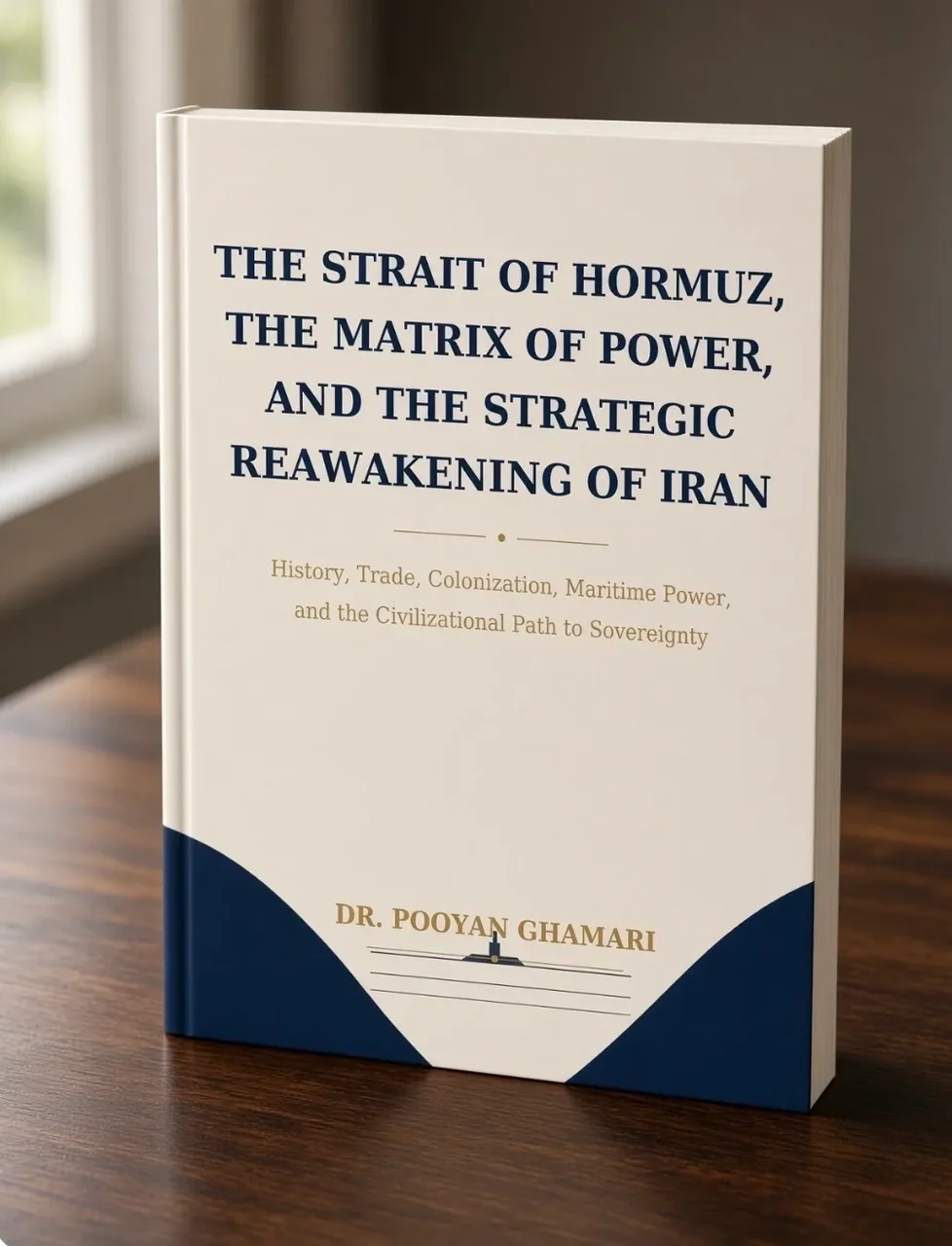
The Strait of Hormuz podcast is a spoken series on one subject: how this narrow waterway between Iran and Oman governs oil, gas, insurance, sanctions, and national sovereignty. It follows the book The Strait of Hormuz, the Matrix of Power, and the Strategic Reawakening of Iran by Dr. Pooyan Ghamari (ISBN 9783696359515). The English series is The Strait of Hormuz: The Matrix of Power. The German series is Die Straße von Hormus: Matrix der Macht.
People search this topic because a fifth of the world’s oil, and a large share of seaborne LNG, normally has to pass a channel only 33 kilometres wide. In 2026 the waterway also showed something news maps miss. A strait can stay “open” on paper while insurance, routing fear, and finance stop the ships.
What is the Strait of Hormuz?
The Strait of Hormuz is the only sea gate out of the Persian Gulf. North is Iran. South is Oman’s Musandam Peninsula. The open ocean beyond is the Gulf of Oman and the Arabian Sea.
At the tightest point the strait is about 21 miles, or 33 kilometres, across. The lanes ships actually use are thinner still. Under the old IMO traffic scheme, inbound and outbound lanes were about two nautical miles wide and sat mostly in Omani waters.
That is why the place is called an energy chokepoint. A small change in risk, law, or insurance changes the price of fuel, gas, and freight far from the Gulf.
How much oil and gas go through the Strait of Hormuz?
Before the 2026 disruption, energy agencies and tanker analysts put the flow near 20 million barrels a day of crude, condensate, and products. That is about one fifth of world oil use, and a larger share of oil that moves by sea.
About 20 percent of the world’s LNG also used this route, most of it from Qatar. Fertilizer, sulphur, and other Gulf cargoes travel with them. Those cargoes feed farms and factories, not only petrol stations.
Saudi Arabia, Iraq, Kuwait, the UAE, Qatar, and Iran all use the strait, in different volumes. Bypass pipelines exist. Saudi Arabia can send crude west to Yanbu. The UAE can send crude to Fujairah. Iran has the Goreh–Jask line. None of these lines can replace the normal Hormuz load. They can only take the edge off a shock.
Why is the Strait of Hormuz important?
Because there is no second door. Gulf oil and Qatari gas reach Asia by this cut of water. Japan, South Korea, India, and China feel a stoppage first. Europe and the United States feel it through the price.
The strait also matters as a legal object. An international strait is supposed to stay open for transit. Treaty text and real practice are not the same thing. Who names the lane, who escorts it, who insures it, and who can halt a payment: those decisions now weigh as much as the width of the channel.
In 2026, after war and threats of mines, daily traffic fell by around 90 percent from the old baseline of well over 100 ships a day. Oil and gas prices moved with that collapse. So did war-risk premiums. The lesson is simple. You do not need a perfect blockade to choke a chokepoint. You need enough fear and enough cost.
Is the Strait of Hormuz open or closed?
“Open” and “closed” are political words. Watch four things instead:
Ship counts, not speeches. AIS behaviour. Some captains sail dark. Advisories from bodies such as UKMTO. War-risk insurance. If cover is too expensive or withdrawn, the voyage dies even when the water is empty.
Iran can raise cost and risk with mines, missiles, inspections, new routing rules, and a claimed “Persian Gulf Strait Authority.” A clean, costless, total legal closure of an international strait is a different claim. Partial pressure was enough, in 2026, to empty the lanes.
What the book is about
The book is short, about 64 to 66 pages in the April 2026 paperback from BoD. The full title is The Strait of Hormuz, the Matrix of Power, and the Strategic Reawakening of Iran: History, Trade, Colonization, Maritime Power, and the Civilizational Path to Sovereignty.
It does not retell the day’s incident list. It asks who grants permission to move resources. Oil in the ground is not power. Oil that can be insured, paid for, classified, and sailed is power.
Ghamari uses “matrix” for the field of permissions around the strait: insurance markets, correspondent banks, sanctions lists, classification societies, corridor contests, and the stories that make those tools feel like weather. A navy is often the last argument. The first arguments sit in underwriting rooms and compliance desks.
The book then turns to Iran and to any state under pressure. Rhetoric does not rebuild sovereignty. Ports that work, law that is not arbitrary, industry beyond raw export, and institutions people can trust do. The path it names is civilizational, not theatrical.
Paperback: ISBN 9783696359515 Ebook: ISBN 9783696318451 Book list: https://ghamari.org/my-books Listing: https://www.isbn.de/buch/9783696359515/the-strait-of-hormuz-the-matrix-of-power-and-the-strategic-reawakening-of-iran
What the Strait of Hormuz podcast is about
The podcast is the book in spoken form. One subject runs through every episode: the Strait of Hormuz as a matrix of maritime power, trade routes, sanctions, insurance, law, and sovereignty.
It is not a daily war show. It is a series that answers the questions people actually type:
What is the Strait of Hormuz? Why is it important for oil and LNG? What happens if it is closed? Can Iran close it? How do sanctions and insurance shut a sea lane without a formal blockade? What can pipelines replace, and what can they not? What would real sovereign capacity look like after a chokepoint shock?
English playlist: https://www.youtube.com/playlist?list=PLc41cB_DEz-k
German playlist: https://www.youtube.com/playlist?list=PLSTBC0RZxaoc
Listen in the language you think in. The thesis is the same. Geography is visible. The systems that grant or deny passage are not, until a crisis names them.
Five points that outlast the news cycle
Hormuz is a legal fight as much as a military one. Treaty language on transit passage and the practice of states do not match.
Asia takes the first cargo hit. Price then travels.
LNG and fertilizer are half the story. Oil gets the headline. Winter power and harvests take the rest.
Insurance can close a strait faster than a minefield. When a voyage cannot be covered or financed, the channel is closed in practice.
Sovereignty is built in ports, courts, yards, and payment rails. Sitting next to a famous strait is not the same as being able to use it on your own terms.
How to use the book and the podcast
Read the book if you want the frame in one sitting. It is brief on purpose. Then use the English or German series as a second pass, one mechanism at a time.
If you brief energy, shipping, law, or statecraft, stop at the map only if you want the public version of the problem. The working version is five questions. Who underwrites the voyage? Who classifies the hull? Who clears the payment? Who names the corridor? Who owns the story of what “open” means?
Those questions are the matrix. The Strait of Hormuz only makes them visible.
Common questions
Why is the Strait of Hormuz important? It is the only maritime exit from the Persian Gulf and normally carries about a fifth of the world’s oil and a large share of seaborne LNG. No other route replaces that volume.
How much oil goes through the Strait of Hormuz? On the order of 20 million barrels a day of crude, condensate, and products in recent pre-shock years.
Can Iran close the Strait of Hormuz? It can make transit dangerous and expensive. That is enough to collapse traffic. A total, costless legal closure is another matter.
What happens if the Strait of Hormuz is closed? Oil and LNG prices jump. Asian importers scramble first. Fertilizer and other Gulf cargoes tighten. Bypass pipelines help only at the margin.
What does “matrix of power” mean? The systems around the waterway that decide whether geography can be turned into usable sovereignty: finance, insurance, sanctions, law, corridors, and narrative.
Where are the book and the podcast? Book: ISBN 9783696359515, https://ghamari.org/my-books English podcast: https://www.youtube.com/playlist?list=PLc41cB_DEz-k German podcast: https://www.youtube.com/playlist?list=PLSTBC0RZxaoc
1. What is the Strait of Hormuz?
The Strait of Hormuz is the only sea exit from the Persian Gulf to the Gulf of Oman and the Arabian Sea, between Iran and Oman. It is the world’s main energy chokepoint for Gulf oil and Qatari LNG.
2. Why is the Strait of Hormuz important?
It is important because about one fifth of the world’s oil and a large share of seaborne LNG normally must pass this narrow channel. There is no second door of equal size.
3. How much oil goes through the Strait of Hormuz?
About 20 million barrels a day of crude, condensate, and products moved through it in recent pre-shock years. That is roughly 20 percent of world oil use.
4. Where is the Strait of Hormuz?
It sits at the mouth of the Persian Gulf. Iran is to the north. Oman’s Musandam Peninsula is to the south.
5. How wide is the Strait of Hormuz?
At its narrowest it is about 21 miles, or 33 kilometres, across. The shipping lanes ships actually use are only about two nautical miles wide each way.
6. Is the Strait of Hormuz open or closed?
Treat “open” as a political word. Check ship counts, AIS tracks, maritime advisories, and war-risk insurance. In 2026 traffic fell by around 90 percent even when officials still called the water open.
7. Can Iran close the Strait of Hormuz?
Iran can make transit dangerous and expensive with mines, missiles, inspections, new routing rules, and insurance shock. That is enough to empty the lanes. A total, costless legal closure of an international strait is a different claim.
8. What happens if the Strait of Hormuz is closed?
Oil and LNG prices rise. Japan, South Korea, India, and China feel the cargo loss first. Fertilizer and other Gulf exports tighten. Bypass pipelines to Yanbu, Fujairah, and Jask cover only a fraction of normal flow.
9. Who controls the Strait of Hormuz?
No single state owns the whole channel. Iran holds the northern shore. Oman holds much of the southern shore and, historically, the main traffic lanes. Insurers, banks, navies, and corridor rules decide whether ships actually sail.
10. What is the Strait of Hormuz podcast?
It is the spoken series for Dr. Pooyan Ghamari’s book The Strait of Hormuz, the Matrix of Power (ISBN 9783696359515). The subject is how oil, insurance, sanctions, law, and sovereignty meet at this chokepoint. English: https://www.youtube.com/playlist?list=PLc41cB_DEz-k German: https://www.youtube.com/playlist?list=PLSTBC0RZxaoc
Originalartikel: https://ghamari.org/articles/f/the-matrix-of-power-book-and-podcast-strait-of-hormuz