US Sanctions Iran Khodro Saipa Railways
Von Dr. Pooyan Ghamari · · 9 Min. Lesezeit
Dieser Artikel ist derzeit nur auf Englisch verfügbar. Eine deutsche Ausgabe ist nicht erschienen.
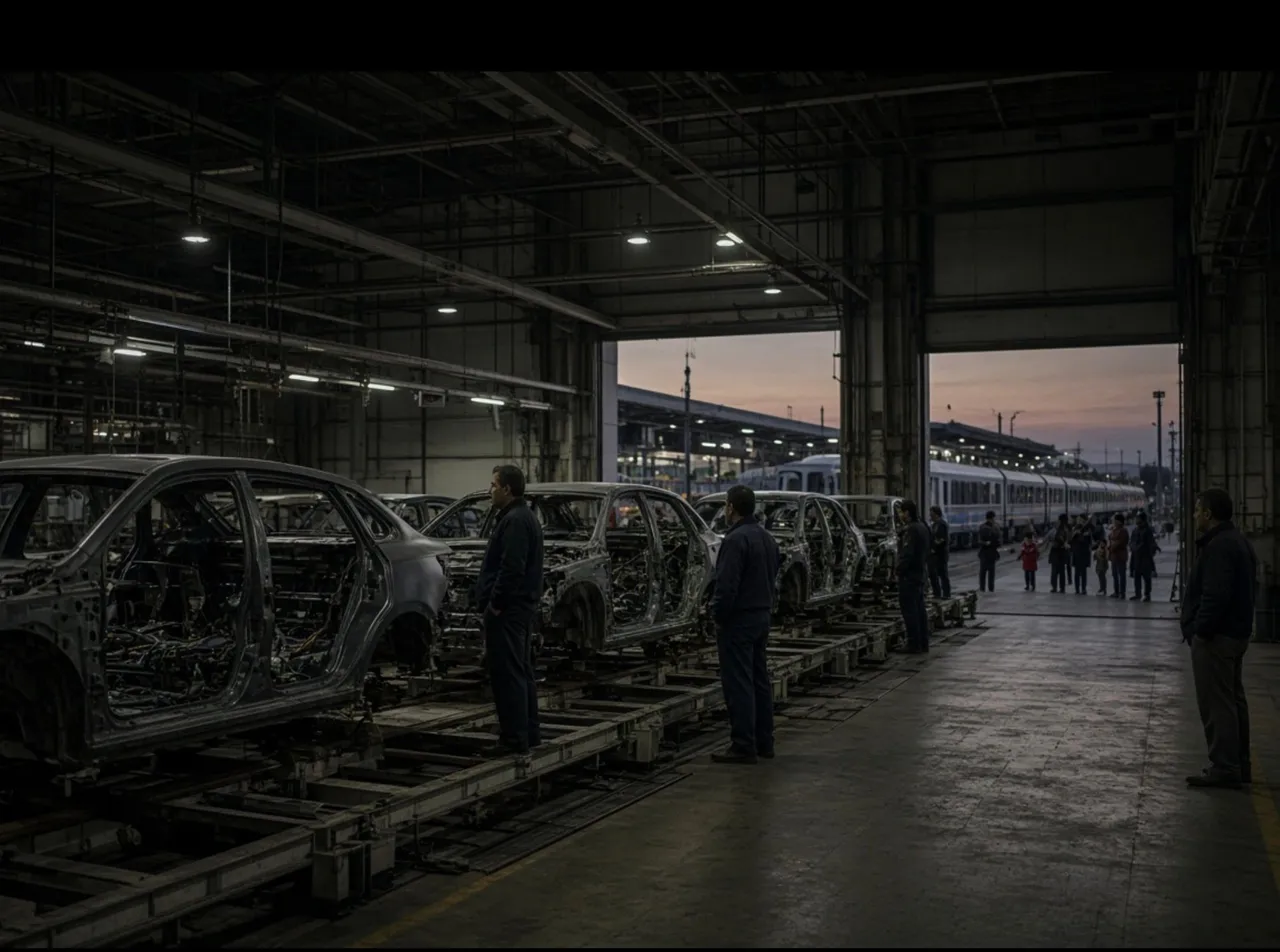
When the Factory and the Railway Become a Permission Slip
Operation Economic Outcast, Iran’s auto and rail sectors, and the invisible empire of conditional sovereignty
By Dr. Pooyan Ghamari, author of The Invisible Empire and the Chain of Free Nations
On 1 October 2026 the U.S. Treasury, under Operation Economic Outcast, issued sectoral sanctions determinations on Iran’s automotive and rail industries and designated Iran Khodro, SAIPA, the state railway, passenger and freight rail companies, and suppliers in Indonesia, the UAE, Turkey, Hong Kong, China and Germany. The official aim is regime revenue, the IRGC and sanctions evasion. The practical effect is wider. Foreign banks and firms now face secondary-sanctions risk for touching the parts, freight, payments and insurance that ordinary transport and production depend on.
The measure, stated plainly
This is how power works when war moves through the economy.
It is not colonialism in the old form of occupying territory. It is not slavery in the legal meaning of owning human beings. It can still create a modern system of dependency. One outside power gains the ability to decide whether another nation can buy parts, move freight, receive payments, insure shipments, or keep its industry alive.
Treasury announced that Operation Economic Outcast would target what it called Iran’s remaining industrial lifelines. OFAC issued two sectoral determinations under Executive Order 13902, covering the automotive sector and the rail sector. Those determinations authorize sanctions on any person determined to operate in either sector. The same action used Executive Order 13871, already aimed at iron, steel, aluminum and copper.
Secretary Scott Bessent put the intention in one sentence: the action “directly targets Iran’s enablers and lays the groundwork for the United States and our partners to drain the regime’s revenue once and for all.”
The automotive designations include Iran Khodro (IKCO), SAIPA, Iran Khodro Diesel, Pars Khodro, Zamyad, Niroo Motor Shiraz and Niroo Motor Damavand. Treasury says IKCO and SAIPA represent more than 90 percent of the domestic market and together produce nearly 1.5 million vehicles a year. It calls the sector Iran’s largest outside oil and gas, even while saying the industry loses more than $1 billion a year.
The rail designations include the state-owned Islamic Republic of Iran Railway Company, which runs passenger and freight services; Raja Passenger Trains Company; and Sherkat-E Rah Ahan-E Khamle-O-Naghle, the Railway Transportation Company, described as a key private freight carrier.
Foreign suppliers were named with them: PT Golden Motorcycle International in Indonesia, Integrated Auto Parts in the UAE, Troy Trading in Turkey, Hessenberg and Tanex in Hong Kong, HEPCO’s Shanghai subsidiary, and metals traders in China, the UAE and Germany. Property of designated persons is blocked. Firms owned 50 percent or more by blocked persons are blocked. Foreign banks face correspondent-account risk if they process significant transactions for designated persons.
That is the secondary-sanctions mechanism in plain language. A bank in Frankfurt, Dubai, Istanbul or Hong Kong does not need to be American to be punished for clearing a payment or insuring a shipment. Access to dollar clearing becomes a political permission slip.
The timing is not abstract. The action follows a U.S. maritime blockade that choked shipping lanes. Treasury says oil revenue has collapsed and that Iran has turned to rail to move oil and sustain regional trade. The railway is being treated not only as civilian transport but as a substitute artery for a blockaded coast.
What Washington claims, and what must still be examined
A serious argument does not begin by denying the other side’s stated case.
The administration says these sanctions are aimed at state revenue, the IRGC, corruption, trade-based money laundering and sanctions evasion. Treasury says the auto sector has been co-opted by the Guard, that IKCO maintains close ties to it, and that HEPCO products have been used by the IRGC-Qods Force at military sites. The State Department frames the action as denying resources for regional instability and military programs.
Those claims must be examined company by company, not swallowed as a slogan and not dismissed as one. Iran’s government, and every armed actor operating under its authority, remains accountable for repression and for wars that ordinary Iranians did not vote to fund with their wages.
Accountability of officials is not a license to treat a civilian industrial base as a single guilty body.
A passenger railway is not a missile factory. A parts invoice for a city bus is not a covert ledger. A mechanic, a farmer waiting on a freight wagon, a family that needs a car to reach a hospital, a workshop that lives on spare parts: none of these become commanders because OFAC has issued a sectoral determination.
The mind of the measure is visible in its design. It does not merely name a general or a proven procurement front. It designates the two firms that make almost every car Iranians can buy, the state railway, the passenger operator, a major freight carrier, and the foreign companies that still sell them parts. It then warns the world that touching this economy can mean exclusion from the dollar system. That is not a scalpel. It is a permission regime aimed at the arteries of daily life.
Not the old empire. The invisible one.
Formal empire retreated. The newer system does not need a garrison in every city. It works through standards, finance, logistics, insurance, ratings, compliance departments and narrative. Colonization evolves. It moves from occupation to compliance, from tribute to permission, from visible empire to invisible empire.
A nation can hold a seat at the United Nations and still be unable to buy a gearbox, insure a grain wagon, or receive payment for steel. Sovereignty on paper remains. Operative sovereignty does not.
Calling this colonialism in the nineteenth-century sense blurs the mechanism and helps the architects dismiss the criticism. Calling it slavery in the legal sense is false. The accurate name is conditional sovereignty, enforced by secondary sanctions: one state, because it controls the dominant clearing currency and the fear of exclusion from it, can decide which civilian industries of another nation are allowed to function.
Collective punishment has long been treated as illegitimate when an occupying power punishes a population for the acts of some of its members. Economic warfare outside formal occupation is wrapped in domestic legal authority and the language of security. The wrapping does not change the incidence. When the target list is the passenger railway and the mass car industry, the cost is socialized onto people who do not sit in the security council.
A just order must hold two sentences at once. Iran’s rulers and armed actors must answer for repression and for violence. No nation has a permanent right to suffocate another nation’s civilian economy and call the result security.
Who actually pays
Iran Khodro and SAIPA are the domestic market. Sanctioning them, their diesel subsidiaries and their foreign parts suppliers raises the price and scarcity of cars, buses, trucks and motorcycles. Treasury itself says the industry already loses more than a billion dollars a year. Cutting the remaining parts channels does not purify it. It freezes it in shortage. Workers and owners pay first. Officials with exempt channels pay last.
RAI and Raja move passengers. The freight carrier moves goods. Treasury’s rationale admits the strategic point: with sea lanes squeezed, rail is how the country tries to keep trade and fuel moving. A sanction that “works,” in the language of Operation Economic Outcast, is a sanction that makes that substitution fail.
Secondary sanctions globalize the cost. An Indonesian exporter, a Turkish parts trader, a Hong Kong intermediary and a German metals firm are the commercial periphery. Once they are designated, their banks retreat, often before any court has tested a transaction. Compliance departments become the unpaid infantry of the invisible empire. They do not need to believe the policy. They need to fear the fine.
That is the criminal logic, used with care. Not a verdict from a tribunal. A design. The design treats civilian dependence as a lever, then describes the lever as a blow against terror. The mind behind it is published in the press release: drain the revenue, close every avenue, make partners understand the risk. The avenue in question includes the avenue a passenger train runs on.
Direction for nations
Outrage is not a policy. Nations that do not wish to live inside a permission slip need structure.
Separate the target from the population in every instrument you sign. Support narrow measures against named officials and proven procurement networks. Refuse sectoral determinations whose operational meaning is “anyone in the car industry or on the railway.” The 1 October release offers no humanitarian exemption.
Build redundant arteries before the next designation. Payments, insurance, parts and fuel logistics that depend on a single clearing currency are a switch another capital can throw. Local-currency settlement, regional clearing and domestic parts capacity are slower than a speech and more useful than one.
Keep a public ledger of civilian incidence. Workers dismissed, routes cut, clinics unreachable, harvests stalled. A specific record can travel into diplomacy and courts. A slogan cannot.
Do not launder regime crimes into a case for foreign economic siege, and do not launder the siege into a case for the regime.
Form the habit of a chain, not a bloc. A chain of free nations is not an anti-American slogan and not a romantic axis. It is a practical agreement that civilian industry, passenger transport and food logistics are not chips on someone else’s war table.
Direction for people
People cannot designate OFAC. They can refuse the false choice.
If you work in a factory, a station or a port, document what the designation changes: the part that no longer arrives, the wage that is late, the train that is cancelled. Specific facts travel.
If your bank or insurer is “de-risking,” ask which clause you are obeying. Secondary sanctions work because private institutions enforce them more broadly than the text requires. Over-compliance is a political act dressed as caution.
If you are told that only two positions exist — bless the siege, or bless the men the siege claims to punish — decline both. A civilization that can hold officials accountable and still protect the mechanic and the passenger has not yet surrendered its judgment.
Security cannot mean that one nation has the permanent right to suffocate another nation’s civilian economy. When access to the global financial system becomes a political permission slip, sovereignty becomes conditional. Naming that fact is the beginning of answering it.
Questions people are asking
What is Operation Economic Outcast? A sanctions campaign announced in August 2026 to cut Iranian state revenue used for war, missiles, cyber operations and the IRGC. The 1 October action extended it to auto and rail conglomerates and foreign suppliers.
Which car companies were sanctioned? Iran Khodro, SAIPA, Iran Khodro Diesel, Pars Khodro, Zamyad, Niroo Motor Shiraz and Niroo Motor Damavand. Treasury says the first two cover more than 90 percent of the domestic market.
Which rail companies were sanctioned? The Islamic Republic of Iran Railway Company, Raja Passenger Trains Company, and the Railway Transportation Company.
Do these sanctions only hit the state? No. Sectoral determinations and secondary-sanctions exposure reach foreign suppliers, banks, insurers, and the workers and passengers who depend on cars, buses and trains.
Is this colonialism? It is not territorial occupation. It is control through finance, logistics and compliance. That is the mechanism in The Invisible Empire and the Chain of Free Nations.
Originalartikel: https://ghamari.org/articles/f/us-sanctions-iran-khodro-saipa-railways