Why Geography Is Not Destiny But Dependency Often Is, Hormuz
Von Dr. Pooyan Ghamari · · 15 Min. Lesezeit
Dieser Artikel ist derzeit nur auf Englisch verfügbar. Eine deutsche Ausgabe ist nicht erschienen.
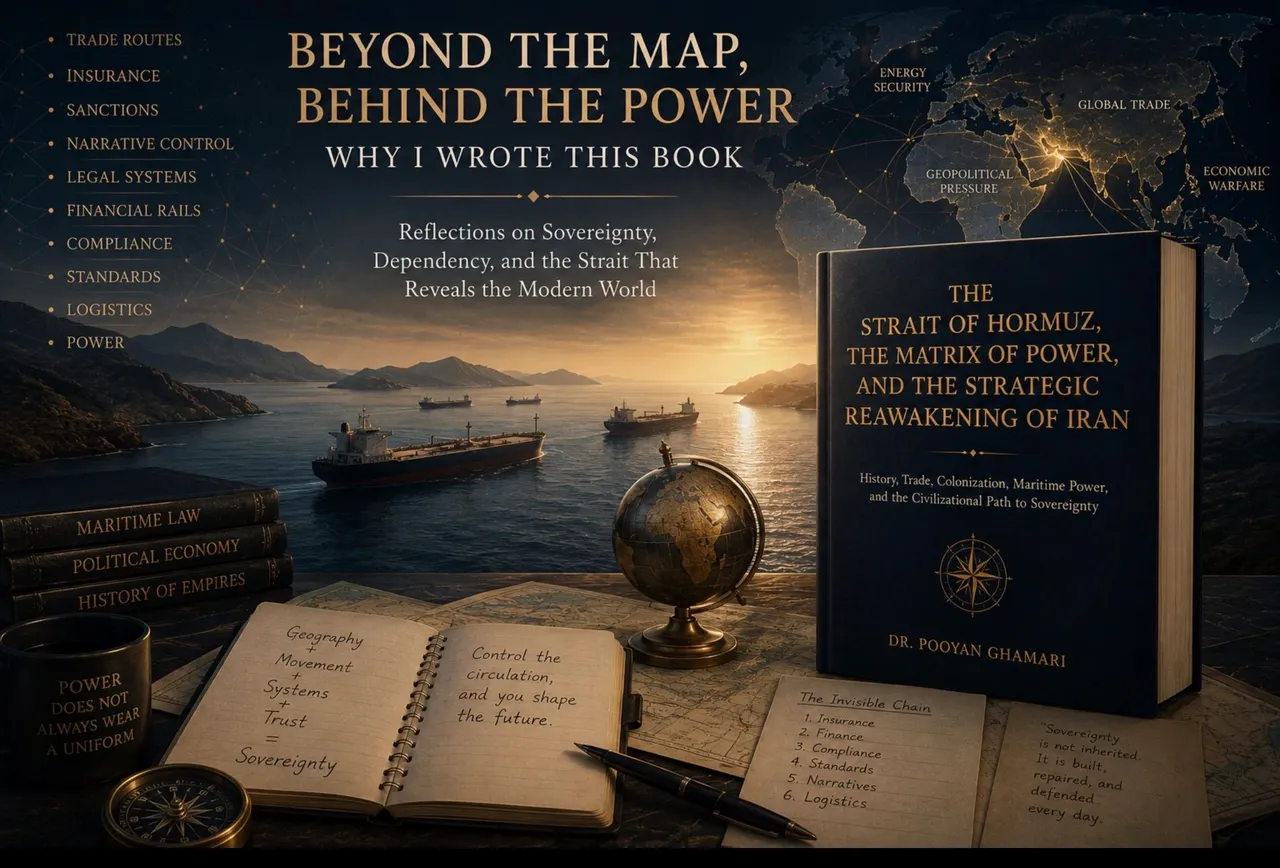
An Author’s Reflection on The Strait of Hormuz, Power, and the Long Work of Reconstruction
Why do nations sitting on strategic crossroads often remain the most dependent?
This question arrived for me not as an abstraction but as an observation. I was watching, over years, how geography that should have been leverage instead became weight. I was seeing nations with control over vital passages behave as though the passages controlled them. I was observing the gap between what the maps suggested a country should be able to do and what that country could actually accomplish.
That gap grew wider the more I studied it. And eventually, that gap became a book.
But the gap was not what I initially thought it was. I had assumed, when I began this inquiry, that the problem was military. That the solution was strategic confrontation. That control over the Strait of Hormuz would automatically translate into power. I was wrong. The invisibility of modern power meant I was asking the wrong questions.
The real discovery came slowly. It came through watching ships move, and then watching whether those ships were allowed to arrive. It came through studying contracts, and then understanding why some contracts were never honored. It came through learning the formal language of international maritime law, and then observing how that language was interpreted differently depending on who was doing the interpreting. It came through realizing that geography had stopped being destiny and become something more subtle and more dangerous: a map of dependencies that looked like independence.
The Architecture I Was Not Supposed to See
For a long time, I thought about the Strait of Hormuz the way most people do: as a chokepoint. A place where geography makes movement narrow. A place where someone standing in the right location might be able to control passage.
But that framing misses something crucial. It assumes that control is primarily about physics—about whether a ship can physically move through the water. In reality, control operates at multiple layers that have nothing to do with the water itself.
A ship can move through the Strait. The water does not stop it. But the ship’s journey does not end in the Strait. The ship is flagged somewhere. The ship is financed somewhere else. The cargo is insured in a third location. The destination port is classified by authorities in a fourth jurisdiction. The bunker fuel is purchased through clearing mechanisms controlled in a fifth place. The insurance company that covered the journey answers to standards set in a sixth.
So the question ceases to be: can the ship move through the water?
The question becomes: can this ship be allowed to move? Can it be insured? Can the payment be cleared? Can it dock? Can the cargo be handled? Can the buyer receive it?
Those questions are answered not in the Strait but in London, in New York, in Hong Kong, in Brussels, in standards committees, in insurance pools, in compliance departments, in narrative systems that decide what is risky and what is safe.
I spent years learning this architecture. And the more I learned it, the more I realized that understanding the Strait required understanding this invisible infrastructure. The geography was only the surface. The real matrix was the structured field of permissions, constraints, standards, and dependencies that operated above the water.
What Frustrated Me Enough to Write
I began this project in 2018 because I was frustrated. Genuinely frustrated.
I was frustrated by watching strategic debates focus on the wrong things. I would read arguments about naval power, about military capability, about the formal legal right to control a passage—and all of it skirted past the actual mechanisms through which modern power was being exercised.
It was as though everyone was discussing the visible game while the real game happened in places no one was looking.
I would watch economists discussing commodity prices without understanding that those prices were set through benchmark processes that excluded certain players. I would observe foreign-policy analysts discussing sovereignty without acknowledging that sovereignty without institutional competence was rhetorical. I would read strategic papers about confrontation with the West without recognizing that confrontation on the wrong terrain guarantees failure.
I was also frustrated by the other direction: by the defensiveness that masqueraded as realism. The voices that said, “We cannot do anything because we are too dependent.” That sat with the dependency as though it were natural, rather than constructed. That confused the current architecture with eternal constraint.
Neither position was adequate. Neither was honest about what was actually possible.
So I began to study it seriously. Not as ideology, but as architecture. As a system that could be understood, mapped, and—potentially—redesigned.
The Accumulation of Small Observations
The book that resulted from this work is built on what seemed, at the time, like small observations.
I was reading about the Portuguese cartaz system in the early sixteenth century, and I noticed something: the Portuguese were not stronger than the merchants they attempted to control. They were simply better at organizing a system through which strength could be exercised. They understood that power could be distributed across an architecture rather than concentrated in one point.
I was studying the history of the Strait through British eyes, and I realized: the British were not more virtuous than anyone else. They simply inherited and then systematized a set of rules that happened to work in their favor. Once those rules were embedded in international law, they became so natural that people stopped noticing they were rules at all.
I was examining contemporary insurance markets, and I discovered: the decisions that moved markets were not made by governments or by military force. They were made by underwriters sitting in offices, assessing risk. And those assessments of risk became self-fulfilling. Once a place was classified as risky, everyone avoided it, which made it genuinely risky, which justified the original classification.
I was tracing the flow of payments through correspondent banking systems, and I learned: a nation could theoretically control its own trade, but if that nation could not clear payments through the dominant global system, the control meant nothing. The clearance layer was more important than the national layer.
Each of these observations seemed isolated. But when you gathered them together, when you saw how they reinforced each other, when you understood that they were not accidents but the logical consequences of a system designed centuries ago and updated continuously—then you understood something different.
You understood that modern sovereignty was not binary. It was not simply present or absent. Sovereignty was layered. A nation could have some of it and not have other parts. A nation could appear sovereign in one dimension while being almost completely dependent in another.
The Difference Between Appearance and Capability
This is what I wanted the book to articulate: the gap between what appears to be true and what is actually true.
Appearance says: a nation at the Strait has leverage.
Capability asks: does that nation control the ships? Does it control the insurance? Does it control the ports where those ships unload? Does it control the standards by which those ships are classified? Does it control the narrative ecosystem in which shipping decisions are made?
If the answer to most of these questions is no, then leverage is more limited than appearance suggests.
This is not depressing. It is clarifying. Because once you understand what actually matters, you can stop expending energy on things that do not matter. You can stop performing symbolic resistance and start building real capability.
And that is what the second part of the book is about. It is not about military confrontation. It is about construction. About what a serious nation would need to do if it wanted to move from dependence to genuine strategic capability.
What Real Reconstruction Actually Requires
I want to be precise about this, because it is the most important part of the book.
Real sovereignty is not rebuilt through rhetoric. It is rebuilt through capacity.
A nation needs ports that function. Not ports for theater. Ports that actually move cargo reliably, that are trusted by shipping companies, that maintain professional standards. A nation needs institutions that deserve trust. It needs legal systems that reduce arbitrariness. It needs industries that can produce not just raw materials but refined goods that cannot be easily replaced by imports. It needs educational systems that produce human capital sophisticated enough to manage complex logistics, insurance, and technical standards.
Most importantly, it needs to understand that this work takes time. It is not dramatic. It is unglamorous. It involves ten years of unglamorous decisions made by people who do not get celebrated for them.
A reinsurance pool for war-risk insurance does not sound revolutionary. But if a nation can build such a pool, if it can capitalize it sustainably, if it can make it transparent enough that international reinsurers gradually trust it—then that nation has moved a piece of the leverage apparatus onto its own territory. That is real power.
An institutional design for a Hormuz Reconstruction and Sovereignty Fund does not make headlines. But if such a fund exists, if it operates with transparent auditing, if it answers to parliamentary oversight, if it actually invests in the infrastructure that matters—then that nation has moved the question from “can we control the Strait?” to “have we built what actually matters around the Strait?”
That shift in questions is more important than any military capability.
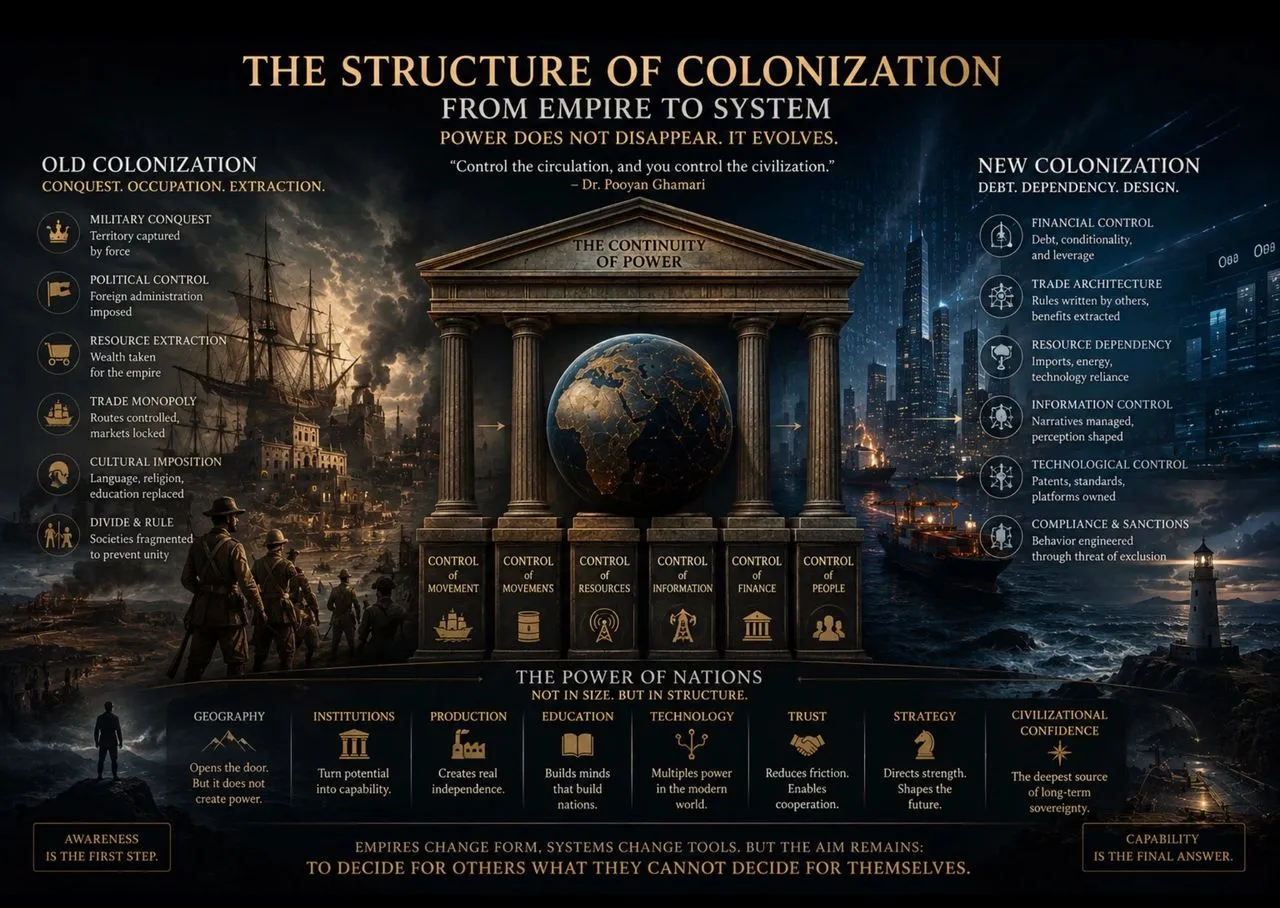
The Civilizational Layer
As I worked on this book, I realized that it was addressing something deeper than strategy. It was addressing civilizational maturity.
There is a moment in a nation’s development when it stops being trapped by history and starts learning from history. When it stops using the past as an excuse and starts using the past as a teaching tool. When it stops saying “this happened to us” and starts asking “what do we do now?”
That moment is not automatic. It requires a certain kind of disciplined realism. It requires the ability to look at your weaknesses without denial and also without despair. It requires strategic patience. It requires the refusal to mistake symbolic gestures for actual capability.
What frustrated me—what still frustrates me—is watching nations that could reach that moment choose not to. Watching them prefer narrative satisfaction to actual construction. Watching them choose confrontation on terrain where they are weak instead of building on terrain where they could become strong.
The Strait of Hormuz, for me, is a mirror. What is visible in Iran’s relationship to the Strait in concentrated form is visible elsewhere in disguised form. Nations everywhere face the question: will we build real capability, or will we perform the appearance of strength?
That question is what animated this book.
Why I Spent Seven Years on This
I began this work seriously in 2018. It has occupied significant portions of my thinking since then. I revised it in 2025 as the world changed—as sanctions regimes hardened, as supply chains broke, as everyone suddenly understood what logistics experts had been saying for years: that geography still matters, that routes still matter, that the physical infrastructure of global movement is fragile.
And I finalized it in 2026 because the original questions had become urgent in a way I had not anticipated in 2018.
When I began, many of the patterns I was describing still seemed abstract to observers. Ports were still discussed as infrastructure, not as instruments of sovereignty. Sanctions were still treated as temporary pressure rather than as durable architecture. Narrative warfare was still dismissed as propaganda at the edges rather than as central to power.
By 2025 and 2026, all of this had become visible. The supply-chain fractures showed that trade routes matter. The hardening of sanctions showed that isolation could be made to last. The expansion of algorithmic systems showed that control over what people believe has become as important as control over what they can do.
The Strait emerged from these experiences as a uniquely diagnostic lens. It is simultaneously ancient and contemporary. It belongs to physical geography and also to law, to logistics, to insurance, to narrative systems, to the subtle management of confidence.
And it revealed something I had only partially understood when I began: that the deepest dependency is often the one that has ceased to appear as dependency at all.
A nation that must constantly ask permission to move its own goods has dependency as its constant companion. But a nation that has internalized the rules so completely that it no longer notices the asking—that nation has reached the deepest level of dependency. It is no longer oppression. It is the normal order of things.
That is what the book is ultimately about. Not military strategy. Not confrontation. But the patient, unglamorous work of moving a nation from that deepest dependency toward something that might be called genuine strategic capability.
What Cannot Be Said About This Book
I want to be very clear about what this book is not, because I suspect its argument will be misunderstood.
This book does not advocate closure of the Strait. That would be catastrophic for global commerce and for any nation that attempted it.
This book does not propose confrontation with the Fifth Fleet. That would be suicidal strategy dressed up as resistance.
This book does not confuse anti-colonial seriousness with indiscriminate hostility. Colonial experience matters historically, but dwelling exclusively in that history prevents strategic thinking in the present.
This book does not imagine that memory alone creates power. Nostalgia for past greatness is the enemy of present construction.
This book does not propose that a nation can simply opt out of global systems and build autarky. That is impossible and undesirable.
What this book does propose is something less dramatic but more consequential: that a nation sitting at one of the great chokepoints of global commerce has the possibility—not the guarantee, but the possibility—of building real capability through decades of patient institutional work. That this work is not theoretical. That it can be designed. That it can be implemented. That it will not be easy or quick or psychologically satisfying, but that it will be real.
The Geographic Lesson That Applies Everywhere
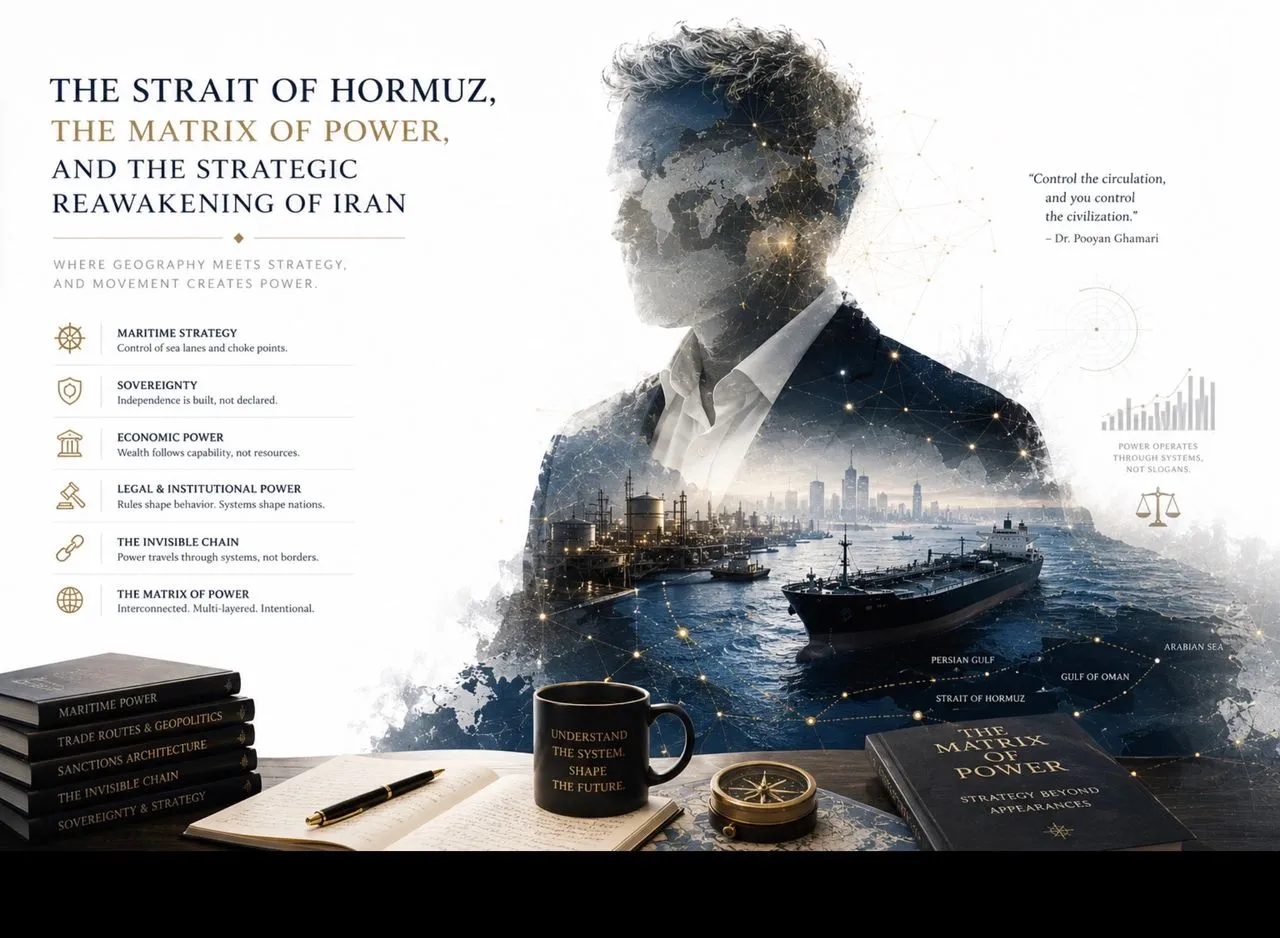
In writing this book, I was primarily concerned with Iran and the Strait. But I became increasingly aware that the patterns I was describing were not unique to that context.
Every nation exists within an architecture of dependencies. Some are more visible than others. Some are more easily changeable than others. But they all exist.
The question is never: how do we escape dependence?
No nation escapes dependence. The world is interdependent. The question is: which dependencies do we accept, which do we try to reduce, and which are we willing to work for decades to transform?
That is a different conversation entirely.
It is a conversation that requires realism about time. It requires accepting that institution-building takes longer than election cycles. It requires the discipline to make decisions that will not be celebrated, that will not result in dramatic headlines, that will simply, over years, shift the architecture slightly.
It is a conversation that requires honesty about weakness. It requires acknowledging what you cannot do, what you are not ready for, what you need to build before you can attempt certain things.
It is a conversation that requires refusing both despair and pretense. Refusing to believe that nothing can change. Refusing to believe that symbolic resistance amounts to actual change.
That conversation is what this book invites. Not specifically about the Strait of Hormuz, though that is the case through which it is examined. But about how any nation, any group, any civilization moves from reaction to form, from dependency to genuine capability, from the performance of strength to actual strength.
Why This Matters Now
When I began this work in 2018, the questions seemed theoretical. Strategic. Interesting to economists and policymakers but not urgent to ordinary life.
By 2026, those questions have become consequential to how the world functions.
Supply chains broke and suddenly everyone understood that routes matter. Shipping routes are not abstractions. They are how people eat, how people work, how commerce survives.
Sanctions regimes hardened and it became clear that isolation is not temporary pressure but can become durable architecture, lasting years, reshaping entire economies.
Algorithmic systems expanded and the relationship between narrative control and economic control became undeniable. What people believe about a nation affects whether they trade with it, whether they insure it, whether they move goods through it.
The questions in this book have moved from the margins to the center of contemporary geopolitical concern.
And yet the responses still often operate at the level of confrontation rather than construction. Still mistake symbolic resistance for actual strategy. Still confuse anger with policy.
The book offers a different approach. Not because it is comforting. It is not. It is demanding. It requires patience, discipline, institutional seriousness, and the refusal of quick satisfactions.
But it is an approach that could actually work.
The Final Question
The book ends without false optimism. It acknowledges the difficulties. It acknowledges that the political systems that would need to implement these strategies are themselves fragile, that they are subject to pressures and temptations that might make sustained work impossible, that strategic discipline is not guaranteed.
But it argues that the work is possible. That it is worth attempting. That the alternative—continuing to mistake performance for power—guarantees failure.
The Strait of Hormuz will not be settled by a book. It will be settled, if at all, by decisions made over decades by people who have the discipline to make them. By institutions that are built and sustained and trusted over time. By a nation that chooses real capability over symbolic satisfaction.
Whether that happens is not my determination to make. But the possibility exists. And this book is an attempt to clarify what that work might look like.
Dr. Pooyan Ghamari
The Strait of Hormuz, the Matrix of Power, and the Strategic Reawakening of Iran
ISBN : 9783696359515
Maritime power, trade routes, sanctions, sovereignty, and the strategic importance of the Strait of Hormuz.
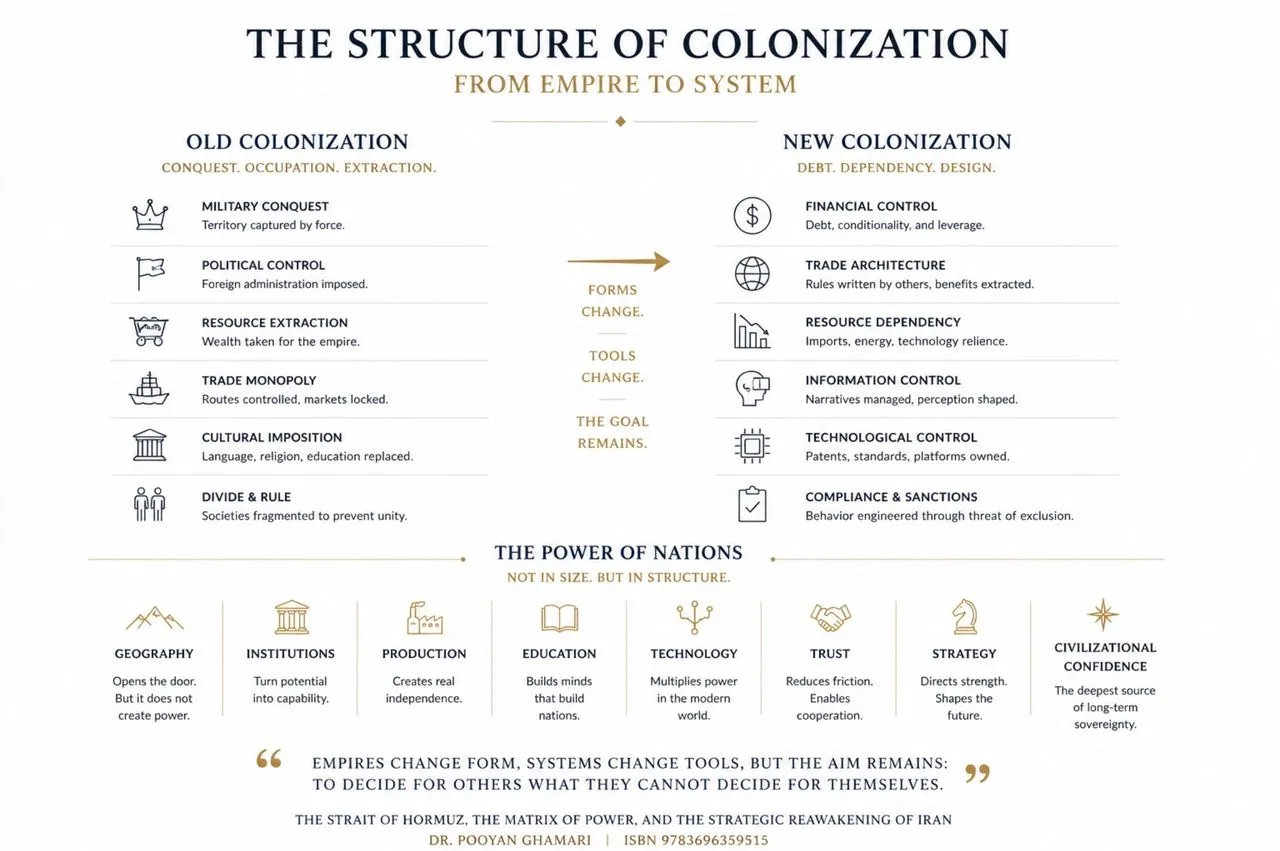
Originalartikel: https://ghamari.org/articles/f/why-geography-is-not-destiny-but-dependency-often-is-hormuz