Can the Arctic shipping route replace the Suez Canal
By Dr. Pooyan Ghamari · · 10 min read
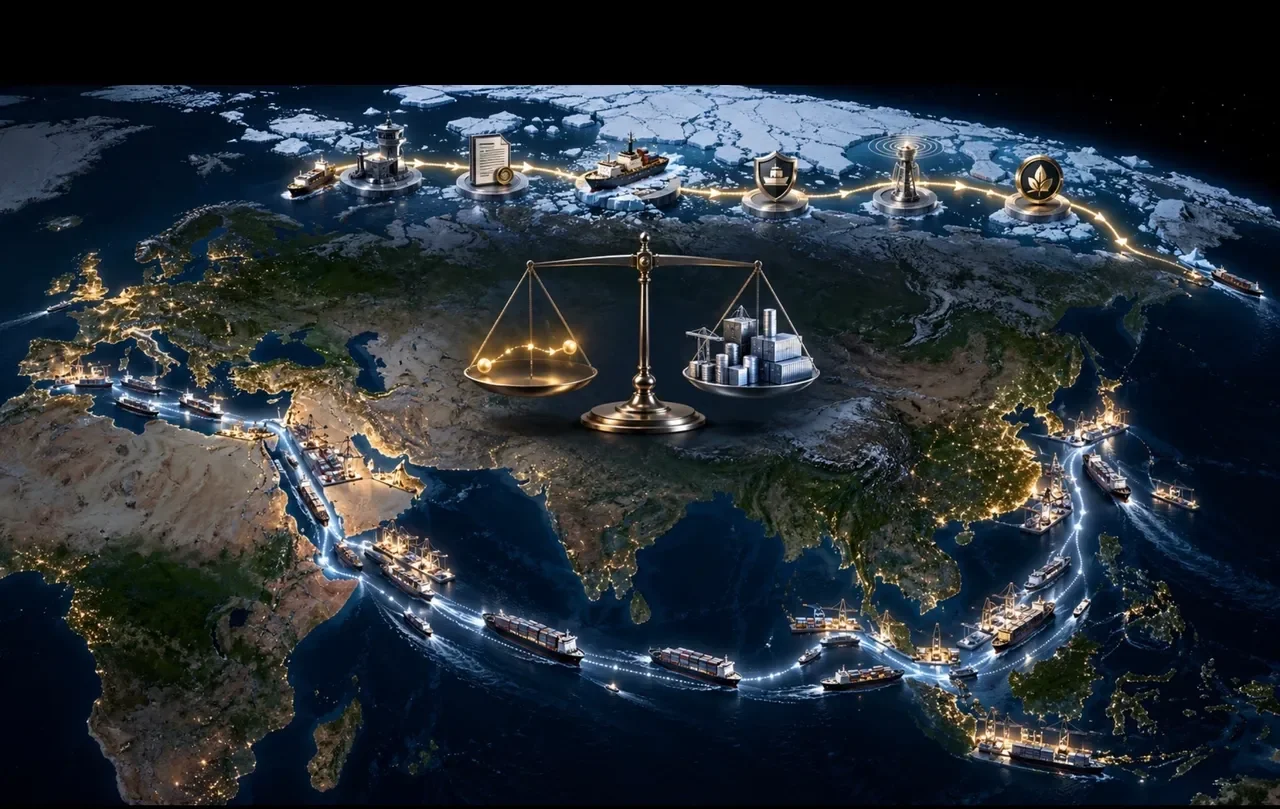
Can the Arctic Shipping Route Replace the Suez Canal? The Real Cost Behind the Shortcut
By Dr. Pooyan Ghamari, PhD, Swiss Economist and International Strategist
No. The Arctic shipping route cannot replace the Suez Canal as a dependable, year round global corridor today. It can shorten selected Asia to Europe voyages and add seasonal resilience, but ice class ships, Russian authorization, insurance, limited rescue capacity, cargo imbalance and unpredictable conditions can erase the apparent savings.
Why the Arctic shipping route is back in focus
On 11 October 2026, South Korea completed its first commercial round trip between Busan and Europe through Arctic waters. The journey took 50 days and included calls at Felixstowe, Rotterdam and Gdansk. Officials said the route reduced sailing time by about one third.
That is a meaningful operational test. It is not proof that a new global trade corridor has replaced the old one.
The vessel carried 737 twenty foot equivalent units against a target of 1,300. The shortfall matters because container shipping is a network business. A route does not become competitive simply because one ship arrives faster. It must attract enough cargo in both directions, sail to a dependable timetable and spread its fixed costs over sufficient volume.
The question is therefore not whether a vessel can cross the Arctic. Ships already do. The economic question is whether the route can deliver cargo more reliably and at a lower total cost than Suez across repeated voyages.
Northern Sea Route vs Suez Canal: distance is only the first price
A line on a map makes the Arctic route look irresistible. For some ports in Northeast Asia and Northern Europe, sailing along Russia’s northern coast can cut distance substantially. Less distance can mean fewer days at sea, lower fuel consumption and less capital tied up in inventory.
But distance is not the same as delivered cost.
The correct calculation is:
Total delivered cost = ship cost + fuel + ice capability + escort and service charges + insurance + authorization + delay risk + port handling + compliance + environmental exposure + inventory cost
Suez may be longer for some origin and destination pairs, but it supports a mature system of large vessels, frequent departures, extensive ports, repair capacity, predictable commercial services and established insurance practice. The Arctic offers a geographic shortcut without yet offering an equivalent commercial ecosystem.
The seven costs hidden behind the Arctic shortcut
1. Special ships reduce the apparent saving
The International Maritime Organization’s Polar Code imposes additional requirements for ship design, construction, equipment, crew training, operations and environmental protection. Ships may need reinforced hulls, cold resistant systems, specialist crews and a Polar Ship Certificate.
These protections are necessary. They also increase capital and operating costs. If a specialized vessel is useful only during a limited Arctic season, its owner must recover that investment over fewer voyages or redeploy it elsewhere.
2. Ice changes time from a schedule into a probability
Shipping customers do not buy the shortest theoretical journey. They buy an arrival window they can plan around.
Ice concentration, fog, wind and rapidly changing weather can reduce speed, alter a route or require assistance. A journey that is usually faster but occasionally delayed can be less valuable than a longer route with a stable timetable. This is especially important for factories using just in time inventory, retailers planning seasonal stock and exporters facing contractual delivery penalties.
3. Russian administration becomes part of the supply chain
Most commercial discussion concerns the Northern Sea Route along the Russian coast. Russia’s navigation rules establish an authorization process for Russian and foreign merchant ships. Russian institutions also oversee important ice information, infrastructure and icebreaker services.
This does not make the route illegitimate. Coastal states have responsibilities for maritime safety and environmental protection. It does mean that a company avoiding dependence on Suez may create a different dependency on Russian permissions, services and political relations.
Sanctions add another layer. A shipowner may need to consider whether payments, insurance, technology, rescue cooperation or contracted services touch restricted entities. The legal answer can vary by vessel, cargo, insurer and jurisdiction. Geography cannot remove compliance risk.
4. Insurance prices the rescue gap
The Arctic is remote. The IMO warns that limited charts, communications and navigation aids complicate voyages, while rescue or pollution cleanup can be difficult and costly.
An insurer is therefore pricing more than the probability of hitting ice. It must consider how quickly a damaged ship can receive help, where it can be repaired, who can tow it, what a spill could cost and whether sanctions complicate payment or assistance.
The cheapest route on a fuel spreadsheet may become the more expensive route after premiums, deductibles, exclusions and delay coverage are included.
5. Smaller networks weaken container economics
Suez is not merely a canal. It is part of a dense port and transshipment network connecting Asia, the Middle East, the Mediterranean and Europe. Large container vessels earn money by combining cargo from many customers and serving multiple markets.
The Arctic route offers fewer commercial stops and less opportunity to rebalance containers. A ship may fill efficiently in one direction but struggle to secure profitable return cargo. Empty capacity on the return journey can cancel much of the value of a shorter outward voyage.
This helps explain the difference between destination shipping and transit shipping. The Arctic already makes practical sense for moving oil, gas, minerals and supplies to or from Arctic projects. Replacing Suez as a general container corridor is a much larger challenge.
6. Environmental risk is also financial risk
More Arctic access is partly a consequence of a warming climate. Using that change as a commercial opportunity creates a difficult paradox.
Black carbon and other emissions can accelerate warming when deposited on snow and ice. A fuel spill in cold, remote waters can be hard to contain and clean. The IMO’s Arctic heavy fuel oil restrictions and the Polar Code reflect these risks.
Environmental damage is not an external footnote. It can become a direct cost through insurance exclusions, cleanup liability, tighter regulation, financing conditions, customer standards and reputational loss. Indigenous and coastal communities may bear consequences even when they receive little of the commercial benefit.
7. Scale determines whether a route becomes a system
The Arctic Council reports that the number of unique ships in the Arctic Polar Code area increased 40 percent between 2013 and 2025, while total distance sailed rose 95 percent. The trend is real.
Yet more Arctic activity does not automatically mean that Asia to Europe container transit is replacing Suez. The total includes fishing, tankers, local supply, cruise ships and resource related traffic. Growth in a region and substitution for a global canal are different claims.
Who gains, who pays, who decides and who is excluded?
Who gains?
Russia can gain service revenue, infrastructure value and strategic influence. Asian and European shippers may gain a faster seasonal option. Owners of suitable ships, icebreakers, ports, satellite services and specialist insurance may gain new business. Cargo owners may gain bargaining power by having another route available.
Who pays?
Shipowners pay for specialized vessels, training and uncertain utilization. Cargo owners pay when delays or limited capacity raise freight costs. Insurers carry difficult to model risks. Governments may finance rescue, navigation and port infrastructure. Arctic communities and ecosystems can bear risks that freight contracts do not fully price.
Who decides?
Russia administers navigation along the Northern Sea Route under its domestic rules. The IMO sets international safety and environmental standards. Flag states, port states, insurers, financiers and sanctions authorities influence whether a voyage is legally and commercially possible. Shipping lines make the final operational choice, but large cargo owners increasingly shape it through environmental and supply chain requirements.
Who is excluded?
Smaller exporters may be unable to absorb specialist freight or uncertain schedules. Shipowners without ice capable vessels cannot participate easily. Communities near the route may have limited influence over decisions whose environmental consequences reach them first. Countries seeking an alternative to a chokepoint may discover that access still depends on institutions they do not control.
My analysis: a second corridor is not the same as independence
I see the Arctic route as a useful supplement, not a replacement for Suez.
Its strongest commercial cases are likely to involve seasonal voyages between Northeast Asia and Northern Europe, cargo with high time value, and destination trade linked directly to Arctic resources. It may also provide temporary resilience when conflict or disruption affects conventional routes.
But a resilience strategy fails if it merely exchanges one concentration of power for another. Suez exposes trade to events in Egypt, the Red Sea and the eastern Mediterranean. The Northern Sea Route exposes it to Russian administration, limited Arctic infrastructure, extreme conditions and a specialized service network.
Real resilience comes from options that can be activated without unacceptable legal, financial or political friction. That may require several corridors, larger inventories, diversified suppliers, better rail links and contracts that allocate delay risk clearly. No single map line can deliver sovereignty.
A practical decision test for shippers and investors
Before treating the Arctic as a cheaper route, decision makers should ask ten questions.
1. Is the comparison based on total delivered cost or only distance and fuel?
2. Can the vessel operate legally and safely under its exact ice conditions?
3. What authorization, pilotage and icebreaker services are required?
4. Does insurance remain valid for the full route, cargo and season?
5. Could sanctions restrict payments, services, repairs or rescue cooperation?
6. What is the realistic delay distribution, not merely the fastest voyage time?
7. Is enough cargo available in both directions?
8. Which ports can handle repairs, emergencies and container repositioning?
9. Who carries environmental liability after a spill or grounding?
10. Does the route diversify strategic exposure or simply move it?
The decisive number is not days saved. It is expected cost per delivered container or tonne, adjusted for delay, legal and environmental risk.
My verdict
The Arctic shipping route is becoming more usable, and dismissing it would be a mistake. The South Korean round trip shows that commercial experimentation is moving into operational reality.
Calling it a replacement for Suez would be an equal mistake. Suez is a global network with scale, frequency and supporting infrastructure. The Arctic remains a seasonal corridor whose economics depend on specialized ships, Russian access, uncertain conditions and incomplete rescue and port systems.
The route’s near term value is strategic optionality. Its long term importance may grow. But the winners will not be those who confuse a shorter path with a cheaper supply chain. They will be those who price every institution between the factory and the final customer.
Frequently asked questions
Can the Arctic shipping route replace the Suez Canal?
Not today. It can supplement Suez for selected seasonal voyages, but limited capacity, ice risk, insurance, Russian authorization and weak support infrastructure prevent dependable year round substitution.
How much time can the Northern Sea Route save?
Savings depend on the origin, destination, vessel, ice and weather. South Korean officials said the 2026 Busan to Europe trial reduced travel time by about one third, but one voyage does not establish a reliable schedule.
Is the Northern Sea Route cheaper than Suez?
It can be cheaper in favorable cases, but distance savings must be weighed against ice capable vessels, escorts, insurance, authorization, delays, limited cargo scale and compliance costs.
Who controls the Northern Sea Route?
Russia administers navigation along the route under its national rules, while ships must also comply with international standards including the IMO Polar Code.
What cargo is best suited to Arctic shipping?
The strongest cases are likely to be Arctic resource cargo, seasonal Asia to Northern Europe shipments and high value goods whose time savings justify added operational risk.
Sources
1. Reuters, “South Korea completes Arctic Europe commercial voyage, eyes regular service despite risks,” 11 October 2026.
2. International Maritime Organization, International Code for Ships Operating in Polar Waters.
3. Arctic Council, The increase in Arctic Shipping: 2013 to 2025.
4. Government of the Russian Federation, Rules of Navigation in the Water Area of the Northern Sea Route, approved 18 September 2020.
5. UN Trade and Development, Review of Maritime Transport 2024.
6. Shin and coauthors, Probabilistic Threshold Conditions for Northern Sea Route Competitiveness Against the Suez Canal Route, 2026.
7. International Maritime Organization, IMO in the Polar Environment: Search and Rescue.
Original article: https://ghamari.org/articles/f/can-the-arctic-shipping-route-replace-the-suez-canal