Marco Rubio Trump Team Empire War Narrative Bison Iran Sanctions
By Dr. Pooyan Ghamari · · 7 min read
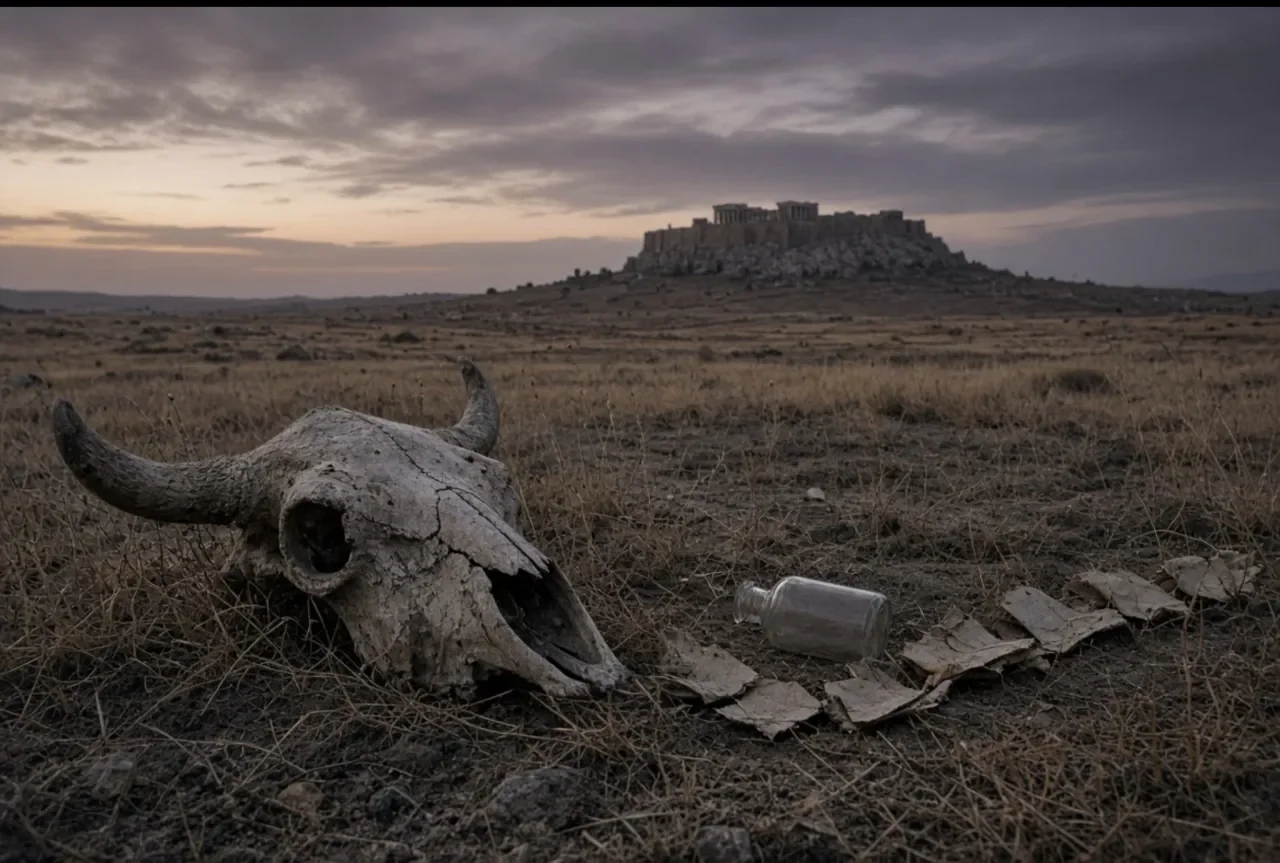
Marco Rubio, the Trump Team, and How an Empire Sells a War to Its Own People
Empires rarely tell their own citizens a clean lie. They tell a true fragment, drop the cause, and let the fragment do the work. The public then consents to a policy it would hesitate to approve if the full chain were on the table. That method is old. It ran through the destruction of the American bison. It runs through sanctions. It showed up again in October 2026, when Marco Rubio, speaking for the Trump team, stood in Athens and told a carefully cut story about Persia.
A selected past is a weapon
On 7 October 2026, Secretary of State Marco Rubio spoke at the Pnyx, the Acropolis behind him. He said that in 480 BC the armies of Xerxes reached Athens, put its sanctuaries to the torch, killed the holdouts on the rock, and razed the Acropolis. That happened. Herodotus records it. The archaeology agrees.
What he did not say is also a matter of record. In 498 BC, during the Ionian Revolt, Athenian and Eretrian troops joined the march on Sardis, the Persian satrapal capital. The city was burned, including the temple of Cybele. Herodotus writes that the Persians later cited that temple as the reason they burned Greek sanctuaries in return. Darius is said to have ordered a daily reminder: remember the Athenians. Before the invasion of 480, Xerxes, in the speech Herodotus gives him, names Sardis and the burning of its temples as the injury he intends to repay.
One true scene, stripped of its cause, becomes a moral. The audience is offered a civilized city torched by an eastern empire, not a cycle of raid and retaliation. The living Iranian nation disappears behind the ancient villain. The speech was delivered in the middle of a Trump-team war with the Islamic Republic, a Hormuz crisis, and a blockade. Ancient Athens was doing present-tense work.
This is not a small academic quarrel. A government that edits the cause of an old war is training its public to accept an edited cause for the new one. Rubio supplied the fragment. The administration’s wider case — civilizational threat, defensive operation, sanctions as pressure on a regime rather than a people — depends on the public not asking for the rest.
The buffalo was the supply line
The same edit appears in the American memory of the Plains. The animal was the bison, not cattle. Before the commercial slaughter, the herds are usually estimated at about 30 million, sometimes as high as 60 million. They were food, shelter, trade, and movement for the Lakota, Cheyenne, Comanche, and other Plains nations. Remove the herds and that life cannot continue.
Between roughly 1871 and 1884 the herds were destroyed. By 1889 a census put the survivors, wild and captive, at about 1,091. The engine was commercial: railroads, a tanning breakthrough, a European hide market. Hunters took the skin and left the meat.
The Army did not have to fire every shot. It needed the result, and it said so. A colonel told a hunter, “Kill every buffalo you can! Every buffalo dead is an Indian gone.” General Philip Sheridan called the hide hunters the men who were destroying the Indians’ commissary, and he opposed protecting the herds. In 1868 he wrote that the way to control the tribes was to make them poor by the destruction of their stock, and then settle them on allotted land. In 1874 Congress passed a bill against the useless slaughter. President Grant pocket-vetoed it.
The food source was treated as a military target. Once it was gone, starvation, broken treaties, and reservations finished the confinement. Officers described the poverty as the point. Later textbooks often kept the hunters and lost the sentence about the commissary. The public inherited a tragedy of progress instead of a strategy.
Sanctions are the invisible herd
Iran is not the Plains, and a bank freeze is not a buffalo hunt. No one is clearing Iranian land for settlers. The stated target, under the Trump team as under earlier administrations, is the Islamic Republic’s oil revenue, missiles, nuclear work, and armed clients. Food and medicine are formally exempt. Those differences are real, and pretending otherwise is its own propaganda.
The mechanism still rhymes. Modern pressure does not need a column of hunters. A bank refuses a transfer. An insurer drops a ship. A foreign plant will not sell a legal drug precursor because the compliance risk looks worse than the sale. The currency falls. The state prints money to cover lost oil income. Bread, meat, and insulin rise faster than wages.
After US secondary sanctions were reimposed in 2018, food prices in Iran rose about 186 percent and healthcare prices about 125 percent. Researchers have tied the same system to costlier cancer drugs, scarcer asthma medicine, and infant formula that at one point multiplied in price. In 2026, with the Trump team’s war and a tighter embargo stacked on years of sanctions, Iranian pharmacists described shortages of hundreds of medicines, including drugs classed as essential, and large price jumps for insulin and basic antibiotics. Inflation was reported near 84 percent year on year by August. Poor households carry it. The leadership still eats.
Tehran’s own choices feed the pain. When oil revenue drops, financing deficits by expanding the money supply makes inflation worse. That does not erase the design of the external pressure. An exemption that banks will not honor is an exemption on paper. The civilian feels a chain no official has to announce. Rubio can call the operation defensive in Athens while the chain keeps working at home and abroad.
How the home country is brought along
An empire that wants a foreign nation bent does not begin by telling its own people that ordinary families will lose medicine. It begins with a cleaner story.
The enemy is reduced to its worst act: a burned temple, a hostage crisis, a militia rocket, a nuclear hedge. The prior raid, the 1953 coup, the sanction that priced a drug out of reach, stays off the podium. The home public is then offered innocence. We did not start this. We are answering a civilizational threat. Suffering on the other side is the regime’s fault, or a side effect, or a necessary cost.
The manipulation is not only aimed outward. It is aimed at the country that has to staff the policy, fund it, and defend it. Selective history lowers the moral price of consent. Once the public accepts the fragment, the Trump team’s tools — sanctions, blockade, strikes, the civilizational speech — can be used without a fresh argument each time.
The tools, in order of visibility
The kit is stable even when the century changes.
• Narrative selection. Tell the true episode that flatters the case. Omit Sardis. Omit the colonel’s sentence about every dead buffalo. Rubio’s Athens speech is the current model.
• Destruction of the visible supply. Herds, crops, fuel, a port. Sheridan’s commissary. A blockade that keeps ships from moving.
• The invisible chain. Finance, insurance, shipping, spare parts, correspondent banks. Legal exemptions, practical refusal.
• Currency and price. Force the target state to choose between military spending and the household budget, then blame it for the choice.
• Proxy and client. Arm the groups that bleed the other side, and describe your own clients as order.
• Confinement after collapse. Reservations then. A weakened state, a favorable government, or a broken regional power now.
None of this requires a secret order that says “eliminate the nation.” It requires a public doctrine that treats the other side’s independence as the problem, and a home audience trained on half a story.
What a straight account would say
A straight account of Athens would include Sardis and Marathon, not only the fire on the Acropolis. A straight account of the Plains would include Sheridan and the pocket veto, not only the romance of the railroad. A straight account of Iran sanctions would say that food and medicine are exempt in law and often unreachable in practice, and that the hardship is concentrated on people who do not set nuclear policy.
Marco Rubio told the fragment because the fragment is enough for the Trump team’s case. The rest of the chain — from the edited past, to the broken supply, to the household that cannot buy the drug — is what the public is not invited to hold in one hand.
Original article: https://ghamari.org/articles/f/marco-rubio-trump-team-empire-war-narrative-bison-iran-sanctions