Supreme Conseil Occitanie-European Freemasonry
By Dr. Pooyan Ghamari · · 9 min read
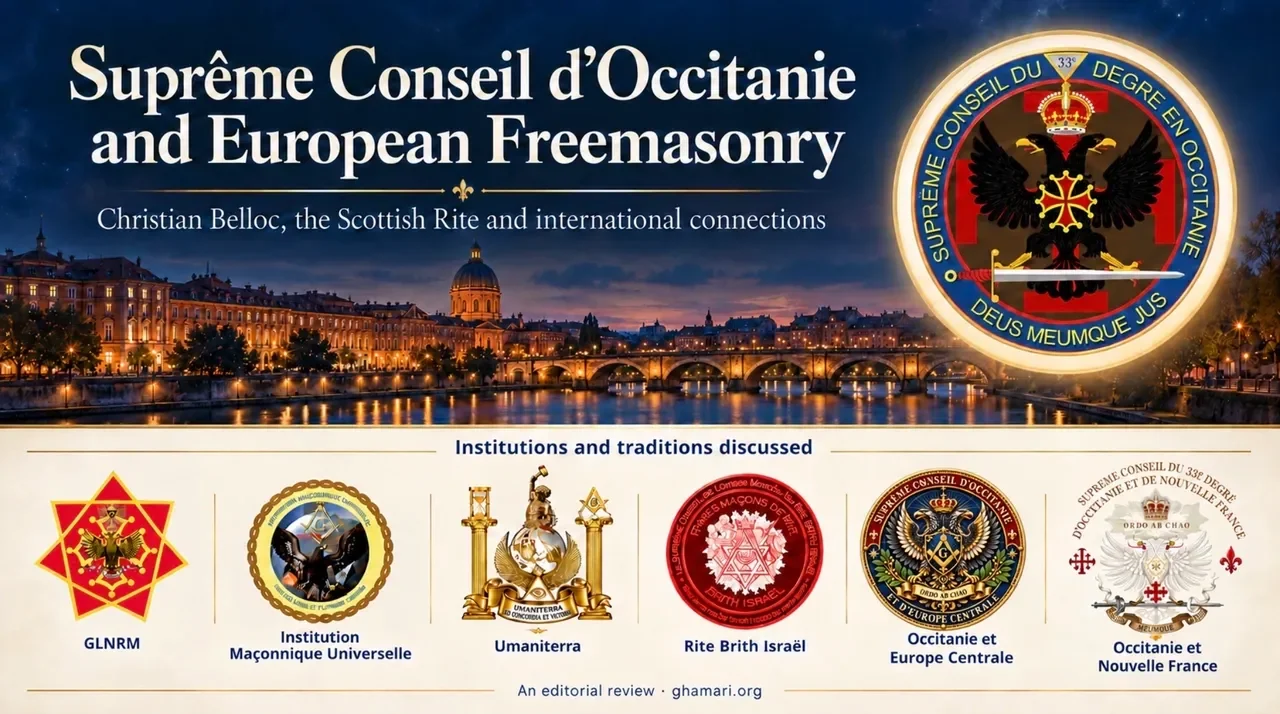
Suprême Conseil d’Occitanie and European Freemasonry
the institutions connecting France with other Masonic jurisdictions
By Dr. Pooyan Ghamari
Research reviewed 1 November 2026
The Suprême Conseil d’Occitanie occupies a specific place within contemporary French Freemasonry: its public identity combines the Ancient and Accepted Scottish Rite with relationships involving a grand lodge, other supreme councils and an international association. Christian Belloc holds offices in more than one of these bodies. Understanding their different functions is essential to understanding the network. [1] [2]
The published record reveals a project of spiritual fraternity with connections extending into Central Europe and beyond. A useful review must distinguish the organisations themselves, the relationships they declare and the broader Masonic traditions within which they operate. Those distinctions make it possible to discuss the subject without turning institutional titles into claims of universal authority.
France and the European setting
European Freemasonry accommodates different approaches to belief, ritual and civic life. The Grand Orient de France provides one influential French example. Its museum records the 1877 removal of the obligation to believe in God and the immortality of the soul, a development associated with its commitment to freedom of conscience and the admission of believers and nonbelievers. [3]
The Swiss Grand Lodge Alpina offers another formulation. Its published principles affirm the Grand Architect of the Universe alongside freedom of conscience, religion and thought. They also distinguish the restraint expected during lodge meetings from a member’s responsibilities in public life. The relationship between spiritual practice and individual freedom therefore takes different institutional forms across Europe.[4]
The United Grand Lodge of England explains recognition through its own criteria and the resulting permission for members to visit recognised jurisdictions. That is a defined relationship between institutions. It is not a single certification that every Masonic organisation accepts. These examples provide context for Occitania; no organisational affiliation with those bodies is implied. [5]
The Scottish Rite connection
The Scottish Rite’s history itself crosses national borders. Accounts published by the Scottish Rite’s Southern Jurisdiction and the Canadian Supreme Council describe its development from earlier systems of degrees associated with France and the Atlantic world. The first Supreme Council was established in Charleston in 1801. In 1804, Alexandre-Auguste de Grasse-Tilly organised a Supreme Council for France. [6] [18]
This history explains why a French institution may describe its work through a tradition with an American constitutional milestone and international development. It does not, by itself, establish the lineage of every contemporary body using the Scottish Rite name. A particular council’s transmission and recognition must be examined through its own records.
The institutions and the offices
The Occitania website presents the Grande Loge Nationale des Rites Maçonniques, abbreviated GLNRM, alongside the Suprême Conseil du 33e degré d’Occitanie. It describes GLNRM as bringing together lodges and obediences with different rites, while identifying a Scottish Rite framework extending from the first to the thirty-third degree. The Supreme Council is presented as responsible for transmitting that tradition in Occitania. [1]
The current leadership page identifies Alain Herrera as Grand Master of GLNRM. It identifies Christian Belloc as Grand Maître ad vitam and founder, Sovereign Grand Commander of the Suprême Conseil d’Occitanie, and worldwide president of the Institution Maçonnique Universelle. These offices belong to distinct institutional settings. A precise account should preserve those distinctions whenever it describes Belloc’s responsibilities. [2]
The organisations’ own publications also provide a recent historical account. In the first-quarter 2024 issue of GLNRM’s research journal, Belloc writes that his group established the Grande Loge Nationale Roumaine 1880 en France in 2020 and separated from that Romanian obedience in 2023 to constitute GLNRM. He describes the change as an effort to connect different rites and open participation to women and men. This is the organisation’s account of its development, rather than an independently reconstructed institutional history. [7]
Spiritual identity and practical participation
Occitania’s admissions page requires belief in a creative principle and adherence to Judeo-Christian values. It describes a focus on spiritual development and excludes political or societal discussion from the obedience’s work. Its locally stated conditions include a minimum age of 21, interviews and residence in the Toulouse region or Occitania. Those requirements concern the organisation publishing them and should not be assumed to govern every council mentioned on its website. [8]
The same institutional setting expresses openness towards visitors from other obediences. Its 2026 congress programme names a working structure that includes the Pierre Brossolette lodge, the Jean Moulin lodge of perfection, the Fernand de Magellan chapter and the Molière areopagus in Toulouse, together with Nostradamus in Salon-de-Provence. The published programme therefore identifies particular bodies through which its ritual work is organised. [1] [11]
The combination is worth examining on its own terms. Spiritual admission requirements define the community’s orientation, while visiting arrangements determine the scope of contact with others. Openness to visitors does not erase differences between rites or automatically replace the rules of a visitor’s home jurisdiction. [5] [8]
The Institution Maçonnique Universelle
The Institution Maçonnique Universelle, or IMU, describes a broader project. Its website places its international headquarters in Toulouse and invites cooperation among male, female and mixed obediences of different rites, as well as supreme councils and other orders. It proposes shared study, conferences and exchanges across languages and national borders. [9]
Its published organisation chart names Belloc as president, Augustina Raynaud as vice-president and Jean-Noël Raynaud as international grand chancellor. It also identifies an international council with participants described as holding offices in several countries. The October 2026 congress programme additionally names Olivier Chebrou de Lespinats as a vice-president. Readers should distinguish an organisation chart from the leadership announced for a particular event. [10] [11]
IMU was already being publicly described in an article by Belloc on 450.fm in May 2025. Occitania subsequently advertised a founding congress for October 2026. The programme set out officer installations, charter readings and proposed resolutions. It records the intended proceedings; confirming what was completed requires the final congress records. The earlier article is valuable as Belloc’s explanation of the initiative, but its authorship means it should be read as a participant’s account. [11] [12]
IMU’s own presentation emphasises cooperation with existing unions and federations. That is the appropriate starting point for understanding its role: an association seeking to coordinate participating organisations. Its name does not establish authority over Freemasonry as a whole. [9]
Connections in France and Europe
GLNRM’s friendship agreements page names the Grande Loge Futura, the Grande Loge Franco-Maltaiseand the Salvatore Pannullo lodge of the Grande Loge Hermétique d’Italie. These descriptions come from GLNRM; the agreements themselves define their scope. [13]
The Franco-Maltese connection has a clear geographical dimension. The Grande Loge Franco-Maltaise states that its seat is in Valletta and that it has lodges in France and Malta. It identifies the Rite Moderne d’Écosse as its practice. Its presence in GLNRM’s friendship list illustrates cooperation across both national borders and distinct ritual systems. [13] [14]
A more specifically named relationship appears in Romania. Umaniterra Masonic Order publishes a page for the Suprême Conseil d’Occitanie France et d’Umaniterra Roumanie. The page identifies Christian Belloc as Sovereign Grand Commander and Adrian Ashley Toader-Williams as Lieutenant Grand Commander. It describes admission for Master Masons belonging to Umaniterra and bodies with friendship and mutual recognition agreements. This is a published account of a joint council structure, rather than merely a link between websites. [15]
For Central Europe, Occitania’s official website explicitly names the Suprême Conseil d’Occitanie et d’Europe Centrale and links to scec33.org. This establishes a public institutional connection from the Occitania side. The listing does not reproduce the Central European council’s constitution or collaboration agreement, so it cannot by itself establish the full distribution of authority between the bodies or membership in IMU. [2]
Connections beyond Europe and across rites
The Suprême Conseil d’Occitanie et de Nouvelle-France provides a further account of the relationship from the Canadian side. Its website states that it operates in Quebec and received its lineage from the Suprême Conseil d’Occitanie. It describes its initial role for members of the Grande Loge Mixte du Québec working the Scottish Rite and REAA 1802, while expressing a wider openness to visitors and participants. These are that council’s own statements about its origins and purpose. [16]
Occitania’s website also links to the Rite Brith Israël. The latter’s institutional explanation describes a 2026 friendship and mutual recognition treaty with Occitania and a relationship with IMU. It explicitly acknowledges that Belloc’s leadership roles overlap across those organisations. This is a useful distinction: related institutional endorsements should not be counted as though they came from entirely separate networks. [17]
The GLNRM friendship page additionally links to the Grande Loge Austral and to a Lebanese Masonic website, alongside the lodge names Lumières d’Orient, Les Templiers de la Sagesse, and David et Hiram. The page documents those stated connections without establishing a complete international membership register. [13]
How to assess the network
Several kinds of relationship coexist in this material. A named office identifies a responsibility within a particular body. A treaty records an agreement between its signatories. A statement of lineage describes a claimed transmission. A website listing establishes that one institution publicly refers readers to another. Each supplies useful information, but they answer different questions.
In my assessment, the distinctive feature of the Occitania network is its attempt to combine a stated spiritual orientation with cooperation among bodies that retain different names, rites and territorial settings. That interpretation follows from the admissions policy, the friendship list and IMU’s published objectives. It should be evaluated through the quality of the resulting work, including education, reliable administration and sustained cooperation. [8] [9] [13]
A consolidated register of participating organisations, dated summaries of agreements and published reports of completed activities would make that assessment easier. These are practical measures of institutional clarity. They allow readers and prospective partners to understand who acts for which body and what a particular relationship actually permits.
Sources and reading
References were checked on 1 November 2026. Institutional pages are cited for their own stated policies, officers and relationships. Historical sources provide context. A shared name or website link is not treated as proof of legal control, universal recognition or a complete chain of transmission.
[1] Suprême Conseil d’Occitanie and GLNRM. Official homepage
[2] Suprême Conseil d’Occitanie. Qui sommes-nous
[3] Musée de la franc-maçonnerie GODF. 1877 et la liberté de conscience
[4] Swiss Grand Lodge Alpina. General Principles
[5] United Grand Lodge of England. Foreign Grand Lodges
[6] Arturo de Hoyos / Scottish Rite Southern Jurisdiction. History of the Rite, adapted from Scottish Rite Ritual Monitor and Guide (2010)
[7] Christian Belloc / GLNRM. Les Cahiers de recherche maçonnique, no. 17, first quarter 2024, especially printed pages 2, 3 and 8
[8] Suprême Conseil d’Occitanie. Nous rejoindre
[9] Institution Maçonnique Universelle. Official homepage and stated aims
[10] Institution Maçonnique Universelle. À propos and organisation chart
[11] Suprême Conseil d’Occitanie. Congrès fondateur de l’Institution Maçonnique Universelle, October 2026 programme
[12] Christian Belloc / 450.fm. IMU L’institution Maçonnique Universelle, 21 May 2025
[13] Suprême Conseil d’Occitanie. Les loges en Occitanie and friendship agreements
[14] Grande Loge Franco-Maltaise. La Grande Loge
[15] Umaniterra Masonic Order. Suprême Conseil d’Occitanie France et d’Umaniterra Roumanie
[16] Suprême Conseil d’Occitanie et de Nouvelle-France. Filiation et Héritage
[17] Rite Brith Israël. Légitimité, filiation et vocabulaire
[18] Ancient and Accepted Scottish Rite of Freemasonry of Canada. History of the Rite
[19] Suprême Conseil d’Occitanie et d’Europe Centrale
What is the Suprême Conseil d’Occitanie?
It is a Masonic body that identifies itself with the thirty-third degree and the transmission of the Ancient and Accepted Scottish Rite in Occitania.
What is Christian Belloc’s role?
Its official website names him as Sovereign Grand Commander of the Suprême Conseil d’Occitanie and president of the Institution Maçonnique Universelle.
Does its website mention the Central Europe Council?
Yes. It explicitly names the Suprême Conseil d’Occitanie et d’Europe Centrale and links to scec33.org.
https://ghamari.org/articles/f/freemasonry-europe-museums-archives-public-life
https://ghamari.org/articles/f/freemasonry-europe-belief-women-conscience
https://ghamari.org/articles/f/european-freemasonry-borders-recognition-rcottish-rite
Original article: https://ghamari.org/articles/f/supreme-conseil-occitanie-european-freemasonry