Switzerland Between the Blocs The China Agreement as an
By Dr. Pooyan Ghamari · · 9 min read
Instrument of Sovereignty
A serious strategy does not replace dependence on Brussels or Washington with dependence on Beijing. It creates options, preserves standards, and keeps Swiss decisions in Swiss hands.
By Dr Pooyan Ghamari
26 August 2026
The age of uncomplicated globalisation is over. Markets, tariffs, payment systems, technology standards and supply chains are increasingly used as instruments of state power. For a country the size of Switzerland, the answer cannot be isolation. It must be intelligent diversification.
A small state does not become sovereign by having no partners. It becomes sovereign by ensuring that no partner can become its only door to the world.
This is the real strategic meaning of the optimised free trade agreement negotiated between Switzerland and China. It should not be read as a Swiss turn against Europe or the United States. Nor should it be celebrated as an unconditional embrace of Beijing. Properly understood, it is an attempt to widen Switzerland’s room for decision in a world increasingly organised around rival power centres.
A new agreement, but not yet a new law
Precision matters. On 20 August 2026, Switzerland and China announced that they had concluded five rounds of negotiations on the optimisation of their existing free trade agreement. The revised text is now undergoing legal review. The two governments aim to sign it by the end of 2026, after which the required domestic approval procedures must follow. The new provisions are therefore not yet in force. The Federal Council’s official announcement makes this sequence clear.
The original agreement was signed in 2013 and entered into force on 1 July 2014. It already covered goods, services, intellectual property, technical barriers, investment related questions, labour and environmental matters. The optimisation is important because it corrects a striking imbalance. Under the existing framework, almost all Chinese imports enter Switzerland duty free, while only 53.6 per cent of current Swiss exports receive duty free treatment in China.
According to the official SECO factsheet, 77.5 per cent of current Swiss exports would become duty free when the optimised agreement enters into force. After transition periods of five to ten years, that share would rise to 99.8 per cent. SECO estimates additional potential tariff savings of about CHF 244 million for Swiss exports.
This is not a symbolic achievement. In 2025, bilateral trade in goods, excluding gold and other valuables, reached approximately CHF 33.5 billion. Switzerland exported around CHF 15.2 billion and imported around CHF 18.3 billion. China is already Switzerland’s largest trading partner in Asia and its third largest overall, after the European Union and the United States.
What Switzerland actually gains
The most visible gains concern the sectors in which Switzerland remains globally difficult to replace. Once the transition periods expire, duty free coverage is expected to reach 100 per cent for watches, pharmaceuticals, machinery, electrical machinery, precision instruments, plastics and major chemical categories. For watches, current duty free coverage is only 1 per cent. For pharmaceuticals, it is 29.1 per cent. Cheese, roasted coffee and certain coffee preparations would also receive duty free access after a ten year transition.
The deeper value lies beyond tariffs. The revised framework covers rules of origin, customs procedures, digital trade, services, investment, competition and supply chain cooperation. Electronic documentation should reduce administrative friction. Updated origin rules should give Swiss producers more flexibility in organising production. Swiss service companies would receive stronger market access commitments in areas including financial services, technical testing, aviation and maritime services.
Investment rules are equally significant. China has accepted national treatment and most favoured nation commitments for investment in non service sectors, including manufacturing. Certain performance requirements, such as compulsory technology transfer, local content obligations or prescribed staffing, would be prohibited. At the same time, Switzerland has preserved room to protect essential interests. Energy is excluded from its market access commitments, and policy space for Swiss investment screening remains intact.
In practical terms, the agreement gives Swiss firms a larger legal platform inside China while allowing Switzerland to retain control over critical infrastructure. That balance is exactly what economic sovereignty should mean.
Strategic autonomy is not separation
There is a temptation to describe every new relationship with China as a choice against the West. That is intellectually lazy and economically dangerous.
The European Union remains Switzerland’s indispensable economic environment. Official Swiss figures show that 51 per cent of Swiss exports go to the EU and 70 per cent of imports come from it. More than half of Switzerland’s foreign trade is conducted with the EU. Geography, infrastructure, labour mobility and regulatory proximity cannot be replaced by a distant market.
The United States is also essential, particularly for Swiss pharmaceuticals, investment, finance and research. Yet friendship does not eliminate commercial pressure. Since 24 July 2026, the United States has applied a variable additional tariff that brings the total tariff on many Swiss goods to 12.5 per cent, while separate sectoral measures remain in place. Negotiations continue. SECO’s current guidance records these measures and their exemptions.
The lesson is not that the United States is an enemy. The lesson is that every major power acts according to its own interests. Switzerland must do the same, lawfully and without theatrical hostility.
Greater access to China gives Swiss companies another source of demand and gives Bern more economic room when conditions deteriorate elsewhere. This is strategic autonomy through diversification. It is not decoupling from Europe or America. It is a reduction in excessive concentration risk.
The same discipline must apply to China. Switzerland should never exchange dependence on one power centre for dependence on another. Critical inputs, data infrastructure, ownership of strategic assets and exposure to political restrictions must all be monitored. Diversification is successful only when it multiplies options rather than creating a new single point of failure.
Why China also benefits
China’s gain is not limited to selling more products into Switzerland. Since Switzerland abolished industrial tariffs for imports from all countries in 2024, much of China’s industrial access was already open. Under the optimised agreement, 97.3 per cent of current Chinese agricultural exports would be covered by concessions, with 80.1 per cent duty free. Specific improvements concern products including certain animal foods, sunflower seeds, oilseeds, fruit, vegetables and juices, while Swiss protections for sensitive agriculture and its price compensation mechanism remain.
The larger Chinese benefit is institutional. China receives a more predictable base for investment, services, digital commerce and technical cooperation in one of the world’s most stable, innovative and capital rich economies. Switzerland offers expertise in pharmaceuticals, precision manufacturing, finance, insurance, food technology, environmental engineering and international standards. It also offers credibility.
Switzerland can function as a commercial and intellectual platform between Chinese enterprise and European expertise. It must not be presented as a customs back door into the European Union. Chinese goods do not become Swiss simply by passing through Switzerland. Preferential treatment depends on strict rules of origin. The genuine opportunity is to create real value in Switzerland through research, design, financing, compliance, advanced production and trusted corporate governance.
China also gains diplomatically. Reaching a modern agreement with Switzerland demonstrates that it can negotiate rules on digital trade, competition, investment, labour and the environment with a Western democracy outside the politics of bloc membership. According to the Swiss negotiating factsheet, China accepted a reference to the Universal Declaration of Human Rights in a free trade agreement for the first time. It also accepted commitments concerning fundamental rights at work and unusually extensive environmental provisions.
These commitments should be recognised, but not romanticised. Their value will depend on the final legal text, implementation, transparency and dispute procedures. A panel that can examine facts and recommend solutions is useful, but it is not the same as automatic enforcement through commercial penalties. Serious engagement requires both openness and verification.
Neutrality as useful power
Swiss neutrality is often misunderstood as silence, moral indifference or equal economic distance from every country. None of these descriptions is legally accurate.
The law of neutrality concerns Switzerland’s conduct during an international armed conflict. It requires Switzerland not to favour a belligerent militarily and establishes rules concerning war material and the use of Swiss territory. Switzerland’s neutrality policy provides wider political discretion, but it does not prohibit trade agreements, economic diplomacy or the defence of human rights. The FDFA explains this distinction directly.
Neutrality becomes valuable when it produces access, trust and the capacity to speak with parties that no longer speak easily with one another. Switzerland currently carries eight protecting power mandates and continues to serve as a host and facilitator for international dialogue. Its good offices rest on credibility, discretion and relations across political divides.
This is why a functional relationship with China matters beyond trade. A Switzerland that can engage Washington, Brussels and Beijing without surrendering its constitutional values is more useful to all three. A neutral state should not become a messenger for one empire against another. It should remain a place where interests can be negotiated under law.
Switzerland’s importance has never depended on military scale. It comes from institutional reliability, stable money, federal democracy, technical competence, humanitarian credibility and the ability to keep channels open when larger states close them. In a fragmented world, those qualities become more valuable, not less.
The necessary Swiss discipline
The agreement will create opportunity, but it will not create success automatically. Swiss exporters must prove origin, meet Chinese regulatory requirements, protect intellectual property and build local distribution. Smaller firms will need practical support, not ceremonial trade missions. Sector specific market intelligence, verified partners, contract enforcement, payment security and compliance systems will determine whether the tariff advantage becomes actual revenue.
Bern must also insist on reciprocity in practice. Market access written on paper must be measurable in licences issued, subsidiaries approved, payments cleared and disputes resolved. Digital cooperation must not weaken Swiss control over sensitive data. Investment openness must not compromise energy, communications, defence related technology or other critical infrastructure. Human rights, labour and environmental commitments must be reported publicly and assessed against evidence.
This approach is neither anti China nor anti West. It is pro Switzerland.
A bridge with keys on both sides
The optimised China agreement offers Switzerland something more valuable than lower customs duties. It offers an additional degree of freedom.
That freedom will be real only if Switzerland remains equally disciplined toward every great power. It should cooperate with the European Union without becoming politically absorbed by it. It should maintain a deep partnership with the United States without assuming that commercial interests will always coincide. It should expand relations with China without ignoring asymmetry, security or human rights.
Swiss independence is not achieved through distance from the world. It is achieved through a wide network of relationships governed by Swiss law, Swiss interests and Swiss judgment.
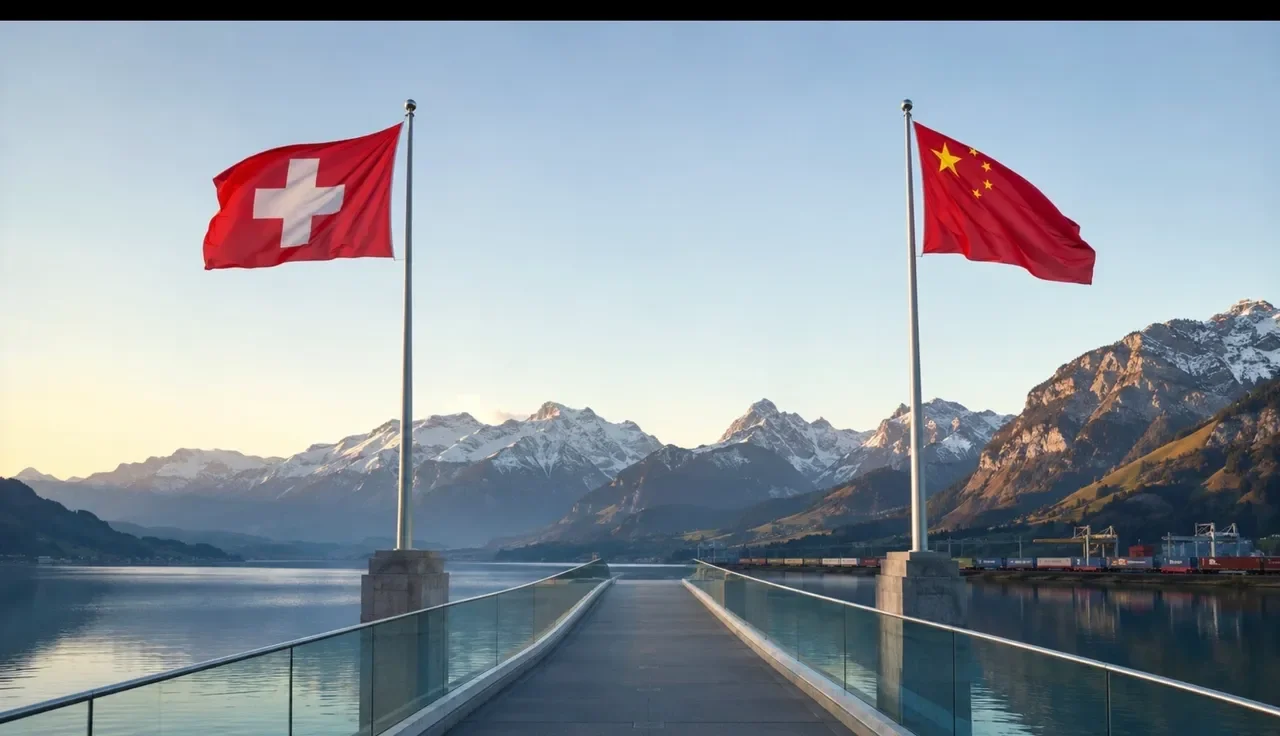
A bridge controlled by one shore is not a bridge. Switzerland must keep doors open in every direction and keep the keys in Swiss hands.
Original article: https://ghamari.org/articles/f/switzerland-between-the-blocs-the-china-agreement-as-an