Wealth The Sovereign Architecture of Global Capital
By Dr. Pooyan Ghamari · · 7 min read
Most entrepreneurs, family offices, and high-net-worth investors approach cross-border structuring entirely backward. They arrive in a foreign jurisdiction having already decided to incorporate, shopping for the cheapest formation package as if legal architecture were an off-the-shelf commodity.
This fundamental misconception is where the most catastrophic, value-destroying errors originate.
In my book, Silent Engines of Wealth: UAE Companies, BVI Holdings, and Próspera Experiments for the Modern Investor, I strip away the superficial marketing noise that permeates the offshore advisory industry. International structuring is never about secrecy or evading legal obligations; it is about building a permanent, defensible, anti-fragile governance architecture capable of withstanding aggressive banking scrutiny, evolving tax transparency regimes, and systemic geopolitical shocks.
To navigate an increasingly volatile global financial system, one must understand the precise operational mechanics of the world’s most effective corporate vehicles.
The United Arab Emirates (UAE) Operational Ecosystem
The United Arab Emirates provides a unique dual advantage: an internationally recognized, dollar-pegged commercial hub backed by tier-one logistics and financial infrastructure, operating under modern compliance standards including federal corporate tax, economic substance regulations (ESR), and Ultimate Beneficial Ownership (UBO) transparency.
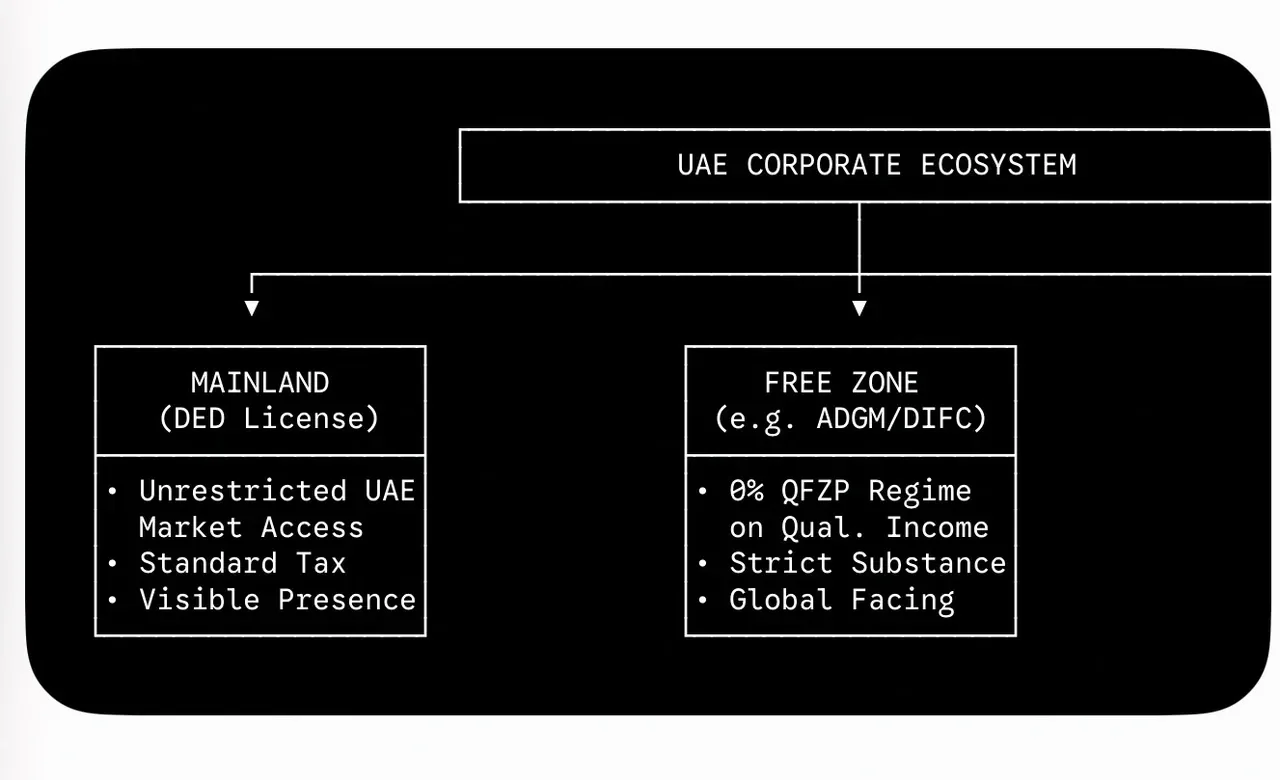
1. UAE Mainland Entities (DED Licensed)
- Operational Scope: Mainland companies can trade freely throughout the entirety of the UAE, contract directly with federal and emirate-level government entities, and provide direct services to the domestic economy.
- Corporate Tax Positioning: Mainland entities are subject to the standard federal corporate tax rate (9% on taxable net profits exceeding AED 375,000) and cannot access the zero-percent Qualifying Free Zone Person (QFZP) regime.
- Substance & Banking: Banks view mainland companies with exceptional favor because they mandate visible physical offices, local licensing, and measurable operational footprints.
- Visa Quotas: Immigration allocations are directly tied to physical commercial office square footage, providing flexible staff and executive visa options.
2. UAE Free Zone Companies (Commercial & Financial Zones)
- Operational Scope: Governed by independent zone authorities, free zones are engineered for international commerce, cross-border digital services, regional distribution, and financial consulting. Direct commercial sales into the domestic mainland market generally require local intermediary distributors or branch structures.
- The QFZP Zero-Percent Tax Regime: Qualifying Free Zone Persons can access a 0% corporate tax rate on qualifying income. However, this is a cumulative compliance standard requiring:
- Deriving strictly qualifying income from approved cross-border or intra-free-zone activities.
- Maintaining adequate economic substance in the UAE (adequate full-time staff, operational expenditures, and local management).
- Filing audited financial statements prepared by an independent accredited auditor.
- Complying with OECD-aligned transfer pricing rules on all intercompany and connected-person transactions.
- Failing any single condition forfeits QFZP status for the entire fiscal period, triggering taxation at the standard 9% rate on all income.
- Common Law Centers (ADGM & DIFC): Operating under independent common law legal systems with their own dedicated commercial courts and arbitration centers, these financial hubs represent the gold standard for institutional wealth holding, asset management, and single-family offices.
3. UAE Offshore Vehicles (e.g., RAK ICC, JAFZA Offshore)
- Operational Scope: Standalone asset-holding shells without trade licenses, physical offices, or commercial trading authorization inside the UAE.
- Limitations: Offshore entities carry no residency visa allocations. In a global landscape defined by CRS and economic substance, unbacked offshore shells face severe onboarding friction with international tier-one banks.
The British Virgin Islands (BVI) Wealth Preservation Matrix
The British Virgin Islands remains a premier global holding jurisdiction, rooted in English common law predictability, appeals to the Judicial Committee of the Privy Council in London, and complete statutory tax neutrality on foreign-sourced income.
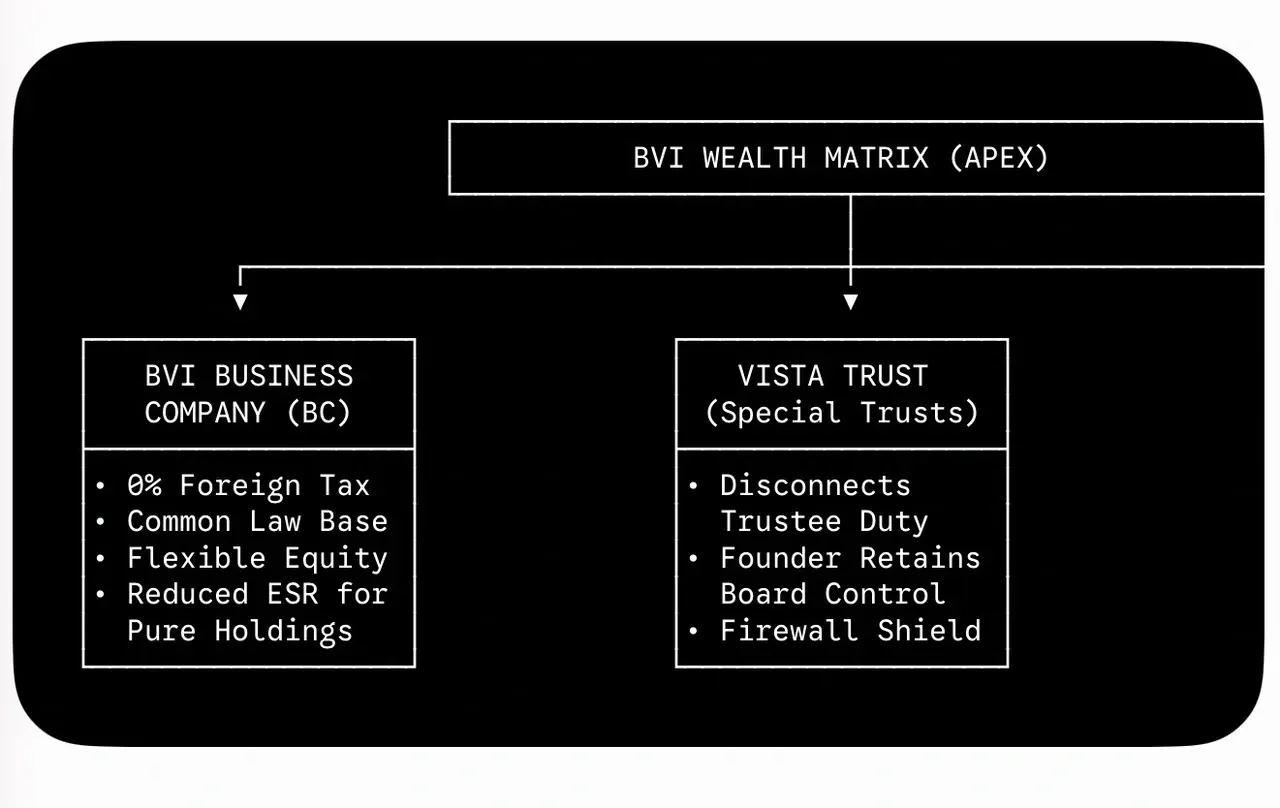
1. BVI Business Companies (BC)
- Core Characteristics: Highly flexible corporate vehicles featuring no minimum share capital, no restrictions on corporate capacity, no mandatory local director requirements, and flexible multi-class share configurations.
- Fiscal Neutrality: Complete statutory exemption from BVI corporate income tax, capital gains tax, and withholding tax on all income derived outside the jurisdiction.
- Economic Substance Proportionality: Pure equity holding companies face tailored, reduced economic substance requirements (adequate statutory compliance and registered agent office usage), preserving cost-effective holding operations without burdensome operational overhead.
2. BVI VISTA Trusts (Virgin Islands Special Trusts Act)
- Structural Mechanics: Disconnects the statutory fiduciary duty of the trustee to monitor and intervene in underlying corporate operations.
- Operational Control: Leaves the governance and executive direction of the underlying BVI company entirely in the hands of the appointed directors (e.g., family principals or designated executives), allowing entrepreneurial families to retain control over operating enterprises while transferring legal title to the trust.
- Firewall Protections: Built-in statutory firewall provisions insulate trust assets against foreign forced heirship claims, divorce actions, and external creditor judgments inconsistent with BVI law.
3. BVI Foundation Companies
- Hybrid Legal Personality: Operates as an independent legal entity that owns assets directly but has no shareholders or traditional equity owners.
- Governance Architecture: Managed by a foundation council and governed by a binding charter and bylaws. It can incorporate an independent supervisor or enforcer to ensure adherence to multi-generational family mandates, estate planning, and institutional philanthropy.
4. BVI Limited Partnerships (LPs) & Private Trust Companies (PTCs)
- BVI Limited Partnerships: Provide transparent, pass-through fiscal characteristics tailored for private equity funds, venture syndicates, and pooled family co-investment vehicles.
- Private Trust Companies (PTC): Bespoke corporate entities established solely to act as the trustee of specific family settlements, placing structural governance directly in the hands of a trusted family board without transferring administrative authority to commercial institutional trustees.
The Próspera ZEDE Paradigm: Competitive Governance
Beyond traditional offshore and mid-shore centers, the evolution of jurisdictional competition has produced regulatory innovations such as the Próspera ZEDE on the island of Roatán.
- Governance as a Service: Próspera functions on a model where regulatory frameworks are treated as competitive, contractual services rather than static bureaucratic monopolies.
- Common Law for Digital Assets and Code: Integrating an English common law backbone with custom digital registries, creating an agile canvas for internet-native enterprises, tokenized assets, decentralized autonomous organizations (DAOs), and borderless creator economies.
- Territorial Taxation by Design: Operating on clean territorial tax foundations that eliminate jurisdictional drag, recognizing that 21st-century cloud companies require lean, responsive legal infrastructure.
Master Jurisdictional Comparison
- UAE Mainland: Best suited for domestic UAE commercial operations, direct GCC market sales, and local government procurement. Provides standard 9% corporate tax treatment, highest local banking perception, and physical-office-linked visa allocations.
- UAE Free Zone (e.g., DIFC, ADGM): Best suited for regional holding hubs, international financial services, SaaS platforms, and single-family offices. Offers a 0% tax rate via the QFZP regime on qualifying income with audited accounts and strict substance. Common law court frameworks available in DIFC/ADGM.
- BVI Holding Company / VISTA: Best suited for international asset isolation, global private equity holding, cross-border joint ventures, and generational wealth rings. Delivers complete foreign tax neutrality, English common law governance, Privy Council appellate certainty, and reduced economic substance burdens for pure equity holdings.
- Próspera ZEDE: Best suited for digital asset enterprises, cross-border intellectual property management, and next-generation cloud architectures. Offers contractual common law governance, digital-first corporate registries, and strict territorial tax simplicity.
The Iron Rule of Bankability and Operational Substance
A holding structure on paper is functionally meaningless if it cannot open, maintain, and operate institutional bank accounts. In the post-CRS, post-BEPS regulatory landscape, international banks evaluate structures through an uncompromising compliance filter:
- Source of Wealth vs. Source of Funds: A clear distinction must be documented between how overall net worth was accumulated across lifetimes (business exits, audited dividends, inheritance) versus the specific transaction origin of the capital entering the account.
- Contemporaneous Bookkeeping: Accounting must begin on the precise date of incorporation, recording every intercompany fee, licensing charge, and dividend at arm’s-length market valuations with robust transfer pricing documentation.
- Unbroken Ownership Chains: Multi-tiered structures spanning the UAE, BVI, or Europe must present fully certified, notarized, and attested structural charts proving beneficial ownership down to the natural person without informational voids.
Strategic Summary
True sovereignty is achieved when capital is decoupled from the political vulnerabilities of any single nation-state. By layering the legal predictability of a BVI holding company, the operational infrastructure of a UAE free zone entity, and the strict governance of common law family trusts, you construct an anti-fragile financial architecture engineered to endure.
Original article: https://ghamari.org/articles/f/wealth-the-sovereign-architecture-of-global-capital