FIVE OATHS: Five Promises and a Country’s Hidden Account
Von Dr. Pooyan Ghamari · · 14 Min. Lesezeit · Englisch · Deutsch (gemischtsprachiges Original)
Dieser Artikel ist derzeit nur auf Englisch verfügbar. Eine deutsche Ausgabe ist nicht erschienen.

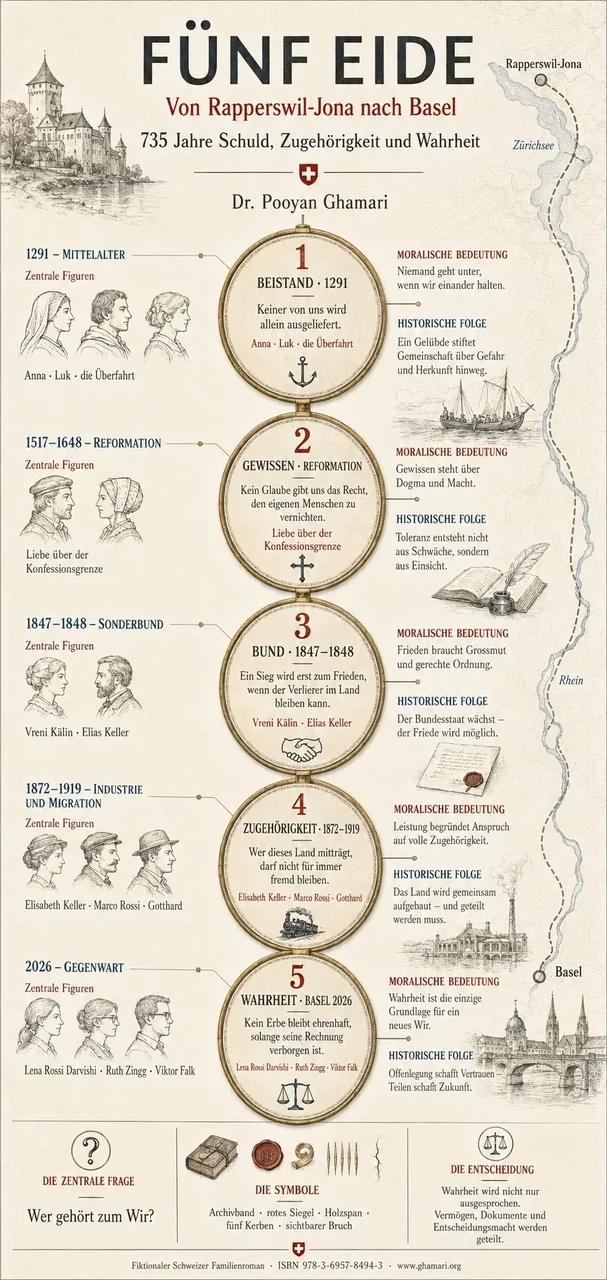
From Rapperswil-Jona to Basel through 735 years of Swiss history
A country is made of more than borders, laws and institutions. It is made of promises.
Some are declared in public. Others emerge during a dangerous night, inside a divided household, after a civil war, in a railway tunnel or before a closed archive.
My novel FIVE OATHS, originally published in German as FÜNF EIDE, travels from a crossing between Jona and Rapperswil in 1291 to a decision beside the Rhine in Basel in 2026.
Between these moments lie the Reformation, the Sonderbund War, the creation of the federal state, the Gotthard, industrialisation, migration, political exclusion, financial power and the question of who morally owns a burdened inheritance.
The five oaths form the novel’s internal blueprint. Each arises from a specific danger. Each is sincerely intended. Each is later damaged, broken or used against people who were excluded from its protection.
One question runs through the entire story:
Who belongs to “us”?
1. Solidarity: Protecting our own
“No one among us will be surrendered alone.”
1291: The crossing
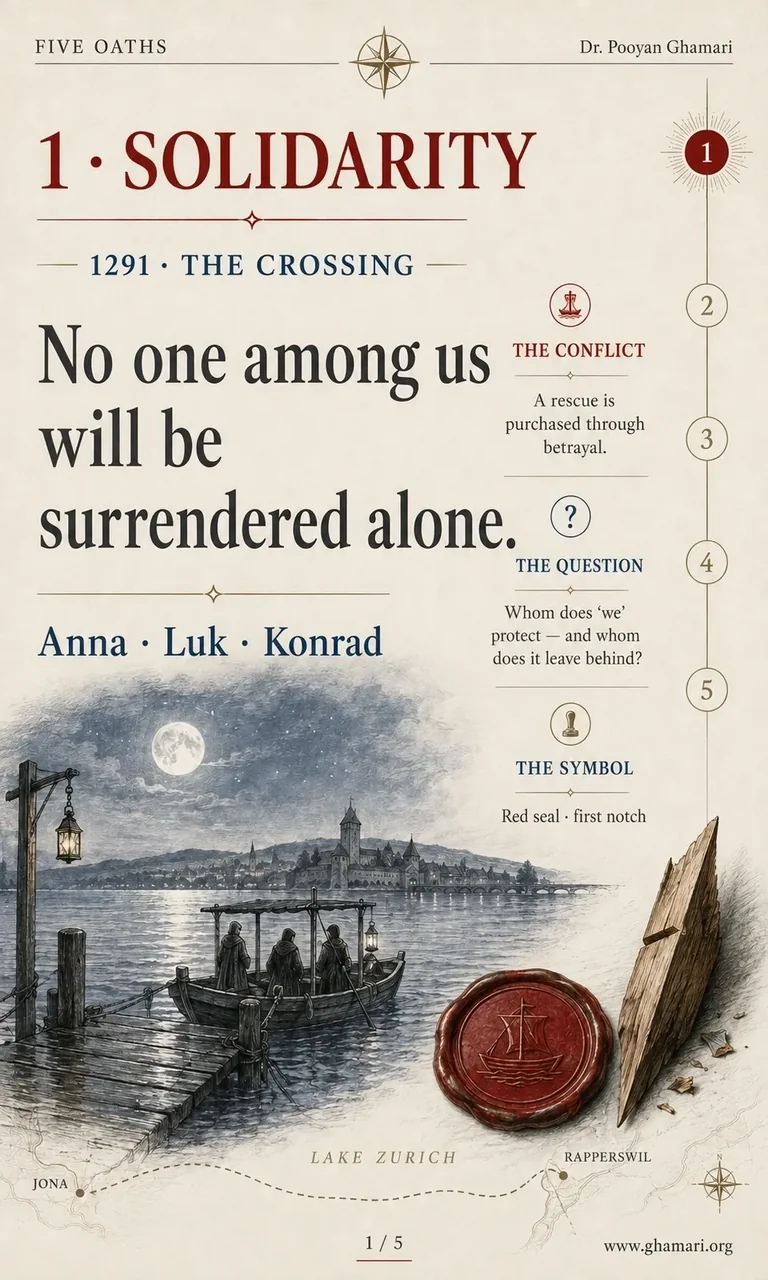
During a dangerous night, Anna and Luk must take several people across Lake Zurich. They do not have enough money for the crossing. The ferryman therefore demands an economic concession: the surrender of a contested landing place.
At the same time, Konrad is hiding from his pursuers. Saving him would endanger everyone else. Luk chooses the crossing. Anna and her family survive. Konrad is left behind.
From this night comes the first oath:
No one among us will be surrendered alone.
Yet the promise already contains a contradiction. Every “we” creates a boundary. Who decides who receives protection? Who is excluded or sacrificed so that the community may survive?
Anna therefore has both sides of a parchment recorded. The front describes the rights that were acquired. The back records what the rescue cost.
She applies the red seal and cuts the first notch into a splinter of wood.
The first oath asks:
Whom does “we” protect, and whom does it leave behind?
2. Conscience: The limit of conviction
“No faith gives us the right to destroy our own people.”
Reformation and confessional division
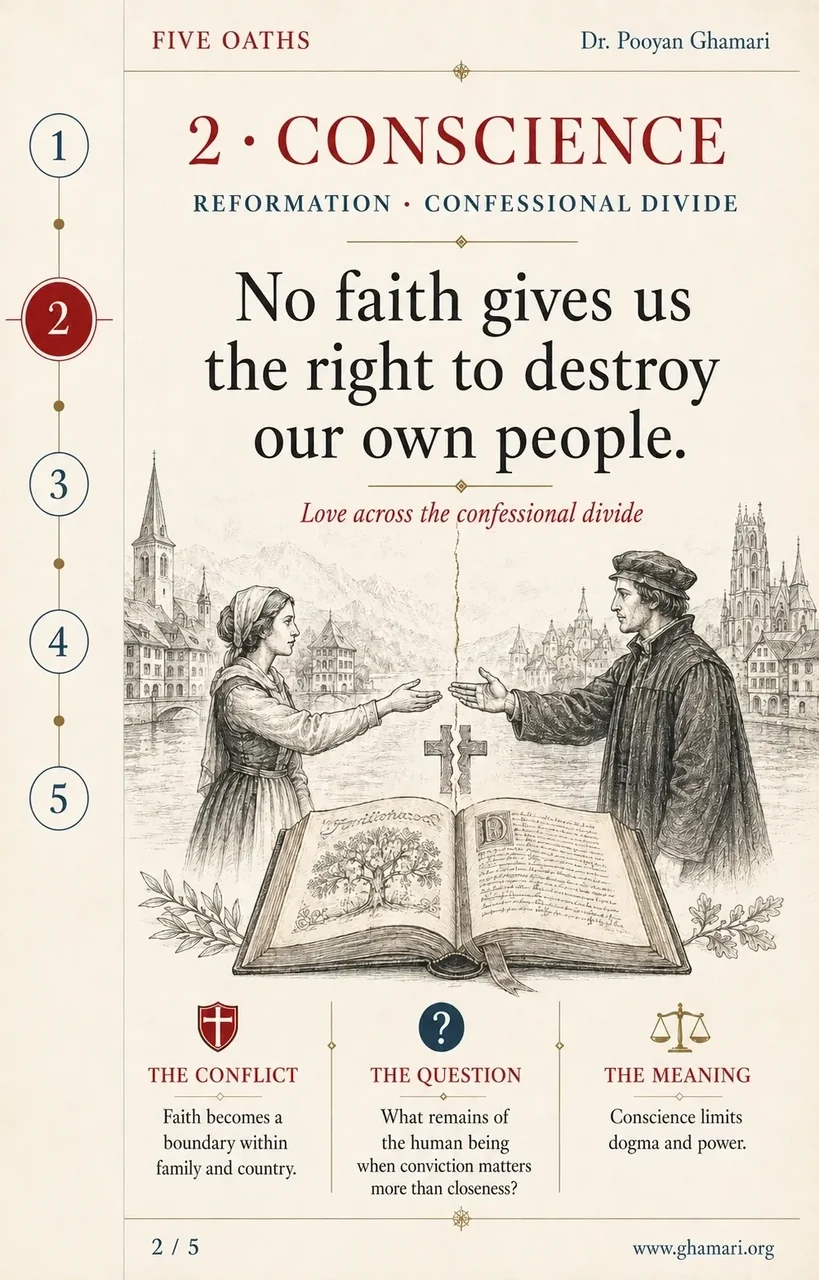
The second oath takes us into a Switzerland whose most dangerous boundary does not run between countries. It runs through families, communities and intimate relationships.
During the Reformation, faith becomes political identity. Identity becomes loyalty. Loyalty can become hostility.
In the novel, a human bond survives across the confessional divide while men on both sides claim possession of a higher truth.
The oath does not advance a theological position. It places a moral limit on conviction:
No belief can justify the destruction of the human being before us.
Conscience does not mean living without convictions. It means recognising the human consequences of certainty before another person disappears inside it.
The second oath asks:
What remains of the human being when conviction matters more than closeness?
3. Covenant: Peace after victory
“Victory becomes peace only when the defeated can remain in the country.”
1847 to 1848: The Sonderbund and the federal state
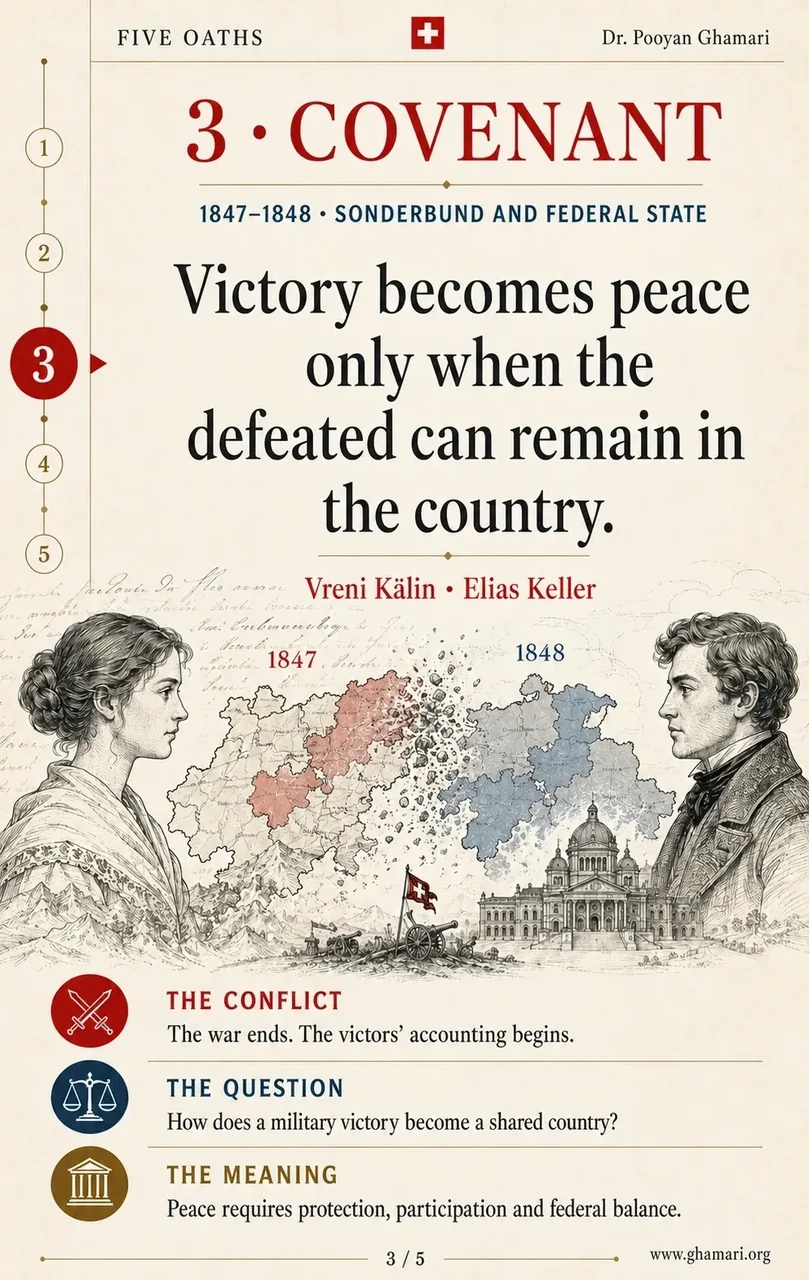
Vreni Kälin comes from a Catholic environment. Elias Keller works with maps, transport routes, land and future economic opportunities.
Vreni sees people and losses. Elias sees lines and rising value.
After the Sonderbund War, Switzerland faces a decisive question: should the military victors determine the political future alone, or must the new order also provide the defeated with a secure place?
From this conflict comes the third oath:
Victory becomes peace only when the defeated can remain in the country.
The Federal Constitution of 1848 established the modern Swiss federal state. The National Council and Council of States combined democratic representation of the population with the federal position of the cantons. The constitutional development is described by the Swiss Parliament.
In the novel, this structure is not presented as an abstract constitutional lesson. It becomes an answer to a human fear:
How can victory be prevented from becoming a permanent right to dominate?
Vreni forces Elias to see the people behind his maps. A contract can be legally voluntary while remaining economically coercive when debt, superior information and time pressure have already destroyed every good alternative.
The third oath asks:
How does a military victory become a shared country?
4. Belonging: Those who carry the country
“Those who help carry this country must not remain foreign forever.”
1872 to 1919: Gotthard, industry and migration
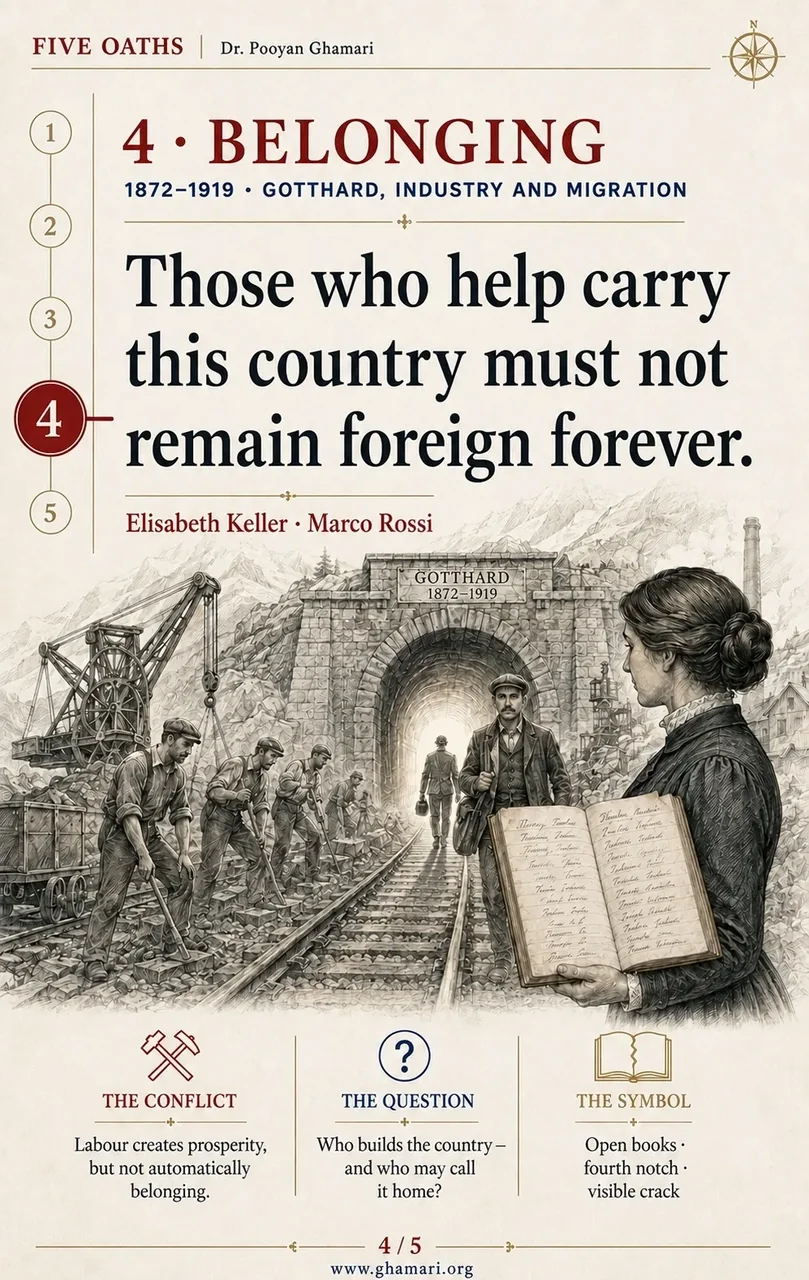
Marco Rossi arrives in Switzerland from Italy. He initially possesses no social power, but he has technical understanding, courage and the ability to recognise dangers before the men who control his work.
In the novel, the Gotthard represents progress and its price.
On one side stand connection, trade and economic development. On the other stand dangerous labour, illness, death and migrant workers whose contribution is needed while their belonging remains disputed.
The Gotthard railway opened in 1882. The Swiss Federal Archives place it at the beginning of the long history of transalpine railway development documented through the NEAT Portal.
Elisabeth Keller discovers that business records describe companies and deliveries precisely while the people behind the labour are abbreviated or omitted.
She begins with their names.
But a name in a ledger does not shorten a working day or heal an injured body. Visibility is necessary, but visibility alone is not justice.
From the relationship between Elisabeth and Marco comes the fourth oath:
Those who help carry this country must not remain foreign forever.
This is not a reward for economic performance. No person should have to prove extraordinary usefulness to acquire human value. The oath exposes the contradiction of a system that integrates people economically while keeping them socially distant.
The fourth oath asks:
Who builds the country, and who may call it home?
5. Truth: The account in the light
“No inheritance remains honourable while its account is hidden.”
Basel 2026
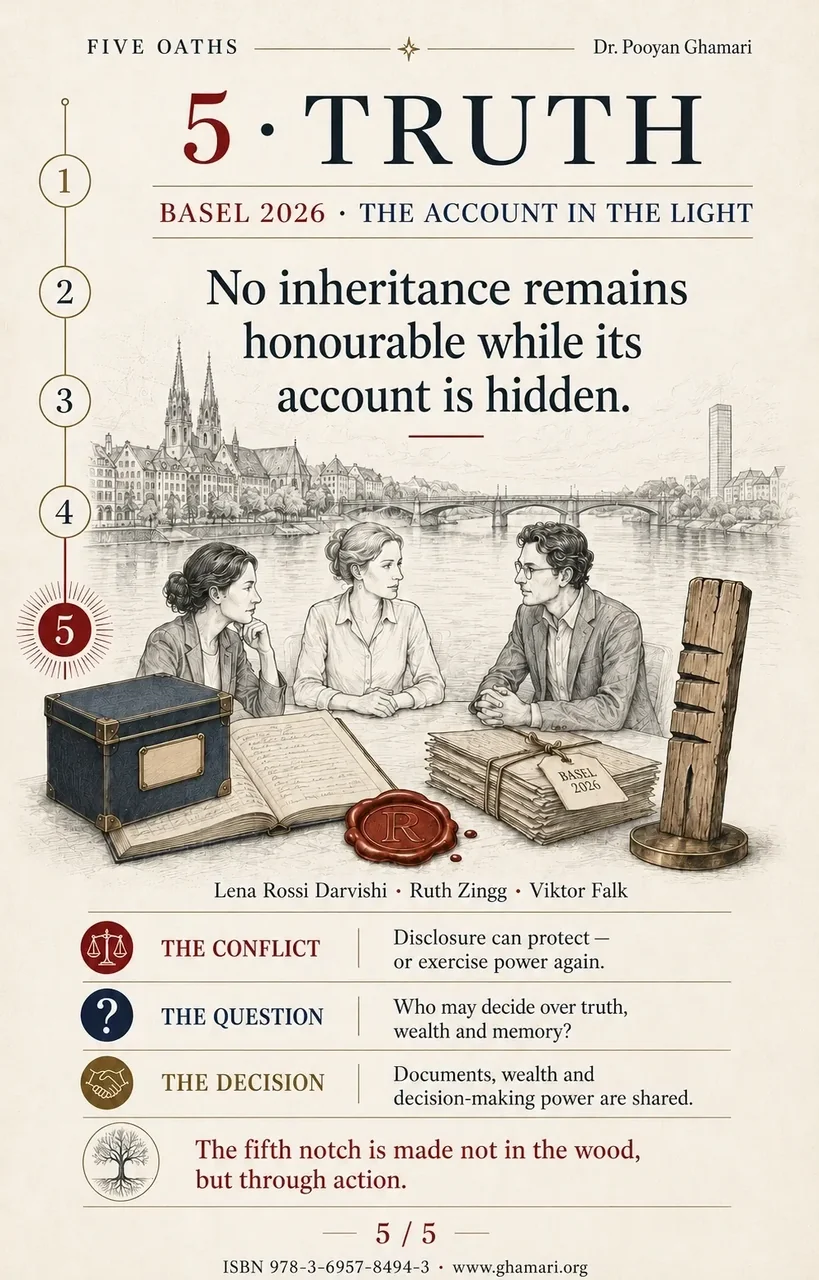
After the death of her mother Clara, Lena Rossi Darvishi inherits an archive volume, a brass matrix for the red seal and the wooden splinter bearing four notches.
Lena is a forensic economist. She follows money flows, contracts, ownership chains and the interests concealed behind apparently neutral decisions.
She discovers that the archive is not an objective witness. It is a selection.
Some documents were preserved. Others were removed. Certain people were protected while being denied access to their own history.
Clara wanted to protect Ruth Zingg. Yet by deciding when and under what conditions Ruth could learn the truth, Clara exercised power over her.
Protection without participation can become another form of dispossession.
Lena must choose among several imperfect paths: public disclosure, legal enforcement, privacy, historical investigation, material restitution and institutional stability.
A spectacular revelation could turn Lena into a public hero. It could also repeat the original injustice by allowing her to decide for Ruth and the other affected people.
The final solution therefore consists of more than words:
- The documents enter independent custody.
- The assets leave the family’s exclusive control.
- Affected people receive decision-making power.
- Those who benefited accept material consequences.
When the moment comes to cut the fifth notch, Lena refuses.
The wood is already damaged. More importantly, another family ritual would leave authority with the same family that controlled memory and access for generations.
The fifth notch is made not in the wood, but through action.
The novel’s blueprint
The five oaths trace an expansion of political and moral consciousness:
- Solidarity: We protect our own people.
- Conscience: We do not destroy others in the name of conviction.
- Covenant: We secure a place for the defeated.
- Belonging: We recognise those who help carry the country.
- Truth: We share knowledge, wealth and decision-making power.
FIVE OATHS is neither an indictment of Switzerland nor a flawless national mythology. It examines a country whose strength lies in repeatedly transforming conflict into institutions, divided power and shared responsibility.
Patriotism does not require hiding a country’s fractures. It means believing that the country is strong enough to look at them.
FÜNF EIDE | FIVE OATHS
From Rapperswil-Jona to Basel. Five oaths. One country. Countless lies. One truth.
Dr. Pooyan Ghamari
ISBN 978-3-6957-8494-3
www.ghamari.org
The novel’s characters, families, companies, archives, letters, contracts and financial structures are fictional. Historical events, places and public institutions are treated through literary fiction.
Deutsche Version
FÜNF EIDE: Fünf Versprechen und die verborgene Rechnung eines Landes
Von Rapperswil-Jona nach Basel durch 735 Jahre Schweizer Geschichte
Ein Land besteht nicht nur aus Grenzen, Gesetzen und Institutionen. Es besteht aus Versprechen.
Manche werden öffentlich abgelegt. Andere entstehen in einer gefährlichen Nacht, in einem geteilten Haus, nach einem Bürgerkrieg, in einem Tunnel oder vor einem verschlossenen Archiv.
Mein Roman FÜNF EIDE führt von einer Überfahrt zwischen Jona und Rapperswil im Jahr 1291 bis zu einer Entscheidung am Rhein in Basel im Jahr 2026. Dazwischen liegen Reformation, Sonderbundskrieg, Bundesstaat, Gotthard, Industrialisierung, Migration, politische Ausgrenzung, Finanzmacht und die Frage, wem ein belastetes Erbe moralisch gehört.
Die fünf Eide bilden den inneren Bauplan des Romans. Jeder entsteht aus einer konkreten Gefahr. Jeder wird ernst gemeint. Jeder wird später beschädigt, gebrochen oder gegen andere Menschen verwendet.
Über allem steht eine Frage:
Wer gehört zum Wir?
1. Beistand: Der Schutz der eigenen Menschen
„Keiner von uns wird allein ausgeliefert.“
1291: Die Überfahrt
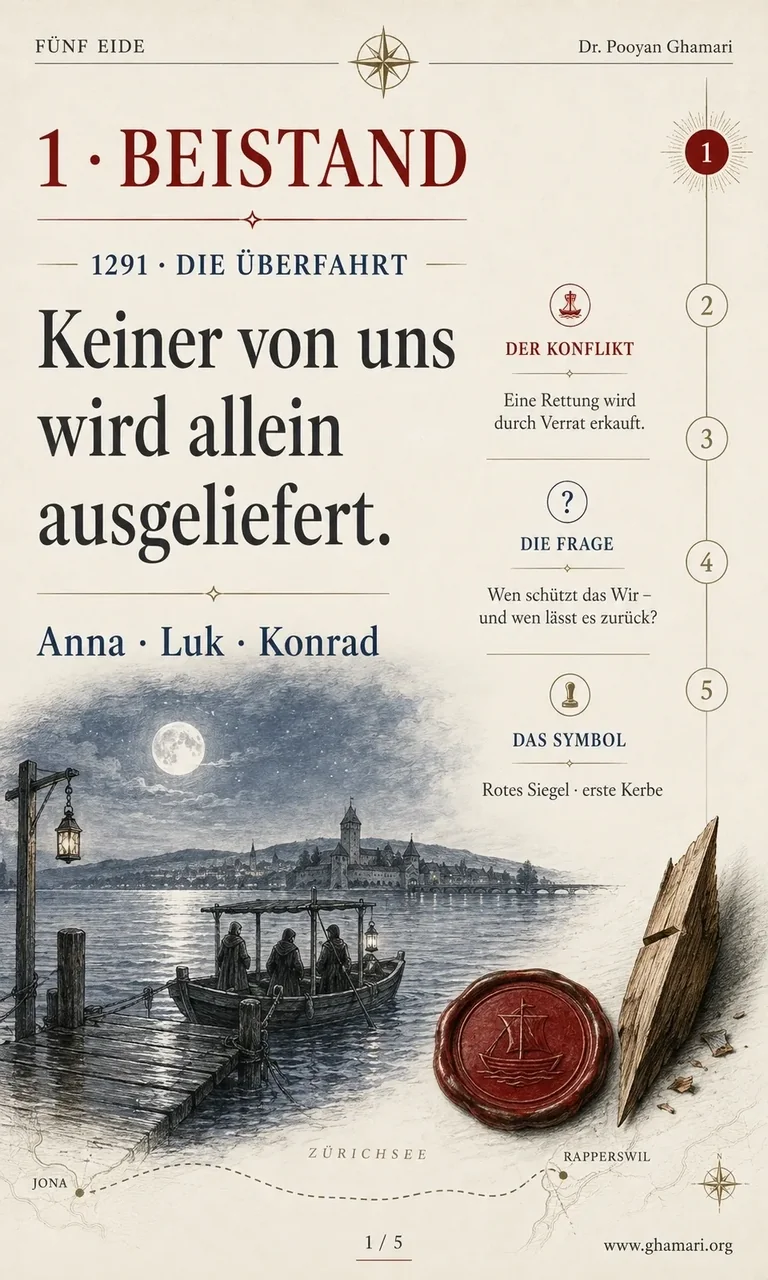
Anna und Luk müssen in einer gefährlichen Nacht mehrere Menschen über den Zürichsee bringen. Für die Rettung fehlt jedoch das Geld. Der Fährmann verlangt einen wirtschaftlichen Vorteil: den Verzicht auf einen umstrittenen Uferplatz.
Gleichzeitig versteckt sich Konrad vor seinen Verfolgern. Seine Rettung würde die anderen gefährden. Luk entscheidet sich für die Überfahrt. Anna und ihre Familie werden gerettet. Konrad bleibt zurück.
Aus dieser Nacht entsteht der erste Eid:
Keiner von uns wird allein ausgeliefert.
Doch das Versprechen trägt bereits einen Widerspruch in sich. Jedes „Wir“ zieht eine Grenze. Wer bestimmt, wer geschützt wird? Wer wird ausgeschlossen oder geopfert, damit die Gemeinschaft überlebt?
Anna lässt deshalb beide Seiten eines Pergaments beschreiben. Vorne stehen die erworbenen Rechte. Hinten steht, was ihre Rettung gekostet hat. Sie setzt das rote Siegel und schneidet die erste Kerbe in einen Holzspan.
Der erste Eid fragt:
Wen schützt das Wir und wen lässt es zurück?
2. Gewissen: Die Grenze der Überzeugung
„Kein Glaube gibt uns das Recht, den eigenen Menschen zu vernichten.“
Reformation und konfessioneller Riss
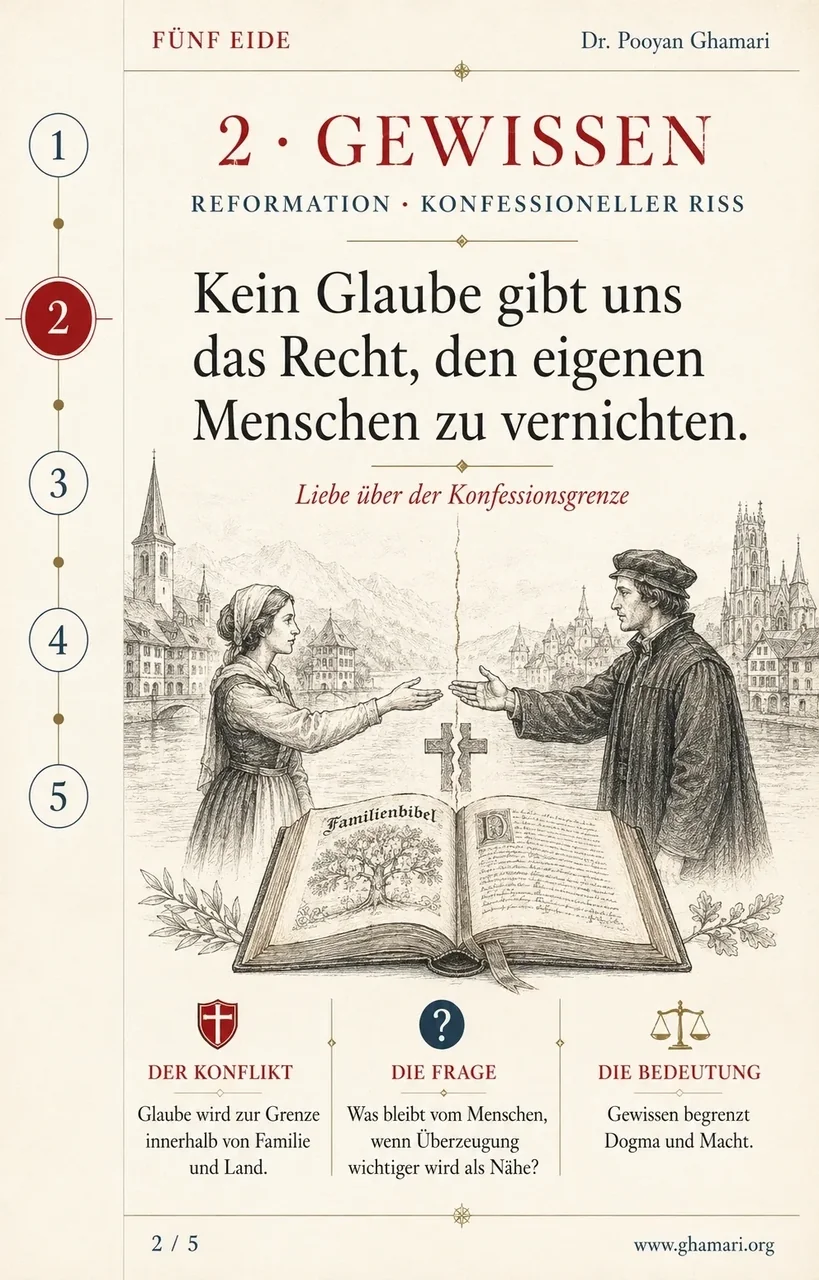
Der zweite Eid führt in eine Schweiz, deren gefährlichste Grenze nicht zwischen Ländern verläuft. Sie verläuft durch Familien, Gemeinden und persönliche Beziehungen.
Während der Reformation wird aus Glauben eine politische Zugehörigkeit. Aus Zugehörigkeit wird Loyalität. Aus Loyalität kann Feindschaft werden.
Im Roman überlebt eine menschliche Verbindung über die Konfessionsgrenze, während Männer auf beiden Seiten behaupten, im Besitz einer höheren Wahrheit zu sein.
Der Eid formuliert keine theologische Position. Er setzt der Überzeugung eine moralische Grenze:
Kein Glaube rechtfertigt die Vernichtung des Menschen vor uns.
Gewissen bedeutet nicht, keine Überzeugungen zu besitzen. Es bedeutet, die Folgen der eigenen Gewissheit zu sehen, bevor ein anderer Mensch darin verschwindet.
Der zweite Eid fragt:
Was bleibt vom Menschen, wenn Überzeugung wichtiger wird als Nähe?
3. Bund: Frieden nach dem Sieg
„Ein Sieg wird erst zum Frieden, wenn der Verlierer im Land bleiben kann.“
1847 bis 1848: Sonderbund und Bundesstaat

Vreni Kälin kommt aus einem katholischen Umfeld. Elias Keller arbeitet mit Karten, Verkehrswegen, Grundstücken und zukünftigen wirtschaftlichen Möglichkeiten.
Vreni sieht Menschen und Verluste. Elias sieht Linien und Wertsteigerungen.
Nach dem Sonderbundskrieg stellt sich die entscheidende Frage: Soll der militärische Sieger die politische Zukunft allein bestimmen, oder muss die neue Ordnung auch den Besiegten einen sicheren Platz geben?
Aus diesem Konflikt entsteht der dritte Eid:
Ein Sieg wird erst zum Frieden, wenn der Verlierer im Land bleiben kann.
Die Bundesverfassung von 1848 begründete den modernen Schweizer Bundesstaat. Nationalrat und Ständerat verbanden das demokratische Gewicht der Bevölkerung mit der föderalen Stellung der Kantone. Die offizielle Entwicklung wird auf den Seiten des Schweizer Parlaments dargestellt.
Im Roman erscheint diese Ordnung nicht als theoretisches Modell, sondern als Antwort auf eine menschliche Angst:
Wie verhindert man, dass ein Sieg zum dauerhaften Recht auf Beherrschung wird?
Vreni zwingt Elias, hinter seinen Karten die Menschen zu sehen. Ein rechtlich freiwilliger Vertrag kann wirtschaftlich trotzdem unter Zwang entstehen, wenn Schulden, Informationsvorsprung und Zeitdruck bereits jede gute Alternative zerstört haben.
Der dritte Eid fragt:
Wie wird aus einem militärischen Sieg ein gemeinsames Land?
4. Zugehörigkeit: Wer das Land trägt
„Wer dieses Land mitträgt, darf nicht für immer fremd bleiben.“
1872 bis 1919: Gotthard, Industrie und Migration
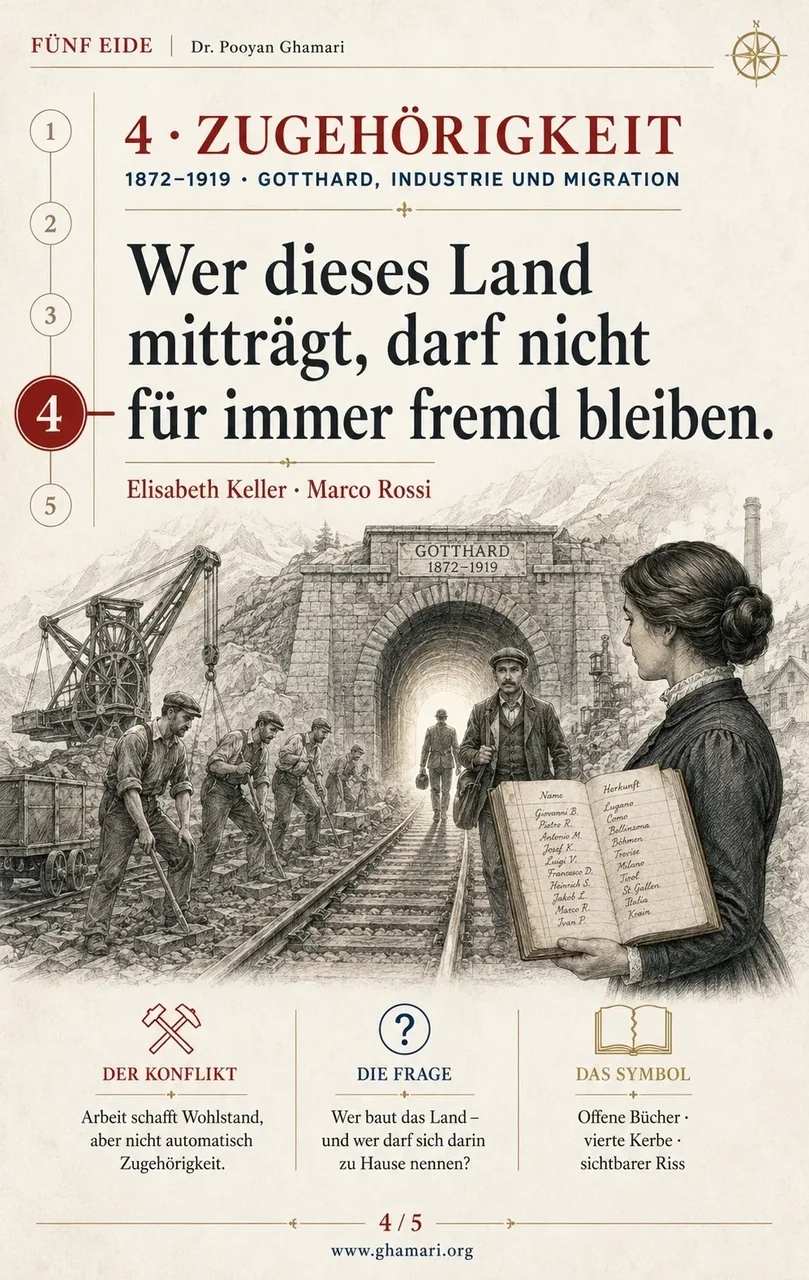
Marco Rossi kommt aus Italien in die Schweiz. Er besitzt zunächst keine gesellschaftliche Macht, aber technisches Verständnis, Mut und die Fähigkeit, Gefahren früh zu erkennen.
Der Gotthard steht im Roman für Fortschritt und Preis zugleich. Auf der einen Seite entstehen Verbindung, Handel und wirtschaftliche Entwicklung. Auf der anderen Seite stehen gefährliche Arbeit, Krankheiten, Tote und ausländische Arbeiter, deren Leistung benötigt wird, während ihre Zugehörigkeit bestritten bleibt.
Die Gotthardbahn wurde 1882 eröffnet. Das Schweizerische Bundesarchiv ordnet sie als Ausgangspunkt einer langen Entwicklung des alpenquerenden Schienenverkehrs ein und dokumentiert diese im NEAT-Portal.
Elisabeth Keller entdeckt, dass Geschäftsbücher Unternehmen und Lieferungen genau erfassen, während die Menschen hinter der Arbeit oft nur verkürzt oder gar nicht erscheinen. Sie beginnt deshalb mit den Namen.
Aber ein Name in einem Buch verkürzt noch keine Arbeitszeit und heilt keinen verletzten Körper. Sichtbarkeit ist notwendig, aber sie ist noch keine Gerechtigkeit.
Aus der Verbindung zwischen Elisabeth und Marco entsteht der vierte Eid:
Wer dieses Land mitträgt, darf nicht für immer fremd bleiben.
Der Satz ist keine Belohnung für wirtschaftliche Leistung. Ein Mensch muss seinen Wert nicht durch besondere Leistung verdienen. Der Eid legt vielmehr den Widerspruch eines Systems offen, das Menschen wirtschaftlich integriert und gesellschaftlich auf Distanz hält.
Der vierte Eid fragt:
Wer baut das Land und wer darf es seine Heimat nennen?
5. Wahrheit: Die Rechnung im Licht
„Kein Erbe bleibt ehrenhaft, solange seine Rechnung verborgen ist.“
Basel 2026
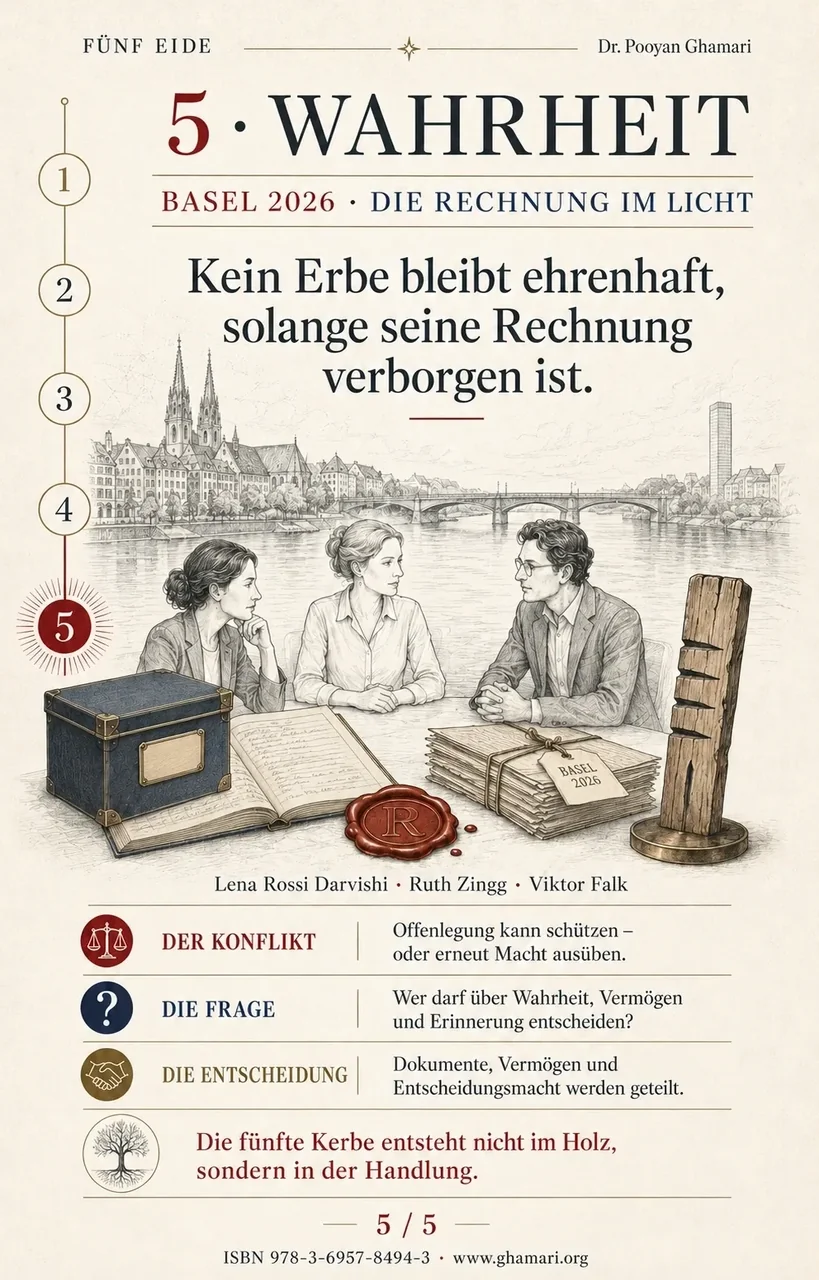
Nach dem Tod ihrer Mutter Clara erbt Lena Rossi Darvishi einen Archivband, eine Messingmatrix für das rote Siegel und den Holzspan mit vier Kerben.
Lena ist forensische Ökonomin. Sie folgt Geldströmen, Verträgen, Eigentumsketten und den Interessen hinter scheinbar neutralen Entscheidungen.
Dabei erkennt sie, dass der Archivband kein objektiver Zeuge ist. Er ist eine Auswahl. Manche Dokumente wurden bewahrt, andere entfernt. Menschen wurden geschützt, aber zugleich vom Zugang zu ihrer eigenen Geschichte ausgeschlossen.
Clara wollte Ruth Zingg schützen. Doch indem Clara entschied, wann und unter welchen Bedingungen Ruth die Wahrheit erfahren durfte, übte sie selbst Macht aus.
Schutz ohne Mitbestimmung kann zur Entmündigung werden.
Lena muss zwischen mehreren unvollkommenen Wegen wählen: Veröffentlichung, rechtliche Durchsetzung, Schutz persönlicher Daten, historische Aufarbeitung, Wiedergutmachung und institutionelle Stabilität.
Eine spektakuläre Enthüllung könnte Lena zur Heldin machen. Sie könnte aber erneut über Ruth und die anderen Betroffenen verfügen.
Die endgültige Lösung besteht deshalb nicht nur aus Worten:
- Dokumente kommen in unabhängige Verwahrung.
- Vermögen wird aus der alleinigen Kontrolle der Familie gelöst.
- Betroffene erhalten Entscheidungsmacht.
- Die Verantwortlichen akzeptieren materielle Konsequenzen.
Als der Moment für die fünfte Kerbe kommt, schneidet Lena nicht.
Das Holz ist bereits beschädigt. Vor allem aber würde ein neues Familienritual die Macht erneut bei jener Familie belassen, die so lange über Erinnerung und Zugang entschieden hat.
Die fünfte Kerbe entsteht nicht im Holz, sondern in der Handlung.
Der Bauplan des Romans
Die fünf Eide beschreiben eine Erweiterung des politischen und moralischen Bewusstseins:
- Beistand: Wir schützen die eigenen Menschen.
- Gewissen: Wir vernichten den anderen nicht wegen unserer Überzeugung.
- Bund: Wir sichern auch dem Verlierer einen Platz.
- Zugehörigkeit: Wir erkennen jene an, die das Land mittragen.
- Wahrheit: Wir teilen Wissen, Vermögen und Entscheidungsmacht.
FÜNF EIDE ist keine Anklage gegen die Schweiz und keine makellose Nationalerzählung. Der Roman betrachtet ein Land, dessen Stärke gerade darin liegt, Konflikte in Institutionen, Machtteilung und gemeinsame Verantwortung zu verwandeln.
Patriotismus bedeutet nicht, die Brüche eines Landes zu verbergen. Es bedeutet, dem Land genug zuzutrauen, um sie anzusehen.
FÜNF EIDE
Von Rapperswil-Jona nach Basel. Fünf Eide. Ein Land. Unzählige Lügen. Eine Wahrheit.
Dr. Pooyan Ghamari
ISBN 978-3-6957-8494-3
www.ghamari.org
Die Romanfiguren, Familien, Unternehmen, Archive, Briefe, Verträge und Finanzstrukturen sind fiktional. Historische Ereignisse, Orte und öffentliche Institutionen werden literarisch verarbeitet.
Originalartikel: https://ghamari.org/articles/f/five-oaths-five-promises-and-a-country%E2%80%99s-hidden-account