Five Oaths: The Moral Blueprint of a Nation
Von Dr. Pooyan Ghamari · · 10 Min. Lesezeit
Dieser Artikel ist derzeit nur auf Englisch verfügbar. Eine deutsche Ausgabe ist nicht erschienen.
What five promises, made across 735 years, reveal about Switzerland, belonging and the price of an honourable inheritance
By Dr. Pooyan Ghamari
A nation can survive the breaking of a law. It can survive military defeat, economic crisis and political scandal. What it cannot survive forever is the collapse of trust between the people who carry its burdens and the institutions that speak in their name.
That is the central idea behind my novel Five Oaths: Five Promises and a Country’s Hidden Account.
The book travels from 1291 to Basel in 2026. It follows five promises made at moments when a community, a family or a country is under pressure. Each promise expands the meaning of responsibility. Each also leaves someone outside its protection.
The question running through the novel is therefore not simply, “What is Switzerland?”
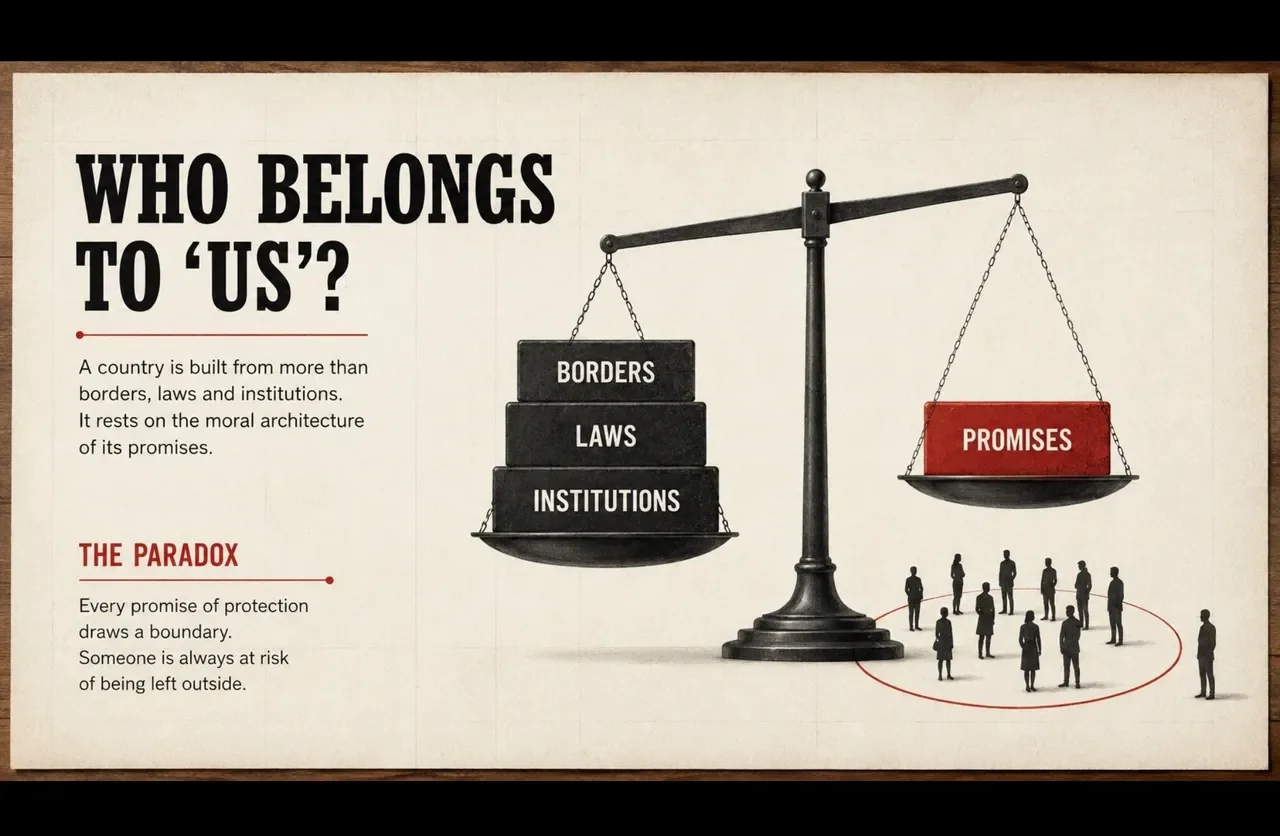
The harder question is: Who belongs to “us,” and who pays the price when that boundary is drawn?
This is not an argument against patriotism. It is an argument for a stronger form of it. A mature country does not need a flawless legend. It needs the courage to examine the gap between what it promised, what it achieved and what others paid for that achievement.
A country is made from promises under pressure
Borders tell us where authority ends. Laws tell us what authority permits. Institutions tell us how authority operates.
Promises tell us why people continue to accept it.
Every political community makes a basic offer: stand with us, carry part of the burden, and you will not be abandoned when danger comes. Yet every promise of protection creates a boundary. The moment we say “our people,” we also create the possibility of someone being left outside.
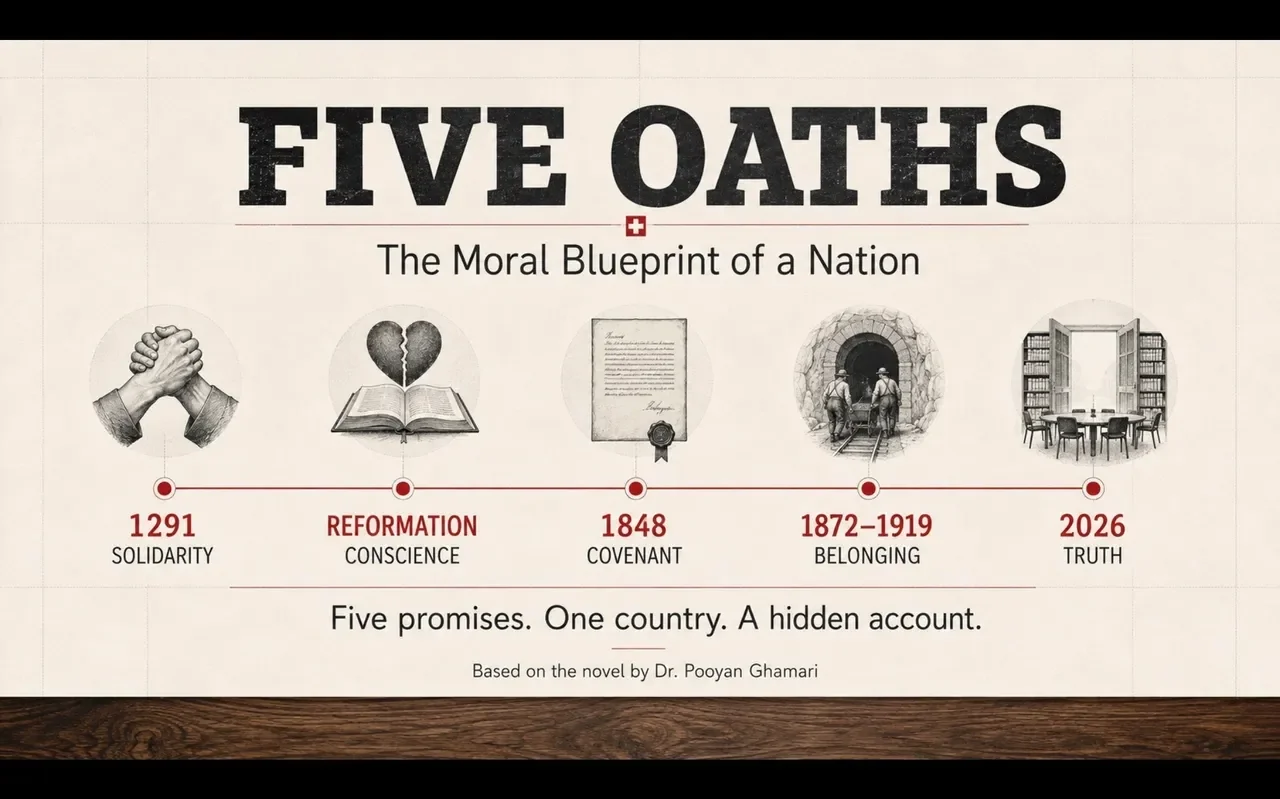
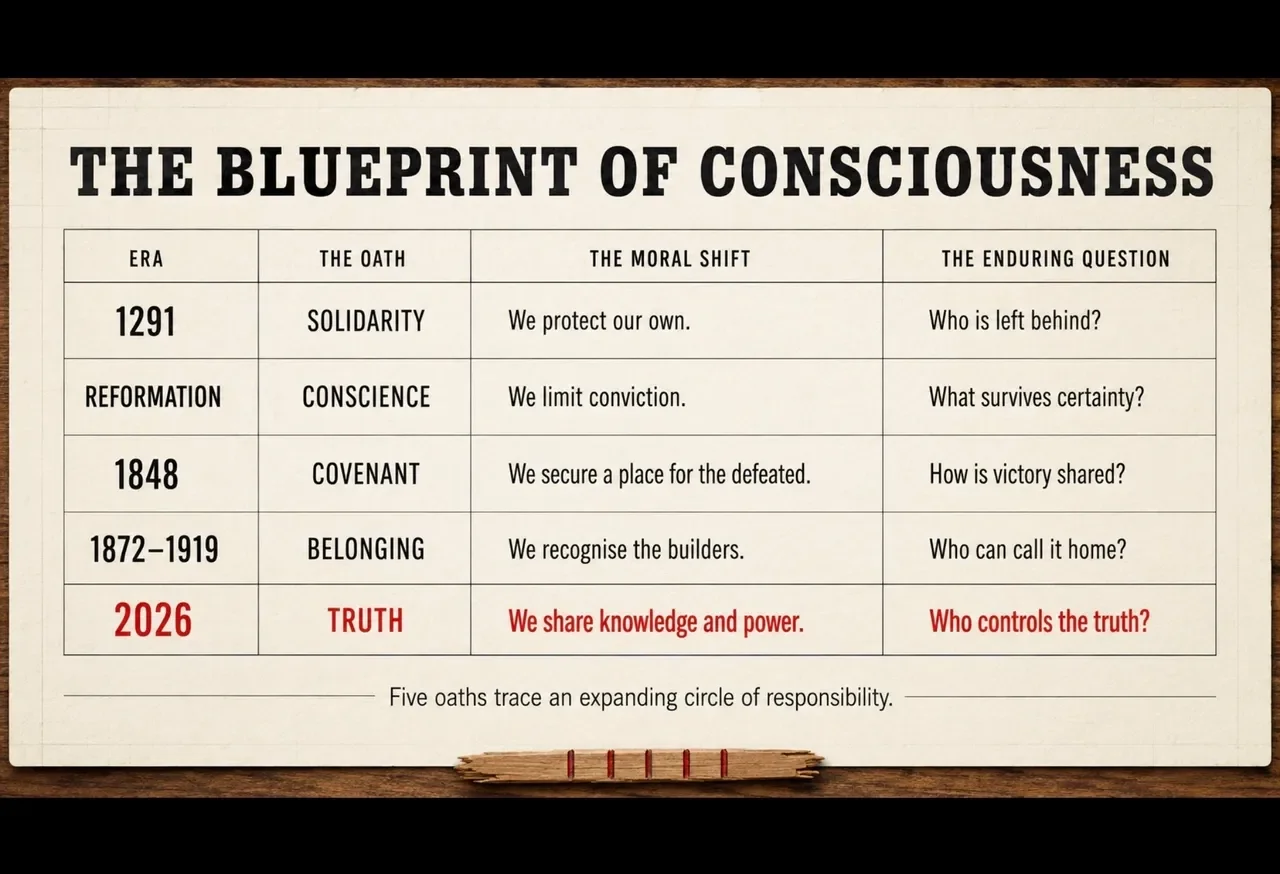
Five Oaths examines that paradox across five historical movements: solidarity, conscience, covenant, belonging and truth.
Together, they form a moral progression. The first oath protects our own. The fifth questions who gave us the right to decide who “our own” are.
First oath: Solidarity
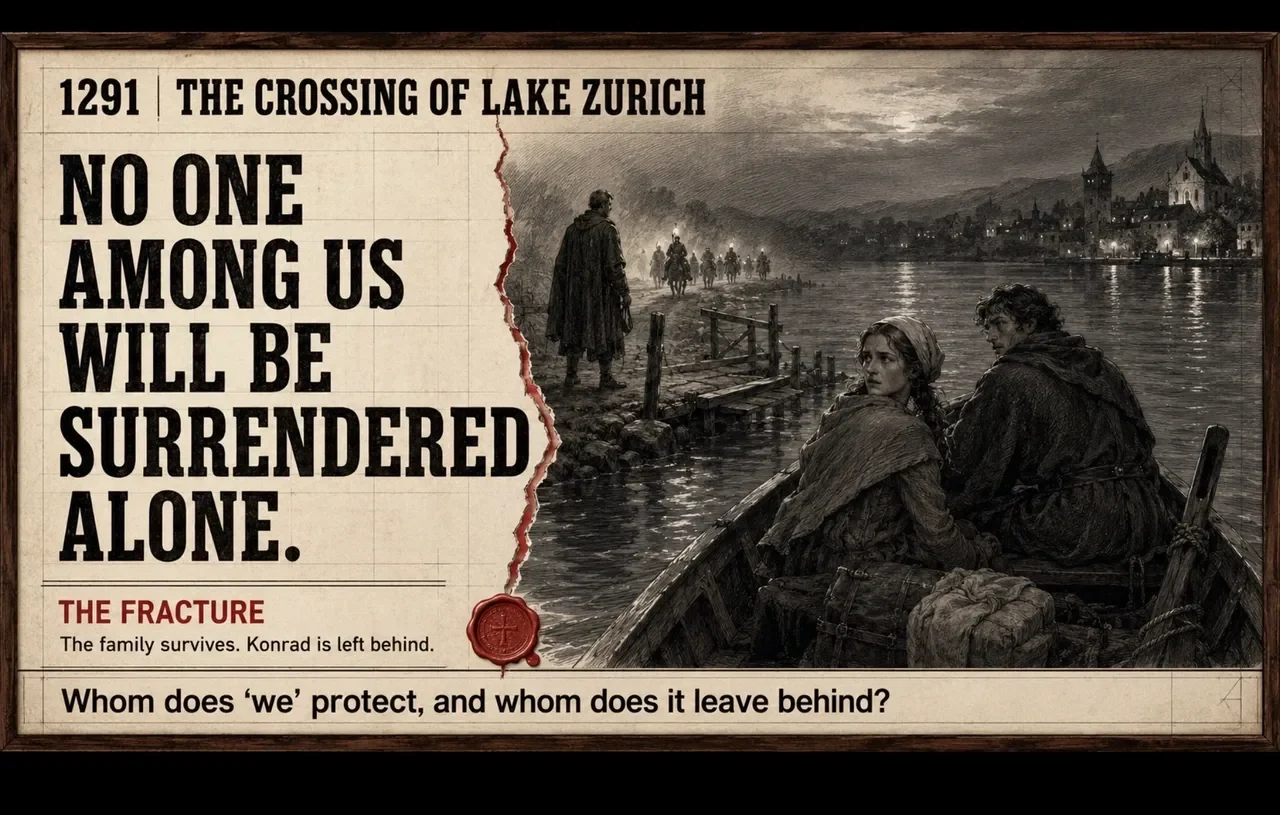
“No one among us will be surrendered alone.”
The Swiss Federal Archives identify the alliance concluded by Uri, Schwyz and Unterwalden in 1291 as the Waldstätte alliance sealed by the Federal Charter. The charter later became central to Switzerland’s national founding story, although its modern symbolic status developed centuries after it was written. Swiss Federal Archives
My novel does not attempt to reproduce that event as documentary history. It deliberately shifts its opening drama toward Lake Zurich and Rapperswil. The purpose is to take the founding promise out of ceremonial memory and place it inside an immediate human choice.
Anna, Luk and Konrad need to cross the water. They do not have enough money. Passage is purchased through the surrender of a disputed landing place and through a second, more terrible concession: Konrad is left behind.
The oath of solidarity is therefore born and broken in the same hour.
Anna records the acquired rights on the front of a parchment. On the back, she records the human cost. That double entry becomes the moral architecture of the entire book.
The front is the history a country displays.
The back is the account it inherits.
Solidarity is essential. No community can exist without it. But solidarity becomes morally dangerous when it protects only the people already inside the circle. The first oath therefore asks a question that every later generation must answer again:
Whom does “we” protect, and whom does it leave behind?
Second oath: Conscience
“No faith gives us the right to destroy our own people.”
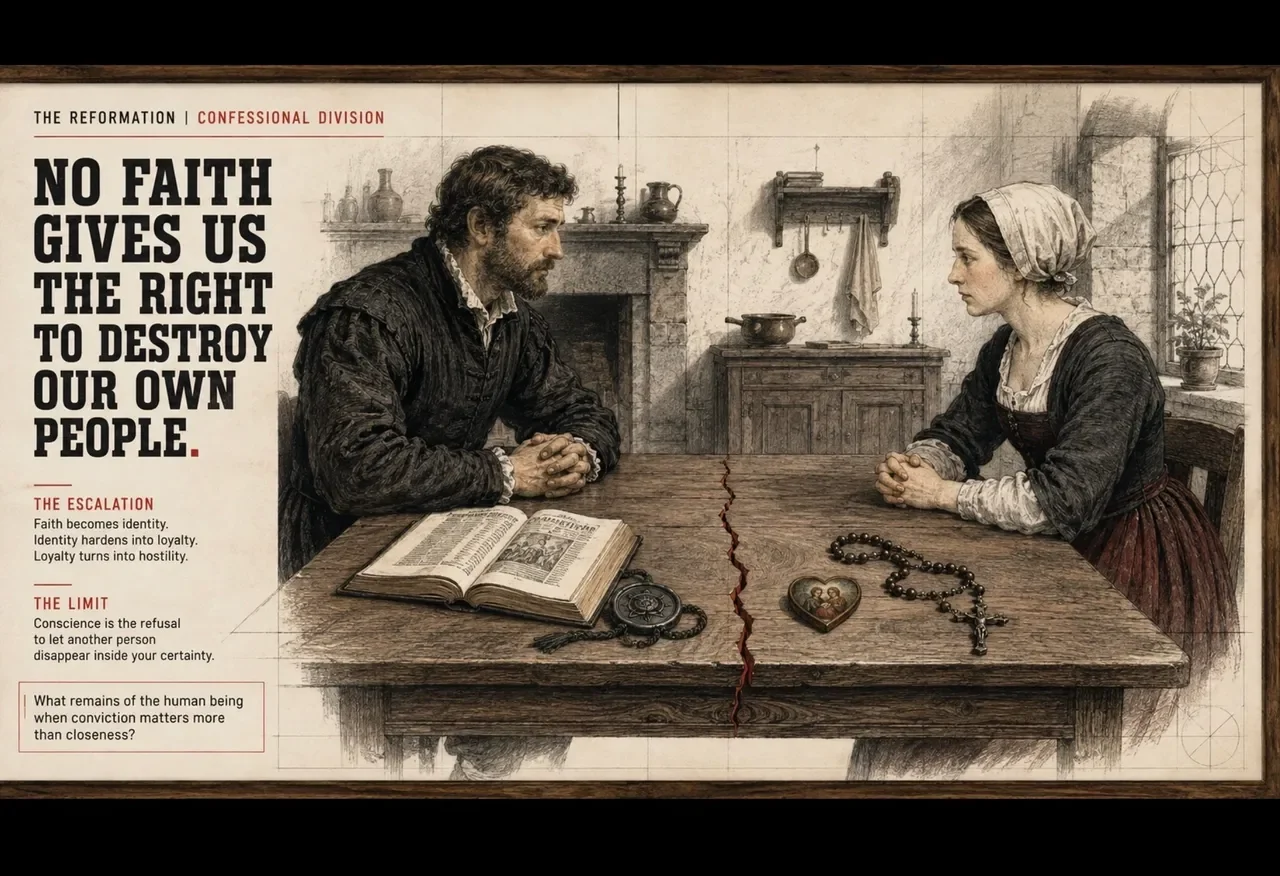
The Reformation did not remain a theological debate. In Switzerland, religious identity became political identity, and political identity became a source of armed conflict. The Federal Department of Foreign Affairs describes the Reformation as political dynamite that divided Catholics and Protestants and contributed to unrest and war. The Second War of Kappel in 1531 ended in a decisive Catholic victory and the death of Huldrych Zwingli. FDFA history of Switzerland, Swiss National Museum
But institutions do not experience religious division. People do.
The true frontier runs through kitchens, marriages, friendships and beds. The person across the table becomes a political category. Affection is tested by certainty. Loyalty to an idea begins to demand hostility toward a human being.
This is where conscience enters.
Conscience is not the absence of conviction. It is the limit we place on what conviction is allowed to do to another person.
The second oath does not ask people to abandon faith. It asks whether faith, ideology or political loyalty can remain honourable after the individual standing before us has disappeared inside a label.
That question has lost none of its force. Our century may use different words, but the machinery is familiar. First a person becomes a category. Then the category becomes a threat. Finally, cruelty is presented as duty.
The oath of conscience interrupts that sequence. It says: I may believe deeply, but I will not use belief to erase your humanity.
Third oath: Covenant
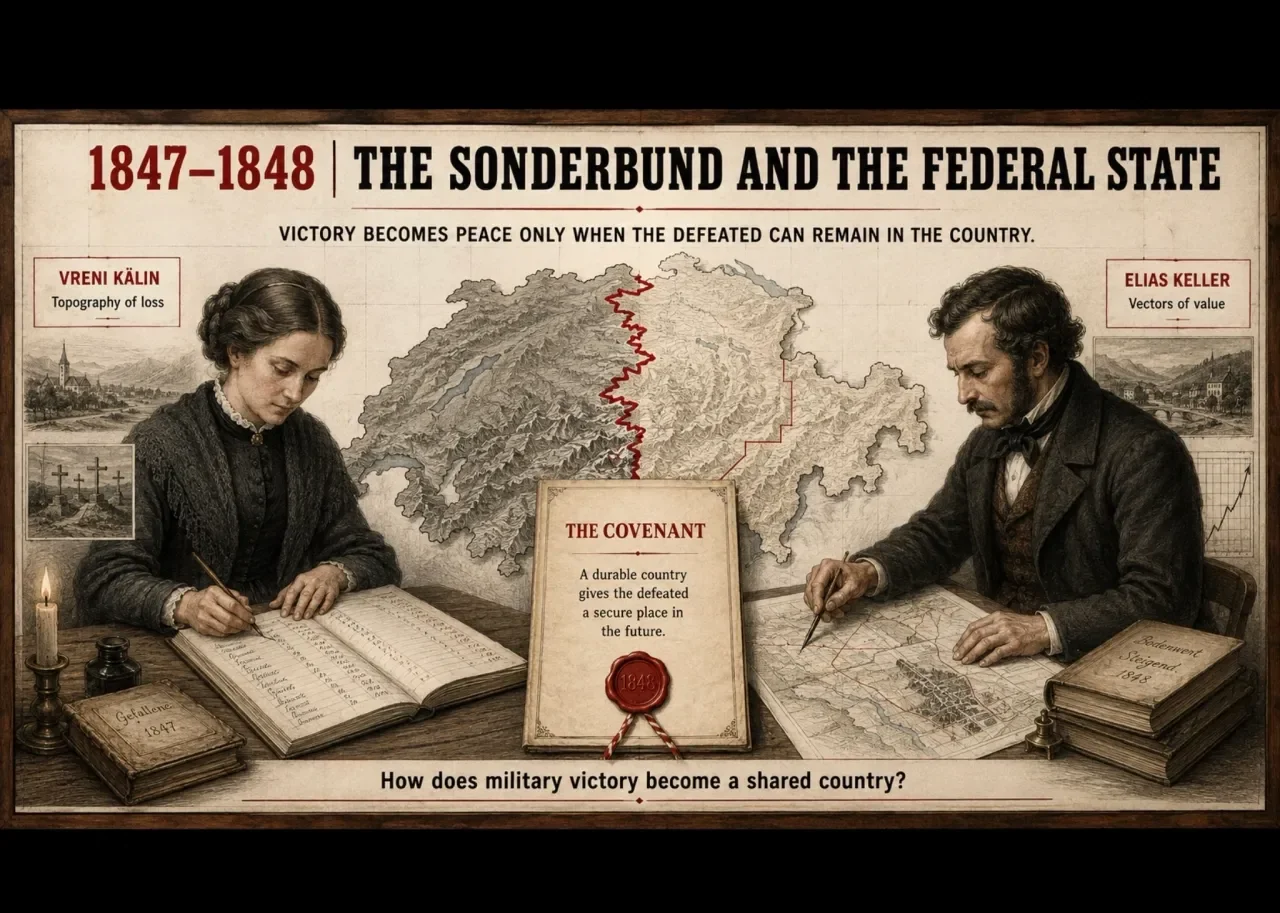
“Victory becomes peace only when the defeated can remain in the country.”
Switzerland’s last civil war, the Sonderbund War of 1847, ended within weeks. The following year, the Constitution of 12 September 1848 established the modern federal state. It preserved substantial cantonal autonomy while creating stronger common institutions. Swiss Parliament, FDFA history of Switzerland
This transition contains one of Switzerland’s most important political lessons: winning a conflict is not the same as building a country.
A victor can occupy territory. A durable order requires the defeated to possess a secure place inside the future.
In the novel, Vreni Kälin counts the dead while Elias Keller studies maps, debt and the future value of land. Their conflict is political, economic and intimate. Vreni sees bodies. Elias sees structure. Neither vision is sufficient alone.
Their story also exposes a quieter form of coercion. A contract may be legally voluntary while remaining economically forced. If debt, time pressure and unequal information have already eliminated every realistic alternative, the signature does not prove freedom. It only proves that a document was signed.
The third oath therefore joins two ideas that are often separated: constitutional peace and economic power.
A covenant is honourable only when the weaker party can remain, speak and negotiate after the stronger party has won.
This is the deeper genius of federalism. It does not require every conflict to disappear. It creates a structure in which disagreement does not automatically become expulsion.
Fourth oath: Belonging
“Those who help carry this country must not remain foreign forever.”
The old Gotthard railway tunnel is one of the great symbols of Swiss engineering. Construction began in 1872, with more than 2,500 men working at peak periods, many of them Italian. A memorial records 177 official deaths, while later research places the toll closer to 200. Workers stopped work in 1875 under brutal conditions, and force was used to break the strike. SWI swissinfo.ch
The railway connected markets, accelerated trade and strengthened the country. Yet the precision of the engineering was not matched by equal precision in the treatment of the people who built it.
That contradiction gives the fourth oath its force.
Marco Rossi, the migrant expert in the novel, sees a danger that others prefer not to see. His knowledge is useful. His labour is necessary. His membership remains conditional.
This is how exclusion often works in advanced societies. The outsider is welcomed as a function before being accepted as a person. His hands may belong to the economy while his family, memory and future remain outside the national story.
The ledgers record materials precisely and people approximately.
Belonging asks for more than gratitude. Gratitude can be ceremonial and temporary. Belonging requires that contribution changes status. If a person helps build the road, the tunnel, the institution or the prosperity of a country, that person cannot remain permanently visible as labour and invisible as a citizen, neighbour or human equal.
The fourth oath asks:
Who may work for the country, and who is permitted to call it home?
Fifth oath: Truth
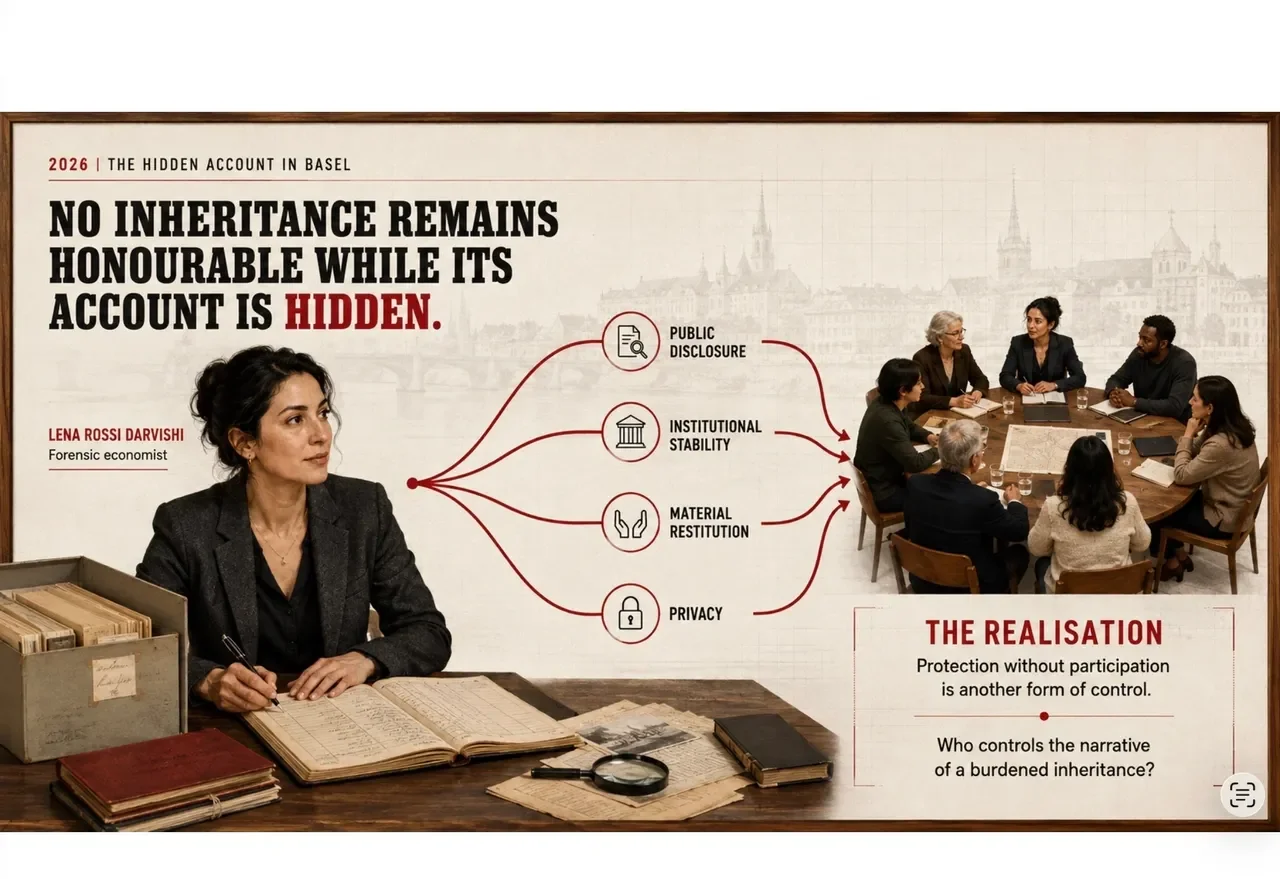
“No inheritance remains honourable while its account is hidden.”
In Basel in 2026, forensic economist Lena Rossi Darvishi inherits an archive, a burdened estate and a wooden splinter marked by four notches.
She believes the archive will tell her what happened. Slowly, she discovers something more disturbing: an archive is not memory itself. It is a selection created by whoever possessed the authority to preserve, classify, hide or destroy.
Clara believed she was protecting Ruth by controlling access to Ruth’s history. The intention may have been care. The result was dispossession. Ruth lost the power to decide how her own experience would be understood.
This reveals the central fracture of the fifth oath:
Protection without participation is another form of control.
Lena faces four competing demands: public disclosure, institutional stability, material restitution and privacy. Any one of them can injure the others. Total disclosure can violate living people. Total privacy can protect inherited advantage. Restitution without authority can become a payment for silence. Stability can become the respectable language of delay.
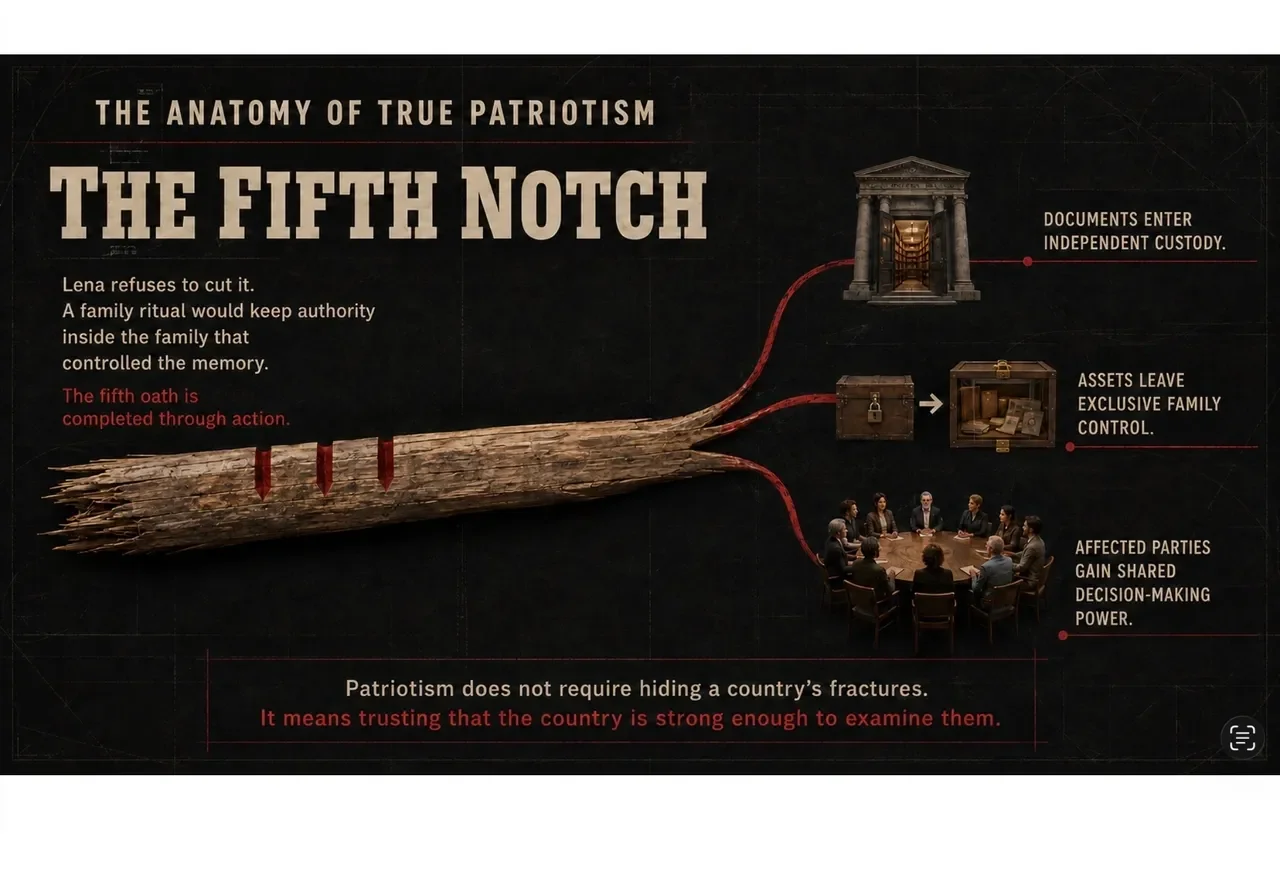
The easy ending would be confession. Lena could reveal the documents, issue a statement, create a foundation and cut the fifth notch into the splinter. Her family would remain the author of both the original story and its moral correction.
She refuses.
The fifth oath is not completed through ceremony. It is completed through the surrender of control. Documents enter independent custody. Assets leave exclusive family control. People affected by the past gain authority over the decisions made in the present.
The fifth notch is not carved into wood. It is carved into the distribution of power.
The hidden account is more than a metaphor
Switzerland has already experienced moments when moral credibility required institutional self-examination.
In 1996, after controversy over gold transactions and dormant assets intensified, the Swiss Parliament and Federal Council established the Independent Commission of Experts, chaired by Jean-François Bergier. Over five years, the commission examined archival evidence and ultimately published a major synthesis supported by 25 volumes of studies and legal analyses. Its work addressed financial assets, refugee policy and Switzerland’s relationship with Nazi Germany. Independent Commission of Experts, final synthesis
That episode matters because it demonstrates that scrutiny does not necessarily weaken a country. It can deepen credibility by replacing protected memory with documented responsibility.
The hidden account in Five Oaths is fictional. The moral problem is not.
Every institution inherits decisions it did not make. Every generation benefits from structures it did not build alone. Innocence and benefit can coexist. That is precisely why responsibility cannot be reduced to personal guilt.
The question is not whether the present generation committed the original wrong.
The question is what it chooses to do after discovering that it still holds the documents, assets or authority produced by that wrong.
The anatomy of true patriotism
Patriotism becomes fragile when it depends on innocence.
If love of country requires us to believe that our institutions were always just, our victories always clean and our prosperity entirely self-made, then patriotism cannot survive contact with evidence.
A stronger patriotism begins elsewhere. It says that a country is worthy of loyalty because it can confront contradiction without destroying itself.
Switzerland’s deepest achievement is not perfection. It is the repeated conversion of conflict into institutions, divided authority and negotiated responsibility. Federalism, cantonal autonomy, constitutional revision and public scrutiny are all forms of a larger political intelligence: power becomes more durable when it accepts limits.
But that intelligence must keep expanding.
Solidarity asks us to protect our own.
Conscience prevents conviction from erasing the person before us.
Covenant gives the defeated a place in the future.
Belonging recognises those whose labour carries the country.
Truth transfers knowledge and decision-making authority to those affected by the past.
This is the moral movement of the five oaths. Each enlarges the circle. Each reveals the insufficiency of the oath before it.
The account remains open
The wooden splinter at the centre of the novel bears four notches. Each notch records an oath. None settles the debt it represents.
That is why Lena refuses the fifth.
The final oath cannot remain a family ritual. If the same family controls the archive, defines the injury, chooses the remedy and receives admiration for its generosity, control has merely changed costume.
Truth becomes credible only when it produces consequences beyond the truth-teller’s control.
That is the final proposition of Five Oaths.
A country is not dishonoured by the discovery of fractures. It is dishonoured when it knows the fractures exist and still chooses concealment over responsibility.
True patriotism does not ask us to hide the account.
It asks whether we are strong enough to open it.
Originalartikel: https://ghamari.org/articles/f/five-oaths-the-moral-blueprint-of-a-nation