The Human Being and the Three Primordial Forces:
Von Dr. Pooyan Ghamari · · 8 Min. Lesezeit
Dieser Artikel ist derzeit nur auf Englisch verfügbar. Eine deutsche Ausgabe ist nicht erschienen.
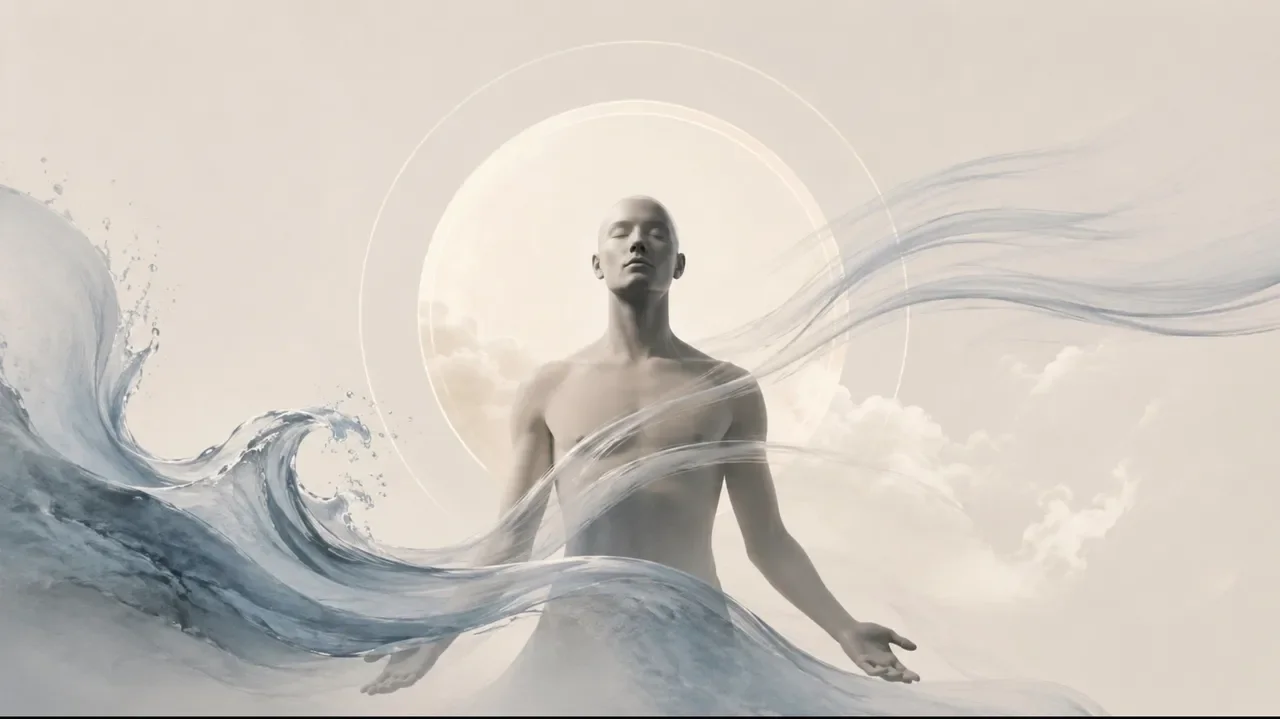
Water, Wind, and Air
By Dr. Pooyan Ghamari
Most people misunderstand strength.
They imagine it as hardness, pressure, resistance, and control. They think the strongest person is the one who never bends, never changes direction, never shows uncertainty, and never slows down. Yet nature tells a different story. The deepest powers in existence are rarely aggressive. They do not shout. They do not beg for attention. They move quietly, but nothing escapes their influence.
Water, wind, and air are among the oldest teachers of human life.
They were here before our cities, our markets, our systems, our ambitions, and our conflicts. They shaped mountains, carried seeds, filled lungs, moved oceans, and kept life in motion long before human beings gave names to power. Their wisdom is simple, but not shallow. Each one reveals a different law of survival, growth, and inner mastery.
Water teaches flexibility.
Wind teaches movement.
Air teaches presence.
A human being who understands these three forces becomes harder to break, easier to renew, and more capable of moving through chaos without losing direction.
Water: The Intelligence of Flexibility
Water does not fight the stone, yet over time it shapes it. It does not panic when the path closes. It turns, lowers itself, waits, gathers, and continues. Water survives because it never confuses flexibility with weakness.
This is one of the most important lessons a person can learn.
Many people fail not because they lack talent, but because they become rigid. They attach their identity to one plan, one outcome, one version of themselves. When life changes, they resist the change so aggressively that they waste their energy fighting reality instead of adapting to it.
Water does not behave this way.
It remains itself in every form. In a river, it moves. In a cloud, it rises. In ice, it holds. In rain, it returns. Its shape changes, but its essence remains.
This is real adaptability.
A flexible person is not someone without principles. Flexibility does not mean surrendering values, accepting humiliation, or becoming whatever the world demands. It means knowing the difference between essence and form. Your essence must stay clear. Your methods can change.
In business, this means adjusting strategy without abandoning vision.
In personal life, it means learning from pain without becoming bitter.
In crisis, it means asking, “What is still possible?” instead of repeating, “This should not have happened.”
Water is also patient. It does not need to win every moment. It understands accumulation. A drop may look insignificant, but repetition gives it force. This is why small daily decisions shape a life more deeply than dramatic declarations.
A person who follows the way of water learns to soften where resistance is wasteful and remain firm where identity is at stake.
That is not weakness.
That is advanced strength.
Wind: The Discipline of Movement
Wind is never frozen. It may be soft or violent, visible only through its effect, but it is always moving. It carries change from one place to another. It clears, disturbs, refreshes, and awakens.
Human beings suffer when they stop moving.
This does not only mean physical movement. A person can travel the world and still be stagnant inside. Real movement is the refusal to let the mind, the work, the soul, or the mission become trapped in dead patterns.
Stagnation is dangerous because it often feels safe. The same routine, the same conversations, the same fears, the same excuses, the same unfinished plans. Nothing collapses immediately, but slowly the inner fire becomes weaker. The person remains alive, but no longer advances.
Wind teaches another way.
Move before you feel ready.
Move even if the step is small.
Move one unfinished thing forward.
A powerful life is rarely built through perfect timing. It is built through repeated motion. Ten minutes of honest action can break months of mental heaviness. One phone call, one page, one decision, one walk, one correction, one message, one completed task. Movement creates evidence. Evidence creates confidence. Confidence creates more movement.
This is how momentum is born.
Wind also teaches detachment. It passes through places without becoming owned by them. It does not cling to yesterday’s direction. When conditions change, it moves differently.
Many people lose years because they are loyal to old versions of themselves. They keep defending choices that no longer serve them. They confuse consistency with imprisonment. Wind reminds us that movement is not betrayal. Sometimes movement is obedience to life itself.
To live with the intelligence of wind is to keep energy circulating. When emotion is heavy, move the body. When thought is confused, move the pen. When business is stuck, move the offer. When relationships are silent, move the conversation. When fear becomes loud, move anyway.
Life rewards those who remain in motion.
Not reckless motion. Not nervous motion. Directed motion.
The wind does not ask permission to exist. It moves, and the world adjusts.
Air: The Power of Invisible Presence
Air is the most silent of the three forces, yet it is the most immediate. A person can live without many things for a long time, but without air, life disappears quickly. Air is invisible, but it is never absent.
This is the mystery of true presence.
The strongest people in a room are not always the loudest. Often, they are the calmest. Their influence does not come from noise, but from inner alignment. They do not need to dominate every conversation. Their attention has weight. Their silence has structure. Their breathing is not owned by panic.
Air teaches us that presence is power before action.
A person who cannot breathe properly cannot think clearly. A person who cannot think clearly cannot decide wisely. A person who cannot decide wisely becomes easy to control.
This is why breath is not a small matter. Breath is the bridge between body and mind. When the breath becomes shallow, the mind becomes reactive. When the breath becomes deep and steady, the nervous system receives a different message: you are here, you are alive, you can respond.
Modern life constantly pulls people away from presence. Screens fragment attention. Speed weakens awareness. Noise becomes addictive. Many people spend their entire day reacting to signals, messages, demands, and fears, while losing contact with the simple fact that they are breathing.
Air calls the human being back.
Before answering, breathe.
Before deciding, breathe.
Before reacting, breathe.
Before entering an important meeting, breathe.
This is not spiritual decoration. It is practical command over the self.
A person who controls attention controls energy. A person who controls energy controls behavior. A person who controls behavior controls results.
Air also represents space. Without space, nothing can move. A room without air suffocates. A mind without space becomes desperate. A life without space becomes mechanical.
To follow the way of air is to create inner room. Room between emotion and action. Room between insult and response. Room between ambition and anxiety. Room between desire and decision.
That space is where wisdom enters.
The Three Forces Inside Human Life
Water, wind, and air are not only elements outside us. They are patterns within us.
Water is how we adapt.
Wind is how we progress.
Air is how we remain conscious.
When a person lacks water, they become rigid. Every change feels like an attack. Every obstacle becomes personal. Every failure becomes an identity crisis.
When a person lacks wind, they become stagnant. They think too much and move too little. They wait for motivation, certainty, approval, or perfect conditions. Life quietly passes them.
When a person lacks air, they become reactive. They lose presence. They speak too quickly, decide too emotionally, and give their power to every external disturbance.
But when these three forces work together, the human being becomes balanced.
Water says: adapt without losing yourself.
Wind says: move without waiting for perfection.
Air says: stay present before you act.
This is a complete philosophy of strength.
It is also a practical system.
In conflict, become water. Do not break yourself against someone else’s hardness. Find the opening. Change the angle. Preserve your essence.
In stagnation, become wind. Do not worship comfort. Move the smallest meaningful thing forward. Energy returns through motion.
In chaos, become air. Do not let panic enter your decisions. Breathe, observe, create space, then respond.
A Simple Daily Practice
The wisdom of these forces becomes real only when it enters daily life.
Each evening, ask one question from water:
“Where did I resist reality today, and how could I have adapted with more intelligence?”
Each morning, ask one question from wind:
“What is one thing I can move forward today, even if only by a small step?”
Before any important decision, ask one question from air:
“Am I present enough to respond, or am I only reacting?”
These questions are simple, but they are not weak. Repeated daily, they begin to reshape the mind. They train flexibility, movement, and awareness. They turn philosophy into behavior.
And behavior is where life changes.
The Quiet Formula of Power
The world often teaches people to become harder. Nature teaches something wiser.
Water survives by flowing.
Wind transforms by moving.
Air rules by being present everywhere without needing to be seen.
The human being does not become powerful by becoming rigid, restless, or loud. Real power is more refined than that. It is the ability to bend without collapsing, move without losing direction, and remain calm without becoming passive.
This is the quiet formula:
Be like water in crisis.
Be like wind in stagnation.
Be like air in chaos.
A person who lives this way becomes difficult to defeat, because they are no longer dependent on perfect conditions. They can adjust, continue, and remain present.
Originalartikel: https://ghamari.org/articles/f/the-human-being-and-the-three-primordial-forces