European Strategic Autonomy Security Prosperity US Dependency
By Dr. Pooyan Ghamari · · 19 min read
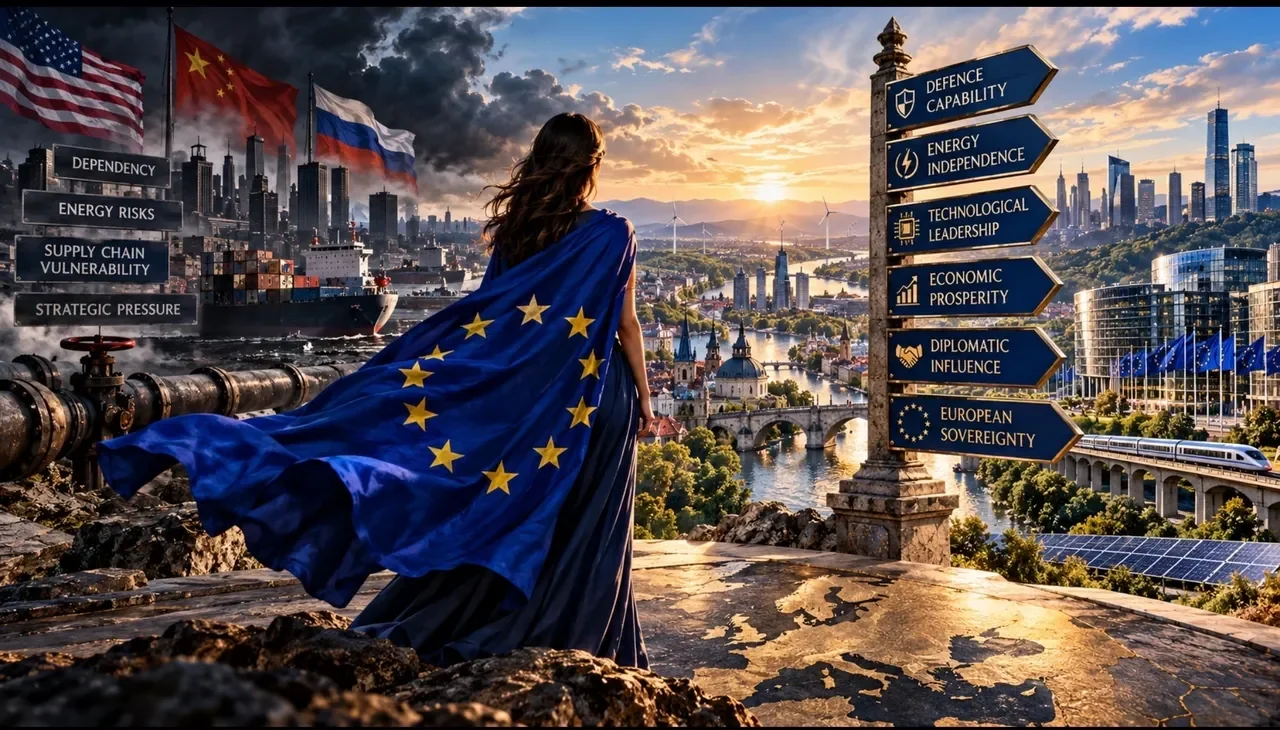
European Strategic Autonomy: Why Europe Must Build Security Without Becoming a Second United States
Europe does not need another master. It needs the capacity to decide.
By Dr. Pooyan Ghamari
Europe is again discussing power.
Defence spending is rising. Governments are speaking about strategic autonomy. Industrial policy has returned. Energy security, artificial intelligence, semiconductors, critical infrastructure, payment systems and military production are no longer treated simply as economic questions. They have become questions of sovereignty.
This transformation is necessary.
But Europe should be careful about what kind of power it is trying to become.
The objective should not be to construct a smaller version of the United States on European soil.
Nor should Europe replace dependence on Washington with dependence on Beijing, Moscow, the Gulf, or any other centre of power.
The real objective should be more ambitious:
Europe should become capable of protecting its people, financing its prosperity and making its own strategic decisions without requiring permission from another power.
That is what European strategic autonomy should mean.
Not anti-Americanism.
Not isolation.
Not neutrality in every conflict.
And certainly not weakness.
It means partnership without subordination.
Cooperation without dependency.
Defence without permanent militarisation of political thinking.
Trade without allowing supply chains to become instruments of coercion.
And foreign policy in which the first question is not, What does Washington want Europe to do?
The first question should be:
What protects European citizens, European prosperity, European sovereignty and long-term peace?
Europe is discovering that dependency has many forms
For decades, Europe benefited from an extraordinary geopolitical arrangement.
The United States supplied much of the hard-security architecture.
Russia supplied large quantities of relatively cheap energy.
China became deeply integrated into manufacturing and supply chains.
American companies came to dominate major layers of the digital economy.
Global financial infrastructure operated to a significant extent through dollar-centred institutions and systems.
Europe concentrated on trade, regulation, welfare, industrial production and economic integration.
For a time, this division appeared efficient.
But efficiency and resilience are not the same thing.
A system can be extremely efficient precisely because it has concentrated a critical dependency in one place.
Then geopolitics changes.
The dependency remains.
This is one of the defining lessons of our age.
Europe has already experienced the consequences in energy.
It is increasingly confronting them in defence.
The same vulnerability exists in semiconductors, artificial intelligence, cloud infrastructure, payment systems, critical minerals, pharmaceuticals, satellite communications and parts of the defence-industrial supply chain.
Even the European Commission’s 2026 macroeconomic analysis acknowledges that dependence on international providers in digital payments represents a risk to European strategic autonomy.
That observation deserves much more attention.
Because sovereignty is not only about tanks.
The country or corporation controlling the infrastructure through which your economy communicates, pays, computes, insures, finances and trades possesses a form of strategic power.
Europe must understand power at that deeper level.
Europe should not confuse an alliance with a permanent delegation of sovereignty
The United States remains an extraordinarily important European ally.
NATO remains central to the defence architecture of most European countries.
Those facts do not disappear merely because Europe seeks greater autonomy.
But there is a fundamental distinction between an alliance and dependency.
In an alliance, two sovereign parties cooperate because their interests substantially overlap.
In a dependency, one party gradually loses the practical ability to choose differently.
The difference becomes visible only when interests diverge.
If Europe can agree with Washington but cannot meaningfully disagree with Washington, then the relationship is no longer fully balanced.
The same principle applies to every great power.
European dependence on Russian energy was dangerous.
Excessive dependence on Chinese strategic supply chains can be dangerous.
Excessive dependence on American security, technology or financial infrastructure can also create vulnerabilities.
Recognising one dependency while refusing to examine another is not strategy.
It is geopolitics through selective vision.
The objective must therefore be neither separation from America nor obedience to America.
It should be a balanced transatlantic partnership between actors capable of saying both yes and no.
Even the European Parliament has called for credible European deterrence that can operate independently of the United States while remaining within a renewed and balanced transatlantic partnership.
That is the intellectually mature position.
America can remain an ally without remaining Europe’s strategic parent.
Can Europe defend itself without the United States?
This question is increasingly searched because it is no longer theoretical.
The correct answer is neither an emotional yes nor an alarmist no.
Today, Europe retains important dependencies on American capabilities.
But that does not mean those dependencies are permanent laws of nature.
They are the consequences of decades of political choices, procurement decisions, fragmented industrial structures and underinvestment.
The European Commission’s 2026 analysis illustrates the structural problem.
Less than half of European defence procurement is currently sourced within Europe.
European states operate far more different weapons systems than the United States, creating duplication, logistical complexity and higher costs.
The Commission estimates that fragmentation and dependence on non-EU suppliers impose significant annual costs on European defence expenditure.
That is not primarily a shortage of money.
It is a shortage of architecture.
Europe already spends enormous sums.
The problem is that twenty-seven states often buy separately, specify separately, certify separately, maintain separately and negotiate separately.
The result is a paradox:
Europe spends billions strengthening its defence while part of that spending reinforces the industrial strength of the external suppliers on whom Europe is trying to become less dependent.
A serious European strategic-autonomy policy therefore cannot merely demand larger defence budgets.
It must ask where the money goes.
Who develops the intellectual property?
Where are the factories?
Who maintains the systems?
Who controls the software?
Who provides the satellites?
Who supplies replacement components in a crisis?
Who has authority over upgrades?
And can Europe continue operating the system if political relations with the supplier deteriorate?
Those are sovereignty questions.
Europe’s security cannot be measured only in weapons
Here I believe much of the present debate remains too narrow.
A society can become militarily stronger and simultaneously become economically weaker.
That is not strategic success.
Suppose Europe spends vastly more on defence but loses industrial competitiveness.
Suppose its citizens face permanently higher energy costs.
Suppose housing becomes inaccessible to younger generations.
Suppose technological leadership migrates elsewhere.
Suppose European firms cannot obtain growth capital at the scale available to American competitors.
Suppose critical digital infrastructure remains externally controlled.
Suppose productivity stagnates while taxation rises to finance defence.
Could European leaders honestly call that system secure?
Security has to be understood as a portfolio.
It contains at least:
territorial security, economic security, energy security, technological security, financial security and social stability.
Destroy one aggressively enough and eventually the others deteriorate.
This is why the European debate should move beyond the military meaning of strategic autonomy.
A missile protects a border.
It does not build a competitive semiconductor industry.
A fighter aircraft does not reduce electricity prices.
A larger army does not automatically create affordable housing.
A nuclear umbrella does not give European companies access to growth capital.
Security policy must therefore answer a much harder question:
What exactly are we protecting?
The answer should be the European way of life itself—not merely European territory.
Prosperity is a national-security asset
For too long, prosperity and security have been discussed as if they belonged to different ministries.
That separation is obsolete.
A country without competitive industry eventually has less money for defence.
A continent without technological leadership becomes dependent on those who possess it.
A society whose citizens no longer believe that the next generation will live better becomes politically unstable.
An economy dependent on expensive imported energy can lose manufacturing even while its military budget rises.
Therefore Europe should redefine prosperity as part of security.
This means asking a different question whenever strategic policy is proposed:
Will this action make Europe stronger ten years from now—or merely more aligned next month?
That test should be applied to sanctions.
Defence procurement.
Energy policy.
Trade agreements.
Technology restrictions.
Industrial subsidies.
Financial regulation.
Relations with the United States.
Relations with China.
Relations with the Gulf.
Relations with Africa.
Relations with India and the wider emerging world.
Europe’s objective should be to increase the number of strategic options available to future Europeans.
Not reduce them.
The Strait of Hormuz demonstrates what strategic autonomy really means
Recent disruptions connected to the Middle East and the Strait of Hormuz are an excellent example.
The EU’s own trade ministers have discussed how conflict affecting Hormuz can raise energy costs, disrupt logistics and threaten European industrial competitiveness.
This is precisely why security cannot be analysed only through military alliances.
A conflict thousands of kilometres from central Europe can alter:
shipping insurance,
oil prices,
gas markets,
fertiliser costs,
aviation,
manufacturing margins,
transport costs,
inflation,
and ultimately the disposable income of European households.
This produces a simple but powerful lesson:
Europe can be militarily distant from a conflict and economically inside it.
European foreign policy therefore needs stronger economic modelling.
Before Europe supports escalation, sanctions or military measures, policymakers should calculate not only the strategic objective but also the second- and third-order economic consequences for European citizens.
Who absorbs the energy shock?
Who loses the export market?
Who replaces the sanctioned supplier?
Who wins the redirected contract?
Who carries the inflation?
And what is the mechanism for ending the confrontation?
These questions are not arguments for passivity.
They are requirements for serious power.
Sanctions without an exit strategy are not strategy
Sanctions can be legitimate instruments of foreign policy.
Europe should retain them.
But sanctions should be treated as instruments—not as moral ceremonies.
Every major sanctions regime should have at least five answers.
What behaviour is Europe trying to change?
What measurable condition would constitute success?
What is the economic cost to Europe?
What humanitarian consequences may appear in the target society?
And what happens if the policy fails?
A sanction that continues indefinitely after losing any plausible mechanism for changing behaviour can become political habit rather than strategy.
There is another problem.
Large states frequently adapt.
Trade is rerouted.
Intermediaries emerge.
Alternative payment channels develop.
Domestic industries substitute.
New partnerships form.
The sanctioning state may then discover that it surrendered a commercial relationship permanently while obtaining little political change.
Again, the correct European question is not:
Are sanctions good or bad?
It is:
Under what conditions do sanctions advance European objectives at an acceptable cost?
That is how sovereign systems think.
Europe needs a sovereign technology layer
The next battlefield of strategic autonomy will not necessarily look like a battlefield.
It may look like a server farm.
A semiconductor fabrication plant.
An AI model.
A satellite constellation.
A cloud contract.
A payment application.
An undersea cable.
A telecommunications standard.
Or a data centre.
Europe has world-class scientific institutions and extraordinary engineering talent.
But in several strategic digital layers, European companies remain behind American and Asian competitors.
This matters economically.
It also matters politically.
Technology creates dependency through standards, ecosystems and infrastructure.
Once an entire economy is built around another power’s technological architecture, replacing it becomes extremely expensive.
That gives the provider leverage even if that leverage is never openly exercised.
Europe therefore needs European capacity in:
artificial intelligence,
cloud infrastructure,
semiconductors,
cybersecurity,
satellite communications,
critical communications,
digital identity,
industrial software,
quantum technology,
and secure payment infrastructure.
The EU is already moving in this direction. Recent European initiatives explicitly describe reducing dependence on foreign technologies as part of technological and strategic autonomy.
But Europe must accelerate.
Digital sovereignty cannot remain a conference slogan while European states procure nearly every critical layer from elsewhere.
The euro must become part of European sovereignty
Currency is another underestimated dimension of strategic autonomy.
Europe created one of the world’s great currencies.
Yet the euro’s geopolitical and financial potential remains only partially developed.
The European Commission itself now argues that strengthening the international role of the euro matters for Europe’s strategic autonomy in an era of geopolitical fragmentation and weaponised finance.
This is significant.
Because financial infrastructure is geopolitical infrastructure.
The ability to settle trade, raise capital, insure transactions and process payments independently affects the freedom of states and companies.
Europe should therefore deepen its capital markets, banking integration and payment infrastructure.
It should make the euro easier to use internationally.
And it should build European payment systems capable of functioning without excessive dependence on external networks.
Not because America is an enemy.
Because infrastructure sovereignty should not depend on friendship remaining permanent.
Strategic planning assumes that governments change.
Interests change.
Technology changes.
Alliances evolve.
A resilient system survives those changes.
Europe needs energy sovereignty—but not energy isolation
Europe learned an extraordinarily expensive lesson from dependence on Russian gas.
The response should not be another single dependency.
Replacing one dominant supplier with another is diversification only on paper.
European energy security should rest on a portfolio:
renewables,
nuclear power where nationally chosen,
storage,
interconnection,
LNG,
multiple external suppliers,
domestic production where economically and environmentally viable,
and eventually much stronger grid infrastructure.
The objective should be simple:
no single foreign actor should possess enough leverage over European energy to transform supply into political coercion.
But affordability matters equally.
An energy policy that is geopolitically sophisticated but economically destroys energy-intensive European industry is incomplete.
Europe must pursue both resilience and competitive prices.
Otherwise strategic autonomy becomes strategic deindustrialisation.
Europe should trade with the world, not retreat from it
Autonomy does not mean autarky.
A Europe attempting to manufacture everything internally would become poorer.
The EU itself increasingly speaks instead about resilience, diversification and de-risking while preserving open trade.
That distinction is essential.
Europe’s strength comes partly from openness.
The Single Market is enormously powerful precisely because it connects hundreds of millions of consumers, businesses and workers to global commerce.
The objective should therefore be interdependence without dangerous concentration.
Europe should expand relationships with the United States.
And with India.
ASEAN.
Latin America.
Africa.
The Gulf.
Japan.
South Korea.
Australia.
And other commercially compatible partners.
The more diversified Europe’s relationships become, the less any single external government can transform economic dependence into geopolitical leverage.
The goal is not to leave the world.
It is to ensure Europe has more than one door into it.
Europe’s greatest strategic asset is not its army
It is its market.
Approximately half a billion Europeans and the wider European economic area represent one of the richest concentrations of consumers, skills, infrastructure and institutional capacity on earth.
Europe sometimes behaves as though it were weak because it lacks one unified army or one powerful central executive.
But power has many forms.
Access to the European market matters enormously to multinational corporations and foreign governments.
European regulations can influence global standards.
European capital matters.
European technology matters.
European consumers matter.
European infrastructure matters.
The challenge is converting fragmented capabilities into strategic leverage without destroying the openness that created European prosperity.
This requires coordination.
Not necessarily centralisation of everything.
Europe’s diversity is an asset.
But fragmentation becomes weakness when twenty-seven national systems separately purchase technologies, energy, defence equipment or infrastructure that would command far greater bargaining power if acquired collectively.
Europe should therefore integrate where scale creates sovereignty and preserve decentralisation where diversity creates resilience.
That is a more sophisticated architecture than simply creating a European superstate.
Europe should become a peace power precisely because it can defend itself
There is another dimension of autonomy that Europe should not abandon.
Diplomacy.
The world already has powerful states capable of escalation.
What is increasingly scarce are credible actors capable of creating exits.
Europe has unusual advantages here.
It contains states with different histories and relationships across the Middle East, Africa, Asia and the Americas.
It has financial resources.
Trade leverage.
Reconstruction expertise.
Legal institutions.
Diplomatic networks.
Development finance.
And experience building political structures across previously hostile nations.
Europe should turn those assets into strategic power.
Imagine a Europe known not simply for sanctions packages or military contributions, but for being the actor capable of constructing:
ceasefire architecture,
reconstruction funds,
neutral negotiating mechanisms,
energy settlements,
trade incentives,
security guarantees,
legal arbitration,
and post-conflict economic integration.
That would not be weakness.
It could become Europe’s most distinctive form of power.
But diplomacy backed by no capability can be ignored.
Therefore Europe needs both:
credible defence and credible peace-making capacity.
The two strengthen each other.
Europe should never become a second United States
This is the philosophical centre of the argument.
America’s system is the product of American history.
Its geography is different.
Its energy resources are different.
Its military structure is different.
Its capital markets are different.
Its technological corporations are different.
Its political culture is different.
Its global obligations and ambitions are different.
Europe cannot simply import that architecture.
Nor should it want to.
Europe’s competitive advantage may lie elsewhere.
In social stability.
Infrastructure.
Human capital.
Manufacturing quality.
Scientific research.
Urban quality of life.
Public health.
Rule-based markets.
Cultural depth.
Cross-border integration.
And the extraordinary achievement of transforming a historically violent continent into a political space where borders between former enemies are crossed routinely without soldiers.
These are not signs of weakness.
They are forms of civilizational capital.
Europe’s challenge is to protect them while rebuilding hard power.
If Europe gains military capacity but loses the prosperity, openness and human security that made the European model worth defending, it will have misunderstood the entire project.
Strategic autonomy should be measured from the citizen upward
Most geopolitical analysis begins with states.
I prefer to reverse the direction.
Begin with the citizen.
Ask what strategic autonomy should mean to a family in Bratislava, Vienna, Berlin, Warsaw, Paris or Madrid.
It should mean that electricity remains available and affordable.
That employment exists.
That industry can compete.
That pensions remain financeable.
That hospitals function.
That critical medicines are available.
That the digital infrastructure is secure.
That war does not arrive casually at the border.
That young people can imagine a future.
That European governments can make decisions based on European interests.
That no foreign government can easily switch off a critical economic function.
And that political leaders cannot permanently demand sacrifice without explaining what strategic architecture those sacrifices are building.
This is where geopolitics reconnects with democratic legitimacy.
A strategy that makes sense in Brussels but repeatedly lowers the security and prosperity of citizens will eventually lose public consent.
No system survives indefinitely by asking its population to finance abstractions whose benefits they cannot experience.
Who gains, who pays, who decides—and who is excluded?
These remain, for me, the four most useful questions in examining systems of power.
Apply them to European defence.
Who gains from the contracts?
Who pays through taxation?
Who decides what Europe purchases?
Who becomes technologically dependent afterward?
Apply them to sanctions.
Who loses the market?
Who acquires it instead?
Who absorbs higher prices?
Who decides when sanctions end?
Apply them to energy.
Who supplies?
Who controls the infrastructure?
Who bears volatility?
Who receives the industrial investment?
Apply them to digital technology.
Who owns the cloud?
Where is the data?
Who controls the standards?
Who can terminate access?
These questions do not automatically produce one political answer.
That is not their purpose.
They expose the architecture beneath the rhetoric.
And sovereignty begins when societies understand that architecture.
The European doctrine should be simple: cooperate with everyone, depend excessively on no one
Europe does not need a new Cold War mentality.
It needs optionality.
The United States should remain a major ally.
But Europe should be able to defend itself.
China should remain an important economic relationship.
But Europe should not become technologically dependent on China.
The Gulf can remain an important energy and investment partner.
But European energy security should not depend on one corridor.
Russia may remain a long-term security challenge and, someday under different political circumstances, perhaps again an economic interlocutor.
But Europe should never reconstruct the old energy dependency.
The principle should be universal:
cooperate broadly; concentrate dependency narrowly only where no realistic alternative exists; build alternatives wherever strategic vulnerability becomes excessive.
That is not isolationism.
It is portfolio management applied to geopolitics.
Sovereignty is the ability to say yes—and still retain the power to say no tomorrow
This may be the simplest definition of European strategic autonomy.
A sovereign Europe does not have to oppose America.
It has to be capable of choosing America.
There is an enormous difference.
Choice gives an alliance legitimacy.
Dependency makes an alliance compulsory.
The same applies to trade, energy, technology and finance.
Europe should aim to create a system in which cooperation remains attractive because it produces mutual benefit—not because alternatives have become impossible.
That would make Europe a stronger partner to the United States, not necessarily a weaker one.
America would deal with a Europe capable of carrying more responsibility.
Europe would negotiate from greater strength.
And disagreements could occur between sovereign partners rather than protector and dependent.
A new European strategic doctrine
Europe’s next strategic doctrine should therefore rest on three promises.
The ability to defend.
Europe should possess enough military, intelligence, cyber, space and industrial capacity to protect its territory even if American priorities change.
The ability to prosper.
European energy, industry, technology, finance and trade policy should preserve the economic base that makes security sustainable.
The ability to decide.
No external capital—Washington, Beijing, Moscow or any other—should possess a practical veto over legitimate European choices.
These three pillars reinforce one another.
Defence without prosperity eventually becomes unaffordable.
Prosperity without security becomes vulnerable.
And both without political autonomy become assets controlled by someone else’s strategic decisions.
Europe does not need to choose between America and independence
This is perhaps the false choice at the centre of the current debate.
Europe can remain Atlantic and become more autonomous.
It can remain open and become more resilient.
It can increase defence spending and simultaneously build diplomatic capacity.
It can trade with China without becoming dependent on China.
It can cooperate with the Gulf without surrendering energy policy.
It can support Ukraine while still developing an independent European security doctrine.
It can disagree with Washington without becoming anti-American.
A mature geopolitical actor should be capable of holding all of these positions simultaneously.
The world is moving toward greater multipolarity.
Europe should not respond by searching for a new patron.
It should become a pole.
Europe must become a system, not territory between systems
This is ultimately the danger.
If Europe fails to build strategic autonomy, it may remain wealthy but increasingly reactive.
American strategic priorities will influence its defence.
Chinese industrial policy will influence its manufacturing future.
External energy producers will influence its inflation.
Foreign technology firms will influence its digital infrastructure.
Global financial systems will influence the practical reach of European policy.
And Europeans will continue debating sovereignty while importing important parts of the machinery required to exercise it.
That is not enough.
Europe has the population.
The capital.
The scientific capacity.
The industrial history.
The universities.
The infrastructure.
The currency.
The market.
And the institutional experience.
What it lacks is not potential.
It lacks sufficient integration of these assets into one strategic architecture.
That should become the project.
Not European empire.
Not European isolation.
Not European imitation of America.
European capability.
A continent capable of defending itself without living for war.
Trading globally without becoming hostage to trade.
Using technology without surrendering control of its critical infrastructure.
Maintaining alliances without outsourcing judgment.
And creating prosperity strongly enough that ordinary Europeans understand what the geopolitical project is actually for.
Because power is not the final purpose of Europe.
People are.
A Europe that becomes powerful while making its citizens poorer, more frightened and less free has failed.
A Europe that remains prosperous but cannot defend its decisions has also failed.
The successful model lies between them:
security strong enough to preserve peace, prosperity broad enough to preserve legitimacy, and sovereignty deep enough to preserve choice.
That is European strategic autonomy worth pursuing.
Europe does not need to become a second United States.
It needs to become capable of being Europe.
Original article: https://ghamari.org/articles/f/european-strategic-autonomy-security-prosperity-us-dependency