Freemasonry in Switzerland History Symbols Influence
By Dr. Pooyan Ghamari · · 15 min read
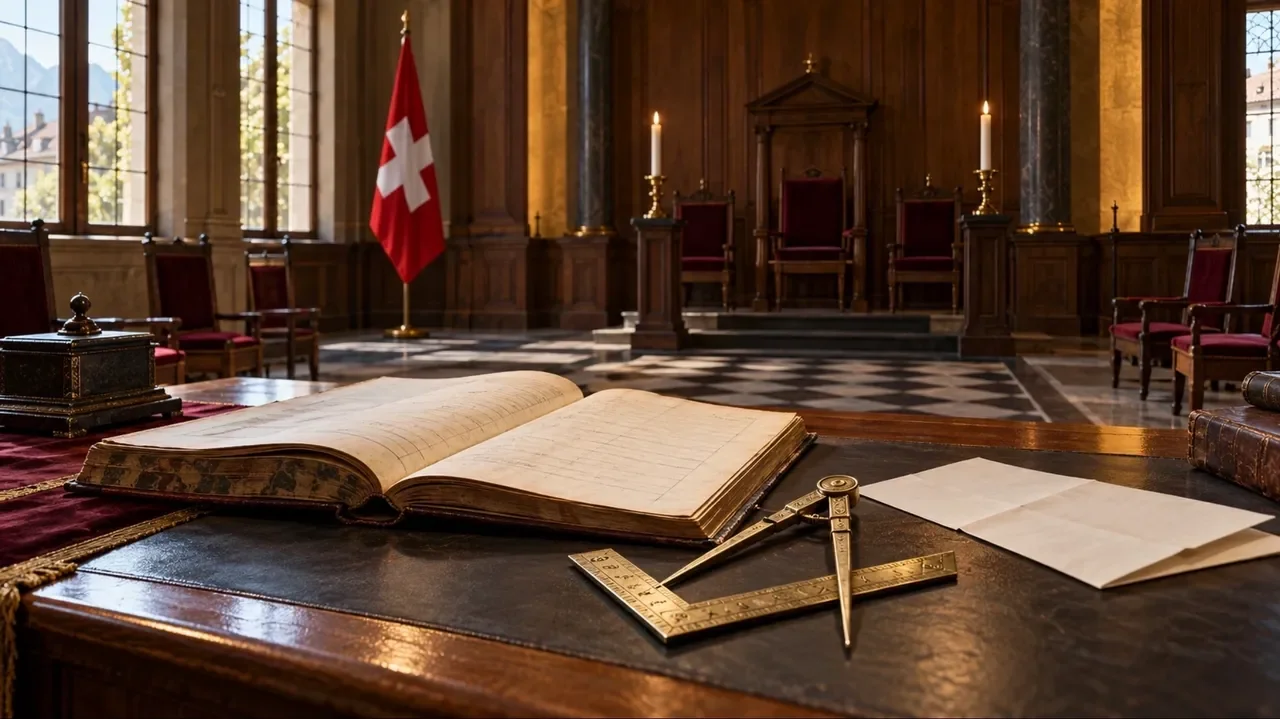
Freemasonry in Switzerland: History, Symbols and the Truth About Influence
By Dr. Pooyan Ghamari, Economist and Author | October 15, 2026
Freemasonry in Switzerland began in Geneva in 1736. Its lodges later included people active in Swiss public life, but that does not mean the lodges founded the federal state or secretly govern it. The useful question is narrower: where did members participate, what did their organisations decide, and what can the records prove?
A society with private ceremonies and well connected members invites two easy stories. In one, it is merely a harmless club. In the other, it is the invisible government behind everything. Both stories spare us the harder work of distinguishing an institution from its members and a relationship from an act of power.
Swiss history offers a way to do that work. It contains lodges founded across linguistic and religious divides, documented participation in civic debates, serious opposition to Freemasonry, a national vote on whether to ban it, and competing Masonic traditions that disagree about their own rules. None of those facts fits neatly inside a single myth.
How did Freemasonry in Switzerland begin?
The Historical Dictionary of Switzerland dates the first Swiss lodge to Geneva in 1736. Its account identifies Lord George Hamilton as the founder of a lodge linked to London. Another lodge appeared in Lausanne around 1739 to 1740. Swiss lodges subsequently developed different English, French and Prussian connections. They did not arrive as one Swiss command structure with a common political programme.
In June 1844, fifteen lodges formed the Swiss Grand Lodge Alpina. Four years later, Switzerland became a federal state under the 1848 constitution. The proximity of those dates is interesting. It is not a chain of causation.
There were personal links. The historian Johann Jakob Hottinger became Alpina’s first grand master. Jonas Furrer, Switzerland’s federal president in 1848, served as its grand orator, according to the Historical Dictionary. That establishes a person’s participation in both worlds. It does not show that an Alpina resolution drafted the constitution or that a lodge directed the new state. To make such a claim, a historian would need the relevant minutes, correspondence, decisions and evidence of actual influence on the constitutional process.
The distinction matters well beyond Freemasonry. If a minister belongs to a church, university, business association or political club, the membership may help explain a network. It does not, by itself, establish who wrote a law or why a vote went one way. Association is a starting point for investigation, not its verdict.
What do Masonic symbols actually tell us?
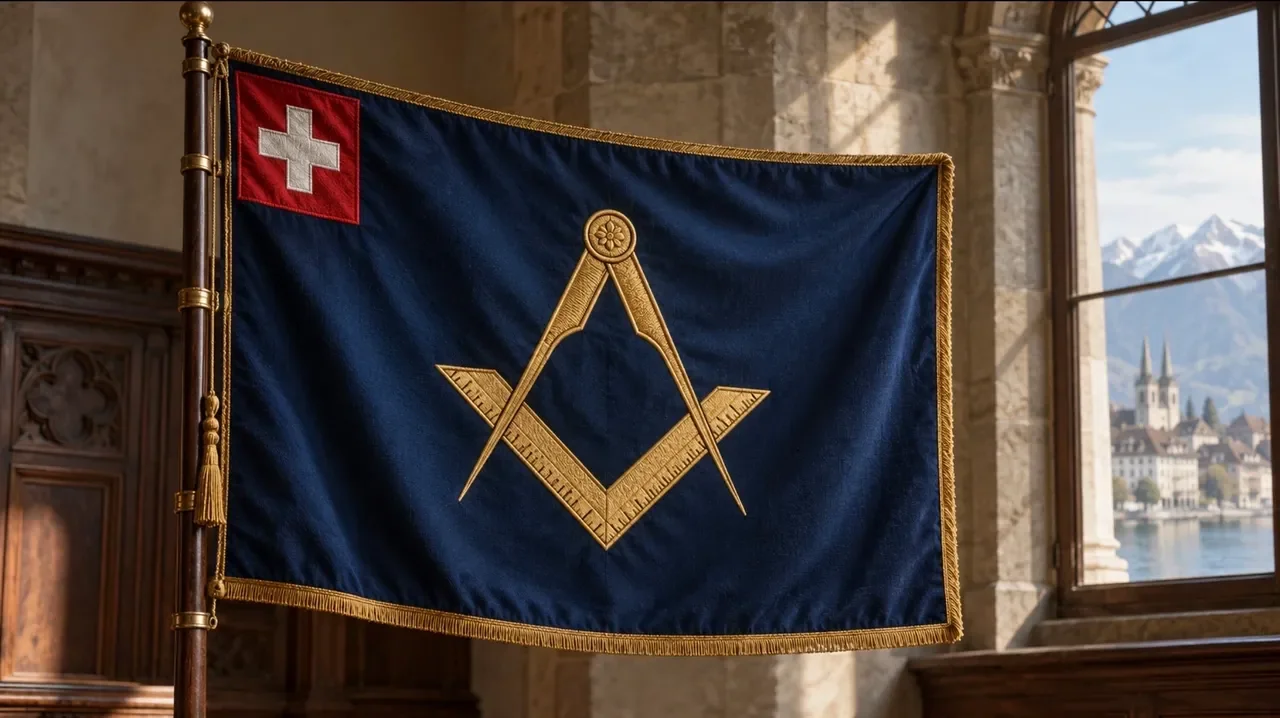
The square and compasses are working tools converted into moral language. In the Masons of California’s explanation of their symbols, the square is associated with moral conduct and the compasses with the individual’s relationship to society. The apron recalls the tools and dress of working stonemasons. Rough and finished stones picture self improvement as work, not an inherited title. Interpretations differ among traditions, so no single emblem is a universal key to every lodge.
The Swiss Grand Lodge Alpina’s published principles place the square, compasses and a sacred text in its ceremonies. They describe its purpose in terms of education, humanitarian principles, friendship, charity and social responsibility. Those are statements of institutional purpose. They are not an independent audit of every member’s conduct.
That is the point often missed in arguments about secret symbols. A sign can express an aspiration without proving that the person displaying it lives up to it. A symbol on a building can identify an affiliation without proving control over the building’s owner, a bank, a government or an entire economy.
I would put the question differently: what did the people behind the symbol actually do when they had a choice? A tool meant to teach upright conduct deserves to be measured against conduct. The image is not the evidence. The decision is.
Why there is no single Swiss Masonic position
Alpina is not the whole of Swiss Freemasonry. Its published rules describe a fraternity for men, a reference to a Supreme Being under the name “Grand Architect of the Universe,” and restrictions on controversial political or religious debate during formal lodge meetings. Its members are expressly allowed to participate in public affairs according to their personal convictions.
The Grand Orient of Switzerland, founded in 1959, describes itself as part of a liberal, nondogmatic current built around freedom of conscience and considerable autonomy for its lodges. Swiss women’s Freemasonry also has its own history: the Historical Dictionary dates the Swiss Women’s Grand Lodge to 1976 and records mixed lodges as well. “Regular” and “liberal” describe traditions and rules of recognition within Freemasonry; they should not be used as a shortcut for good and bad, real and fake, or politically identical.
There is an uncomfortable lesson here for a writer interested in power. Historically, many lodges were spaces for educated and prosperous men. Their language of equality coexisted with exclusions. Women built separate institutions in part because access was unequal. A serious history should be able to recognise the moral vocabulary, the charitable work and the gatekeeping at once.
Did Swiss Freemasons influence politics?
Yes, in the ordinary and historically documentable sense that some members and some lodges participated in public debates. The Historical Dictionary describes politically active Geneva lodges in the nineteenth century discussing labour law, compulsory insurance, education, welfare, neglected children and the separation of church and state. It also records support for hospitals, care institutions, nurseries and school meals in other cantons.
That record should not be erased to defend the claim that lodges were “never political.” Nor should it be inflated into proof of permanent, coordinated control. Alpina’s current published principles prohibit divisive political and religious debate in formal meetings. A rule in a contemporary organisation cannot be projected backwards onto every Geneva lodge in a different century, and a nineteenth century debate cannot be projected forward onto every lodge today.
This is where my four questions help: who gains, who pays, who decides and who is excluded?
If a lodge member argues for a welfare reform, the public can study the proposal, the recorded vote, the beneficiaries and its costs. If a public contract goes to another member’s firm, the relevant questions concern the tender, decision makers, competing bids, disclosures and terms. In either case, the investigator must identify a decision and a mechanism. A shared handshake is not a substitute for either.
I distinguish three levels of influence. Contact means two people know one another. Coordination means they act together toward an identifiable objective. Control means one can reliably determine or veto the other’s choice. Each level requires stronger evidence than the one before it. A membership roster might establish an opportunity for contact. Minutes or correspondence might establish coordination. To establish control, one would have to show that a decision changed because of that relationship and that the power to produce such a change was real.
An economist would also ask what else explains the outcome. If officials from the same canton, university, party and lodge supported a reform, which connection mattered? Did nonmembers support it too? Was it already gaining public support? These are not excuses to ignore a hidden conflict. They are checks against attributing an entire political process to the most mysterious name in the room. Without a comparison, a pattern can be made to say almost anything.
This gives citizens a practical direction. When someone says a private network controls a public institution, request one concrete decision and the records that connect the alleged network to it. If there is a financial benefit, trace ownership and payment. If there is a policy benefit, trace drafts, lobbying, committee records and votes. If there is no identifiable decision, the claim has not yet become an investigation.
The 1937 vote: criticism, fear and the limits of suspicion
Switzerland put the question of prohibition to a national vote on November 28, 1937. The proposed ban extended beyond Masonic lodges to the Odd Fellows, the philanthropic Union and similar organisations. It was initiated by Arthur Fonjallaz and allies in the political climate of the 1930s. According to the University of Bern’s Swissvotes account, the Federal Council argued that existing law could address unlawful conduct and that the accusations used to justify a general ban lacked proof.
The initiative was rejected. The Historical Dictionary gives the result as 515,327 votes against and 234,980 in favour; Swissvotes reports a 31.3 percent yes share. Swissvotes also documents anti Jewish claims in the campaign. Those claims must be described as allegations used by campaigners, not as findings about Jews or Freemasons.
There is a political principle in this result that remains useful. A society need not admire an association to defend its right to exist. Switzerland’s Federal Constitution, Article 23, guarantees freedom of association. That freedom protects many groups, including ones a citizen may dislike. At the same time, it does not turn a private association into an exemption from scrutiny of a public official’s specific conduct.
Criticism of exclusion, privilege or possible conflicts of interest can be legitimate. Collective accusation without evidence is not. The first asks for records. The second converts uncertainty into a target.
The modern test of influence is not a symbol but a decision
Suppose a municipal authority awards a valuable property contract and one official and one bidder happen to belong to the same private association. The association could be a Masonic lodge, a sports club, an alumni network or a professional chamber. The membership is relevant enough to check for a relationship. It is insufficient to establish favouritism.
Ask who had authority over the procurement. Examine the published criteria and competing bids. Determine whether the official participated in the decision, whether a relevant interest was disclosed under applicable rules, whether the chosen terms depart from the market, and whether the process would have looked the same without that personal link. An investigation can then move from a suggestive connection to a defensible account of cause and consequence.
This also protects people who are wrongly accused. One can demand transparent public decisions without demanding public lists of everyone’s private beliefs and associations. The public claim should be proportional to the public evidence.
My own judgment is that the most consequential forms of influence often look less theatrical than a secret rite. They can be ordinary access to a decision maker, the framing of acceptable options, a bidder’s informational advantage or a rule that excludes a competitor. Those mechanisms exist across many institutions. Naming one fraternity as the explanation for every outcome makes those everyday mechanisms harder, not easier, to see.
If Freemasonry offers a moral discipline, its best public test is whether its members accept that standard of accountability. If critics want to expose improper power, their best test is whether they can identify a decision, its beneficiaries, its costs and the records that connect them. Neither respect nor suspicion should be given a free pass.
Frequently asked questions
1. What is Freemasonry?
It is a family of fraternal organisations using lodge meetings, ceremonies and symbols drawn from stonemasonry to explore ethics, fellowship and service. Rules vary among Masonic traditions.
2. When did Freemasonry arrive in Switzerland?
The first Swiss lodge documented by the Historical Dictionary of Switzerland was founded in Geneva in 1736.
3. Where was Switzerland’s first Masonic lodge?
In Geneva. The lodge was linked to the Grand Lodge of London and founded by Lord George Hamilton, according to the Historical Dictionary.
4. Which is the oldest Swiss lodge still active?
The Historical Dictionary identifies Geneva’s Union des Cœurs, founded in 1768, as the oldest Swiss lodge still active at the time of its historical account.
5. What is the Swiss Grand Lodge Alpina?
It is a federation of Swiss lodges formed by fifteen lodges in June 1844. It represents one Masonic tradition, not all Swiss Freemasons.
6. Was Alpina founded before modern Switzerland?
Yes. Alpina was established in 1844, four years before the Swiss federal state created under the 1848 constitution. Timing alone does not show that one created the other.
7. Did Freemasons found the Swiss federal state?
The cited historical record documents individual Masons in Swiss public life, not a collective lodge plan that founded the federal state. A stronger claim would require specific documentary evidence.
8. Was Swiss president Jonas Furrer a Freemason?
The Historical Dictionary records Jonas Furrer, federal president in 1848, as Alpina’s grand orator. His dual roles are historically relevant but do not establish institutional control.
9. Are all Swiss Freemasons members of Alpina?
No. Switzerland also has liberal, women’s and mixed Masonic organisations with different rules and histories.
10. What is the Grand Orient of Switzerland?
It is a separate Masonic federation founded in 1959. Its own account places it in the liberal, nondogmatic tradition.
11. Can women be Freemasons in Switzerland?
Yes. The Swiss Women’s Grand Lodge dates to 1976, and mixed Masonic lodges also exist. Alpina’s published admission rules are male only.
12. Are mixed lodges the same as women’s lodges?
No. Mixed lodges admit members of more than one gender; women’s lodges are organisations for women. Both differ from Alpina’s male only admission rule.
13. What does “regular” Freemasonry mean?
It refers to recognition under a particular set of Masonic rules and relationships, often associated with belief in a Supreme Being and other traditional requirements. It is an internal classification, not a legal verdict on other lodges.
14. Is Freemasonry a religion?
Alpina describes its practice as a fraternity and moral education, not a separate church. Its principles invoke a Supreme Being; other Masonic traditions have different approaches to belief.
15. Must all Swiss Freemasons believe in God?
No single answer covers all Swiss traditions. Alpina’s principles refer to a Supreme Being, while the Grand Orient describes itself as nondogmatic and emphasises freedom of conscience.
16. What does “Grand Architect of the Universe” mean?
In Alpina’s published principles, it is a Masonic term for the Supreme Being. Its use should not be assumed to have identical meaning in every tradition or for every individual.
17. What are the three basic Masonic degrees?
Entered Apprentice, Fellow Craft and Master Mason are the three symbolic degrees described in standard accounts of lodge Freemasonry. Other rites may add further degrees.
18. What is a 33rd degree Mason?
The 33rd degree belongs to the Scottish Rite, not to a universal chain of command over every Freemason. The Scottish Rite’s own FAQ says no Masonic degree is more important than Master Mason.
19. What do the square and compasses symbolise?
They begin as builders’ tools and are used for moral reflection. The Masons of California describe the square as an emblem of morality and the compasses as relating individual conduct to society.
20. What does the Masonic apron represent?
It recalls the working apron of a stonemason and is worn in lodge ceremonies. Its symbolism links the member to the image of ethical work on oneself.
21. What does the letter G mean in Masonic imagery?
The Masons of California explain it as geometry within the square and compasses emblem. Symbolic explanations can vary by place and tradition.
22. Is every eye or pyramid a Masonic sign?
No. The eye has appeared in Masonic and non Masonic imagery, and visual resemblance does not establish organisational authorship or political control.
23. Why do lodges use rituals?
Rituals give structure to instruction, memory and shared experience. Their existence does not by itself establish a political programme; claims about political acts require evidence of decisions.
24. Is Freemasonry a secret society?
Swiss organisations publish histories and principles, while some ceremonies and memberships remain private. It is more precise to ask what is private and whether a particular public decision is transparent.
25. Are Masonic membership lists public?
Not necessarily. Publicly documented historical members can be discussed, but one should not infer someone’s membership from a photograph, symbol or unverified online list.
26. Did Swiss lodges ever discuss public policy?
Yes. The Historical Dictionary describes nineteenth century Geneva lodges debating labour, education, welfare and church state questions. That historical record should not be confused with every lodge’s present rules.
27. Does Alpina permit political debate in its meetings today?
Its published principles say members should not debate controversial political or religious matters during formal lodge meetings. Members may participate in public life according to their own convictions.
28. What was the 1937 Swiss anti Freemasonry referendum?
Voters considered a constitutional initiative to prohibit Freemasonry and certain other associations on November 28, 1937. It failed, with 31.3 percent voting yes.
29. Why did the Federal Council oppose the 1937 ban?
The Swissvotes account says it found existing legal tools sufficient for unlawful acts and no proof for the campaign’s sweeping accusations. Freedom of association was also at stake.
30. Do Freemasons control Swiss banks or government?
The sources cited here do not establish such collective control. A credible claim would need named institutions, decisions, mechanisms and records, not a list of shared memberships.
31. When does lodge membership become a public interest issue?
When a specific official decision may involve a relevant personal interest or undisclosed relationship. The appropriate test is the applicable disclosure rule and the documented decision process, not automatic suspicion of association.
32. How should a claim about Masonic influence be checked?
Verify the membership, identify the decision and its date, obtain primary records, map who benefited or lost, then test whether the alleged relationship actually explains the outcome better than alternatives.
33. Why does this history matter today?
It teaches a distinction every democracy needs: defend private association, scrutinise public power, and refuse to turn either symbols or fear into evidence.
Sources and evidence note
This article distinguishes documented history from my interpretation of how to investigate influence. A lodge’s published principles establish what that organisation says about itself; they do not verify the conduct of every member. Membership alone cannot establish a causal claim about a government decision.
1. Historical Dictionary of Switzerland, “Freimaurerei”, historical article updated May 15, 2007.
2. Swiss Grand Lodge Alpina, General Principles, institutional statement.
3. Grand Orient of Switzerland, “Une histoire riche”, institutional history.
4. Swissvotes, University of Bern, 1937 ban initiative analysis, scholarly referendum account.
5. Swiss Federal Constitution, Article 23, freedom of association.
6. Masons of California, Freemasonry Symbols, institutional explanation of one tradition’s symbolism.
7. Scottish Rite of Freemasonry, Frequently Asked Questions, institutional explanation of Scottish Rite degrees.
Relevant internal links for the editor: The Invisible Chain and The Invisible Empire and the Chain of Free Nations in the book catalogue, for readers who want the author’s broader theory of power; The Architecture of Sovereignty for the distinction between discernment and reactive suspicion. These are thematic reading suggestions, not evidentiary sources for the history above.
Original article: https://ghamari.org/articles/f/freemasonry-in-switzerland-history-symbols-influence