Gold, Trust, and the Future of Wealth
By Dr. Pooyan Ghamari · · 10 min read
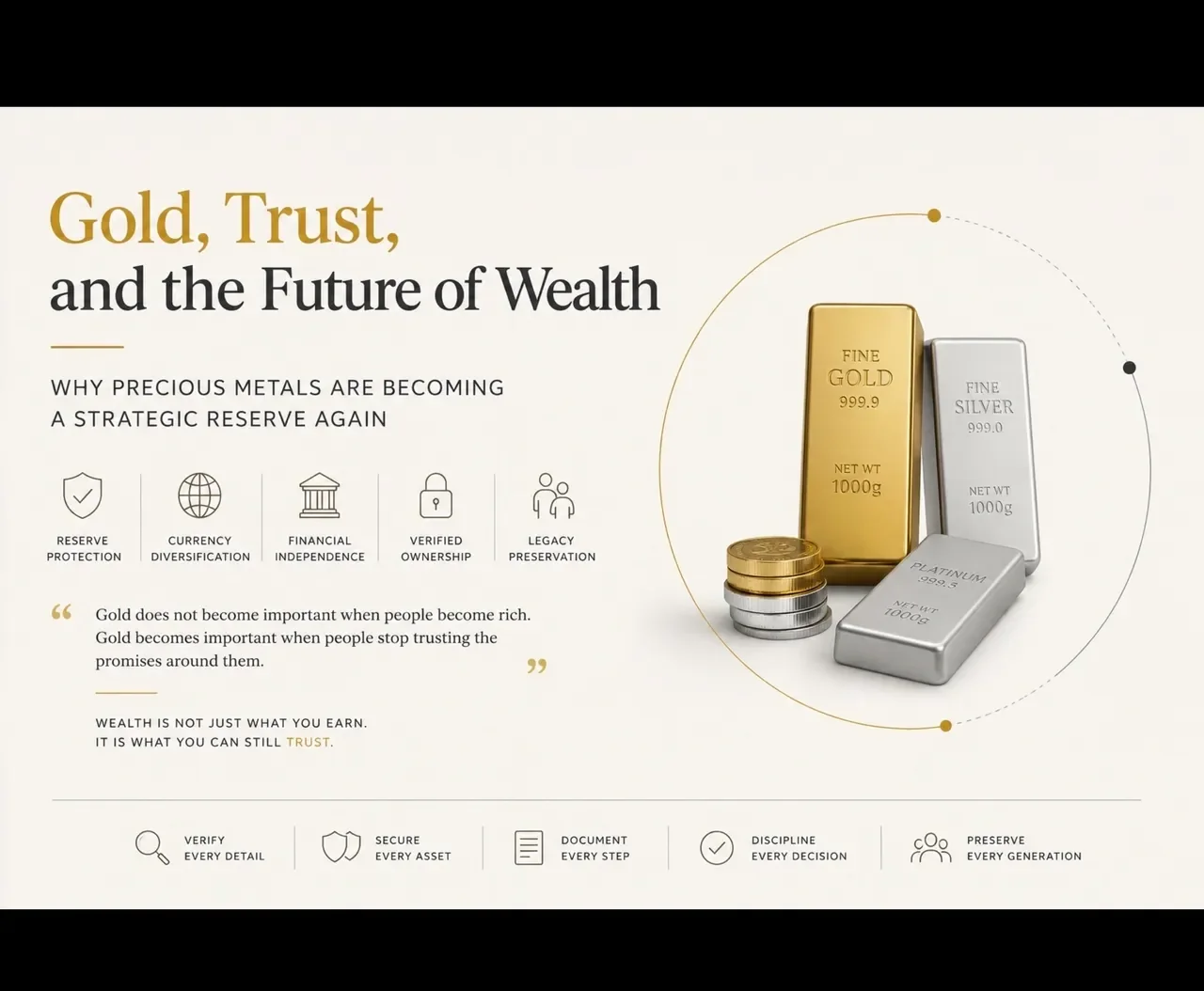
Why Precious Metals Are Becoming a Strategic Reserve Again
The Return of Trust Assets
by Dr. Pooyan Ghamari
Gold does not become important when people become rich. Gold becomes important when people stop trusting the promises around them.
A currency is a promise. A bank balance is a promise. A bond is a promise. A pension is a promise. Even a supply chain is a promise that distance, politics, energy, shipping, credit, and law will all behave well enough for goods to arrive on time. Most wealth in modern society rests on these promises. For long periods, that system works. Then confidence thins, and people begin searching for assets that do not need as many explanations.
That is where precious metals return.
Gold is not returning because investors suddenly became nostalgic. It is returning because the world is being forced to price risks it once preferred to ignore: war, debt, inflation, currency distrust, banking fragility, supply-chain pressure, and political fragmentation. In a recent strategic review, Dr. Pooyan Ghamari frames precious metals less as a speculative bet and more as a discipline built around trust, verification, custody, and risk management. That is the correct starting point. Gold bought emotionally can become a mistake. Gold held intelligently can become part of a reserve system.
The 2026 market shows both sides. The World Gold Council reported that central banks bought 244 tonnes of gold on a net basis in Q1 2026, and its 2026 survey found that 89% of central-bank respondents expect global gold reserves to rise over the next 12 months, while 45% expect their own institution’s reserves to increase. (World Gold Council) At the same time, gold has been volatile. The World Gold Council’s mid-year outlook reported that the LBMA Gold Price reached US$5,405 on January 29, 2026, then fell to US$4,001.80 on June 25. (Reuters)
The lesson is clear. The structural case for gold is strong, but timing still matters.
The Real Reason Gold Still Matters
Gold pays no dividend. It collects no rent. It does not build a company, employ people, or compound earnings. Anyone buying gold must understand that first.
Its role is different. Gold is a reserve asset, a liquidity shield, a crisis hedge, a currency distrust instrument, and a psychological anchor. It is not income. It is not growth in the normal business sense. It is an asset people turn to when they want part of their wealth outside the chain of promises.
That explains why central banks still care about it. Institutions that issue currency continue to hold and buy an asset that no central bank can print. Their behaviour does not prove that gold must rise every year. It proves something more subtle: official institutions still see gold as useful when monetary trust becomes complicated.
For families and private investors, the logic is similar but smaller. Gold can protect part of wealth from currency debasement, banking stress, and political uncertainty. But it cannot replace income, skill, business ownership, real estate cash flow, or productive investment. A serious investor does not turn gold into religion. He gives it a job.
War, Inflation, Debt, and Currency Distrust
The risk is not certainty. The risk is that investors are now forced to price possibilities that were previously ignored.
Europe understands this well. Energy shocks, war near the continent, inflation pressure, and weaker growth have made financial security feel less theoretical. The ECB’s June 2026 projections placed euro area headline inflation at 3.0% in 2026, 2.3% in 2027, and 2.0% in 2028, with the inflation path heavily shaped by energy prices. (European Central Bank) The ECB also noted that energy inflation was projected to peak at 12.5% in the third quarter of 2026, with uncertainty linked to oil and energy assumptions. (European Central Bank)
Debt is another part of the trust problem. Reuters, citing the Institute of International Finance, reported that global debt reached nearly US$346 trillion, around 310% of global output, in late 2025. (Reuters) High debt does not automatically mean collapse. But it means governments, central banks, and markets have less room for mistakes.
This is the environment where precious metals become relevant again. Not because every currency will fail. Not because war is guaranteed. But because the cost of trusting one system with everything has become too high.
Technology and the Myth of Artificial Gold
One futuristic fear is that technology will one day manufacture gold cheaply and destroy its value. The fear sounds modern, but the science does not support it at investment scale.
Gold is an element. Chemistry cannot create it because chemical reactions rearrange electrons and molecules, not atomic nuclei. To create gold, one must change the nucleus of another element. That is nuclear transmutation.
CERN has shown that this is scientifically possible in tiny quantities. The ALICE experiment measured lead nuclei converting into gold during near-miss collisions at the Large Hadron Collider. During Run 2 from 2015 to 2018, about 86 billion gold nuclei were created at the four major experiments, equal to only 29 picograms, or 2.9 × 10⁻¹¹ grams. CERN states that this is trillions of times less than what would be required to make jewelry. (CERN)
So the real threat is not laboratory gold. I cannot confirm any commercial process capable of producing investment-grade gold cheaply at scale. The real danger is simpler: fake gold, poor documentation, weak custody, emotional buying, high spreads, leverage, and entering after panic has already pushed prices too far.
Gold, Silver, Platinum, and Palladium Are Not One Trade
Precious metals are often grouped together, but each metal has a different economic character.
Gold is the reserve metal. It responds to central-bank demand, real interest rates, currency distrust, geopolitical risk, and confidence in the monetary system. It is the anchor.
Silver is more explosive. It has a monetary side, but it is also an industrial metal. The Silver Institute expects the silver market to remain in deficit in 2026 for a sixth consecutive year, with a projected deficit of 67 million ounces. It also expects physical investment demand to rise 20% to 227 million ounces, while industrial fabrication is forecast to fall 2% to around 650 million ounces because of photovoltaic thrifting and substitution. (The Silver Institute) Silver can outperform gold in a strong metals cycle, but it can punish late buyers more aggressively.
Platinum is the contrarian scarcity story. The World Platinum Investment Council forecasts a fourth consecutive platinum market deficit in 2026, with the market short by 297,000 ounces. It also expects bar and coin investment demand to rise 27% to 718,000 ounces. (platinuminvestment.com) Platinum has industrial use, supply concentration, and a different investor psychology from gold.
Palladium is more tactical. It can move sharply when supply is tight, but its dependence on automotive demand and substitution risk make it less suitable as a foundation holding. JPMorgan expects palladium at about US$1,350 per ounce by the end of 2026 and an average near US$1,300 in 2027. (Reuters)
The simple version is this: gold protects, silver accelerates, platinum offers scarcity with industrial complexity, and palladium belongs mainly to tactical investors.
Europe’s Precious Metals Psychology
Europe does not buy gold only for profit. It buys gold because memory matters.
Families remember inflation. Countries remember war. Business owners remember banking stress. Older generations understand that paper wealth can be strong for years and fragile in days. That psychology creates demand for assets that can be held, verified, inherited, and explained.
The European legal framework also matters. EUR-Lex states that qualifying investment gold includes certain bars or wafers of at least 995 thousandths purity and certain coins of at least 900 thousandths purity. The supply, intra-Community acquisition, and importation of investment gold are VAT exempt. (EUR-Lex)
But the future will not belong to informal gold dealing. Regulation is tightening. Regulation (EU) 2024/1624 establishes an EU-wide limit on large cash payments above EUR10,000 and strengthens anti-money-laundering rules for obliged entities, including certain high-value goods sectors. (EUR-Lex)
That changes the market. Europe does not only need gold sellers. It needs compliant, transparent, verified precious metals infrastructure.
How Metals Can Help Investors Grow Wealth
Precious metals can help wealth, but not by pretending to be something they are not.
They can diversify currency exposure. They can provide liquidity in crisis. They can protect part of a family reserve. They can help investors avoid having all assets tied to banks, equities, property, or one currency. They can serve as an opportunity reserve during market stress, because liquid metal can be sold when better assets become cheap.
But the limits are real. Metals do not produce income. They can fall sharply. They can move sideways for long periods. They carry storage costs. Physical buying includes spreads. Small products often carry higher premiums. If an investor puts too much into metals, he may protect himself from one risk while creating another: lack of productive growth.
The discipline is allocation. For a conservative investor, one possible framework is to keep gold as the core, with only limited silver and little or no palladium. A balanced investor may use gold as the foundation and silver or platinum as smaller satellite positions. An aggressive investor may hold more silver and platinum, but only with full acceptance of volatility.
The right structure depends on liquidity, income, time horizon, business needs, family obligations, and the ability to stay calm during price declines.
How Investors Lose Money in Precious Metals
Most losses in precious metals are not mysterious.
People buy after panic. They pay high premiums because fear makes them impatient. They treat jewelry as investment. They ignore the difference between the selling price and buyback price. They trust unknown dealers. They buy undocumented metal. They overpay for rare coins without understanding numismatic value. They use leverage. They confuse mining shares with physical metal. They buy tokenized gold without checking custody, audit, legal title, redemption rights, and jurisdiction.
Another mistake is storing too much at home. A small emergency reserve may make sense for some families, but serious wealth requires professional security, insurance, documentation, and inheritance planning.
The worst mistake is emotional buying. Fear can identify a risk, but it should not write the investment plan.
The Future Business Opportunity: Verified Precious Metals
The next opportunity is not simply selling gold. The next opportunity is verification.
This is where Dr. Ghamari’s strategic view becomes practical. The market already has sellers. What it lacks is enough trust infrastructure: verified buying, verified selling, assay support, transparent spreads, published buyback rules, secure storage partners, audited vaulted metal, digital ownership records, inheritance documentation, monthly accumulation plans, corporate treasury advisory, and multilingual education.
The strongest position is not “buy gold because the world is dangerous.”
The stronger position is: before you buy, here is what is real, what is documented, what it costs, where it is held, how you can exit, and what risk remains.
That is the difference between a gold shop and a wealth verification system.
Three Possible Futures
My base view is that gold remains structurally relevant but volatile. Central-bank demand, inflation memory, currency distrust, debt pressure, and geopolitical risk support the long-term role of gold, but corrections remain normal. HSBC lowered its 2026 average gold forecast to US$4,560 per ounce, citing a stronger dollar and a more hawkish Federal Reserve, while still noting that fiscal deficits and sovereign debt could support gold longer term. (Reuters)
The bull case is a deeper trust crisis. War risk rises, energy stress returns, real yields fall, debt fears grow, currencies weaken, and investors rush toward tangible reserves. In that world, gold can rise again, silver may outperform because of its smaller and more volatile market, and platinum can benefit if deficits remain visible.
The bear case is relief. Geopolitical tensions cool, the dollar strengthens, real yields stay high, equities attract capital, and investors reduce defensive positions. In that case, gold can consolidate or correct, while silver, platinum, and palladium may fall harder.
The risk to watch is positioning. When everyone buys as if calm is impossible, even a small improvement in sentiment can hurt prices.
The Ethical Position
A serious adviser should not sell fear. A serious adviser should help people understand what gold can protect, what it cannot protect, and when buying more becomes irrational.
The real adviser does not only tell a client when to buy gold. He must also know when to tell the client to keep cash, reduce exposure, or walk away.
That is the difference between advice and sales.
The Future Belongs to Verified Wealth
Gold will remain powerful not because it promises profit, but because it survives distrust.
It has no central issuer, no political loyalty, no promise of yield, and no need to explain itself through a balance sheet. That is why it continues to matter when confidence becomes expensive.
The next phase of precious metals will not reward panic. It will reward disciplined investors, verified custody, transparent pricing, realistic allocation, clean documentation, and the courage to avoid emotional buying.
The future is not fear-based gold.
It is verified wealth.
Original article: https://ghamari.org/articles/f/gold-trust-and-the-future-of-wealth