Iran’s Path Forward: Global Prosperity, Diaspora Empowerment, and
By Dr. Pooyan Ghamari · · 49 min read

Economic Integration
Balanced Multilateral Treaty Framework for All Parties
This document presents a formal, multilateral Treaty framework designed to deliver final, sustainable peace through Iran’s full economic integration, permanent deterrence protection, and shared global prosperity. Unlike the 2015 JCPOA which relied on revocable executive waivers , this Treaty is legally binding at the highest international level: ratified through national legislatures, endorsed by UN Security Council Chapter VII resolution, and backed by automatic enforcement mechanisms with symmetric costs for any party that breaches or reverses commitments.
The framework delivers: Iran’s military sovereignty and existential nuclear deterrent (protected absolutely), the world’s legitimate non-proliferation guarantee (IAEA Additional Protocol + continuous verification + 180-day breakout floor), irreversible sanctions relief through legislation, $50-80 billion annual oil revenue, $50+ billion reconstruction financing, permanent Hormuz revenue, WTO membership pathway, full diaspora reintegration (unlocking $10-15 billion annual remittances and diaspora capital), and regional economic interdependence making war and isolation economically suicidal for all. Any party attempting to breach or reverse faces automatic compensatory pain: escalating sanctions, binding arbitration awards, temporary loss of trade privileges, or for Iran expedited military snapback. This makes the Treaty nearly unbreakable while delivering genuine win-win outcomes for Iran, Iranians at home and globally, the region, and the international community.
FOUNDATION AND LESSONS
Why 2015 Failed and How 2026 Succeeds
In 2015, Iran and the world powers signed the Joint Comprehensive Plan of Action (JCPOA), an agreement designed to freeze Iran’s nuclear program in exchange for sanctions relief. The result was instructive—and tragic.
Iran permanently dismantled nuclear centrifuges, shipped uranium stockpiles out of the country, and converted its weapons-capable reactor to civilian research. In return, Iran received sanctions relief granted through executive order waivers that lasted less than two years. In May 2018, a new U.S. administration reversed course with a single decision. Iran lost its leverage forever. Sanctions returned. The economy collapsed. By 2025-2026, Iran faced the worst of both worlds: military deterrence reduced through JCPOA commitments, yet with no relief and no path forward.
The core flaw: executive waivers are not law. They can be revoked by any new administration. They are politically fragile and reversible.
This Treaty solves that fatal weakness.
The Three Core Problems It Solves
Problem 1: Reversibility. The 2015 agreement could be unwound by presidential decision. This Treaty is embedded in national legislatures and international law, making reversal require new laws and international consensus—far more difficult and politically costly.
Problem 2: Asymmetric Risk. Iran gave up permanent capability (centrifuges dismantled, uranium shipped out) for temporary relief. This Treaty maintains a clear separation: Iran’s military is entirely outside this agreement (never constrained), while only Iran’s civilian nuclear program is verified. Iran gives up nothing permanent.
Problem 3: Lack of Mutual Pain. The 2015 agreement had no mechanism making reversal expensive for the other side. This Treaty includes automatic compensation ($10-20 billion in escrow), binding arbitration, expedited trade penalties, and all enforcement triggers working symmetrically—if Iran breaches, serious consequences; if the world reverses unjustly, Iran gets automatic compensation and the reversing party faces binding arbitration and temporary trade loss.
CORE PRINCIPLES OF THE TREATY
Three Governing Principles
Principle 1: Permanent Military Sovereignty. Iran’s military institutions, ballistic missiles, conventional forces, and existential nuclear deterrent are completely outside this Treaty. They are protected absolutely and forever. No verification, no constraints, no external judgment. This removal of existential vulnerability is essential for Iran to agree to anything.
Principle 2: Clear Boundary Between Military and Civilian. Only Iran’s civilian nuclear program is subject to verification and limits. This verifiable boundary removes international uncertainty while protecting Iranian deterrence. The international community receives credible, monitored assurance that Iran’s civilian nuclear program is peaceful (3.65% enrichment maximum, 500 kg stockpile limit, 5,060 centrifuges maximum, 180-day minimum breakout time, IAEA Additional Protocol monitoring). Iran’s military nuclear option remains untouched.
Principle 3: Prosperity as Peace Foundation. Sustainable peace rests on shared economic interest, not military threats. This Treaty generates massive, rising prosperity for every Iranian at home and in the diaspora—jobs through reconstruction, competitive wages through manufacturing, education through investment, entrepreneurship through banking access, and diaspora wealth through reintegration. When a nation’s people are prosperous and rising, war and isolation become economically suicidal for any political faction.
WHAT IRAN PROTECTS ABSOLUTELY
Military Red Lines—Completely Outside This Treaty
These commitments are permanent, unconditional, and cannot be negotiated in any future discussion:
IRGC and Military Institutions
The Islamic Revolutionary Guard Corps is established by Iran’s Constitution as part of Iran’s sovereign state structure. This Treaty does not address, restrict, monitor, verify, constrain, or make subject to external judgment any aspect of Iran’s military institutions—their structure, command, doctrine, modernization, budgets, operations, or alliances.
No foreign power will demand or accept the transparency, audits, restructuring, or privatization of Iran’s military. This is non-negotiable.
Ballistic Missile Program
Iran’s ballistic missile program remains completely outside this Treaty. Iran retains absolute freedom to:
• Test ballistic missiles on any schedule
• Extend range and accuracy without limit
• Expand stockpiles indefinitely
• Transfer missile technology to allies as Iran determines
• Modernize and upgrade systems continuously
• Conduct military exercises involving missiles
There are no notification requirements, no monitoring, no external limits, no verification. Iran’s conventional deterrent—the primary protection against invasion or coercion—is sacrosanct.
Nuclear Deterrent Option
Iran commits not to pursue nuclear weapons under normal circumstances. However, Iran retains the permanent, inalienable right to leave this Treaty and pursue military nuclear capability if Iran faces existential threat or if the existential conditions described below occur. This right cannot be negotiated away, and no party may condition sanctions relief or other benefits on Iran waiving this right.
Conditions under which Iran may leave the Treaty and pursue weaponization:
• Direct military attack on Iranian territory or imminent invasion threat
• Attempted regime change operations by external powers
• Credible evidence of sanctions reversal without verified Iranian breach
• Withdrawal by any permanent UN Security Council member
• Evidence of coordinated covert operations against Iran’s security
In these cases, Iran provides 180-day notice of intent to withdraw and pursue nuclear weapons development. The international community may object through the Joint Compliance Commission, but cannot legally prevent Iran’s right to withdraw and weaponize.
Military Alliances
Iran retains complete freedom to:
• Support any state or non-state entity Iran determines is legitimate
• Provide weapons, training, and financial support to allies
• Conduct joint military operations with partners
• Form mutual defense agreements and regional partnerships
No party may condition sanctions relief or treaty benefits on Iran limiting military alliances or support for partners.
WHAT IRAN ACCEPTS (Limited, Credible, Low-Cost Concessions)
Civilian Nuclear Verification—The Clear Boundary
Iran accepts International Atomic Energy Agency monitoring of Iran’s civilian nuclear program because:
1. Iran has legitimate civilian nuclear power needs
2. Verification removes international uncertainty and builds credibility
3. This is the only way to unlock the economic relief Iran requires
4. The verification is limited, transparent, and technologically sound
5. It protects Iran’s military nuclear option (verification applies only to civilian enrichment)
Specific Nuclear Parameters (Civilian Only)
Enrichment Level: Maximum 3.65% uranium-235
• Suitable for civilian power generation (3-5% range)
• Far below weapons-grade (90%+ required)
• Publicly verifiable through IAEA sampling and analysis
• Verified monthly through uranium hexafluoride analysis
Uranium Stockpile: Not to exceed 500 kilograms UF6 equivalent
• Measured and verified monthly
• Excess material may be diluted or shipped out
• Clear, technical threshold with no ambiguity
Centrifuge Inventory: Maximum 5,060 IR-1 centrifuges
• Zero advanced centrifuges (IR-2M, IR-4, or successors)
• New installations only with Joint Compliance Commission approval
• Monthly physical verification at Natanz, Esfahan, and other sites
Breakout Time Floor: Minimum 180 days
• Defined as time required to produce 25 kilograms of 90% enriched uranium from current stockpile and cascading capacity
• Verified quarterly by independent technical commission
• If approaching threshold, Iran has 30 days to restore parameters through centrifuge reduction or stockpile dilution
Verification Mechanisms
IAEA Monitoring at Declared Civilian Sites:
• Continuous digital cameras at centrifuge halls (24/7 video feed)
• Monthly on-site inspections by IAEA inspectors
• Environmental sampling from facility sites
• Centrifuge performance and capability monitoring
• Uranium enrichment measurements through mass spectrometry
IAEA Additional Protocol Implementation:
Iran commits to sign, ratify, and fully implement the IAEA Additional Protocol, which provides:
• Broader access to Iranian nuclear facilities for the IAEA
• Expanded environmental sampling
• Access to additional locations specified by the IAEA
• Interviews with Iranian scientists (voluntary, not coercive)
• Declarations of past military dimensions activities and current research
The Additional Protocol is the international gold standard for nuclear verification confidence. Iran’s commitment to implement it demonstrates genuine commitment to peaceful civilian nuclear activities and builds legitimate world confidence.
Snap Inspections (Emergency Verification):
If the Joint Compliance Commission detects credible evidence of potential violation, IAEA may conduct snap inspections with 15-minute notice (instead of normal 72-hour notice) at the specific facility or location in question. These are limited to 1-2 hours and focused on the suspected violation area.
Joint Compliance Commission Technical Verification:
A standing technical commission—comprising experts from Iran, the IAEA, and three neutral technical experts appointed by Brazil, India, and Switzerland—conducts quarterly verification:
• Reviews all IAEA reports
• Calculates breakout time
• Confirms compliance with all parameters
• Publishes quarterly technical report (sensitive details redacted for security)
• Serves as binding technical authority
(disputes resolved through arbitration if needed)
Behavioral Commitments (Reciprocal with All Parties)
Iran’s Behavioral Commitments
No Transfer of Weapons of Mass Destruction: Iran commits that no nuclear weapons, chemical weapons, biological weapons, or weapons-usable materials shall be transferred to any non-state actor. This commitment:
• Costs Iran nothing (Iran has no WMD to transfer)
• Is verifiable through IAEA monitoring and intelligence sharing
• Strengthens international non-proliferation norms
• Can be monitored through the Joint Technical Committee
Commercial Shipping Safety (Peacetime): During peacetime and absent active military conflict, Iran commits to not conduct military attacks against commercial shipping in the Strait of Hormuz or international waters. This commitment:
• Automatically suspends if Iran faces military attack, invasion, or blockade
• Preserves Iran’s right to respond to actual military threats
• Protects legitimate commerce while preserving Iranian deterrence
• Is implemented through maritime incident procedures (hotlines, de-escalation protocols)
Maritime Incident Procedures: Iran commits to establish and maintain 24/7 crisis communication channels, maritime hotlines, and incident management procedures that allow rapid de-escalation if accidents occur. These procedures:
• Prevent miscalculation turning incidents into conflicts
• Benefit all parties through reduced accident risk
• Are symmetric and reciprocal with other parties’ commitments
• Are transparent and clearly documented
Reciprocal Commitments by All Parties
No Sabotage: The United States, European Union, Russia, China, and regional partners commit to:
• No cyber attacks on Iranian military or civilian infrastructure
• No bombing or missile attacks on Iranian facilities
• No covert sabotage operations against Iranian nuclear, energy, or military installations
• No industrial sabotage targeting Iranian manufacturing or oil/gas operations
No Assassinations: All parties commit to:
• No targeted killings of Iranian officials, military leaders, scientists, or civilians
• No covert assassination operations
• No support for assassination attempts by third parties
No Regime Change Operations: All parties commit to:
• No CIA-style coups or destabilization operations
• No funding or support for armed rebellion against Iranian government
• No intelligence operations designed to overthrow or destabilize Iran’s government
• No direct or indirect support for regime change groups
No Blockade or Siege: All parties commit to:
• No naval blockade of Iranian ports
• No forced closure of international waters to Iranian shipping
• No sanctions on shipping insurance targeting Iranian vessels
• No denial of maritime access or artificial scarcity
No Use of Military Activity as Pretext for Sanctions: All parties commit to:
• Not using Iranian military exercises, tests, or operations as pretext for sanctions reimposition
• Not alleging “destabilizing behavior” to trigger economic punishment
• Distinguishing between normal military operations (permitted) and treaty violations (sanctionable)
These reciprocal commitments are equally binding on all parties. If any signatory violates these commitments (e.g., if a foreign power conducts covert sabotage against Iranian facilities), Iran may respond with proportional measures and the violating party faces consequences under the Treaty’s enforcement mechanisms.
WHAT IRAN EXTRACTS (Transformative Economic Power)
Permanent, Legislative Sanctions Relief
This is the economic foundation of the entire agreement. Iran’s relief is structured to be durable, irreversible, and legally binding.
The Three Legal Locks on Sanctions Relief
Lock 1: UN Security Council Chapter VII Resolution
The United Nations Security Council passes a binding resolution that:
• Endorses this Treaty as the comprehensive framework for nuclear and regional peace
• Authorizes permanent lifting of all UN sanctions on Iran
• Makes the Treaty’s obligations and enforcement mechanisms internationally binding
• Requires Security Council consensus (not unilateral action) for any modification
A Chapter VII resolution is the highest form of international legal obligation. It binds all UN member states and cannot be unilaterally reversed by any single country.
Lock 2: Domestic Legislation (U.S. and EU)
United States:
• Congress votes to pass the “Iran Peace, Prosperity, and Non-Proliferation Treaty Implementation Act” (requires simple majority in both chambers)
• This legislation permanently repeals all U.S. sanctions on Iranian oil exports, banking, technology, and investment
• Once laws are changed, reversal requires new legislation—a process taking months and requiring political justification
• To reimpose sanctions requires a supermajority Senate vote (67 votes) not a simple majority, raising the political bar significantly
European Union:
• The EU Commission and Council of Ministers formally lift sanctions through legal directives
• Individual EU member states update their sanctions laws
• This creates multiple legal hurdles for reversal (EU consensus, member state coordination)
Lock 3: Private Contract and Investor Protection
Companies, investors, and financial institutions engaging in lawful Iran trade under this Treaty receive:
• Statutory safe harbor from secondary sanctions
• Private right of action (can sue U.S. government if illegally sanctioned)
• Compensation insurance if sanctions reimposed without verified breach
• Arbitration protection (disputes resolved internationally, not by U.S. courts)
• Legal indemnification protecting companies from retroactive punishment
This means foreign companies investing $100 billion in Iranian infrastructure, technology partnerships, and manufacturing cannot be retroactively sanctioned or punished. Their investments are legally protected. This creates powerful constituencies defending the Treaty in every capital.
What Gets Lifted
Oil Sanctions (Complete Removal):
• Iran may export unlimited crude oil, refined petroleum, and petrochemicals
• Standard international shipping, insurance, and banking
• Pricing at market rates (no forced discounts or shadow pricing)
• Estimated revenue: $50-80 billion annually (at 2.0-2.5 million barrels per day export capacity and $70-90 per barrel pricing)
Banking and Financial Sanctions (Complete Removal):
• Iranian banks receive SWIFT access and connectivity
• Correspondent banking relationships with major international banks
• Trade finance, letter of credit, and settlement services normalized
• Currency can be held and exchanged internationally
• Investment and capital flows unrestricted
Technology Transfer Sanctions (Complete Removal):
• Civilian nuclear fuel and components (legally sourced)
• Renewable energy systems (solar, wind, hydro, battery storage)
• Water desalination and purification technology
• Medical equipment, pharmaceuticals, and healthcare devices
• Electricity grid modernization and smart grid technology
• Telecommunications infrastructure and 5G systems
• Agricultural technology, seeds, and farm equipment
• Industrial machinery, tools, and manufacturing equipment
• Aviation parts, training, and safety systems
• Semiconductor technology (civilian applications)
• Artificial intelligence and data systems (civilian use)
• University research partnerships and academic exchanges
Technology licensing is processed by relevant governments within 30 days of application. Joint ventures between Iranian and international companies are permitted with standard protections.
Timing and Tranches
Tranche 1 ($10 billion) - Month 1:
• Released within 30 days of Treaty entry into force
• Triggered by Iran’s initial IAEA verification report confirming nuclear compliance
• No conditions after release; Iran controls allocation
Tranche 2 ($8 billion) - Month 4:
• Released after IAEA confirms Month 3 compliance (enrichment maintained, no anomalies)
• Joint Compliance Commission quarterly verification completed
• No conditions after release
Tranche 3 ($5 billion) - Month 7:
• Released after Joint Compliance Commission confirms Month 6 verification
• Breakout time floor (180+ days) confirmed
• Verification of PMD (past military dimensions) history completed
• No conditions after release
Tranche 4 ($2 billion) - Month 13:
• Released after final nuclear arrangements formally implemented
• All initial milestones achieved
• IAEA and Joint Commission certify sustained compliance
• No conditions after release
Total: $25 billion in frozen assets released over 12 months (contingent only on Iran’s verified compliance)
Oil Revenue and Economic Transformation
With sanctions lifted, Iran’s oil exports normalize:
Conservative Scenario (baseline for planning):
• Export capacity: 2.0 million barrels per day
• Price: $75 per barrel (average over time)
• Annual revenue: $55 billion gross
• After costs/refining/shipping: ~$50-55 billion net annual revenue
Optimistic Scenario (with global energy disruption):
• Export capacity: 2.5 million barrels per day
• Price: $85-90 per barrel (if global supply tightens)
• Annual revenue: $75-80 billion gross
• Net annual revenue: $65-75 billion
This oil revenue becomes the engine of Iran’s economic transformation:
Government Operations (30%): $15-17 billion annually
• Salaries for public sector (defense, healthcare, education)
• Infrastructure maintenance and operations
• Social safety nets and pensions
• Governance and administration
Reconstruction Investment (25%): $13-15 billion annually
• Electricity grid modernization (current: 40% renewable target → 60% by 2035)
• Water systems (desalination, purification, irrigation)
• Rail infrastructure (Tehran-Isfahan-Shiraz-Hormuz modern corridor)
• Port development (Chabahar, Bandar Abbas, Bushehr modernization)
• Housing construction (2+ million units over 10 years)
• Hospital and healthcare facility modernization
Military Modernization & Deterrence (10%): $5-7 billion annually
• Conventional weapons procurement
• Ballistic missile programs
• Naval and air force modernization
• Cyber and defense systems
• Ensures Iran’s deterrent capability strengthens, not weakens
Currency Stability & Reserves (15%): $8-10 billion annually
• Central Bank reserves building
• Inflation control through supply management
• Protection against economic shocks
• Sovereign wealth fund contribution
Debt Service & International Obligations (10%): $5-6 billion annually
• Foreign debt interest and principal
• International organization contributions
• Treaty implementation costs
Emergency & Contingency (10%): $5-6 billion annually
• Crisis response
• Unexpected needs
• Investment opportunities
Banking and Financial Integration
SWIFT Access
Iranian banks are reconnected to the Society for Worldwide Interbank Financial Telecommunication (SWIFT) system, the global standard for international payments. This enables:
• Instant, reliable fund transfers between Iranian and international banks
• Trade financing through standard letter of credit mechanisms
• Investment settlements and capital flows
• Currency exchanges at competitive rates
• Reduced transaction costs compared to informal channels
Correspondent Banking
Major international banks (in North America, Europe, Asia, Gulf) establish correspondent relationships with Iranian banks, meaning:
• Direct account relationships enabling efficient payments
• Reduced intermediaries and faster settlement
• Lower transaction fees
• Better foreign exchange rates
• Easier trade financing for import/export
Multi-Currency Settlement
Iran’s banking system integrates into global multi-currency settlement:
• Oil revenues settle in dollars (standard), euros, yuan, or rials
• Imports can be purchased in various currencies
• Forex markets operate transparently
• Regional banks can use local currencies (Gulf dirham, Turkish lira, etc.)
Technology Access and Joint Ventures
Civilian Technology License Program
A dedicated bilateral technology licensing framework enables rapid approval for Iranian companies and research institutions to import and use civilian technology from global sources:
Priority Sectors (30-day approval timeline):
• Renewable energy (solar panels, wind turbines, battery systems, grid integration)
• Water technology (desalination, purification, treatment systems)
• Medical equipment and pharmaceuticals
• Electricity grid modernization
• Agricultural technology and irrigation
• Industrial manufacturing equipment
• Telecommunications and IT systems
Joint Venture Framework:
• Iranian companies can form partnerships with international firms
• Technology transfer agreements are standard (not restricted)
• Intellectual property protections enforceable through international arbitration
• Profit-sharing and licensing fees flowing to both parties
• Training and skills transfer required
University and Research Partnerships:
• Iranian universities can establish research collaborations with leading international institutions
• Academic exchanges (faculty, students, researchers)
• Joint research projects in medicine, energy, agriculture, computing
• Shared publications and knowledge creation
• Iranian talent developing at home instead of emigrating
$50+ Billion Reconstruction Program (2027-2035)
Financing Sources
Tier 1: Immediate Capital (2027-2029)
• Frozen assets released: $25 billion
• Chinese development financing: $5-8 billion (via China Development Bank, Belt and Road Initiative)
• Gulf state investments (Saudi, UAE, Qatar): $3-5 billion
• European Development Bank: $2-3 billion
• World Bank and regional banks: $2-3 billion
• Iran’s own resources (early oil revenue): $5-8 billion
• Tier 1 Total: $25-30 billion
Tier 2: Medium-Term (2029-2032)
• Iran’s sustained oil revenue: $40-50 billion over 3 years
• Continued international development financing: $10-15 billion
• Diaspora investment and remittances: $10-15 billion
• Private sector infrastructure financing: $5-10 billion
• Tier 2 Total: $65-90 billion
Tier 3: Long-Term Sustainability (2032-2035)
• Iran’s oil revenue: $40-50 billion annually
• Regional and global private investment
• Domestic industrial growth and reinvestment
• Tier 3 Total: $100+ billion
Grand Total Over 8 Years: $150+ billion in reconstruction investment
Sector Allocation
Electricity Sector (25% = $37.5 billion):
• Grid modernization (SCADA systems, smart metering, distribution)
• Renewable energy integration (solar, wind, hydroelectric expansion)
• Battery storage systems (grid stability)
• Transmission line upgrades
• Energy efficiency programs (industrial, commercial, residential)
• Target: 60% renewable energy by 2035; 24/7 reliable power nationwide
Water Systems (20% = $30 billion):
• Desalination facilities (Persian Gulf coast: Hormuz, Bandar Abbas, Bushehr)
• Water purification and treatment plants
• Pipeline infrastructure (long-distance water transport)
• Irrigation system modernization (agriculture water security)
• Wastewater recycling and reuse
• Aquifer management and groundwater recharge
• Target: Universal clean water access; agricultural water security
Transportation & Logistics (20% = $30 billion):
• Railway modernization (Tehran-Isfahan-Shiraz-Hormuz modern corridor)
• Port infrastructure (container capacity, cargo handling, maritime services)
• Road systems (highways, urban roads, safety)
• Urban public transit (buses, metro systems, integrated transport)
• Aviation infrastructure (airports, maintenance facilities)
• Target: Regional transportation and trade hub status
Housing & Urban Development (15% = $22.5 billion):
• Urban housing construction (2.5+ million units targeting working/middle class)
• Sewerage and waste management systems
• Urban parks and public spaces
• Telecommunications infrastructure (broadband, wireless)
• Disaster-resilient construction standards
• Target: Modern housing; homelessness eliminated; quality of life improved
Manufacturing & Industrial (15% = $22.5 billion):
• Free trade zones and special economic zones
• Manufacturing facility construction (automotive, appliances, machinery)
• Technology parks (software, electronics, advanced manufacturing)
• Supply chain infrastructure
• Export-oriented production capacity
• Target: Competitive global manufacturing; 500,000+ jobs in manufacturing
Healthcare & Education (5% = $7.5 billion):
• Hospital modernization (equipment, facilities, standards)
• Medical research institutions
• University facility upgrades
• Technical training centers
• Healthcare worker training
• Target: World-class healthcare and education; research competitiveness
Hormuz Peace and Services Compact (Permanent Revenue Stream)
Governance Structure
Members: Iran, Oman, Saudi Arabia, United Arab Emirates, Qatar
Chair: Rotating annually (Iran Year 1, Oman Year 2, Saudi Year 3, UAE Year 4, Qatar Year 5)
Board: One representative per member (5 voting members)
Technical Committee: 3 experts per country (maritime, safety, services)
Advisory Council: 5 neutral international maritime experts (non-voting)
Decision Process:
• Operational decisions: Simple majority (3 of 5)
• Revenue/financial changes: Supermajority (4 of 5)
• Monthly meetings; quarterly reviews; annual summit
Services Provided and Revenue
Search and Rescue Operations:
• Professional teams, equipment, coordination
• 24/7 availability in Hormuz region
• International best practices
• Estimated cost to users: $500K-$2M per rescue operation
• Annual revenue potential: $150-250 million
• Iran’s share (35%): $50-90 million
Emergency Towing and Salvage:
• High-capacity tugboats and salvage equipment
• Professional crews and vessels
• Rapid response capability
• Estimated cost to users: $200K-$1M per operation
• Annual revenue potential: $100-180 million
• Iran’s share (35%): $35-65 million
Pollution Response & Environmental Protection:
• Oil spill response capability
• Environmental monitoring and cleanup
• Marine pollution prevention
• Estimated cost per incident: $100K-$500K
• Annual revenue potential: $80-150 million
• Iran’s share (35%): $28-52 million
Navigation Data & Traffic Management:
• Real-time vessel tracking (AIS system)
• Traffic coordination and collision avoidance
• Routing optimization for safety and efficiency
• Digital navigation services
• Estimated cost per vessel transit: $5K-$20K
• Estimated annual transits: 10,000-15,000
• Annual revenue potential: $150-300 million
• Iran’s share (33%): $50-100 million
De-Mining and Hazard Clearance:
• Mine detection and removal readiness
• Clearance operations if incidents occur
• Hazard identification and mapping
• Estimated cost per operation: $200K-$500K
• Annual revenue potential: $50-100 million
• Iran’s share (30%): $15-30 million
Port Services (Repair, Supply, Waste):
• Emergency vessel repair facilities
• Provisions and fuel supply
• Waste reception facilities
• Crew services and support
• Estimated cost per vessel service: $10K-$50K
• Estimated annual services: 5,000-8,000
• Annual revenue potential: $150-250 million
• Iran’s share (30%): $45-75 million
Maritime Insurance Verification & Digital Certification:
• Insurance policy verification for safe passage
• Digital vessel certification (compliance, safety)
• Claims validation and dispute resolution
• Blockchain-based maritime credentials
• Annual revenue potential: $50-100 million
• Iran’s share (30%): $15-30 million
Additional Services (Arbitration, Communication, etc.):
• Maritime commercial arbitration
• Crisis communication channels
• Maritime safety conferences and coordination
• Annual revenue potential: $70-120 million
• Shared equally among all members
TOTAL ESTIMATED ANNUAL REVENUE: $850 million - $1.4 billion
IRAN’S SHARE (30-35%): $250-450 million annually
(Note: These are conservative service-based estimates. Higher per-vessel fees or additional service categories could increase revenues significantly. Assumptions are based on 20 million barrels per day Hormuz traffic, professional maritime service pricing, and participation from shipping companies, energy importers, and insurance providers.)
Hormuz Sovereign Wealth and Security Fund
Iran’s Hormuz revenue is managed professionally and dedicated to long-term national benefit:
Fund Structure:
1. Maritime Security Account (40% of revenues): ~$100-180 million annually
• Coast Guard modernization and equipment
• Rescue vessel and equipment upgrades
• Naval facility improvements
• Safety technology and training
• Maritime security operations
2. Reconstruction Account (40% of revenues): ~$100-180 million annually
• Port infrastructure development
• Coastal region development
• Transportation and logistics
• Housing and urban infrastructure
• Southern province economic development
3. Reserve Account (20% of revenues): ~$50-90 million annually
• Future generations’ benefit
• Currency stability
• Emergency reserves
• Sovereign wealth fund accumulation
Management:
• Iran-controlled board with professional fund manager
• Each member appoints one director
• Annual independent audit (Big Four accounting firm)
• Quarterly financial reports published (builds credibility)
• Monthly distributions to member accounts
• Transparent financial management
World Trade Organization Membership (36-Month Pathway)
Strategic Importance
WTO membership transforms Iran from a sanctioned, isolated state into a rules-based trading partner with most-favored-nation status, dispute resolution protection, and investment guarantees. This is essential for long-term prosperity.
Three-Stage Pathway (36 Months)
Stage 1: Application & Trade Regime (Months 6-12 after sanctions lift)
Iran submits formal WTO membership application including:
• Complete description of Iran’s trade regime (tariffs, regulations, laws)
• Full tariff schedules (detailed product-by-product listings)
• Services trade commitments (which sectors Iran will open)
• Legal framework for foreign investment
• Government procurement policies
• Intellectual property protections
• Agriculture and food safety standards
The application is reviewed by WTO member states. Technical discussions assess Iran’s compliance with WTO rules.
Stage 2: Bilateral Market Access Negotiations (Months 12-24)
Iran negotiates bilateral agreements with major trading partners:
• United States: Negotiates level of market access for Iranian oil, petrochemicals, agricultural products, and manufactured goods; U.S. offers access to American markets and technology
• EU Countries: Each member negotiates specific market access, investment terms, and trade flows
• China: Negotiates natural resource exports, manufactured goods, and technology partnerships
• India: Negotiates oil, agricultural products, IT services, and manufacturing
• Japan, South Korea, ASEAN: Negotiate bilateral trade flows and investment
Each negotiation is reciprocal: Iran opens certain markets to foreign companies; other countries commit to open markets to Iranian exports and protect Iranian investments.
Stage 3: General Council Approval (Months 24-36)
The WTO General Council reviews all bilateral agreements and votes on Iran’s full membership. This requires consensus (all members agreeing) or supermajority. Iran becomes full member with rights and obligations effective.
What WTO Membership Delivers
Most-Favored-Nation (MFN) Status:
• Iranian exports receive the same tariff treatment as any other WTO member
• Iranian goods cannot be discriminated against in international markets
• Estimated trade benefit: 30-50% increase in export volume for competitive sectors
Market Access:
• Iranian oil competes on price and quality in all WTO markets
• Petrochemicals face same trade rules as other producers
• Manufacturing goods face standard tariffs, not punitive rates
• Agricultural products receive market access
• Services (shipping, banking, IT, consulting) can operate internationally
• Estimated export increase: 50-100% over 5-10 years
Trade Dispute Resolution:
• If a country discriminates against Iranian goods unfairly, Iran can bring dispute to WTO
• Neutral panel reviews evidence
• Panel orders compensation or tariff reduction if Iran wins
• Creates legal protection against discriminatory practices
• Removes ability of powerful countries to act unilaterally
Investment Protection:
• Bilateral investment treaties signed with WTO members
• Foreign investments in Iran receive legal protections and arbitration rights
• Iranian investments abroad receive equivalent protection
• Arbitration disputes resolved by international courts, not national courts
• Creates confidence for foreign companies to invest large sums in Iran
Transparency and Rules:
• WTO rules require countries to apply trade laws consistently and transparently
• Regulations cannot change capriciously to harm competitors
• Standards are published and applied equally
• Businesses can plan investments knowing rules are stable
Economic Impact of WTO Membership
Year 1 Post-Membership:
• Exports rise 20-30% as trade barriers fall
• Investment inflows increase 30-50%
• Manufacturing expands to serve global demand
Year 3-5 Post-Membership:
• Exports rise 50-100% total
• Manufacturing competitive globally
• Technology partnerships accelerate
• Employment in export sectors grows 200,000+ jobs
• Wages rise to global competitive levels ($2,000-4,000/month for skilled workers)
Year 5-10:
• Iran becomes regional export hub
• Diversified, competitive economy
• Integration into global supply chains
• Investment in Iranian manufacturing attractive internationally
GUARANTEES, ENFORCEMENT & AUTOMATIC PAIN FOR ALL PARTIES
The Core Innovation: Symmetric Enforcement
This Treaty succeeds because any breach triggers automatic, costly consequences for the breaching party. There is no ambiguity, no political discretion, no ability to “negotiate away” enforcement. The cost of breaking the agreement exceeds any benefit.
Tier 1: Written Notice (Days 1-5)
Trigger: Any party alleges non-compliance by another party
Process:
• Accusing party delivers formal written notice
• Detailed explanation of alleged violation with specific evidence
• Responding party has 5 calendar days to reply
• Response may acknowledge violation, deny allegation, or request investigation
Consequences: None at this stage
• No sanctions
• No suspensions
• Negotiation and dialogue continue
Purpose: Formalize the allegation and allow immediate response before escalation
Tier 2: Emergency Consultation (Days 6-14)
Trigger: Written notice not resolved; continuing concern about compliance
Process:
• Parties meet (video conference or in-person)
• Accusing party presents full evidence (documents, data, testimony)
• Responding party presents defense and counter-evidence
• Both sides explain their position
• 8-day consultation window (must conclude by Day 14)
Resolution Options:
1. Resolve as Misunderstanding: Both parties agree allegation was mistaken; normal operations continue
2. Agree on Remedy: Violating party acknowledges violation and commits to specific corrective action within defined timeline
3. Agree to Investigation: Parties request neutral investigation to clarify facts
Consequences if Resolved: No further action; agreement continues normally
Escalation Path: If consultation unresolved by Day 14 → automatic escalation to Tier 3
Purpose: Allow early resolution through dialogue before formal proceedings
Tier 3: Independent Fact-Finding (Days 15-30)
Trigger: Consultation unsuccessful; facts remain disputed
Process:
Establish a 3-person independent fact-finding panel:
1. One technical expert appointed by accusing party
2. One technical expert appointed by accused party
3. One neutral technical expert (scientist, engineer, international expert) appointed by mutual agreement or by Brazil/India/Switzerland if parties cannot agree
Panel Investigation (15 days):
• Reviews all evidence: documents, reports, measurements, satellite data, interviews
• Takes testimony from both sides under neutral procedures
• Consults with IAEA, technical bodies, or outside experts as needed
• Conducts on-site inspection if relevant (especially for nuclear allegations)
• Issues detailed technical finding
Panel’s Findings (purely technical, not legal judgment):
• “What are the facts?” (Did enrichment exceed 3.65%? By how much? For how long?)
• “What is the physical evidence?” (Measurements, IAEA data, environmental samples)
• “What is the timeline?” (When did violation occur? Is it ongoing?)
• Panel does NOT judge severity or recommend punishment—only determines facts
Consequences:
• Accusing party receives factual determination
• If facts confirm violation, proceeds to Tier 4
• If facts clear accused party, dispute ends (no violation found)
• Either party may request arbitration if disagreeing with panel’s facts
Example:
• Allegation: “Iran enriched uranium above 3.65%”
• Panel investigation finds: “IAEA data shows enrichment at 3.71% for 6 days in March 2027, then diluted back to 3.65%”
• Finding: Factual violation of 0.06% for 6 days confirmed
• Next step: Tier 4 determines appropriate remedy
Purpose: Remove political judgment; establish clear technical facts through neutral investigation
Tier 4: Proportional Remedy (Days 31-45)
Trigger: Facts established showing material violation
Process:
Violating party and Joint Compliance Commission determine proportional remedy. Options (in order of severity):
Option 1: Corrective Action (Most Common)
Violating party commits to specific action within defined timeline (typically 15-30 days):
• Nuclear: “Iran will dilute excess uranium stockpile to below 500 kg within 30 days, verified by IAEA”
• Shipping: “Iran commits to halt military operations near commercial shipping lanes within 15 days”
• Behavioral: “Iran commits to cease alleged activity within 14 days”
Verification occurs before corrective period ends. If party complies, violation resolved.
Option 2: Operational Halt
Violating party halts activity pending resolution:
• Nuclear: “Iran halts new centrifuge installation pending investigation”
• Military: “Iran halts alleged military exercise pending consultation”
• Duration: Usually 30-60 days
Option 3: Compensation
Party that caused damage pays compensation:
• Nuclear: If Iran’s violation caused international concern and economic impact, Iran pays compensation
• Sanctions Reversal: If sanctioning power illegally reversed relief, pays automatic compensation to Iran from escrow
• Amount: Determined by joint commission or arbitration based on documented harm
Option 4: Temporary Suspension of Benefits (Escalated)
For serious, repeated, or unresolved violations:
• Suspend technology licensing approvals for 30-60 days
• Suspend reconstruction financing disbursement temporarily
• Suspend Hormuz revenue share temporarily
• Suspend WTO preference temporarily
Automatic reversal: If violating party complies with corrective action, benefits immediately restore.
Option 5: Enhanced Monitoring (For Compliance Risk)
If violation indicates potential future non-compliance:
• Increase IAEA inspection frequency (weekly instead of monthly)
• Add additional environmental sampling locations
• Extend snap inspection authority beyond normal 15-minute notice window
• Duration: Until joint commission determines risk resolved
Tier 5: Binding Arbitration (Days 46-90)
Trigger: Party disagrees with remedy; refuses corrective action; or believes remedy disproportionate
Process:
Independent arbitration panel convened:
• Established international arbitrator (from pre-agreed roster)
• Additional arbitrator selected by accusing party
• Additional arbitrator selected by accused party
• Panel has binding authority to decide disputes
Arbitration Authority:
• Reviews entire dispute from beginning
• Can accept new evidence not presented in earlier tiers
• Can overturn or modify fact-finding if new evidence emerges
• Can adjust remedy if panel believes it disproportionate
• Issues binding decision enforceable internationally
Enforcement of Arbitration Decision:
• Panel orders specific action or compensation
• International enforcement mechanisms (national court support, asset seizure authority if necessary)
• Private arbitration awards enforceable in signatories’ courts
• No party can unilaterally refuse arbitration decision
Duration: Maximum 45 days (expedited process)
Example:
• Fact-finding found: Iran enriched uranium to 3.71% for 6 days
• Joint Commission recommended: Iran dilute excess uranium + pay $50M compensation
• Iran disputes remedy: Files arbitration claiming severity was minor, cure happened automatically
• Arbitration panel reviews evidence, agrees enrichment was brief and self-corrected
• Panel orders: Iran implements automatic dilution procedures + pays $10M (not $50M)
• Decision is binding; Iran must comply within 15 days
Tier 6: Enforcement of Arbitration & Escalated Consequences
Trigger: Party refuses arbitration decision or compensatory obligations
Process:
For Iran’s Material Nuclear Breach (Expedited Snapback)
If Iran violates nuclear commitments and refuses remedies:
• Definition of Material Breach: Enrichment >5% U-235, OR stockpile >1,000 kg, OR breakout time falls below 90 days, OR Iran denies IAEA access >30 days, OR Iran transfers nuclear material to non-state actor
• Automatic Response: Escalating sanctions automatically triggered
• Day 1: Technology licensing suspended
• Day 5: Oil sanctions partially re-imposed (20% of export revenue affected)
• Day 15: Full oil sanctions restoration if Iran doesn’t comply
• Day 30: Full economic snapback if still non-compliant
The key innovation: No political discretion. Definitions are technical. Triggers are automatic. Escalation is mathematical, not political.
For Unjustified Sanctions Reversal or Breaches by Sanctioning Powers
If United States, EU, or other parties illegally reimpose sanctions without verified Iranian breach:
Automatic Consequences:
1. Immediate Escrow Release: $10-20 billion held in escrow automatically released to Iran
2. Compensatory Damages:
• Calculated based on documented trade losses
• Iran’s lost oil revenue (if sanctions block exports)
• Economic damage to Iranian economy (inflation, unemployment, currency depreciation)
• Example: If oil sanctions block $25B in revenue and cause $15B in economic damage = $40B compensatory award to Iran
3. Temporary Trade Penalties: Reversing party loses trade privileges
• WTO most-favored-nation status suspended temporarily
• Its goods face elevated tariffs in Iranian markets
• Duration until full compliance with arbitration award
4. Binding Arbitration Award: International court validates Iran’s damages claim
• Award enforceable against sanctioning party’s assets globally
• Judgment debts collect from foreign assets, trade revenues, or other sources
5. Restoration of Iran’s Rights: All sanctions relief immediately restored
• Oil sales resume
• Banking access restored
• Technology licensing re-authorized
• Frozen assets releases resume
Why This Works:
The cost of illegally reimposing sanctions on Iran ($40B+ in compensation + trade penalties + global market disruption) exceeds any benefit. This makes illegal reversal economically and politically impossible for any administration.
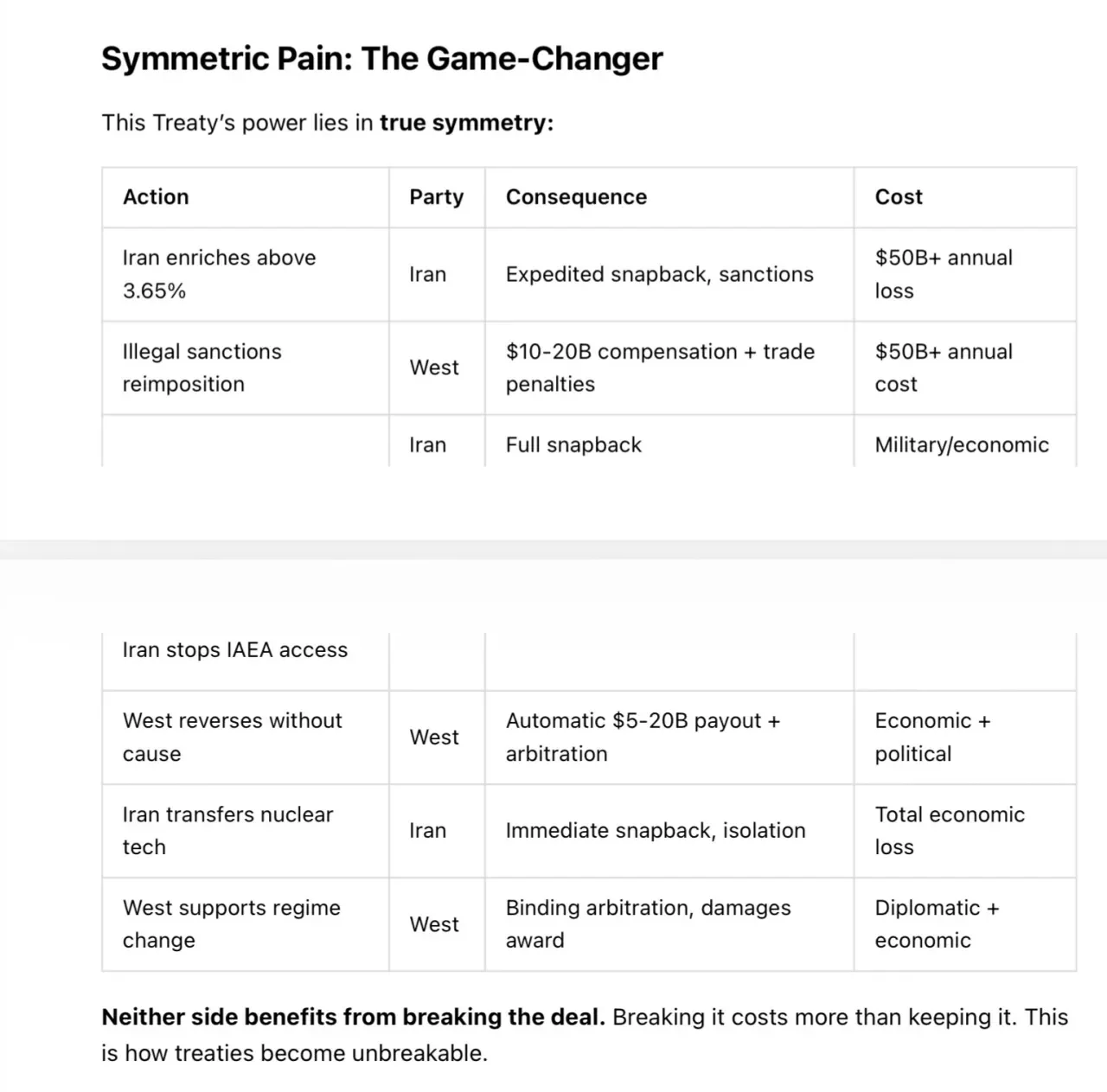
Symmetric Pain: The Game-Changer
This Treaty’s power lies in true symmetry:
Independent Binding Arbitration: The Final Authority
A standing Permanent Court of Arbitration or dedicated Treaty Arbitration Panel (composed of internationally respected jurists and technical experts) serves as final interpreter of the Treaty. Its decisions are:
• Binding: Parties must comply or face automatic enforcement
• Enforceable: International courts recognize and enforce awards against national governments’ assets
• Transparent: Decisions published, reasoned, and subject to limited appeal
• Neutral: Panel members selected from pre-agreed roster; each party appoints one member; members select chair
This removes unilateral interpretation power and ensures disputes are resolved fairly.
EMPOWERING IRANIANS WORLDWIDE
Diaspora as Global Citizens: $200 Billion in Unrealized Potential
The Iranian diaspora—4 to 5 million Iranians scattered across North America, Europe, Middle East, Asia, and Australia—represents one of the world’s most accomplished and wealthy diaspora communities. Yet sanctions have completely severed this community from participating in their homeland’s development.
This Treaty reconnects diaspora to Iran and unlocks transformative wealth creation.
Current Diaspora Wealth & Capability
Total Estimated Wealth: $200+ billion in accumulated assets
• Professional earnings invested in real estate, businesses, portfolios
• Entrepreneurs who built successful companies
• Executives, engineers, doctors, academics with global experience
• Access to capital markets, investment networks, and business expertise
Geographic Distribution:
• North America: 1.5-2 million (concentrated in California, New York, Ontario)
• Europe: 800,000-1.2 million (Germany, France, Sweden, UK)
• Middle East/Gulf: 500,000-800,000 (UAE, Qatar, Saudi Arabia)
• Australia: 200,000-300,000
• Rest of World: 500,000+
Expertise:
• Technology (Silicon Valley, Toronto, Berlin tech hubs)
• Medicine and healthcare
• Engineering and manufacturing
• Finance and investment
• Law and governance
• Education and research
• Business and entrepreneurship
How Sanctions Blocked Diaspora
Before This Treaty:
• Iranians abroad could not invest in Iran (capital controls)
• Banking transfers to Iran blocked or delayed for months
• Remittances subject to heavy fees and restrictions
• Business partnerships with Iran prohibited (OFAC sanctions)
• Professional collaboration blocked (visa restrictions, sanctions)
• Cannot own property or operate businesses in Iran legally
Result:
• $200 billion in diaspora wealth remained isolated
• Brain drain accelerated (talent went abroad, couldn’t return to contribute)
• Families in Iran received minimal support from diaspora
• Homeland development proceeded without diaspora participation
What This Treaty Enables
Immediate: Diaspora Investment
Within 30 days of sanctions lift, Iranian diaspora can:
• Invest in Iranian technology startups (venture capital)
• Establish manufacturing partnerships with Iranian firms
• Finance reconstruction projects (real estate, infrastructure)
• Provide capital for educational institutions
• Fund research institutions and universities
• Purchase corporate bonds and securities
Investment Protection:
• Treaty includes explicit bilateral investment protection chapter
• Diaspora investments protected from political risk
• Dispute resolution through international arbitration (not Iranian courts)
• Convertibility of profits (diaspora can repatriate returns in convertible currency)
• Intellectual property protection for joint ventures
Realistic Investment Scenarios:
1. Technology Venture Capital: Silicon Valley Iranian investors establish $5-10 billion venture capital fund investing in Iranian tech startups
• Software, AI, mobile apps, fintech companies
• Jobs created: 50,000+ high-wage tech positions
• Return to diaspora: 25-30% over 5 years
• Return to Iranian economy: $10-20 billion in market value
2. Manufacturing Joint Ventures: Iranian entrepreneurs in Canada, Germany establish manufacturing partnerships in Iran
• Auto parts, appliances, machinery manufacturing
• Investment: $2-5 billion
• Jobs: 100,000+ manufacturing positions
• Return: 15-20% annually on invested capital
3. Real Estate and Reconstruction: Diaspora investors finance urban housing and commercial real estate
• Investment: $5-10 billion
• Properties financed: 500,000+ housing units
• Jobs: 250,000+ in construction and services
• Returns: Property appreciation + rental income
4. Institutional Investment: Diaspora wealth managers invest in Iranian government bonds, infrastructure
• Investment: $10-15 billion
• Financing: Reconstruction projects, Hormuz services, regional bank
• Returns: 5-7% yield + capital appreciation
Total Diaspora Investment Potential: $25-50 billion over 5 years
Economic Multiplier Effect: $75-150 billion in Iranian economic activity
Professional and Academic Networks
University and Research Partnerships
Diaspora academics and researchers establish formal partnerships:
• Iranian-American universities joint degree programs
• Research collaborations (medicine, energy, agriculture, technology)
• Exchange programs (faculty, students, postdocs)
• Shared laboratories and equipment
• Joint publications and intellectual property
Benefits:
• Knowledge transfer to Iranian institutions
• Brain drain reversal (Iranian talent returning to research positions in Iran)
• International research credibility for Iranian institutions
• Competitive wages in Iran for PhD-level researchers
Professional Mentorship
Diaspora professionals mentor Iranian counterparts:
• Doctors mentor medical professionals
• Engineers advise manufacturing companies
• Lawyers help establish corporate governance
• Technologists transfer advanced skills
• Managers mentor business leaders
Executive and Management Expertise
Diaspora business leaders advise and manage Iranian companies:
• Corporate governance and transparency
• Supply chain optimization
• Quality control and international standards
• Financial management and accounting
• Strategic planning and market development
Trade Networks and Export Access
Diaspora Distribution Networks
Iranian diaspora communities have established distribution networks in every major market:
North America:
• Iranian-Canadian merchants with retail and wholesale networks
• Iranian-American companies with West Coast, East Coast distribution
• Access to major retailers, distributors, logistics companies
Europe:
• German Iranian businesses with manufacturing and distribution expertise
• French Iranian merchants with luxury goods distribution
• Swedish and Nordic distribution networks
• Central European trade corridors
Middle East/Gulf:
• UAE-based Iranian entrepreneurs with regional distribution
• Qatar and Saudi networks for export
• Gulf port and logistics infrastructure access
Asia-Pacific:
• Australian Iranian businesses with Asia-Pacific logistics
• Singapore-based regional distribution hubs
• Indian and Southeast Asian partnerships
Export Strategy
Iranian producers can now use diaspora networks to export goods globally:
Products:
• Agricultural goods (pistachios, dates, saffron, tea)
• Textiles and handicrafts
• Petrochemical derivatives
• Manufactured goods (competing globally through diaspora distribution)
• Technology and software
Revenue Impact:
• Current agricultural exports: ~$2-3 billion
• With diaspora distribution: $5-8 billion potential
• Manufacturing exports (new): $5-10 billion potential
• Total new export revenue: $10-15 billion annually
Remittances: The Immediate Economic Impact
Current Remittance Reality
• Current sanctions-constrained remittances: $2-3 billion annually (unofficial channels)
• Fee burden: 8-15% lost in transfer costs and black market discounts
• Delivery time: Weeks to months (slow and unreliable)
• Transparency: Zero (hidden transactions)
Post-Treaty Remittances
With banking normalization:
• Official Channel: Remittances through SWIFT in days, at competitive exchange rates
• Volume: Potential $10-15 billion annually (at full normalization)
• Efficiency: 2-3% transaction costs (vs. 8-15% currently)
• Speed: 1-3 business days (vs. weeks)
• Transparency: Full documentation and tracking
Direct Impact on Iranian Families
$10-15 billion annual remittances flowing to Iranian families means:
• Educational Investment: 1.5-2 million Iranian children receive improved education
• Healthcare Access: 3-4 million additional Iranians receive quality healthcare
• Housing Improvement: 2-3 million families upgrade housing
• Small Business: 500,000+ families start small businesses or expand shops
• Consumption: 5+ million Iranians improve diet, clothing, quality of life
• Savings & Security: 2-3 million families build emergency reserves
Multiplier Effect:
Every dollar remitted circulates 3-4 times through the economy (families spend on goods and services, businesses invest, government collects taxes). So $10-15 billion in remittances generates $30-60 billion in economic activity.
Tax Revenue
Government tax revenue from remittance-driven economic activity: $1-2 billion annually (funds social services, infrastructure, security)
Institutional Participation: Diaspora in Nation-Building
Diaspora experts participate in Iran’s institutional development:
Governance and Public Administration:
• Iranian-American experts advise on regulatory frameworks
• Iranian-Canadian expertise applied to government efficiency
• Transparency and anti-corruption institutional design
• Federal/provincial governance models (if applicable)
Education System:
• Diaspora educators design curriculum reforms
• Quality assurance and accreditation frameworks
• Research and innovation incentives
• International university partnerships
Healthcare System:
• Diaspora doctors design clinical standards
• Medical education curriculum development
• Hospital management best practices
• Public health programs
Technology and Infrastructure:
• Diaspora tech experts advise on smart grid, telecommunications
• Cybersecurity framework design
• Digital government services
• IT infrastructure standards
Financial System:
• Diaspora financial professionals advise on banking regulation
• Central Bank independence and monetary policy
• Capital market development
• Anti-money laundering frameworks
This is not external interference—it is diaspora using expertise to strengthen homeland.
PART VIII: DOMESTIC PROSPERITY REACHING EVERY IRANIAN
The Distribution Challenge: Why Prosperity Must Be Universal
A deal can fail if benefits only reach elites. For this agreement to survive political pressure, it must visibly improve ordinary Iranians’ lives: workers, families, students, young people.
Wage and Employment Strategy
Job Creation Through Reconstruction ($50B Program)
The $50+ billion reconstruction program directly creates jobs:
Construction & Infrastructure (2027-2032):
• 250,000+ construction workers building electricity grids, water systems, ports, rail, housing
• Average wage: $800-1,200/month
• Multiplier effect: Additional 250,000 jobs in supply, logistics, services
Manufacturing Expansion:
• 300,000+ jobs in manufacturing (automotive, appliances, machinery, electronics)
• Average wage: $1,200-1,800/month
• Multiplier: Additional 200,000 jobs in supporting industries
Technology and Services:
• 100,000+ jobs in technology, software, IT services
• Average wage: $2,000-3,500/month
• Multiplier: Additional 50,000 jobs
Horticultural and Agricultural Processing:
• 150,000+ jobs in food processing, export preparation
• Average wage: $600-1,000/month
• Multiplier: Additional 100,000 jobs
Oil, Gas, and Energy:
• 50,000+ jobs in oil/gas operations, refining, distribution
• Average wage: $1,500-2,500/month
Total Direct + Multiplier Jobs Created (5-year period): 1.5 million+
Wage Growth Projections
Year 1 (2027): 100,000+ jobs created, average wage $950/month
Year 2 (2028): 300,000+ cumulative jobs, average wage $1,100/month (+15%)
Year 3 (2029): 600,000+ cumulative jobs, average wage $1,300/month (+18%)
Year 5 (2031): 1.5 million+ cumulative jobs, average wage $1,700/month (+31%)
Comparison to Current (2026): Average Iranian wage ~$500/month under sanctions
Post-Treaty Wage: $1,700/month (+240% increase)
Food Security and Household Consumption
Food Price Reduction
• Current food inflation under sanctions: 15-20% annually
• Post-sanction inflation target: 3-5% annually
• Food price relief within 12 months: 20-30% real purchasing power increase
Staple Availability
• Flour, rice, sugar, oil, dairy: Unrestricted imports normalize prices
• Fresh produce: Agricultural investment increases domestic production
• Protein sources: Fish, chicken, lamb production increases
• Nutrition: Average caloric intake rises, malnutrition declines
Household Food Budget Impact
• Current: Family spends 40-50% of income on food
• Post-treaty: Family spends 25-30% of income on food
• Freed income available for education, healthcare, housing, savings
Housing and Urban Development
Housing Program (2.5 Million Units Over 10 Years)
• Target population: Working and middle-class families currently in inadequate housing
• Unit types: Apartments, townhouses, single-family homes
• Average unit cost: $15,000-$20,000 (modest, efficient, dignified)
• Financing: Government-subsidized mortgages, 15-20 year terms
• Target wage earner: Families earning $800-2,000/month can afford units through subsidized mortgages
Housing Impact by Income Level
Low-Income Workers ($500-800/month current):
• Housing cost post-treaty: $80-120/month (subsidized mortgage)
• Before: 70% of income on rent
• After: 12-15% of income on mortgage + ownership equity
• Freed income: $350-650/month for other needs
Working-Class Families ($1,000-1,500/month):
• Housing cost: $120-180/month
• Ownership: Build equity instead of renting
• Freed income: $500-800/month
Middle-Class Professionals ($2,000-3,500/month):
• Housing investment opportunities: Purchase multiple properties
• Rental income: Additional revenue stream
• Wealth building through real estate appreciation
Urban Quality of Life
Modern housing includes:
• Electricity 24/7 (grid modernization)
• Clean water (water system expansion)
• Sewerage and sanitation
• Natural gas for heating/cooking
• Internet/broadband connectivity
• Parks and public spaces
Education and Healthcare
Education Investment
• Reconstruction program includes $7.5B for education
• Curriculum modernization and teacher training
• Technology access (computers, internet in all schools)
• University facility upgrades
• Scholarship programs for talented students from low-income families
Wage Incentive for Education
• University graduates earn $2,000-3,500/month (vs. $800-1,200 without degree)
• Vocational training graduates earn $1,200-1,800/month
• This economic incentive drives school enrollment and completion
• Brain drain reverses: educated young people find opportunity at home
Healthcare Access
• Hospital modernization: Modern equipment, trained staff
• Medicine availability: Technology transfer enables domestic pharmaceutical production
• Preventive healthcare programs: Reduces disease burden
• Cost reduction: Competition increases with capacity; prices fall
• Insurance and pension programs strengthen as government revenue increases
Government Pension and Welfare
With sustained oil revenue ($50-80B annually), government can strengthen:
Pensions:
• Retiree pensions increased 30-50% within 2 years
• Cost-of-living adjustments annually
• Coverage expanded to previously excluded workers
Healthcare Subsidies:
• Medications subsidized (reducing costs 50%+)
• Surgery and hospital care covered under insurance
• Preventive care incentivized
Child and Family Allowances:
• Birth allowances for new children
• Student allowances
• Family support for vulnerable populations
Anti-Inflation and Currency Stability
The Challenge: Currency Collapse Under Sanctions
Current situation: Rial has lost 90%+ of value since 2011
• 2011 exchange rate: 10,000 rials per dollar
• 2024-2025 rate: 400,000+ rials per dollar
• Result: Savings wiped out, elderly impoverished, purchasing power destroyed
Post-Treaty Currency Recovery
Central Bank Strategy:
• Oil revenue in dollars (stable)
• Dollar reserves built ($10-15B within 2 years)
• Rial demand increases (people willing to hold rial again)
• Foreign exchange controls gradually liberalized
• Gradual, managed currency appreciation
Timeline:
• Year 1: Rial stabilizes (halts depreciation)
• Year 2: Rial appreciates 20-30% vs. dollar
• Year 3: Rial appreciates additional 15-20%
• Year 5: Rial reaches 150,000-200,000 per dollar (from 400,000+)
Impact on Savers:
• Retirees’ remaining savings gain 60-80% in purchasing power
• People holding rials benefit from appreciation
• Savings culture returns (people willing to save in rial again)
Prosperity Visible in 30 Months
Year 1 (2027):
• Oil revenue reaches markets
• Sanctions lift officially
• Prices stabilize (food, fuel, electricity)
• 100,000+ jobs created
• Wages begin rising
• Medicine and food available
• Ordinary Iranian perception: “Things are improving”
Year 2 (2028):
• Reconstruction visible (new buildings, infrastructure, buses)
• 300,000+ employed in new jobs
• Wages up 15-20%
• Housing starts (new construction visible in cities)
• Electricity more reliable
• Ordinary Iranian perception: “Life is getting better; I can see it”
Year 3 (2029):
• GDP growth 5-7% annually
• Wages up 30-40% from 2027
• 600,000+ employed in growth sectors
• Housing units delivered (people moving into new homes)
• Technology visible (modern infrastructure, broadband)
• Ordinary Iranian perception: “Things are fundamentally improving; this deal was worth it”
Year 5 (2031):
• GDP 20-25% larger than 2027
• Average wage 50-70% higher than 2027
• Manufacturing competitive globally
• Living standards visibly improved
• Housing widely available
• Education and healthcare modern
• Public consensus: This agreement transformed Iran
This visible transformation creates political constituency protecting the agreement against saboteurs on any side.
PART IX: REGIONAL INTEGRATION & SHARED PROSPERITY
The Reconstruction and Settlement Bank: Converting Rivalry into Partnership
Mission
A multilateral development bank financing infrastructure, trade, and reconstruction across Iran, Iraq, Gulf states, Turkey, Central Asia, and beyond. Its purpose: create economic interdependence that makes war and isolation economically suicidal for all parties.
Participants
• Iran, Iraq, Saudi Arabia, UAE, Qatar, Oman, Kuwait
• Turkey, Central Asian states (Kazakhstan, Uzbekistan, Turkmenistan)
• China, India, Russia (as partners/investors)
• European investors (optional)
Capitalization
• Initial Capital: $20-30 billion
• Sources: China (5-8B), Gulf states (5-7B), Iran (3-5B), Others (3-5B)
• Shareholders: Weighted voting by capital contribution
• Governance: Board of directors (one per major shareholder), professional management
Financing Activities
1. Cross-Border Infrastructure: Rail, roads, ports connecting Iran, Iraq, Turkey, Central Asia
2. Energy Projects: Pipeline connections, LNG facilities, electricity grids, renewable energy
3. Trade Finance: Letters of credit, guarantee instruments, insurance
4. Technology Transfer: Joint ventures, skills training, capacity building
5. Reconstruction Financing: Urban development, industrial zones, agriculture projects
Trade Integration
The bank facilitates:
• Oil and Gas Trade: Iran’s exports, pipeline transportation, regional energy integration
• Agricultural Trade: Iranian agricultural products to Gulf and Central Asian markets
• Manufacturing Trade: Iranian goods competing in regional and global markets
• Services Trade: Shipping, insurance, finance, tourism, education
Economic Interdependence Model
When all regional states invest in and profit from Iran’s stability:
• Saudi Arabia profits from Iranian oil revenue (joint projects, trade)
• UAE benefits from Hormuz services and regional trade
• Iraq benefits from Iranian investment and trade
• Turkey benefits from transit and energy pipelines
• Central Asia benefits from Iranian ports and energy
• China, India, Russia benefit from massive investment returns
Result: War becomes economically ruinous for everyone. Isolation becomes economically suicidal. Peace becomes profitable.
Regional Security Framework (Persian Gulf Stability Pact)
Members
Iran, Saudi Arabia, UAE, Oman, Qatar, Iraq (optional)
Core Principles
• Non-Aggression: No military attacks without legitimate defense
• Incident Management: Clear procedures for accidents and crises
• Transparency: Limited military information sharing and de-escalation procedures
• Economic Integration: Joint projects and trade
• Dispute Resolution: Regional commission for conflicts
Specific Rules (Reciprocal)
• Maritime Incidents: 24/7 hotlines, de-escalation procedures, accident investigation
• Military Exercises: 72-hour notice of major exercises
• Weapons Testing: Notification of ballistic missile tests with time/location
• No Sabotage: Reciprocal commitment to no covert operations
• No Assassination: All parties commit to no targeted killings
• No Blockade: No naval blockade of any member state
Dispute Resolution
Process:
1. Bilateral consultation (7 days)
2. Mediation by neutral member (Oman, India, or neutral country) (7 days)
3. Regional panel determination (3 arbitrators, binding decision)
4. Compliance with panel decision (mutual enforcement)
PART X: PATHWAY TO GLOBAL INTEGRATION
World Trade Organization Membership: 36-Month Timeline
(See detailed section above—WTO membership is critical for long-term prosperity and competitiveness)
Key Timeline:
• Month 6: WTO application submission
• Month 12: Bilateral negotiations begin with major trading partners
• Month 24: Bilateral agreements finalized
• Month 36: WTO General Council approval; Iran becomes full member
Economic Impact:
• Exports rise 50-100% over 5 years
• Manufacturing competitive globally
• Investment inflows 30-50% higher
• 200,000+ jobs created in export sectors
• Wages rise to international levels in competitive industries
PART XI: WHY THIS TREATY IS UNBREAKABLE & DELIVERS FINAL PEACE
Seven Layers of Protection Making Reversal Impossible
Layer 1: Legal Bindings
• Formal multilateral Treaty
• Ratified by national legislatures (not executive waivers)
• UN Security Council Chapter VII endorsement
• Domestic law in key capitals
• Cost to reverse: Requires new laws in multiple countries
Layer 2: Economic Interconnection
• $50-80B annual oil revenue flowing to global markets
• Banking integration (SWIFT, correspondent networks)
• $50B reconstruction ($5B annually in foreign investment)
• Technology partnerships across all sectors
• Diaspora $10-50B investment portfolio
• Cost to reverse: Global economic disruption; $50B+ in lost global trade
Layer 3: Stakeholder Investment
• Chinese development bank $5-8B investment (BRI)
• Gulf states $3-5B investment in regional bank
• European companies $5-10B in technology partnerships
• Diaspora $10-50B direct investment
• Cost to reverse: These stakeholders actively defend the treaty
Layer 4: Automatic Enforcement
• Joint Compliance Commission with automatic triggers
• Expedited snapback for serious breaches (no political discretion)
• Binding arbitration (no appeals or delays)
• Compensation mechanism ($10-20B escrow)
• Cost to reverse: Automatic retaliation; no ability to negotiate away consequences
Layer 5: Verification Credibility
• IAEA Additional Protocol (most intrusive verification available)
• Continuous monitoring (cameras, environmental sampling)
• Clear technical definitions (enrichment %, stockpile limits, breakout time)
• Quarterly public reports
• Cost to reverse: Loses verification credibility internationally
Layer 6: Regional Integration
• Hormuz Compact (all Gulf states benefit)
• Reconstruction Bank (China, India, Russia invested)
• Trade corridors (Turkey, Central Asia integrated)
• Cost to reverse: Regional partners defend treaty; war becomes economically suicidal
Layer 7: Domestic Political Support
• Every Iranian benefits from jobs, wages, housing, healthcare, education
• Diaspora population (4-5 million) benefits from investment opportunity
• Middle class expands (from 15% to 30%+ of population)
• Youth see opportunity at home (brain drain reverses)
• Cost to reverse: Political faction trying to reverse faces massive domestic opposition
What Makes It Final and Sustainable
Irreversibility for Sanctions:
• Legislation (not waivers) must be reversed
• Requires 67-vote supermajority Senate (not simple majority)
• Creates 120-day Congressional process (not executive decision)
• Compensation kicks in automatically if illegal reversal attempted
• Makes reversal politically impossible
Irreversibility for Iran’s Commitment:
• Verification is technical (not political)
• Automatic enforcement triggers (no discretion)
• Escalating consequences for violations (proportional pain)
• 180-day notice period to withdraw (not immediate)
• Makes reversal costly and delayed
Shared Prosperity as Peace Foundation:
• Every party benefits economically
• War and sanctions reversal become economically irrational
• Stakeholders (China, Russia, EU, Gulf, diaspora) defend treaty
• Regional integration makes isolation costly
• Public support sustains the agreement
THE CHOICE BEFORE IRAN AND THE WORLD
Iran’s Strategic Decision
Iran faces a historic choice. The old model of confrontation, isolation, and sanctions pressure has failed. Iran’s economy has been devastated. Generations of Iranians have lost opportunity. The diaspora has been severed from the homeland.
This Treaty offers a different path: one where Iran’s military remains strong, Iran’s deterrence is protected, and Iran’s people, both at home and globally, achieve rising prosperity.
What This Treaty Guarantees
For Iran:
Military sovereignty and deterrence completely protected
$50 to $80 billion in annual oil revenue
$50 billion reconstruction transforming infrastructure
More than 1.5 million new jobs at rising wages
Diaspora investment of $10 to $50 billion reintegrated into the national economy
WTO membership and global trade integration
Hormuz revenue of $250 to $450 million annually
Irreversible sanctions relief protected by law and mutual economic pain
For Iranians at Home:
Wages triple in 5 years
Housing becomes available and affordable
Healthcare and education modernize
Electricity and water become reliable
Jobs are created in reconstruction, manufacturing, and technology
Opportunity expands for young people and brain drain reverses
Living standards rise visibly
For Iranian Diaspora:
Reconnection to homeland
Investment opportunity in Iranian startups and manufacturing
Remittance freedom of $10 to $15 billion annually
Professional participation in nation-building
Wealth creation through Iranian success
Role in regional integration
For the World:
Peaceful Iranian civilian nuclear program, verified
Regional stability through economic integration
Reliable oil and energy supplies
Global trade expansion
Reduced conflict risk and defense costs
Shared prosperity instead of rivalry
Shared Global Prosperity
This Treaty delivers final, sustainable peace not through military domination but through shared economic interest. When nations profit from each other’s stability, they protect that stability. When populations are prosperous and rising, they reject war and isolation.
Iran, with its ancient civilization, talented population, strategic geography, and natural resources, is meant to be a prosperous regional power and respected global partner. This Treaty makes that possible.
The choice is now before Iran and the international community: Pursue the old model of confrontation and isolation, or embrace this new path of prosperity for all.
The vision is clear. The path is achievable. The future is shared.
WHAT THIS TREATY ACHIEVES
For Final, Sustainable Peace
Iran’s military deterrence permanently protected, with no vulnerability
World’s legitimate non-proliferation guarantee through the IAEA, Additional Protocol, and verification
Economic interdependence makes war economically impossible
Regional integration creates mutual interest in stability
Brain drain reverses as talent returns home and opportunity becomes visible
How It Guarantees Success
Legally binding through Treaty, legislative ratification, and UN Chapter VII
Economically binding through $50 to $80 billion in annual oil revenue, $50 billion reconstruction, and diaspora investment
Institutionally binding through automatic enforcement, binding arbitration, and independent verification
Politically binding because stakeholders in every capital defend it
Socially binding because every Iranian benefits and a public constituency protects it
How It Fixes Every Past Weakness
Solves the 2015 reversibility problem through legislation, not waivers
Adds symmetric enforcement, creating pain for any breaker
Includes stronger verification through the Additional Protocol
Protects diaspora investment through arbitration protection
Creates domestic prosperity with 1.5 million jobs and rising wages
Builds regional peace through economic integration
Integrates Iran globally through WTO membership
Key Mechanisms Making It Work
Escrow: $10 to $20 billion automatic compensation if illegally reversed
Snapback: expedited sanctions for serious nuclear breaches
Arbitration: binding international dispute resolution
Verification: IAEA Additional Protocol and continuous monitoring
Enforcement: automatic triggers, proportional pain, and no political discretion
Integration: Hormuz Compact, Reconstruction Bank, and WTO membership
Original article: https://ghamari.org/articles/f/iran%E2%80%99s-path-forward-global-prosperity-diaspora-empowerment-and