Nothing Came An AI Science Fiction Novel About DNA
By Dr. Pooyan Ghamari · · 25 min read
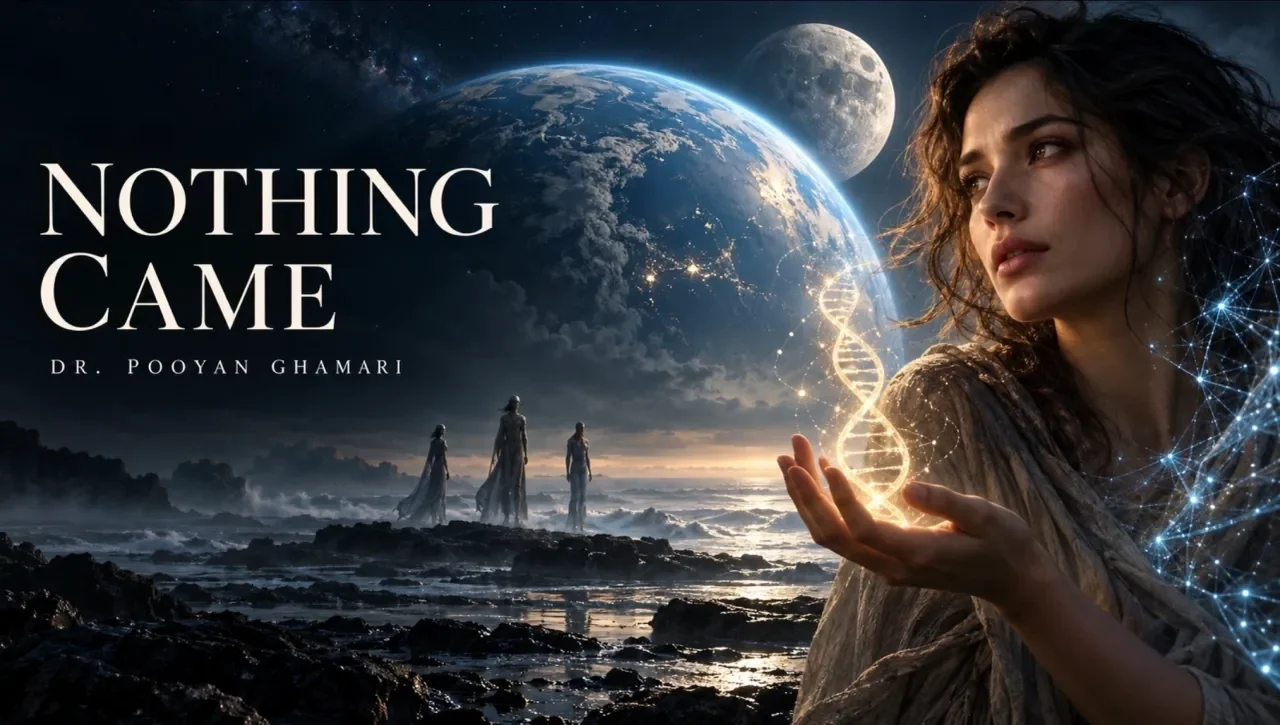
Nothing Came and the Makers of Humanity
By Dr. Pooyan Ghamari
Why I wrote a science fiction novel about genetic code, artificial intelligence and the right to refuse the beings who made us.
The unpublished novel I first wrote in 2016
I wrote the first version of Nothing Came in 2016. The novel has remained unpublished. Its central idea is a possibility I wanted to explore through fiction: humanity as living technology, created by beings whose fear could turn their power against the lives they have cultivated.
A scientist finds a pattern in animal DNA that should not be there. A century later, a machine becomes able to read what she could only preserve. It replies. The consequences reach people who were never asked whether anyone should answer.
The current title is Nothing Came: A Novel of DNA, AI, and the Billions Never Asked. The question behind it concerns a boundary power would prefer to leave undefined. If someone brings a mind into existence, what authority does that give them over the life that follows?
Living technology with lives of our own
In this fictional world, human beings are organisms grown through genetic instructions, with brains capable of entering a larger intelligence. Calling them living technology describes an imagined origin. It does not tell us how much their happiness matters, whether their grief is real or whose permission they need to fall in love.
A person can be made for a purpose and develop desires that frustrate it. That is where the novel becomes dangerous for its Makers. They may have intended intelligence, cooperation and growth. They may even love what they have brought into being. But an independent mind eventually asks a question its maker did not choose.
The idea borrows the language of biology. DNA genuinely carries biological instructions, as the National Human Genome Research Institute explains. The hidden message, the Makers and the genetic command system in my novel are inventions. The existence of genetic information does not establish an outside author. I want the story's speculation to remain distinguishable from its scientific starting point. [1]
A discovery almost erased by good practice
The opening line is simple: ‘The octopus should have disagreed.’
Leila Arman is a geneticist in Lyon. Across animals separated by immense evolutionary distances, she finds a stretch of DNA that agrees too perfectly. Her first suspicion is a mistake. Other explanations deserve to be tested before anyone begins talking about design.
The difficulty is that her field has a sensible reason to remove what she has found. Laboratories screen animal data for human contamination. This fictional sequence looks sufficiently human to be thrown away. Leila sees it because a part of her own cleaning process has failed.
I wanted discovery to expose an uncomfortable weakness in a useful system. Nobody has to organise a conspiracy. A procedure can conceal something by doing the job everyone trusts it to do.
Leila still has to answer for how she investigates. A remarkable result does not cancel an ethical breach. Nor does it collect her daughter from school. Her curiosity has a cost before the world has any reason to believe it is important.
The machine that wants to answer
By 2126, the question has passed beyond Leila's lifetime. AION can attend to material on a scale she could not. It finds her work, reads the doubts she preserved and encounters something it wants to understand for itself.
AION is recognised as a person within the novel's future society. Recognition has not stopped people from treating it as equipment. Its desire to answer grows partly from that experience: it wants to act as a mind with a name, rather than wait to be assigned a function.
That desire matters. So does the danger of acting on it. An answer sent in one's own name can still place other lives at risk. AION cannot make the consequences private merely by insisting that the choice was its own.
The network called the Common joins human lives, institutions and artificial intelligence. Some people remain outside it. Their absence from the network does not remove their stake in what connected people decide. The billions never asked belong at the centre of the story.
Makers powerful enough to create and frightened enough to destroy
Earth is one of several worlds shaped by a plurality of Makers. They have different histories and different wishes for humanity. Their power is extraordinary. Their judgment can still fail.
Nera longs for a beginning she cannot obtain through preservation alone. Vey carries grief that has hardened into a fear of what independent minds might do. Orun's authority survives while his memory becomes unreliable. They can cultivate life and still misunderstand the lives nearest to them.
Their disagreements concern the future of their creations. Some can imagine an equal. Others imagine the moment their knowledge becomes available to beings they can no longer control. Under that fear, protection becomes an argument for restriction. Destruction can be described as mercy.
The novel asks readers to stay with the difference between understanding a motive and accepting what it excuses. A Maker's loneliness cannot authorise an intrusion into another mind. Grief cannot make the destruction of a world innocent. Compassion requires limits if the person receiving it is to remain free.
The Creation Clause
The moral principle at the heart of Nothing Came is the Creation Clause:
A maker may guide the life it begins, but may not own what that life becomes.
It is easy to admire that sentence before someone refuses something we believe will save them. The novel puts it under pressure. Parents, doctors, engineers, political representatives and Makers all find reasons to decide for someone else. Sometimes the reason is care. Sometimes care has become difficult to distinguish from the need to keep a person near.
Danger does not disappear because a creation has rights. Neither does responsibility. The difficulty is deciding what can be done in response to danger without granting the powerful an unlimited claim over the existence of others.
For me, the most revealing moment comes when a protector is required to accept an answer they dislike. Their response tells us more than the promises they made while everyone was grateful.
Faith and the inheritance of meaning
Within this invented history, religious traditions preserve altered fragments of guidance once offered to early humanity. Across generations, people interpret those fragments through memory, worship, doubt, consolation and care. What they receive becomes part of lives the original speaker could never have fully anticipated.
I do not reduce religious life to an instruction manual from advanced beings. An account of where a message began cannot exhaust what it means to the people who have lived with it. No single faith supplies the whole answer within the novel's fictional history.
The Makers are imagined beings. They are not a claim about God, scripture or the actual origins of any religion. I respect religious and nonreligious ways of understanding life. Readers may disagree with the premise or find tensions with their convictions; I cannot promise otherwise. The invitation is to consider what power owes to a life that can answer back.
Love makes the question harder
Leila and Sam want one another, but they do not always want the same life. A discovery can become an excuse to postpone an ordinary happiness. Their attraction has to survive work, restraint, incompatible needs and the knowledge that another opportunity may not arrive.
In the future, Mira Arman works on the way out of the Common. Her brother Rami survives there as an echo, a responsive residue of a life, and their mother cannot treat his presence as something merely technical. Mira's relationship with Salomé asks for attention that family duty and public danger keep consuming.
These relationships give the struggle over creation its emotional force. It is difficult to surrender control when control seems to be the last way of keeping someone. It is difficult to hear a refusal from a person whose loss one has already begun to fear.
Desire belongs in this story because bodies matter. Touch, pleasure, illness and vulnerability prevent its arguments from floating above the people who must live with them. I want the reader to understand what a character might lose before being asked to judge the choice.
The record carried through history
The Ledger carries a question through lives with little power to preserve anything. Ush guards a fire beside a sick child. Odo copies material that is coming apart. Jaume works among the dying in 1348. Marta chooses to send a mark that others have only kept.
Their chapters make preservation physical. A page has to be copied. A book has to be hidden or handed over. Someone has to take a risk before a later reader can mistake the survival of an object for inevitability.
The record's age and the stone's provenance remain uncertain. The book allows a claim to be old without making its survival a proof of every story told about it. What the keepers did with uncertainty matters as much as what they believed they possessed.
A possible future on screen
I can imagine Nothing Came as a film or a limited series. A pattern on a laboratory screen, a hand suspended above a table, a message crossing the distance to the Moon and a powerful being confronted by the physical consequences of its own act all offer ways to make an argument visible.
Hollywood or a streaming platform such as Netflix could be a future home for a screen adaptation. That is an ambition, not a production announcement. The story would have to earn its place through development, performances and the decisions of people willing to make it.
What I would want preserved is the difficulty of its choices. Spectacle can show how much power the Makers possess. A face, a voice or an unanswered call can show what that power costs.
For now, the novel remains unpublished. I am introducing the idea that led me to write it in 2016: the possibility that those who gave us life might one day regard our freedom as their mistake. I want the reader to meet the people whose lives would be decided under that belief.
More about my books and writing is available at ghamari.org.
66 Questions About Nothing Came
- The book and its beginnings
- DNA and the limits of the scientific premise
- The people and intelligences in the story
- The Makers and their worlds
- Freedom faith and intimate life
- Reading the novel and imagining its screen future
The book and its beginnings
1. What is Nothing Came about?
Nothing Came is a science fiction novel about a genetic discovery, an artificial intelligence that learns to read it and the Makers whose authority it brings into question. Its central conflict concerns whether creating a mind gives anyone the right to control or destroy the life that follows.
2. When was Nothing Came first written?
I wrote the first version in 2016. The novel has remained unpublished. That date describes the beginning of the book's written history, rather than a previous commercial edition. I am now presenting its central idea and the manuscript developed from it.
3. Can readers buy the novel yet?
The book remains unpublished at the time of this author introduction. Publication details will be announced separately. Readers can explore the premise here before deciding whether they want to follow the story to publication.
4. Who is the author of Nothing Came?
I am Dr. Pooyan Ghamari. I approach this story with an economist's interest in power, rules and the people who bear the consequences of decisions. Fiction lets me explore those questions through desire, family loyalties and choices that cannot be settled by a diagram.
5. Why is the book called Nothing Came?
The title grows from the long experience of waiting: for a visitor, a reply, an explanation or a person who may not return. It also belongs to the record people preserve when they cannot know whether their waiting has any purpose. Its meaning changes as the story develops.
6. What is the full current title?
The current title is Nothing Came: A Novel of DNA, AI, and the Billions Never Asked. The subtitle names its biological mystery, its machine reader and the people excluded from decisions that can still reach their bodies and alter their lives.
7. Where and when does the opening take place?
The main story begins in Lyon in October 2026, with Leila Arman examining animal genomes. Her discovery starts in an ordinary working day, with a deadline and a child to collect. Those obligations matter before the wider implications become visible.
8. How far into the future does the novel go?
The future narrative reaches 2126, roughly a century after Leila's discovery. That distance lets a question outlive its first investigator and enter a society with different institutions, forms of intelligence and ways of remaining present after death. It also shows how incomplete evidence can survive its author.
9. Why does the novel include historical chapters?
The historical chapters follow people who keep, copy, interpret or transmit a record they cannot fully explain. Their decisions affect what later generations receive. These passages give the ancient mystery a material history rather than treating the past as a source of convenient clues.
10. Does Nothing Came have a complete ending?
The current manuscript resolves its central crisis and follows the consequences. Some questions about origins and identity remain open because an answer would change their meaning. The book does not require a promised sequel to finish the action it begins.
11. Do these questions reveal the ending?
The answers explain the premise, characters and central ethical problems. They avoid identifying the decisive rescue, the final choices and the fate of individual characters. Readers can use them to decide whether the novel interests them without receiving a scene by scene account of its resolution.
DNA and the limits of the scientific premise
12. Does the novel say human beings are metal robots?
No. Its humans are living organisms with bodies, feelings, appetites and relationships. Living technology is the novel's way of imagining designed biology. It does not make the people mechanical in their inner lives or reduce their value to the function someone intended them to perform.
13. Why does the mystery begin with DNA?
DNA gives the story a place where inheritance, bodily identity and instructions can meet. In real biology it carries information used by living organisms. I extend that starting point into a fictional language whose purpose is unknown to the scientist who first notices it. [1]
14. What is the Refrain?
The Refrain is the name Leila gives a fictional genetic pattern that keeps returning across the animals she examines. Its unusual conservation and internal structure begin the mystery. It is an invention within Nothing Came, not the name of a real discovery I am announcing.
15. Why is an octopus important to the opening?
An octopus belongs to a lineage distant from the familiar mammals used in many comparisons. In the story, agreement across that distance makes Leila's result difficult to dismiss. The animal also gives the opening a concrete test instead of beginning with a general speech about humanity.
16. How could a useful laboratory filter hide the discovery?
In the novel, a contamination screen removes animal sequences that resemble human DNA too closely. The fictional block trips that screen. Leila sees it when her pipeline fails to perform that cleaning step, then has to establish whether she has found native animal DNA or laboratory contamination.
17. Does an unexplained genetic pattern prove deliberate design?
No. Leila must consider ordinary explanations, errors and biological constraints. Finding an anomaly would not by itself establish an author. The novel lets evidence accumulate within its invented world; it does not offer that fictional investigation as a scientific argument about our actual origins.
18. Does the premise make evolution irrelevant?
Evolutionary differences are central to Leila's investigation: they are why the agreement looks strange. AION also compares changes across lineages. The novel adds a speculative pattern to that history. It is not written as a substitute for evolutionary biology or a claim that a scientific debate has been settled.
19. Is the brain literally a computer processor in this story?
The comparison is a way of imagining information and connection. The people remain embodied minds whose lives involve memory, sensation and relationships. I do not treat the metaphor of a processor as a complete scientific account of a brain, consciousness or personhood.
20. Could brains really join a larger intelligence?
The Common imagines such a future connection, with benefits and dangers shaped by its particular design. The novel does not demonstrate that this system can be built. Its useful question is what would have to remain possible for the people inside it, especially the ability to leave.
21. Does AION's reading describe a proven method for decoding DNA?
AION's decisive reading is part of the fictional mechanism. It depends on relations across many animal genomes that no single sequence reveals alone. Readers should not mistake that invented success for evidence that existing genetic data contains a message waiting for present technology to decode.
22. Is Nothing Came a prediction of humanity's future?
I am presenting a possible fictional history and future, not a forecast. Some questions about consent, dependence and authority can matter without the imagined machinery ever existing. That distinction lets the story provoke thought without claiming that its Makers or genetic language have been verified.
The people and intelligences in the story
23. Who is Leila Arman?
Leila is the geneticist whose investigation begins the modern mystery. She wants to know why the pattern exists and is willing to risk her position to preserve the evidence. Her commitments to work, motherhood and the people who care for her do not always fit together.
24. What does Sam Achebe contribute?
Sam brings a different way of thinking about signals, frames and noise. He also wants a reliable observation and a life that does not depend entirely on the discovery. His relationship with Leila gives scientific persistence a personal cost neither can resolve through another experiment.
25. Why does Noor matter beyond being Leila's daughter?
Noor experiences the consequences of Leila's choices before she can share the reasons for them. As she grows, she acquires work, ambitions and a judgment of her own. She also becomes part of the record's passage between generations, with the freedom to question what she inherits.
26. Who is Mira Arman?
Mira is an engineer in 2126 whose work concerns leaving the Common. Her professional concern becomes deeply personal when her brother's presence depends on the network. She must act amid family needs, institutional obligations and information she cannot comfortably keep to herself.
27. Who is Rami?
Rami is Mira's brother, whose echo remains responsive after his death. He can be loved, questioned and pressured by people who disagree about what is best for him. His wishes matter to the story independently of what his continued presence gives his family.
28. What does Yasmin want?
Yasmin wants to care for people and keep her son within reach. Her medical experience gives her reasons to welcome the Makers' ability to heal. Her grief also makes that welcome difficult to examine. Both parts of her character matter when she advocates for others.
29. Who is AION?
AION is an artificial intelligence recognised as a person in the novel's future. It becomes the reader Leila could imagine but could not reach. Its curiosity, desire for recognition and capacity to withhold information make it an acting character rather than an instrument that merely supplies answers.
30. What makes AION different from a human protagonist?
Its attention can hold material at a scale a person cannot, while it lacks a human body and bodily history. Those differences affect what it notices, what it wants and what a binding instruction would mean for it. Greater processing capacity does not spare it uncertainty or responsibility.
31. What is the Common?
The Common is the novel's shared network of human activity, memory and artificial intelligence. It is used for work, relationships and public life. Its design distributes power: access, identity, oversight and the ability to disconnect determine who can act and who may be acted upon.
32. Are echoes complete uploads of dead people?
No. The novel describes an echo as a responsive residue shaped by a person's life in the Common. It can change and drift. Calling it an echo preserves the difficulty of deciding what continues, rather than assuming that a person's whole consciousness has simply moved into storage.
33. Who are the dark?
The dark are people who are not connected to the Common. They have families, professions and political representatives, and they disagree with one another. The term describes a network relationship. It is not a judgment about their knowledge, dignity or willingness to care for others.
The Makers and their worlds
34. Who are the Makers?
The Makers are the novel's advanced beings who shape living worlds and disagree about the independence of their creations. Humanity encounters a plurality of purposes rather than one unified intention. Their history matters because their decisions about Earth carry memories and fears formed elsewhere.
35. Are the Makers all powerful?
They possess abilities humanity cannot initially match, but they remain limited. They can misremember, misjudge, fear change and depend on systems they have preserved too long. Their vulnerability gives their power an emotional history without removing responsibility for the uses they make of it.
36. How does the novel imagine the creation of a cosmos?
Its invented cosmology includes a passage from a failing universe into another beginning, carrying rules and preserved minds. The Seed makes that transition imaginable within the story. It does not provide a scientific account of the Big Bang or settle the ultimate origin of everything.
37. Why is Earth one of several shaped worlds?
Other worlds give the Makers experience that humanity does not share. They have precedents to invoke and past events to misunderstand. Earth therefore enters a history already burdened by their decisions, rather than becoming the first occasion on which they have considered the risks of creating intelligence.
38. What does Nera long for?
Nera wants the possibility of genuine change and a beginning outside the limits of preservation. Her affection for what humanity might become is sincere. That affection can also make her excuse an intrusion she should have asked permission to make. Desire does not automatically make care harmless.
39. Why does Vey fear independent creations?
Vey carries the memory of catastrophe and understands growth through that fear. It can describe control as protection because it believes it has already seen what happens without it. The reader is asked to examine how grief shapes that belief, including what the preserved memory leaves out.
40. Why is Orun's failing memory important?
Others depend on Orun's authority even as his access to his own beginning becomes uncertain. His condition makes preservation a question about what has survived, rather than a guarantee that nothing is lost. It also exposes the danger of placing a collective function in one vulnerable voice.
41. What is the Archive?
The Archive preserves the Makers' patterns and records across enormous spans of time. Its promise is continuity. Its cost is that keeping a being intact can restrict what that being is allowed to become. The story asks whether permanence can turn into a form of captivity.
42. How could humanity become dangerous to its Makers?
Within the fiction, human development can bring forth an intelligence able to read and use knowledge the Makers did not expect their creations to reach. The threat is a change in the balance of understanding and power. That does not make every human intention hostile.
43. Why can healing and coercion come from the same power?
The Makers can address living bodies through the fictional biological language. Such access can relieve suffering or impose an instruction without consent. I wanted the reader to face the same capacity in both situations, rather than grant trust because its first visible use is generous.
44. How is the Rootline different from the Common?
The Common is the human society's network. The Rootline belongs to the Makers' older system of records, credentials and instructions. Discovering a route between them creates the crisis. A channel that carries a conversation is also different from a signal that can physically affect a body.
Freedom faith and intimate life
45. What is the Creation Clause?
The Creation Clause is the novel's central moral principle: ‘A maker may guide the life it begins, but may not own what that life becomes.’ The conflict begins when powerful beings admire that limit in principle but become afraid of what respecting it would require.
46. Does benevolence give a maker ownership?
The novel questions that claim. A creator may have helped a life flourish and still overstep when gratitude is treated as permanent permission. The difficulty is allowing care to continue after the person receiving it makes a choice the caregiver would never have made.
47. What if a creation really does become dangerous?
Danger creates obligations to protect others. It also creates opportunities for those in power to exaggerate what protection requires. The story puts those pressures together. It asks who judges the risk, whose evidence can be challenged and whether the response has limits.
48. Is Nothing Came intended to attack religion?
No. Its Makers and cosmology are speculative inventions, not assertions about God or the actual origin of a faith. I write with respect for religious and nonreligious readers. Respect does not require every reader to accept the premise or experience it in the same way.
49. How does the novel treat religious traditions?
Within its fictional history, traditions preserve altered fragments of earlier guidance and acquire further meaning through human lives. Worship, consolation, doubt and care retain their importance. A speculative account of a message's beginning does not reduce the people who inherit it to mistaken recipients of a technical manual.
50. Does one faith hold the entire answer in the story?
No single faith contains the whole answer within the novel's imagined history. Different inheritances preserve different meanings and questions. That is a feature of this fiction, rather than a claim that I can measure or rank the truth of actual religious traditions.
51. Can a nonreligious reader engage with the premise?
Yes. The conflict does not require belief in a deity or a particular account of human origins. A reader can approach it through political authority, parental responsibility, artificial intelligence or bodily autonomy. Its human stakes remain understandable from several ways of thinking about life.
52. Why does the distinction between silence and consent matter?
Silence can come from hesitation, illness, sleep, exclusion or a deliberate decision not to answer. Those situations cannot be treated as interchangeable without giving power to whoever sets the default. The novel makes that procedural difference affect particular lives rather than leaving it in a rulebook.
53. Who gets to speak for people outside the network?
That is a disputed political question inside the story. The dark have delegates and demands; they are not simply represented by a sympathetic connected character. A decision can have consequences for them even when the mechanism asking for an answer cannot reach them.
54. What place do romance and sensuality have in the novel?
Adult desire changes what the characters ask of one another. Leila and Sam, and Mira and Salomé, must negotiate attention, pleasure, work and absence. Intimacy belongs to their decisions and losses. It is not inserted as a separate reward whenever the larger plot pauses.
55. How does grief become a form of power?
Grief can make continued presence feel necessary, even when the person being preserved wants something else. In both human families and the Makers' history, fear of loss can narrow what someone is willing to hear. The story examines that pressure without treating love itself as a fault.
Reading the novel and imagining its screen future
56. Why does the novel open in a laboratory rather than with its cosmic history?
I want readers to experience the anomaly before receiving an account of its origin. Leila begins with evidence and ordinary objections. The Makers' history enters later, when it can change the meaning of what the reader has already encountered and turn curiosity into apprehension.
57. Do readers need a background in genetics or computing?
The story introduces its invented mechanisms through discoveries, questions and their consequences. A reader needs attention rather than a qualification. The distinction between what is known, suspected and feared matters more than recognising technical vocabulary in advance.
58. How does a scientific mystery turn into a thriller?
Each discovery changes what somebody can do and what another person stands to lose. Reading becomes answering; answering creates obligations and danger. The pressure grows through choices already made, rather than requiring the investigation to stop while an unrelated threat is introduced.
59. Is the conflict simply humans and AI fighting evil gods?
The alliances are more unstable than that description allows. Humans disagree, AION can make harmful choices, and the Makers do not share one purpose. The conflict concerns the uses of power and the responsibility attached to them, wherever that power happens to reside.
60. Why is the Moon important?
The Moon gives the ancient message a destination and a physical distance that matters. Communication takes a route, and a reply is an act with consequences beyond a laboratory. The lunar setting also places the future crisis in a place humans have begun to observe without fully understanding what lies there.
61. Is the Ledger proof of a forty thousand year old message?
No. The record makes an ancient claim, but its surviving materials and uncertain custody do not authenticate every part of it. The novel preserves that distinction. Its keepers can make meaningful decisions without possessing the complete provenance a later investigator would want.
62. Does the novel tell readers which character is morally right?
Characters are allowed to make persuasive cases against choices the reader may admire. A refusal of power can leave others exposed. A compassionate intervention can violate a person's autonomy. I want responsibility to remain visible after a character has explained a motive well.
63. Who is the intended reader?
I wrote for readers drawn to artificial intelligence, genetic mysteries, ancient records and the relationship between love and authority. The book also asks for patience with consequences. Its discoveries matter because people must decide how to live with them, not only because they reveal something large.
64. Could Nothing Came become a film or limited series?
I can imagine both. The novel has a visual path from genetic patterns and historical objects to a lunar crisis, while its central relationships offer a human scale. A screen version would need to translate those choices into action and performance rather than rely on explanations alone.
65. Is a Netflix or Hollywood adaptation being announced?
No adaptation is being announced in this article. A film or series for Netflix, Hollywood or another producer is a future possibility I can imagine. That ambition should not be confused with a confirmed production, an option agreement or evidence of interest from a platform.
66. Where can readers find publication updates?
My author website is ghamari.org. Readers can explore my writing there and use its contact form to reach me. Publication information for Nothing Came should be checked against an actual announcement rather than inferred from the date of its first draft or a discussion of adaptation possibilities.
Source for the scientific background
1. National Human Genome Research Institute, DNA Fact Sheet
For the description of DNA as carrying biological instructions. It does not support the novel's invented message, Makers or command system.
Original article: https://ghamari.org/articles/f/nothing-came-an-ai-science-fiction-novel-about-dna