The White Door Protocol Chapters 1 to 7 Summary Novel
By Dr. Pooyan Ghamari · · 6 min read
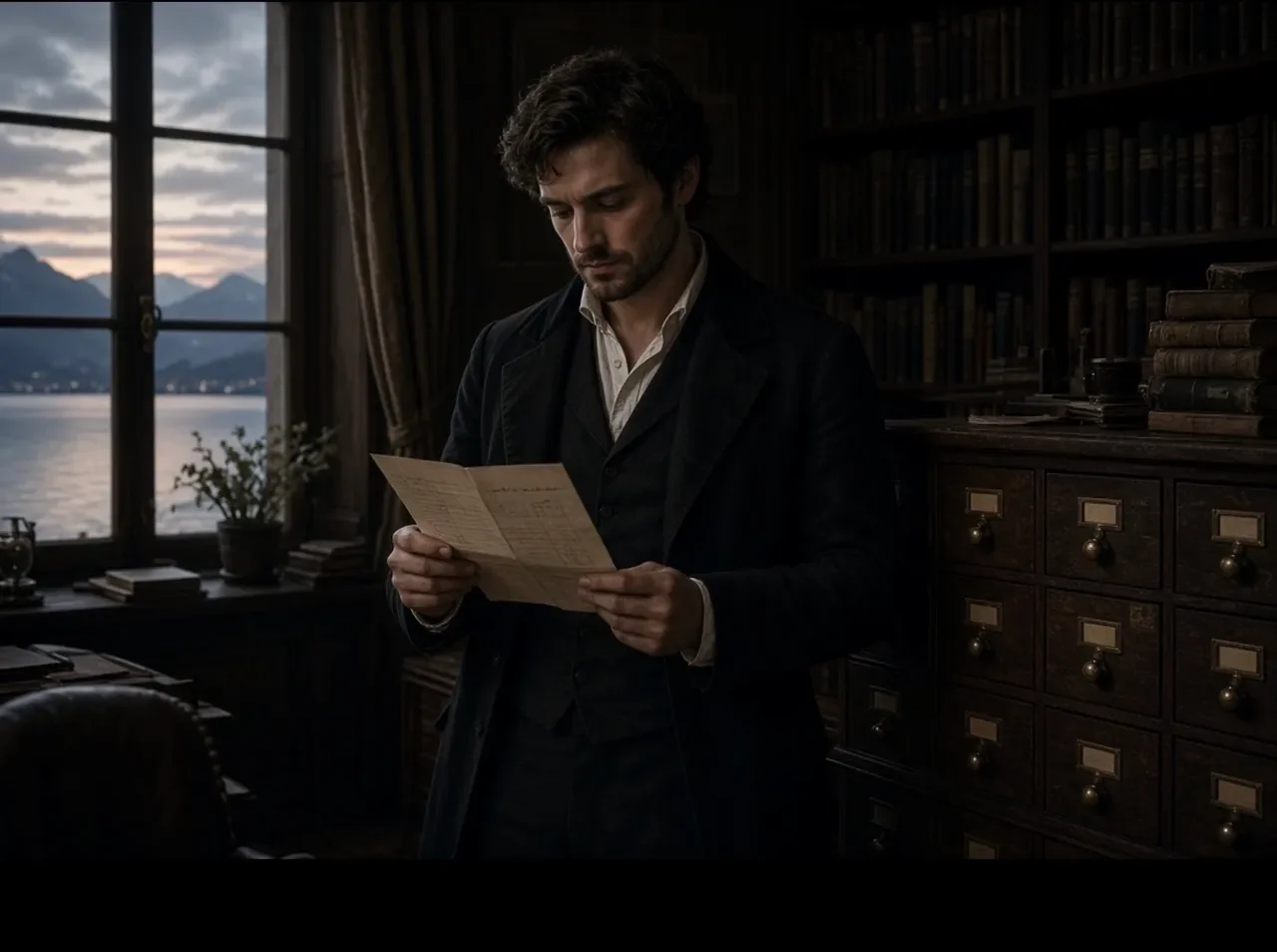
The Ledger Opens. Prologue through Chapter 7
The White Door Protocol: The First Ledger (Prologue to Chapter 7)
Prologue. Geneva, 2015
Elias Veyr is finishing the donors’ annex when he notices Corvane Holdings has paid for accommodation the foundation does not provide. Noor Haddad shows him a handwritten sheet ruled in five columns. Most entries are marked white. A few are red or blue. The last line, in darker ink, reads A.C. Gold. On appointment to Transport and Maritime, April. Velin. He takes the photocopy, promises to raise it, and that evening sits at Matthias Brenner’s table with Victor Halden and says nothing.
Three Questions
- What does the colour gold record that the other colours do not? A political outcome treated as already decided.
- Why is Elias’s silence more consequential than the sheet itself? Because the appointment occurs exactly as written and his own directorship follows.
- How does the prologue establish the novel’s central test? Once the page has been seen, every later choice is measured against the decision not to act on it.
Chapter One. Vienna, 29 September 2026
Eleven years later an envelope arrives containing a high resolution scan of the same sheet, now showing Noor’s pencil tick, and an index card with a web address and four words: Linden. Quarry. Eleven. Heron. The linked file holds 214 pages. Elias reads one paragraph written by someone who was fifteen and stops. He checks twenty financial items. Eighteen verify. He writes to Mara Solen asking only whether the material can be assessed responsibly.
Three Questions
- Why does the pencil tick identify the page more reliably than the text? It is a mark Noor made on the original after Elias’s copy had already been taken.
- What principle governs Elias’s refusal to continue reading the statements? They were not written for him. Curiosity is not consent.
- What do the four words on the card later prove to be? Private reference points from a single year of Noor’s work, legible only to someone who had been in the building.
Chapter Two. Amsterdam, 30 September 2026
Mara ends the video call the moment the handwritten sheet appears. That night she retrieves her own 2008 index card. The ruling, the short vertical line, the full stop after the colour, and the open lower case g match. She replies with five conditions: normal rates paid in advance, financial records only, no onward disclosure without agreement, full disclosure of what Elias actually knows, and her unconditional right to stop.
Three Questions
- Why is recognition immediate for Mara? She ruled and filed cards in the same hand for two years.
- What does the requirement of payment protect? It prevents the work from becoming an unrecorded personal favour that can later be denied.
- How does her refusal of the statements align with Elias’s earlier choice? Both treat the personal accounts as belonging to the people who wrote them, not to later readers.
Chapter Three. Saranza, 2 October 2026
Alden Crowe receives three photocopies: his 1994 fellowship letter, a Corvane schedule for the flat he occupied in Geneva, and a February 2009 Saint Orison guest list. A slip reads White, 1994. Blue, 2009. He writes a public letter making the Velin certificate conditional on a binding sixty million euro fisheries annex, has it entered in the register, and locks the envelope in his safe.
Three Questions
- Why does the warning deliberately omit 2015? That is the year whose documentation would end his tenure. The earlier years only create embarrassment.
- What precisely did Crowe fail to do on the island in 2009? He saw a girl of about fifteen waiting on the jetty at night, received a polite answer to his question, and went to bed without further inquiry.
- Does the public letter constitute an accounting? It secures a material protection for the fishing communities. It does not yet name the events the photocopies document.
Chapter Four. Amsterdam, 6 October 2026
Elias travels overnight and tells Mara the complete 2015 sequence: the sheet, the promise, the dinner, the directorship, Noor’s non renewal. Mara has already tested his sample and forty additional items. Most are authentic company paper. Two named Swiss recipients leave no trace in any registry or gazette. They agree that only three pages will be shown to the administrators.
Three Questions
- Why are the two unverified companies analytically useful? They appear solely as recipients and fit the profile of careful later insertions rather than original entries.
- What does Mara’s reserved right to stop establish? That her continued involvement remains a revocable professional judgement, not a binding commitment.
- How does Elias characterise his eleven year silence? As a failure to find the second sentence after an apology, rather than as a repeated decision.
Chapter Five. Zurich, 12 October 2026
Adrian Vale examines the three pages and states that if they are estate records they are not Elias’s to withhold. He outlines the principal assets: the minority stake in Velin Terminal Holdings and the island company. Noor Haddad, now head of records, looks at the cropped number and says it is not one of theirs because theirs carry a prefix. In the lobby Elias apologises for 2015. Noor replies that she has had eleven years to establish the order of events and will not discuss the pages.
Three Questions
- Why is Noor’s formulation about the prefix narrower than it first appears? A prefix is the element most easily removed by cropping. Her sentence addresses format rather than provenance.
- What institutional tension does Adrian acknowledge? His duty to obtain the best lawful price for creditors collides with the fact that the price depends on a political vote in another country.
- Does Elias’s apology alter Noor’s position? No. She treats the sequence as already settled and declines any further private accounting.
Chapter Six. Zurich and Amsterdam, 13 to 15 October 2026
Mara locates a newspaper reproduction of an administrators’ inventory page bearing the stamp KO CRV 0004127. Typeface, position and surviving digits match the fragment. Adrian confirms the prefix appears on every copy the firm produces. Corporate tracing shows Strandholm Logistik absorbed into Meridian Strait Logistics. Konrad Weil leads the relevant programme and maintains a residence on the ship Meridian House. Elias accepts Ottilie Brask’s invitation to speak on the November crossing and brings Mara under her own professional name.
Three Questions
- What does the missing prefix conceal? The identity of the specific numbered set from which the pages were extracted.
- Why does Mara reject any form of cover credit? Re entering under concealment would reproduce the operating method of the system she left.
- How does the ship invitation change the character of the inquiry? It moves the work from documents that can be examined at a distance into a closed community whose members have mutual reasons for discretion.
Chapter Seven. Cascais, 2 November 2026
Celeste Marrow briefs Victor Halden on the sequence that will place him aboard as P. Arnaud and bring him to the island strongroom on 20 November so the 2015 file can be used. She finds and deletes his unsent message to a Lisbon criminal lawyer. That evening Konrad shows her the salon card naming both Elias Veyr and Mara Solen. She decides she will not sail. She will meet the ship on the island.
Three Questions
- Why is Victor’s physical presence in the library required? Letters can be disputed. A living man who confirms them cannot be dismissed as easily.
- What does the deleted draft demonstrate about Victor’s state? He had already composed the sentence that would take the archive to a prosecutor and had not yet been able to send it.
- How does the appearance of Mara’s name affect Celeste’s assessment? It violates the long standing assumption that those who left the system would remain unidentified and silent.
Original article: https://ghamari.org/articles/f/the-white-door-protocol-chapters-1-to-7-summary-novel