Police Violence Protest Rights Democracy Test
By Dr. Pooyan Ghamari · · 13 min read
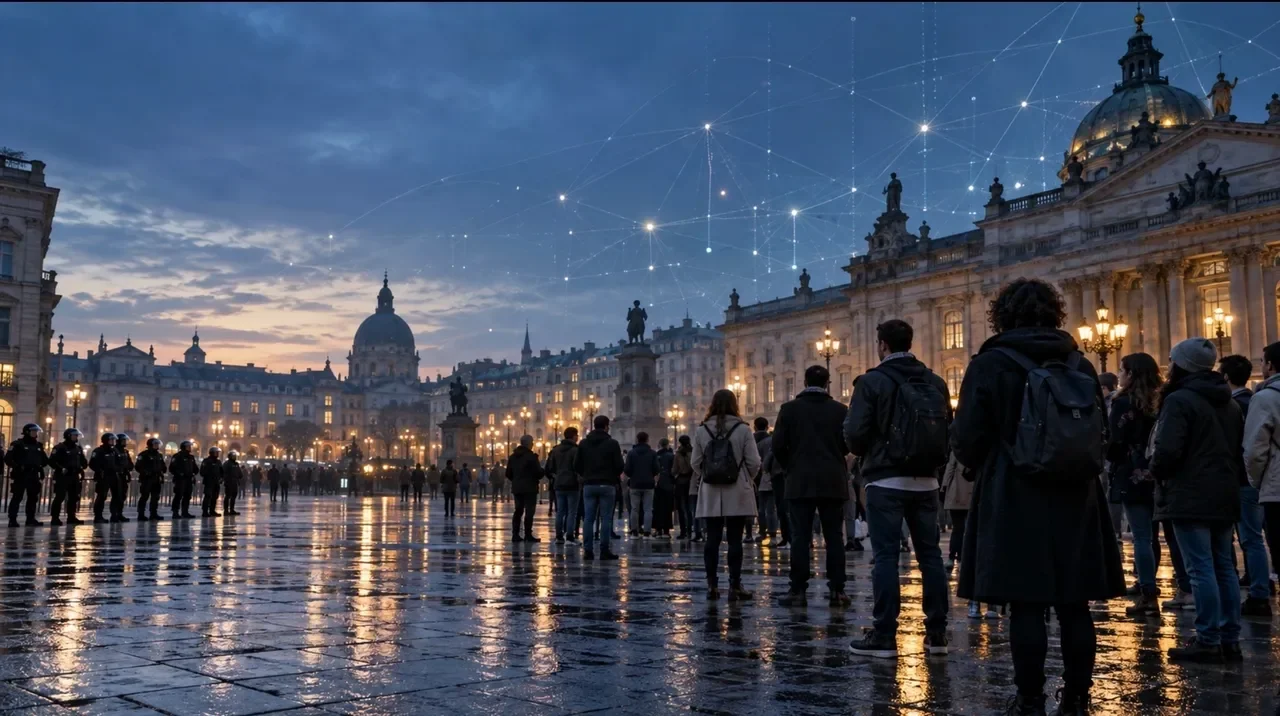
The Democracy Test: What States Reveal When Citizens Dissent
By Dr. Pooyan Ghamari
Every government speaks the language of public order when it fears disorder. Every government speaks the language of security when it wants citizens to accept more control. Every government claims a duty to protect police officers, public buildings and ordinary people from violence.
That duty is real. A person who fires a gun at police, throws a firebomb into an occupied vehicle or sets a police station on fire with people inside commits a grave crime. No serious theory of freedom requires a society to excuse it.
The political trap begins when a state uses the crime of one person to reduce the rights of thousands. It becomes deeper when governments use the word democracy as a public identity while punishment, surveillance, financial pressure and fear make meaningful dissent too expensive for ordinary people.
The question is therefore not whether France, the United States, Germany, Iran, Russia or China ever punish violence. All do. The question is whether they can distinguish an individual criminal act from political disagreement, prove guilt fairly, impose a proportionate punishment and allow citizens to investigate the state itself.
That is the democracy test.
A child injured and a police station burned
France offers a sharp illustration of the problem. On 5 October 2026, a fifteen year old boy in Lens lost his hand and part of his lower arm during school protests after he reportedly picked up a police dispersal grenade. The French government subsequently suspended the use of stun grenades while the case is investigated.[1]
This cannot be dismissed as an unfortunate detail. A weapon that permanently mutilates a child raises a direct question of necessity, proportionality and command responsibility. A democratic government does not become exempt from human rights scrutiny because police were facing disorder.
Yet the other side of the same week also matters. On 8 October, masked people set fires outside a police station in Bordeaux. The flames spread inside the building and three officers evacuated through an emergency exit. French authorities opened a criminal investigation.[2]
Both facts can be true at the same time.
The injured student deserves an impartial investigation, medical support and accountability if police conduct was unlawful. The people who deliberately endangered officers in Bordeaux must be identified and prosecuted on evidence. One truth does not cancel the other.
The dishonest political method is to use the injury of the child to excuse attacks on police, or to use the fire at the police station to excuse indiscriminate force against students. A lawful state must reject both.
The first lie: every protester is innocent
Protest movements are made of human beings. They can include peaceful citizens, angry teenagers, opportunists, provocateurs, people who destroy property and, in rare cases, people willing to seriously injure or kill. Serious reporting must not hide this reality.
In the United States during the 2020 protests after the killing of George Floyd, the Department of Justice stated that more than 300 people faced federal charges connected to crimes during nationwide demonstrations, including roughly 80 accused of arson or explosives offences.[3]
Individual cases produced substantial sentences. A woman who threw a Molotov cocktail at an occupied NYPD van during a protest received a seventy two month federal prison sentence.[4] A man who used explosive devices against two police vehicles in Seattle received forty months in prison.[5]
These prosecutions show that the United States does not treat attacks on police as protected expression. Nor should it. The law may properly punish arson, assault, attempted murder and murder.
France follows the same basic principle. It has no death penalty. Article 66 1 of the French Constitution states that no person may be sentenced to death.[6] But arson, violence against public officials and attempts on life can carry long prison sentences. The exact charge must depend on evidence, intent, whether people were placed in danger and the role of each accused person.
The line is clear. Peaceful criticism must be protected. Violence against people must be prosecuted.
The second lie: violence by some people cancels the rights of everyone else
The fact that violent acts occur inside or near a protest does not give police unlimited authority over every person present. International standards require force to be necessary and proportionate. Individual wrongdoing does not make collective punishment lawful.
During the same 2020 United States protests, Amnesty International documented 125 separate incidents of police violence against protesters, medics, journalists and legal observers in forty states and Washington, DC. The organisation reported use of batons, chemical irritants and impact projectiles, including in situations involving peaceful participants.[7]
France has a similar record of concern. Amnesty International’s current country report says security forces were accused of excessive force during demonstrations and that the United Nations Committee against Torture expressed concern that stun grenades and projectile launchers had regularly caused serious injuries.[8]
Germany also cannot be treated as a clean exception. Amnesty reported that Berlin police ordered speech and slogans at a Palestinian solidarity protest to be in German or English only. When protesters chanted in Hebrew and Arabic, police dispersed the gathering violently, according to the report.[9]
These examples do not prove that France, the United States or Germany are equivalent to authoritarian states. They prove that legal democracies can abuse force, restrict unpopular speech and make some groups bear more risk than others. A democratic label is a claim that must be tested, not a permanent certificate of innocence.
What changes when the state punishes political identity itself
Iran, Russia and China are not simply countries where police sometimes use excessive force. Their systems create a different and more dangerous relationship between citizen and state.
In Iran, the judiciary announced on 5 October 2026 that it had executed two men arrested in connection with January protests. State media said they had been convicted of membership in an armed rebel group, carrying weapons, causing fear and involvement in the deaths of four police officers.[10] I cannot independently verify the individual underlying allegations from publicly available evidence.
That uncertainty is central. The Independent United Nations Fact Finding Mission on Iran has found serious evidence of murder, imprisonment, torture, rape and other sexual violence during the response to the 2022 protests. It concluded that some conduct amounted to crimes against humanity.[11] In 2026, the United Nations Human Rights Council also condemned reports of thousands killed, mass arrests, torture, enforced disappearance and unfair proceedings connected with the nationwide protests that began in December 2025.[12]
If an Iranian citizen truly kills a police officer, the act should be investigated and prosecuted. But justice cannot rest on torture tainted confessions, lack of access to counsel, closed proceedings, political charges with vague definitions or fast executions. A legitimate court tests evidence. It does not produce fear as a governing instrument.
Russia has built a parallel system around the language of security, extremism, foreign influence and false information. The United Nations Human Rights Council has expressed concern about mass arbitrary arrests, excessive force against peaceful protesters, the closure of independent media and laws used to suppress antiwar speech and political dissent.[13]
China often prevents the protest from becoming visible at all. United Nations experts have described allegations of arbitrary detention, incommunicado detention and enforced disappearance of people who participated in or supported the White Paper protests and other peaceful acts of dissent. The same experts described a broader chilling effect on lawyers, journalists, artists, activists and ordinary citizens.[14]
In these systems, the state does not need to wait for a firebomb. A critical post, a slogan, a private meeting, a memorial, a donation or a call for reform may be converted into evidence of disloyalty.
The real difference is not perfection. It is the possibility of correction
France, Germany and the United States each have serious problems with policing, discrimination, surveillance and unequal access to justice. They also retain institutions through which citizens can challenge power.
France’s constitutional tradition protects the free communication of ideas and opinions, while allowing only necessary and proportionate restrictions defined by law.[15] Germany’s Basic Law protects freedom of expression, assembly, association and political participation.[16] The United States First Amendment protects speech, press, peaceful assembly and petition of government.[17]
These legal guarantees do not prevent abuse. Their value lies in whether citizens can use them in practice.
In a functioning democracy, people must be able to:
1. Criticise the president, police, military and foreign policy without being imprisoned for the opinion itself.
2. Publish video evidence of police misconduct.
3. Use independent journalists, lawyers, courts and civic organisations to challenge the state.
4. Organise opposition parties, unions, campaigns and peaceful demonstrations.
5. Receive a fair, public and individualised trial if accused of a crime.
6. Appeal a conviction and obtain review from judges who are not politically controlled.
7. Return to public life after criticising power.
Where these safeguards work, a government can be corrected. Where they are removed, elections and constitutions can become theatre.
The invisible chains are as important as the visible baton
Power does not operate only through police weapons and prison doors. It also operates through systems that make dissent costly before anyone enters a courtroom.
The visible tools are familiar: tear gas, batons, projectiles, arrests, emergency powers, surveillance cameras and riot police.
The invisible tools are often more durable:
1. A worker who fears losing employment for public speech.
2. A family that fears losing housing, education, health care, travel rights or a bank account.
3. A journalist who fears loss of access, advertising, legal costs or retaliation against relatives.
4. A civil organisation labelled extremist, foreign controlled or dangerous because it criticises policy.
5. An online system that can identify, rank, exclude or economically marginalise a person at scale.
6. A country dependent on outside payment systems, shipping, energy, cloud infrastructure or financial approval.
There is no evidence of one secret command centre directing every government, company and institution. The real mechanism is less theatrical and more durable. Different centres of power often share incentives: preserve control, reduce disruption, protect revenue, avoid blame and define criticism as a threat.
This is why economic coercion and technological concentration belong in the democracy discussion. A citizen whose speech is formally lawful but whose work, payment access, data trail and ability to organise are controlled by opaque systems does not possess full practical freedom.
The same concern applies to countries. A state that cannot access banking, energy, communications, cloud services or trade on fair terms may retain legal sovereignty while losing much of its practical capacity to choose its own development path.
The answer is not isolation or romantic nationalism. It is plural access, transparent law, independent courts, public infrastructure, real competition and limits on the power of any state or corporation to make civic participation conditional on obedience.
Human rights cannot be a weapon used only against rivals
The credibility of human rights collapses when powerful governments use them selectively.
France cannot condemn repression abroad while treating the mutilation of a student as an acceptable cost of crowd control. The United States cannot defend free speech internationally while allowing journalists, medics and peaceful protesters to be attacked at home. Germany cannot defend pluralism while selectively narrowing the language and visibility of unpopular causes.
Iran cannot invoke national sovereignty while torturing, disappearing or executing people after defective political trials. Russia cannot claim security while criminalising antiwar speech and destroying independent media. China cannot claim social harmony while treating peaceful criticism as a danger requiring disappearance and fear.
The standard must remain the same. No person should be injured without necessity. No person should be punished without evidence. No person should be tortured. No person should be disappeared. No person should be executed after an unfair trial. No family should be made a hostage to the political opinion of one of its members.
The democracy test
When a protest becomes tense, the true character of a state emerges. Not in a leader’s speech. Not in a constitution displayed on a website. Not in a flag.
Ask these questions:
1. Can people protest peacefully against those in power?
2. Can they criticise the police after an injury or death?
3. Can journalists document the event without being attacked or silenced?
4. Can a person accused of violence see the evidence, choose a lawyer and appeal before an independent court?
5. Does the state punish only proven individual crimes, or use one violent act to terrorise an entire movement?
6. Does the state protect public order without making citizens permanently afraid of their own government?
7. Can economic, digital and legal systems be challenged when they become instruments of political control?
The answer to these questions reveals more than speeches about democracy.
The democracy test does not ask whether a state has problems. Every state does. It asks whether the public can expose those problems, demand remedy and survive the challenge.
That is where the real face of power becomes visible.
Questions readers ask
Is setting fire to a police station protected protest?
No. Deliberately setting a police station on fire, particularly when people may be inside, is a serious crime. It should be investigated through individual evidence and prosecuted through a fair court process.
Does police violence in France, Germany or the United States mean these states are the same as Iran, Russia or China?
No. The abuses must be taken seriously, but the systems differ in the availability of independent media, lawyers, courts, political opposition and public scrutiny. Those safeguards are incomplete but materially important.
Can a democratic country punish someone for shooting at police?
Yes. It may prosecute violent acts through charges such as attempted murder, assault, firearms offences or arson. Democracy requires legal accountability for violence and legal protection for peaceful dissent.
What makes a protest trial fair?
A fair trial requires clear charges, access to a lawyer of choice, disclosure and testing of evidence, an impartial court, a public hearing where appropriate, protection from torture and coerced confessions, and a meaningful right of appeal.
What are invisible chains in a democracy?
They are systems that reduce practical freedom without openly banning speech. They can include economic dependency, surveillance, legal intimidation, discrimination, platform control, loss of employment and unequal access to justice.
Sources and notes
- Reuters. “France Suspends Use of Stun Grenades to Police Student Protests.” 7 October 2026.
https://www.reuters.com/world/europe/france-suspends-use-stun-grenades-police-student-protests-2026-10-07/ - Reuters. “Bordeaux Police Station Attacked by Arsonists.” 8 October 2026.
https://www.reuters.com/world/bordeaux-police-station-attacked-by-arsonists-2026-10-08/ - United States Department of Justice. “Over 300 People Facing Federal Charges for Crimes Committed During Nationwide Demonstrations.” 2020.
https://www.justice.gov/archives/opa/pr/over-300-people-facing-federal-charges-crimes-committed-during-nationwide-demonstrations - United States Department of Justice. “Saugerties Woman Sentenced to 72 Months’ Imprisonment for Attempted Arson of NYPD Van Occupied by Four Police Officers.”
https://www.justice.gov/usao-edny/pr/saugerties-woman-sentenced-72-months-imprisonment-attempted-arson-nypd-van-occupied - United States Department of Justice. “Edmonds, Washington, Man Sentenced to Prison for Molotov Cocktail Attacks at May 30, 2020 Protest.”
https://www.justice.gov/usao-wdwa/pr/edmonds-washington-man-sentenced-prison-molotov-cocktail-attacks-may-30-2020-protest - French Constitution. “Article 66-1.”
https://www.legifrance.gouv.fr/loda/article_lc/LEGIARTI000006527559 - Amnesty International. The World Is Watching: Mass Violations by United States Police of Black Lives Matter Protesters’ Rights. 2020.
https://www.amnesty.org/en/documents/amr51/2807/2020/en/ - Amnesty International. “Human Rights in France.”
https://www.amnesty.org/en/location/europe-and-central-asia/western-central-and-south-eastern-europe/france/report-france/ - Amnesty International. “Human Rights in Germany.” 2025.
https://www.amnesty.org/en/location/europe-and-central-asia/western-central-and-south-eastern-europe/germany/report-germany/ - Reuters. “Iran Executes Two Men Arrested Over January 2026 Protests.” 5 October 2026.
https://www.reuters.com/world/middle-east/iran-executes-two-men-arrested-over-january-2026-protests-mizan-reports-2026-10-05/ - United Nations Independent International Fact-Finding Mission on Iran. Update. 13 September 2024.
https://www.ohchr.org/sites/default/files/documents/hrbodies/hrcouncil/ffmi-iran/FFM-Iran-Update-13-September-2024.pdf - United Nations Human Rights Council. “Human Rights Council Adopts Resolution Extending Mandates of Fact-Finding Mission and Special Rapporteur on Iran.” January 2026.
https://www.ungeneva.org/en/news-media/meeting-summary/2026/01/human-rights-council-adopts-resolution-extending-mandates-fact - United Nations Human Rights Council. “Situation of Human Rights in the Russian Federation.” 2023.
https://docstore.ohchr.org/SelfServices/FilesHandler.ashx?enc=E6VMd%2Bo21BqA8T8A0xejfH3mNtcltTssTi6AEJSUpW8aAe8%2FZyFxGPV%2FoMdvo7ocJ7Ky0AetoSPQAn%2BmkRI23Q%3D%3D - United Nations Special Procedures. “Communication Concerning Allegations of Detention and Enforced Disappearance in China.” 2024.
https://spcommreports.ohchr.org/TMResultsBase/DownLoadPublicCommunicationFile?gId=29478 - French Constitutional Council. “Article 11 of the 1789 Declaration of the Rights of Man and of the Citizen.”
https://qpc360.conseil-constitutionnel.fr/en/ms-teresa-c-and-another - German Bundestag. “Introduction to the Basic Law.”
https://www.bundestag.de/en/parliament/function/legislation/01legisinf-245854 - United States Congress. “First Amendment: Freedom of Religion, Speech, Press, Assembly, and Petition.” Constitution Annotated.
https://constitution.congress.gov/browse/essay/amdt1-4-1/ALDE_00000395/
Original article: https://ghamari.org/articles/f/police-violence-protest-rights-democracy-test