Swiss Instant Payments vs SEPA Instant: What Changes in 2026?
By Dr. Pooyan Ghamari · · 3 min read
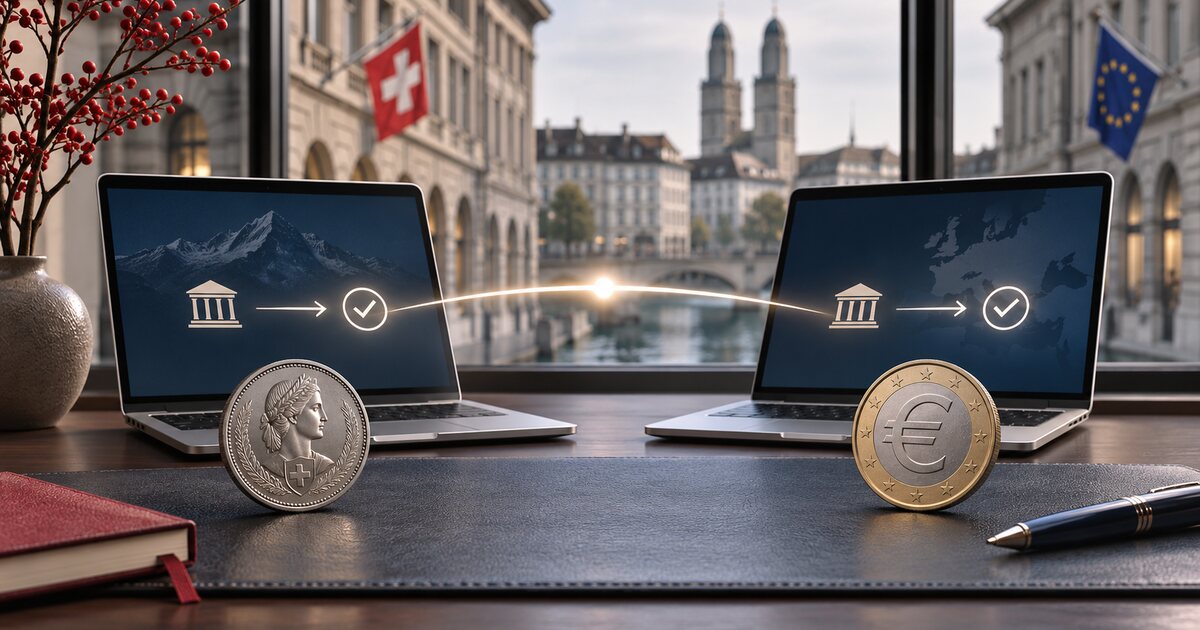
Paying a Swiss supplier on a Saturday and paying a German supplier on the same Saturday may look like identical transactions on a phone. The currency, the participating banks and the payment infrastructure make them quite different. Understanding that difference can prevent an expensive misunderstanding when an invoice is due immediately.
What changes at the end of 2026?
Switzerland introduced instant payments in August 2024. The Swiss National Bank's launch announcement set a deadline of the end of 2026 for institutions active in retail payments to be reachable. In an April 2025 speech, the SNB clarified that the obligation concerns receiving instant payments. It is not a promise that every bank will offer the same outgoing service, limits or customer fees. Ask your bank what it actually supports.
Swiss instant payments settle in francs through the Swiss payment infrastructure. SIX describes SIC as the central system for Swiss franc payments between financial institutions. Money can be credited immediately, including outside ordinary banking hours, when the relevant service is available.
SEPA Instant is a different payment rail
SEPA Instant Credit Transfer denominates transfers in euros rather than Swiss francs. Switzerland belongs to the geographical scope of SEPA; that fact alone does not guarantee that a particular Swiss bank offers instant euro transfers. The bank must support the relevant scheme and the recipient must be reachable. The European Payments Council describes the scheme as making funds available in under ten seconds.
The EU instant payments regulation has a separate timetable. For covered providers in euro area member states, the principal receiving deadline was 9 January 2025 and the sending deadline 9 October 2025. The latter date also applies to the payee verification requirement. Providers must offer it without a separate charge. These are EU obligations with defined scope and exceptions; they do not automatically become Swiss law simply because Switzerland belongs to SEPA. See the ECB implementation timetable.
The hidden cost of an immediate payment
Imagine a Swiss importer owes an Austrian manufacturer EUR 25,000. A rapid transfer does not establish the exchange rate, the supplier's bank reachability or the final cost of converting CHF into EUR. If one quote uses an effective exchange rate of CHF 0.95 per euro and another uses CHF 0.96, the totals before other fees are CHF 23,750 and CHF 24,000 respectively. The hypothetical difference is CHF 250. Comparing transfer speed while ignoring the currency quote would miss the larger cost.
Faster settlement does offer a genuine economic benefit: a company can release goods against confirmed receipt, reduce uncertainty about arrival and reconcile a paid invoice sooner. But the value depends on the entire operating process being ready. An accounting department that only updates its records on Monday may lose much of the advantage of a Saturday payment.
What businesses should check before sending
- Confirm which currency the invoice requires and whether the beneficiary accepts the selected account.
- Check instant-payment availability, transaction limits, exchange rate and the all-in cost with the sending bank.
- Independently verify new or altered supplier bank details using a known contact. Do not rely on a recently received email alone.
- Agree which receipt or bank confirmation releases an order, and arrange a fallback if instant transfer is unavailable.
Instant settlement makes preparation more valuable, not less. Once a payment has been executed, recovering money sent to a wrong or fraudulent beneficiary may be difficult. A payment that arrives quickly is only useful if it arrives in the right place.
Related analysis: How stablecoins change cross-border payments. The same question applies to conventional and digital payment networks: who controls settlement, how much does access cost, and what happens when the expected route fails?
Editorial illustration generated for this article. This is general educational analysis, not individual financial advice.
Original article: https://ghamari.org/articles/swiss-instant-payments-vs-sepa-instant