Can AI Reject Job Application Eu
Von Dr. Pooyan Ghamari · · 12 Min. Lesezeit
Dieser Artikel ist derzeit nur auf Englisch verfügbar. Eine deutsche Ausgabe ist nicht erschienen.
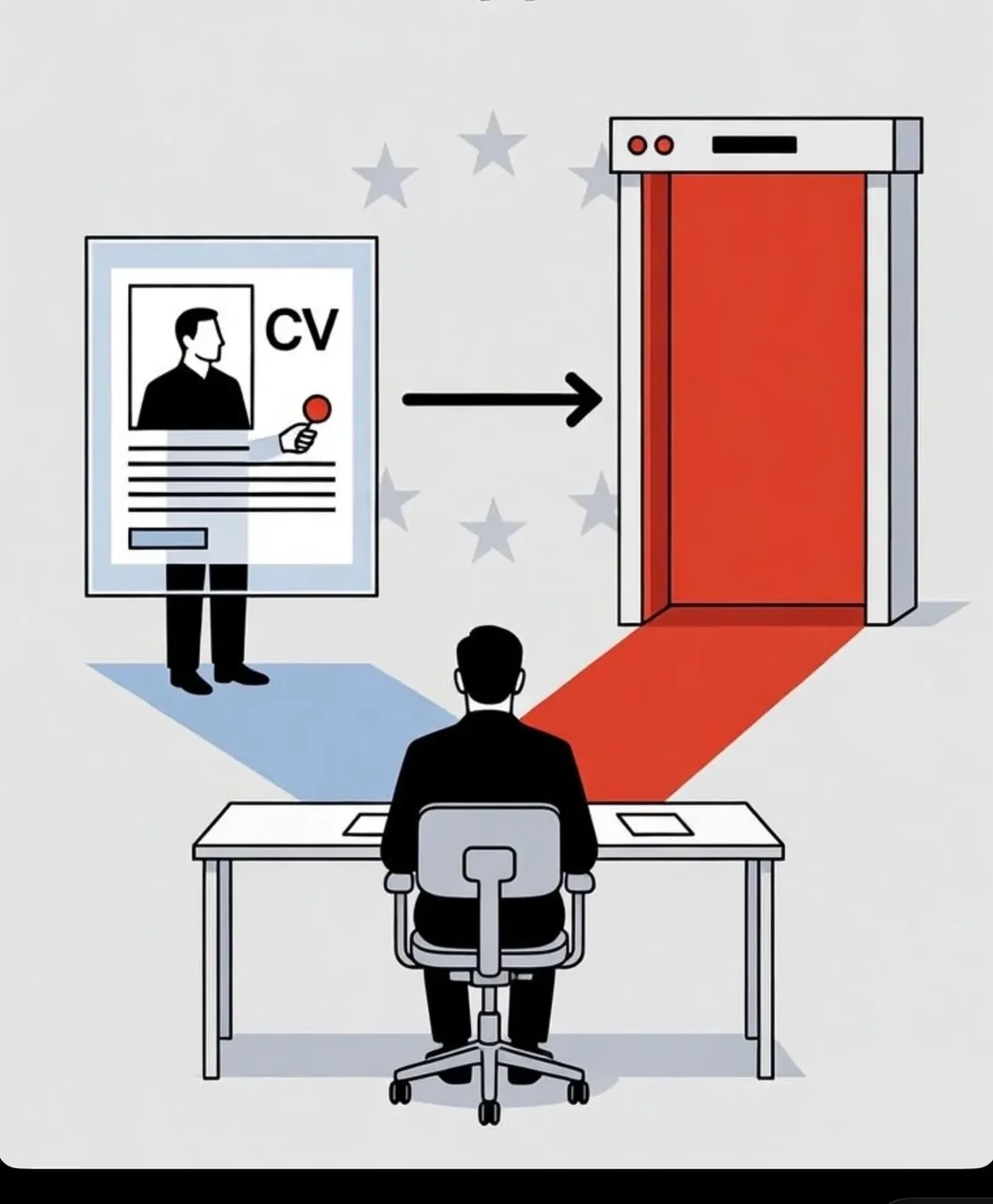
Can AI Reject Your Job Application in the EU? Rights in 2026
By Dr. Pooyan Ghamari, Economist and Author | 28 September 2026
Yes. Employers can use AI to screen or rank applicants in the EU. But if rejection is based solely on automated processing and significantly affects you, GDPR Article 22 may restrict it and require safeguards. AI Act rules for high risk recruitment systems apply from 2 December 2027.
This distinction matters. An automated email does not prove that an algorithm made the decision, and the presence of a recruiter does not prove that a human genuinely decided. The real question is how the application moved from submission to rejection, who had authority to change the outcome and whether the applicant can correct an error or challenge the reasoning.
The answer is not that every recruitment algorithm is illegal. It is that an employer cannot turn a consequential decision into an unaccountable process simply by purchasing software.
Can AI reject your job application in the EU?
AI can lawfully assist with recruitment in the European Union. A system may parse a CV, match stated skills to a job description, rank applicants, schedule interviews or help a recruiter search a large candidate pool.
The legal risk becomes sharper when the system does more than assist. If software automatically excludes an applicant without meaningful human involvement, and the exclusion has a legal or similarly significant effect, Article 22 of the General Data Protection Regulation may apply.
The European Data Protection Board gives automatic refusal of applicants through an online platform as an example of a decision that can significantly affect a person. The European Commission explains that solely automated decisions with legal or similarly significant effects are restricted, subject to limited exceptions. Where an exception applies, safeguards can include information about the automated decision, human intervention, an opportunity to express a position and a right to contest the decision.
That is the current protection. It does not depend on waiting for the AI Act’s high risk recruitment rules.
The decision path matters more than the label
Employers and software suppliers use terms such as matching, screening, recommendation and decision support. These labels do not answer the legal question.
Consider three different processes.
In the first, software extracts education and experience from a CV, but a recruiter independently reads every application and makes the shortlist. Automation is involved, but the final decision is not necessarily based solely on it.
In the second, software assigns each candidate a score. A recruiter sees only the top ten names and never reviews anyone below the threshold. The system may be deciding who can realistically compete, even if a human later selects among the survivors.
In the third, an applicant receives an automatic rejection seconds after submitting a form. No person checks the application, the input data or the reason for exclusion. This is the clearest case for asking whether Article 22 applies.
A human signature at the end of a process is not enough. Guidance endorsed by the European Data Protection Board says human involvement must be meaningful, not a token gesture. The reviewer should have the competence, authority and practical ability to change the outcome.
My judgement is simple: accountability should follow practical control. The actor who defines the target, chooses the data, sets the threshold or accepts the ranking cannot escape responsibility by saying that the machine produced the score.
What the EU AI Act changes, and when
The AI Act classifies many systems used to recruit or select people as high risk. Annex III expressly covers systems used to place targeted job advertisements, analyse and filter applications, and evaluate candidates. This reflects the fact that access to work affects income, mobility, dignity and long term opportunity.
The timetable is important. Following the 2026 AI Omnibus, the main rules for high risk AI systems in employment are scheduled to apply from 2 December 2027. The European Commission says these rules will require measures including risk management, appropriate data governance, technical documentation, logging, information for deployers, human oversight, accuracy, robustness and cybersecurity.
The future regime also includes a right, in defined circumstances, to obtain a clear and meaningful explanation of the role of a high risk AI system and the main elements of an adverse decision.
This does not create a legal vacuum until December 2027. GDPR, equality law, consumer and employment rules, contractual duties and existing AI Act prohibitions can still apply. The precise result depends on the system, the employer, the data, the decision path and national law.
One rule is already especially relevant to hiring. The AI Act prohibits AI systems that infer emotions from biometric data in workplace settings, apart from limited medical or safety uses. Commission guidance interprets the workplace context to include candidates during selection and hiring. A system claiming to infer enthusiasm, honesty or emotional stability from a face or voice therefore raises a different and more serious issue than ordinary video recording or transcription.
What an applicant can ask after an automated rejection
An applicant usually cannot see the screening architecture. The practical response is to ask focused questions that force the process into view.
Write to the employer or recruitment contact and request the following:
1. Confirmation of whether automated processing, profiling or an AI based screening tool was used.
2. Confirmation of whether the rejection was made solely by automation or whether a person reviewed the complete application before the decision.
3. The categories and sources of personal data used, including any data obtained from third parties or inferred from other information.
4. Meaningful information about the main factors and logic that influenced the result, together with the expected consequences of the processing.
5. A copy of the personal data used to evaluate the application, where the GDPR right of access applies.
6. Correction of any inaccurate or incomplete data.
7. Meaningful review by a person who has the authority and competence to change the decision, where applicable.
8. An opportunity to explain relevant context and contest the result.
A concise request could read:
“Please confirm whether automated processing or profiling was used in evaluating my application, whether the decision was made solely by automated means, what personal data and main factors influenced the result, and whether I may obtain meaningful human review, correct inaccurate data and contest the decision.”
This is not a demand for source code. In a 2025 judgment concerning automated credit scoring, the Court of Justice of the European Union held that meaningful information should enable a person to understand and challenge an automated decision. The case was not about recruitment, so it should not be presented as a hiring judgment. Its wider lesson is still useful: an explanation must make the decision contestable, not merely describe automation in abstract language.
If an employer refuses a valid data protection request, the applicant can ask for the reason and may be able to complain to the relevant national data protection authority. Legal deadlines, remedies and employment rights vary by jurisdiction. Applicants facing a serious consequence should obtain qualified local advice.
The hidden economics of automated hiring
The visible event is one rejected application. The less visible system is a chain of incentives.
The employer wants speed and lower screening costs. The software provider wants recurring revenue and data that improve its product. The recruitment team wants a manageable shortlist. Investors reward scalable processes. Each incentive can be rational on its own.
The cost can fall on the person with the least information.
A candidate may never learn that a badly parsed CV, an employment gap, an inaccessible assessment, an unusual career path or a proxy variable lowered a score. The applicant bears the lost opportunity but cannot inspect the rule that produced it. This is an information asymmetry before it becomes a technology problem.
The International Labour Organization warns that AI in human resource management can suffer from poorly defined objectives, biased or low quality data and opaque programming. These weaknesses can undermine both fairness and business performance.
Automation can also improve hiring. It can process large applicant pools, make criteria more consistent, identify overlooked skills and reduce some forms of human arbitrariness. A human reviewer can be biased, tired or inconsistent. Replacing every algorithm with an unaudited person is not a serious solution.
The better question is whether the combined human and technical process produces a more accurate, fair and contestable decision than the process it replaced.
Who gains, who pays, who decides and who is excluded?
Who gains?
Employers gain speed, scale and lower administrative cost. Recruitment platforms gain commercial power because they sit between labour supply and employer demand. Strong candidates may gain faster matching when the tool recognises their skills accurately.
Who pays?
Applicants pay when a false negative closes a door without explanation. Employers also pay when a model rejects capable people, reproduces historical preferences or creates regulatory and reputational risk. Smaller employers may bear compliance costs even when they rely on a larger vendor.
Who decides?
The formal answer may be the employer. The practical answer may be distributed among the vendor that designed the model, the employer that chose the objective, the team that configured the threshold, the platform that supplied the data and the recruiter who accepted the output.
Who can refuse?
An applicant may decline an optional assessment, but refusal can remove the only path to the job. Consent in a relationship with such unequal bargaining power deserves careful examination. A nominal choice is not always a realistic choice.
Who is excluded?
The most exposed candidates are often those who do not resemble the historical pattern used to define success. This can include people with disabilities, career changers, migrants, older applicants, people with employment gaps and candidates whose experience is expressed in a format the system does not read well.
Exclusion does not require malicious intent. It can emerge from the objective selected, the data available and the cost function the organisation chooses to optimise.
A better test for employers
An employer should not ask only whether a hiring tool is accurate. Accuracy can hide whose errors matter.
Before using an automated screening system, decision makers should ask:
1. What exact outcome is the system predicting, and is that outcome genuinely connected to job performance?
2. Which applicants are most likely to be misread or excluded?
3. Can the employer test false negative rates and reversal rates after human review?
4. Does the reviewer see enough information to challenge the model, or only the model’s conclusion?
5. Can candidates correct data and present relevant context without navigating a maze?
6. Are accessible alternatives available for people with disabilities?
7. Does the contract give the employer sufficient audit rights, documentation and incident support?
8. Who has authority to stop the system when evidence of harm appears?
Procurement is governance. When an employer buys a ranking system, it is not merely purchasing efficiency. It is delegating part of the institution’s judgement to a technical and commercial chain. The contract should therefore define access to evidence, responsibility for errors, audit rights, data use, retention, security, model changes and termination.
My analysis: the real right is the right to reopen the decision
Transparency is valuable, but disclosure alone does not repair a wrong result. An applicant can receive a polished explanation and remain excluded.
The decisive safeguard is the ability to reopen the decision before a competent person who sees the relevant evidence, can correct bad data and has authority to reverse the outcome. Without that power, “human in the loop” becomes ceremony.
I would judge an automated hiring process by four measures: how often errors are found, how often human review changes an outcome, how quickly a challenge is resolved and whether error rates differ across relevant groups. These measures turn ethics from a slogan into an operating system.
The wider issue is institutional sovereignty. When access to work depends on systems that employers cannot explain, audit or replace, control moves away from both the applicant and the organisation. The strongest employers will not reject technology. They will refuse to become dependent on decisions they cannot defend.
AI can assist with recruitment in the EU, but it does not erase legal responsibility. A fully automated rejection can trigger GDPR protections now. The AI Act already prohibits certain workplace emotion recognition, while its main high risk recruitment duties are scheduled to apply from 2 December 2027.
For applicants, the practical response is to ask whether automation was decisive, what data and factors were used, whether inaccurate information can be corrected and whether a qualified person can genuinely reconsider the result.
For employers, the standard should be higher than speed. A hiring system must be accurate enough to use, fair enough to defend and open enough to challenge.
This article provides general educational information, not legal advice. The application of EU and national law depends on the facts, the system and the jurisdiction.
Frequently asked questions
1. Can an employer use AI to reject my job application in the EU?
Yes, employers may use AI in recruitment, but a rejection based solely on automated processing can be restricted by GDPR Article 22 when it has a legal or similarly significant effect. Limited exceptions and safeguards may apply.
2. Do I have a right to human review of an AI hiring decision?
Potentially. If GDPR Article 22 applies and an exception permits the automated decision, safeguards may include human intervention, the opportunity to express your position and the right to contest the decision. The facts of the process matter.
3. Must an employer tell me that AI screened my application?
GDPR transparency duties can require information about automated decision making in relevant cases. The AI Act will add obligations for high risk employment systems, but its main high risk rules apply from 2 December 2027.
4. Can an employer analyse my face or voice to detect emotions in an interview?
The AI Act prohibits AI systems that infer emotions from biometric data in workplace settings, including recruitment, except for limited medical or safety uses. This is narrower than a ban on all video recording, transcription or interview analysis.
5. What should I do if I believe AI rejected me unfairly?
Ask whether automation was used, whether a person made the decision, what data and main factors mattered, and how to obtain access, correction and meaningful human review. If necessary, contact the relevant national data protection authority or obtain local legal advice.
Sources
1. European Commission, AI Act: regulatory framework and current application timeline, including the 2 December 2027 date for high risk employment systems.
2. European Commission AI Act Service Desk, Annex III and Article 86, on high risk recruitment uses and the right to an explanation in defined cases.
3. European Commission, Guidelines on prohibited AI practices, together with Article 5, on workplace emotion recognition.
4. European Commission, Dealing with requests from individuals under the GDPR, on access, correction and restrictions on automated decision making.
5. European Data Protection Board, Respect individuals’ rights, including automatic refusal of online applicants as an example of a significant automated decision.
6. Court of Justice of the European Union, Case C-203/22, Dun & Bradstreet Austria, judgment of 27 February 2025, on meaningful information that enables a person to understand and challenge an automated decision.
7. International Labour Organization, AI in human resource management: The limits of empiricism, 11 November 2025.
human dignity in automated systems to Human Dignity and Power.
Link the phrase invisible systems that shape opportunity to The Invisible Chain.
biography to the Dr. Pooyan Ghamari books collection.
Originalartikel: https://ghamari.org/articles/f/can-ai-reject-job-application-eu