Old Empires, New Masks: Sovereignty, Colonial Memory
Von Dr. Pooyan Ghamari · · 11 Min. Lesezeit
Dieser Artikel ist derzeit nur auf Englisch verfügbar. Eine deutsche Ausgabe ist nicht erschienen.
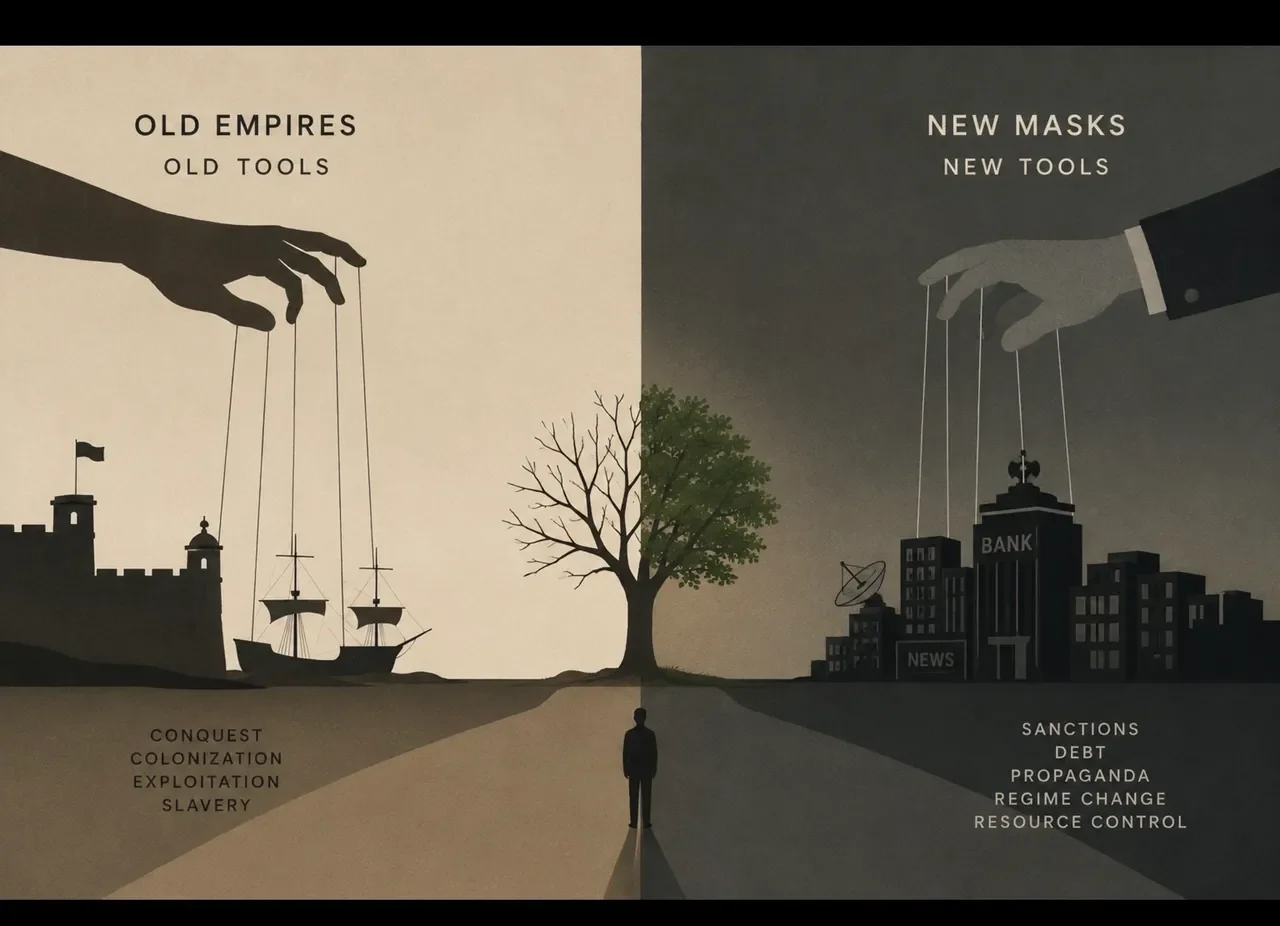
and the Future of Global Order
By Dr. Pooyan Ghamari
The Old Empire in a New Language
Empires are rarely buried in one ceremony. First the uniforms disappear. Then the flags change, the offices are renamed, and the language becomes softer. Direct rule gives way to advisory missions. Occupation becomes stabilization. Economic pressure becomes compliance. Military threat becomes security architecture. The old colonial officer leaves the room, but the structure of command often remains.
Across the modern age, especially since the rise of Atlantic slavery, settler conquest, and industrial empire, domination has repeatedly learned to speak through the language of progress. It once spoke openly of empire, race, civilization, and conquest. Later it learned to speak of democracy, development, security, human rights, and international order.
Democracy is not the enemy. Human rights are not the enemy. Law is not the enemy. These are among the highest achievements of political civilization. The danger begins when noble words become selective weapons. When rights are defended only against rivals and ignored among allies, they stop serving justice. When law restrains the weak but excuses the powerful, it becomes decoration. When democracy is demanded from outside through pressure, sanctions, bombs, or regime engineering, it is no longer democracy. It is domination with a cleaner vocabulary.
The Historical Wound
Modern power did not rise only through science, contracts, parliaments, and markets. It also rose through land seizure, forced labor, racial theory, military violence, and the destruction of peoples whose existence stood in the way of expansion.
In the Americas, Indigenous nations endured disease, warfare, forced displacement, broken treaties, cultural destruction, and the loss of ancestral lands. Historians continue to debate exact population figures before European arrival and the relative role of disease, violence, and social collapse. That debate does not change the core reality: the demographic collapse and dispossession were vast. The Smithsonian’s National Museum of the American Indian records that treaties between the United States and Native Nations were often broken and sometimes coerced. The National Park Service documents how the Indian Removal Act forced southeastern tribes to give up their lands and move west of the Mississippi River.
The transatlantic slave trade was not only cruelty. It was a business model. The National Endowment for the Humanities, drawing on the Trans Atlantic Slave Trade Database, states that about 12.5 million Africans were forced aboard slave ships, and about 10.7 million survived the Middle Passage between 1526 and 1866 before being enslaved in the plantation economies of the Americas and the Caribbean.
That system fed plantations, ports, banks, shipping networks, insurance markets, manufacturing supply chains, and imperial treasuries. Lloyd’s own historical account estimates that slavery related business accounted for between one third and 40 percent of premium income in the second half of the eighteenth century.
Racial hierarchy was not a random prejudice floating above history. It was a political technology. It helped turn human beings into property, labor, and legal inferiors. UNESCO describes the transatlantic trade in enslaved Africans as forced displacement that enriched imperial powers and produced false narratives of white supremacy and racial inferiority.
This must be said precisely. The issue is not white people as a race. The issue is racial supremacy as an ideology. It is the belief that some peoples are born to command while others are born to obey, supply labor, surrender resources, or receive moral lectures from above. When that mindset returns through extremist politics, migration panic, war propaganda, or foreign policy arrogance, it carries the same intellectual poison that once justified slavery and colonization.
Trade, Opium, and the Machinery of Control
Empire often enters through the door of commerce before it builds the architecture of rule.
The English East India Company began as a commercial enterprise. In 1600 it received a royal charter granting monopoly rights over English trade across Asia and the Pacific. Over time, trade hardened into military power. British Library material published through the Qatar Digital Library records that the Company seized control of Bengal in 1757 and received the diwani in 1765, giving it the right to collect revenues from Bengal, Bihar, and Orissa. That revenue strengthened its military presence and helped turn a trading company into a hybrid sovereign power.
India shows how access can become authority. Commerce became taxation. Taxation became administration. Administration became law. Law became empire. UK Parliament’s own historical account records that by 1856 much of the Indian subcontinent and much of Burma were ruled directly by the Company or through allied local rulers. After the uprising of 1857, the British state formally took over Company rule through the Government of India Act of 1858.
China offers another lesson, sharper and darker. The Opium Wars were not simply military conflicts. They exposed how trade language can conceal coercion when backed by naval force. The U.S. Office of the Historian states that the Opium War and the treaties that followed belonged to an era when Western powers sought broad access to Chinese products and markets. The later agreements became known as unequal treaties because they gave foreigners privileged status and extracted concessions from China. The UK National Archives also records that the Opium Wars produced treaties expanding British control over Hong Kong territory.
The lesson is not difficult. When empire wants access, it calls the demand openness. When the weaker side resists, resistance becomes disorder. When pressure succeeds, domination is renamed stability. When the injured nation remembers, memory is dismissed as resentment.
The Modern Mask
Colonialism did not vanish. It became more technical.
The old empire took land. The modern version can take decision making power. The old empire raised flags over ports and ministries. The modern version can freeze assets, restrict banking channels, sanction industries, shape insurance risk, influence credit access, control technology flows, define diplomatic legitimacy, and frame public perception.
This does not mean every sanction is colonial or every Western policy is imperial. Serious analysis must avoid that lazy conclusion. Some sanctions target specific individuals or entities for legal reasons. The real test is legality, proportionality, humanitarian cost, and consistency. When pressure spreads from officials to ordinary civilians, when medicine, development, trade, or education becomes collateral damage, financial pressure begins to resemble siegecraft without walls.
The United Nations Charter is built on sovereign equality and the principle that states should not threaten or use force against the territorial integrity or political independence of other states. Yet legal language loses force when applied unevenly. A rule that punishes enemies and protects friends is not law in the moral sense. It is power wearing a robe.
The Office of the UN High Commissioner for Human Rights maintains a mandate on the negative impact of unilateral coercive measures. Its 2025 report by Special Rapporteur Alena F. Douhan addresses the direct and indirect effects of unilateral sanctions and overcompliance on economic, labor, and social rights, especially for vulnerable groups.
The battlefield has expanded beyond armies. It now includes payment systems, data infrastructure, maritime insurance, credit ratings, export controls, media narratives, shipping routes, investment risk, and access to technology. Modern domination does not always need a governor. Sometimes it needs the power to decide which nation may trade, which currency may move, which government may be recognized, which suffering may be seen, and which law may be paused.
A more stable order cannot be built by giving empire better public relations. Power must be restrained by truth, law, memory, reciprocity, and human dignity.
Iran and the Dignity of Old Civilizations
Iran is not simply a state inside modern borders. It is a civilizational space with deep continuity in language, philosophy, poetry, science, law, trade, spirituality, and strategic geography. Columbia University’s Center for Iranian Studies describes Encyclopaedia Iranica as a major research tool covering Iranian civilization from prehistory to the present, and notes the geographic centrality of Persia throughout history.
That memory is not decorative. Old civilizations can accept dialogue, reform, trade, and cooperation. What they reject is humiliation dressed as diplomacy.
Iran’s geography gives it weight that cannot be wished away. It sits near the Persian Gulf, the Caspian region, Central Asia, the Caucasus, South Asia, and the Arab world. The Strait of Hormuz alone shows the strategic value of this position. The U.S. Energy Information Administration reported that in 2024 oil flows through the Strait of Hormuz averaged about 20 million barrels per day, roughly 20 percent of global petroleum liquids consumption.
Iran also has a substantial domestic market, a well educated workforce, major natural gas and crude oil reserves, and important agricultural, hydrocarbon, and service sectors. At the same time, the World Bank notes that Iran faces structural challenges, intensified sanctions, and growing water and energy shortages that disrupt economic activity.
This is the point many people miss. Iran does not need humiliation, threats, sanctions, or military lectures. It also cannot build a strong future on anger, isolation, slogans, or romantic memory. Civilizational pride without institutional competence becomes performance. Resistance without economic strategy becomes fatigue.
Iran’s path forward must be disciplined sovereignty. That means internal reform, serious institutions, economic modernization, technological capacity, education, industrial strategy, regional diplomacy, diaspora capital, independent financial architecture, legal credibility, strategic patience, and national dignity.
Submission is not a strategy. Chaos is not liberation. A serious nation chooses strength with intelligence, reform with sovereignty, and dignity with competence.
Civilizational Networks, Not Empires
The next struggle for power will not be decided only by military size. It will be decided by energy corridors, ports, food security, water security, critical minerals, artificial intelligence, satellite systems, cybersecurity, data sovereignty, digital money, tokenized assets, independent payment rails, education, manufacturing depth, diaspora capital, and trusted regional alliances.
Old empires prefer dependent states. The coming age requires capable states.
A capable state protects its data. It secures water and food. It educates its population for technological competition. It builds ports, logistics corridors, energy systems, payment infrastructure, and industrial capacity. It attracts diaspora wealth through credible rules, not emotional speeches. It turns geography into leverage, culture into soft power, energy into strategy, and sovereignty into competence.
This is where ancient civilizations can return as living networks, not museum pieces. Iran, India, China, the Arab world, Africa, Latin America, and Eurasia all carry histories of injury, resistance, adaptation, and renewal. Their future will not be secured by speeches against empire alone. It will be secured by institutions that work, economies that produce, alliances that endure, and leadership that understands power as a system.
Civilizational dignity is not nostalgia. It is memory disciplined into strategy.
Sovereignty Without Illusion
A serious defense of sovereignty must also face internal failure. Many countries across Asia, Africa, the Middle East, and Latin America struggle with corruption, weak institutions, repression, inequality, mismanagement, and injustice. These problems must be confronted without excuses.
But internal weakness does not grant foreign powers the right to dismantle sovereignty, engineer governments, punish civilians, seize resources, or turn nations into chessboards.
A nation must repair its own house. No empire has the right to burn that house down and call the fire liberation.
Sovereignty is not isolation. It is the right of a people to shape their future without coercion. Democracy grows through legitimacy, law, institutions, participation, education, public trust, and internal reform. It cannot be delivered by bombs. Human rights cannot be protected through double standards. Development cannot be forced through humiliation.
No More Colonialism Under Modern Names
Peace requires more than the absence of war. It requires the end of old habits hiding inside polished language.
Democracy without sovereignty becomes theater.
Human rights without consistency become propaganda.
Security without justice becomes domination.
Peace without dignity cannot last.
Old civilizations do not need to be conquered, corrected, or humiliated. They deserve to be treated as equal participants in the future of humanity. Stability will not come from replacing old empires with new slogans. It will come when power learns limits, law applies equally, memory is respected, and dignity is not treated as a privilege granted by the strong.
The age of empire must not be allowed to survive simply because it has learned to speak more politely.
Selected Historical References
National Museum of the American Indian, Nation to Nation: Treaties Between the United States and American Indian Nations, on treaties, coercion, and Native sovereignty.
National Park Service, Trail of Tears National Historic Trail, on the Indian Removal Act and forced relocation west of the Mississippi River.
National Endowment for the Humanities, The Transatlantic Slave Trade Database, on the forced transportation of Africans across the Atlantic.
UNESCO, Transatlantic Slave Trade, on forced displacement, imperial enrichment, and racial supremacy narratives.
Lloyd’s, Marine Insurance and Slavery, on the relationship between slavery, insurance, and British commercial finance.
British Library through Qatar Digital Library, A Brief History of the English East India Company 1600 to 1858, on the Company’s transformation from trade to military and revenue power.
UK Parliament, East India Company and Raj 1785 to 1858, on Company rule, the 1857 uprising, and the transfer of power to the British Crown.
U.S. Office of the Historian and UK National Archives, on the Opium Wars, unequal treaties, and the colonial history of Hong Kong.
United Nations, Charter of the United Nations, Article 2 principles on sovereign equality and the prohibition on the threat or use of force.
OHCHR, A/HRC/60/36, on the impact of unilateral coercive measures and overcompliance on economic, labor, and social rights.
Columbia University Center for Iranian Studies, Encyclopaedia Iranica, on Iranian civilization and historical centrality.
U.S. Energy Information Administration, on the Strait of Hormuz as a critical oil transit chokepoint.
World Bank, Islamic Republic of Iran Overview, on Iran’s economic structure, resource base, domestic market, workforce, sanctions pressure, and water and energy constraints.
Originalartikel: https://ghamari.org/articles/f/old-empires-new-masks-sovereignty-colonial-memory