Switzerland: The Nation That Chose Citizenship Over Blood
Von Dr. Pooyan Ghamari · · 26 Min. Lesezeit
Dieser Artikel ist derzeit nur auf Englisch verfügbar. Eine deutsche Ausgabe ist nicht erschienen.
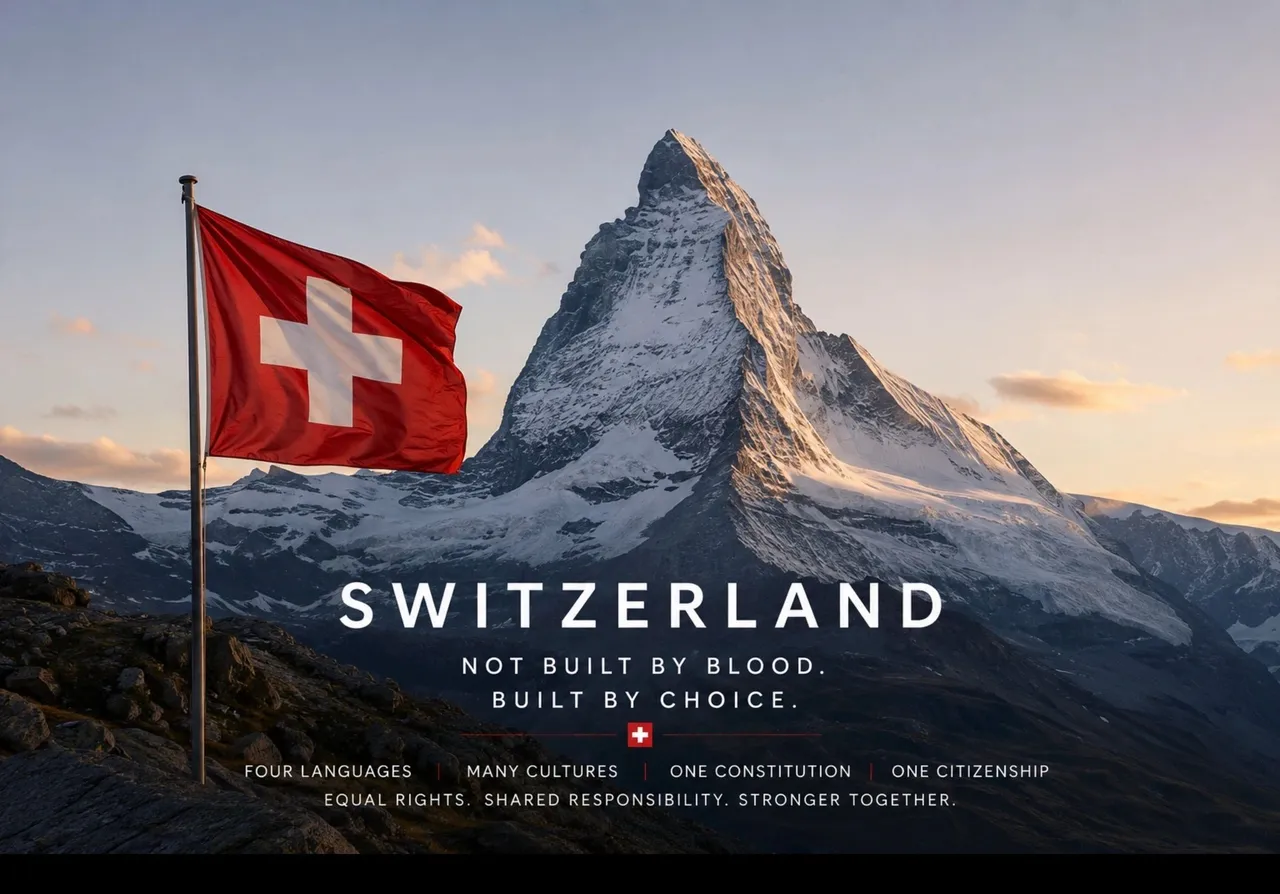
What Makes a Nation?
The Swiss Answer, and Its Complications
This version removes the ordinary figures named Heinrich, Anna, Jakob, and Marco from the earlier draft. The draft did not identify a parish register, militia roll, census record, court file, military roster, or chronicle entry sufficient to prove those people existed. A person enters this manuscript only when a document can carry the weight. The result is less smooth, but it is more honest: parchment, votes, constitutional articles, casualty lists, court decisions, official statistics, and institutional records do more work here than representative characters.
Part One: What Did the Defeated Cantons Accept?
What did Lucerne, Uri, Schwyz, Unterwalden, Zug, Fribourg, and Valais accept after November 1847: the Swiss federation, the new constitution, or simply the fact that the Sonderbund had lost before any outside power could change the result?
That question is harder than the usual story allows. The seven cantons had not merely disagreed with a policy. They had formed a separate defensive alliance, the Sonderbund, in December 1845, to defend Catholic religion and cantonal sovereignty against the liberal majority in the Federal Diet. The conflict grew from earlier disputes over Aargau monasteries, Jesuit activity, free corps raids, and the unresolved question of whether a majority of cantons could force a constitutional direction that conservative Catholic cantons considered illegal. In July 1847 the Diet declared the Sonderbund dissolved. In October it appointed Guillaume-Henri Dufour, a Genevan officer and a Reformed conservative, to command the federal army. The Sonderbund army was commanded by Johann Ulrich von Salis-Soglio, also Reformed, also conservative, and from Graubünden. The religious map does not fit the simple sentence, Protestant victors defeated Catholic rebels. Catholic Solothurn, Ticino, and St. Gallen accepted the use of force against the Sonderbund. Protestant conservatives stood on both sides of the campaign.[5]
The war itself was short. Fribourg capitulated on 14 November 1847. Zug followed on 21 November. The decisive fighting around Gisikon and Meierskappel came on 23 November, after which Lucerne surrendered. The original central cantons and Valais then submitted without further major fighting. The most recent casualty figures given by the Historical Dictionary of Switzerland are 60 dead and 386 wounded among Federal Diet troops, and 33 dead and 124 wounded among the Sonderbund forces. The total is 93 dead and 510 wounded, not eight hundred killed. A public history account by the Swiss National Museum gives the same general scale, 93 dead and about 500 wounded.[5][6]
The numbers matter. A war with 93 dead can still decide the shape of a state. It can still leave graves, resentment, widows, burned villages, unpaid debts, and broken political trust. But it cannot be used as if it were a massacre whose horror alone forced reconciliation. The machinery of Switzerland after 1847 was not born from sentimental exhaustion. It came from victory, fear of European intervention, the legal ambiguity of the 1815 Federal Pact, and the need to bring the defeated cantons back into a constitutional order that they had not freely designed.
Even the legality of the settlement does not resolve cleanly. The Federal Archives describes the constitution of 1848 as the fundamental law adopted by the 22 cantons and brought into force on 14 September 1848. The same account notes that the defeated Catholic cantons initially resisted. The Historical Dictionary of Switzerland adds a sharper constitutional problem: the 1815 Pact contained no rule for revision, Catholic conservatives saw the majority procedure as revolutionary, and the question remains controversial. Switzerland did not simply apply a rule everyone had already accepted. It survived because one side won a war and then wrote rules that were broad enough, and limited enough, for the losers to continue living under them.[7][9]
That is not a conclusion. It is the first contradiction. A federation remembered for compromise was remade by force. A constitution remembered as a settlement was, for several cantons, first experienced as defeat.
Part Two: The Parchment That Later Became a Beginning
The 1291 Federal Charter is often asked to explain too much. It can bear some weight, but not all of it.
The document was drawn up by Uri, Schwyz, and Nidwalden in early August 1291. Its clauses promised mutual help against violence and injustice, rejected judges who had bought their office or were foreign to the valleys, and set procedures for civil and criminal disputes. It did not announce a nation. It did not abolish existing lordship. The official Swiss government account says directly that the existing balance of power remained intact, and that the agreement secured the local status quo rather than launching a revolutionary act of peasant self-determination.[1]
That already changes the question. The document is not empty mythology. It contains institutions, obligations, legal procedures, and a promise of mutual aid. But it is not a modern constitution. It tells us less about national identity than about local communities trying to protect their jurisdiction in a landscape of overlords, judges, roads, tolls, markets, and Alpine passes.
Its second life began much later. The same official account says the charter became Switzerland's official founding document only at the end of the nineteenth century. It had been rediscovered in the eighteenth century, entered the politics of national memory in the nineteenth, and was tied to the federal jubilee of 1891 and the later national day of 1 August. In other words, 1291 belongs to two different histories. It is a medieval legal document. It is also a nineteenth-century answer to the problem of how a modern federal state should narrate its own age.[1]
The Battle of Morgarten, usually placed near the same origin story, has the same problem. On 15 November 1315, Duke Leopold of Habsburg moved troops through the Aegeri valley toward Schwyz territory. The Historical Dictionary of Switzerland says the exact objective remains uncertain. Schwyz forces attacked near Schornen and the south end of Lake Aegeri; the fighting was brief and bloody; the event was later followed by the pact of Brunnen on 9 December 1315. Modern historiography has reduced claims that Morgarten decisively weakened Habsburg power. The battle matters, but not because it gives a clean national birth scene.[2]
A cautious history must let both facts remain: documents and battles helped communities cooperate, and later generations magnified those documents and battles into origins. The same parchment can be evidence and symbol. It cannot be treated as both at once without saying when the change occurred.
So the question becomes narrower. When did Swiss political survival depend on actual medieval agreements, and when did it depend on later generations deciding which agreements should be remembered?
Part Three: Kappel, and the Peace That Did Not End Suspicion
The Reformation did not introduce difference into the Confederation. It made difference theological, institutional, and harder to bargain away.
Huldrych Zwingli's reform in Zurich began in the 1520s. Zurich did not merely change worship inside church walls. It removed images, dissolved monasteries, reshaped preaching, marriage, education, poor relief, and the relation between council and clergy. That was a local revolution inside a confederal structure where no canton lived entirely alone. Zurich's reform altered the bargaining position of Bern, Basel, Schaffhausen, Lucerne, Uri, Schwyz, Unterwalden, Zug, and the common lordships administered jointly by Catholic and Reformed cantons.[3][4]
The first Kappel conflict in 1529 ended without the decisive battle later imagined around it. The second did not. On 11 October 1531, a Zurich force of about 2,000 men faced roughly 7,000 from the five Catholic cantons. The attack began late in the afternoon. Zurich's army broke. About 500 Zurich men were killed, including Zwingli. His body was burned as that of a heretic. The Historical Dictionary of Switzerland notes that the battle did not end the war, and that later stories of betrayal, common in the sixteenth and nineteenth centuries, do not stand as historical explanation.[3]
The casualty figure has to remain exact enough to prevent melodrama. It was not nearly nine hundred men killed at Kappel. It was about 500 Zurich dead at Kappel, followed by further fighting in the campaign. The difference is not pedantry. Once numbers are inflated or compressed, the event begins to serve an argument rather than discipline one.
The settlement that followed was not modern toleration. The four National Peaces of 1529, 1531, 1656, and 1712 ended confessional wars among Confederates and modified the legal order created by the federal pacts. The Second Peace of Kappel was concluded on 20 November 1531 between the five Catholic cantons and Zurich, later with Bern, Basel, and Schaffhausen. It restored and adjusted a legal balance. It did not make Catholics and Protestants admire one another. It did not erase inequality in common territories. It did not prevent later confessional war. It made continuation possible under legal conditions one side accepted after defeat.[4]
One has to be careful with the word coexistence. If it means peace without conversion, then yes, the Swiss Confederation learned forms of coexistence. If it means equal respect among confessions, the evidence is weaker. In some common bailiwicks, Reformed parishes could be returned to the old faith under rules that did not work symmetrically in the other direction. The peace was not a philosophical embrace of pluralism. It was a legal armistice around institutions, parishes, bailiwicks, votes, and armed limits.[4]
The contradiction remained useful. Catholic and Reformed cantons could distrust one another and still sit in the same Diet. They could block each other, bargain with foreign powers, and quarrel over common lordships. They could also discover that confessional victory, if pursued without limit, endangered the whole confederal arrangement on which each side depended. That discovery did not require virtue. It required memory, fatigue, and a calculation that the next campaign might cost more than the last treaty.
The parchment of the Second Peace of Kappel still exists in the Zurich State Archives. It is not an abstract lesson. It is a document dated 20 November 1531, written after a battlefield on which Zwingli died and after which nobody could honestly say the Confederation had become harmonious.[4]
Part Four: 1848 Without Innocence
The road to 1848 passed through Catholic institutions, liberal revolutions, failed raids, and the question of who had the right to revise the federal order.
In the 1830s and 1840s liberal cantons pushed constitutional reform. Conservative Catholic cantons feared that the new majority would use reform to weaken cantonal sovereignty and Catholic institutions. The Aargau monastery dispute of 1841 and the Jesuit question hardened the conflict. Lucerne's decision to call Jesuits into education gave radicals a target. Free corps raids against Lucerne deepened Catholic fear. The Sonderbund, formed on 11 December 1845 in Lucerne, was a defensive alliance inside the Confederation, and to the liberal majority it was incompatible with the 1815 Pact.[5]
The Federal Diet's majority changed in 1847 after shifts in cantons such as Geneva and St. Gallen. On 20 July 1847 it declared the Sonderbund dissolved. The conservative side argued that such a decision required unanimity. The majority did not accept that claim. By autumn, the legal conflict had become a military one.[5]
Dufour's conduct of the campaign matters because it shaped the settlement that followed. He sought rapid operations, limited destruction, and a victory that would not make later coexistence impossible. This is not a sentimental claim about war. It is visible in the operational record and in the casualty figures. The Federal army mobilized tens of thousands, yet the fighting ended with 93 dead and 510 wounded in total. A harsher campaign could have produced a different constitution, or no workable constitution at all.[5][6]
Yet restraint should not erase coercion. The defeated cantons did not write the new order from a position of equality. The Federal Chancellery's official vote record for the total revision of the federal pact in 1848 gives 145,584 votes in favor and 54,320 against, 72.8 percent yes among valid ballots, and a cantonal result of 15 and a half cantons in favor against 6 and a half opposed. But the procedure was not uniform. Some cantons used popular votes, some Landsgemeinden, some parliamentary decisions; in Lucerne, abstentions were counted in a way that helped produce acceptance. The Historical Dictionary of Switzerland explicitly names the rejecting cantons: Uri, Schwyz, Obwalden, Nidwalden, Zug, Valais, Ticino, and Appenzell Innerrhoden, with Lucerne and Fribourg treated through contested procedures.[8][9]
The constitution declared by the Diet on 12 September and in force from 14 September 1848 transformed the Confederation into a federal state. Article 3 stated the principle that the cantons were sovereign insofar as their sovereignty was not limited by the federal constitution, and that they exercised all rights not delegated to the Confederation. Federal authority covered foreign relations, war and peace, customs, coinage, weights and measures, and other defined matters. Much of civil law, criminal law, police, public instruction, transport, and economic legislation remained cantonal in 1848. The constitution centralized the state and preserved cantonal power at the same time.[7][9]
The compromise was therefore real, but it had limits. The bicameral parliament, with a National Council based on population and a Council of States representing cantons, protected small cantons. The Federal Council gave executive collegiality instead of presidential centralization. Yet the first order of 1848 did not grant full religious equality. The Historical Dictionary of Switzerland notes that freedom of worship removed discrimination against Protestant and Catholic minorities, but not against Jews or other religious communities. The settlement recognized the conflicts that had nearly broken the old Confederation. It did not yet recognize every minority as equal before the same constitutional imagination.[9]
This is where clean stories fail. The victors did not simply dominate the losers. The losers did not simply consent. The constitution was neither pure imposition nor pure reconciliation. It was a victorious settlement designed to leave room for the defeated.
Part Five: The Instruments That Made Losing Repeatable
A federation survives not because nobody loses, but because losing does not always mean exclusion.
The 1848 constitution contained only limited direct democratic instruments at the federal level. Mandatory referendum applied to constitutional revision, and 50,000 citizens could demand a total revision. The larger machinery associated with Swiss direct democracy came later. The 1874 constitutional revision introduced the optional referendum. The 1891 revision introduced the popular initiative for partial constitutional revision. The thresholds now familiar at federal level, 50,000 valid signatures within 100 days for an optional referendum, and 100,000 valid signatures within 18 months for a popular initiative, are not medieval customs. They are constitutional technologies built, amended, and expanded over time.[9][10]
The optional referendum changed the minority position. The Historical Dictionary of Switzerland calls it a weapon of minorities. A parliamentary majority could no longer assume that a passed law was safe. Opponents could force a vote. Catholic conservatives, who had been defeated in 1847 and marginalized in the early federal state, could use referendum politics to resist and negotiate. The entry of Josef Zemp, a Catholic conservative, into the Federal Council in 1890 marked a later stage of incorporation. Integration did not arrive all at once in 1848. It was forced by repeated voting, bargaining, and the cost of governing against a mobilized minority.[9]
This point matters because direct democracy is often described as if it were a national personality trait. The documents show something more practical. Referendums and initiatives turn political defeat into delay, correction, revenge, or renegotiation. They give minorities a legal way to reopen questions. They also give majorities a legal way to write hard preferences into law and even into the constitution. Both uses belong to the same instrument.
The Landsgemeinde belongs in the story, but not as folklore. In cantons that retained open-air assemblies, citizens saw law made by bodies, hands, voices, and the public exposure of voting. That kind of politics teaches participation to those admitted to the circle. It also exposes, with unusual clarity, who is outside the circle. The same institution can look like intense democracy from one angle and inherited exclusion from another.
The Swiss machinery of coexistence was never one machine. It was a set of overlapping devices: cantonal autonomy, bicameralism, mandatory and optional referendums, popular initiatives, collegial government, militia service, multilingual administration, party bargaining, and the practical memory that today's defeated side may be tomorrow's veto player. None of these devices abolishes conflict. They make conflict legible and recurring.
That recurrence can be stabilizing. It can also be cruel. A minority that loses once may hope for another vote. A minority that is the subject of the vote may discover that repetition does not protect it. The difference becomes visible later, when the issue is no longer Catholic conservative incorporation into a Christian federal state, but women's suffrage, Jura self-determination, naturalisation, migration, and Muslim religious architecture.
Part Six: Jura, or a Border Moved by Votes
The Jura question is often told as proof that Switzerland can solve territorial disputes peacefully. The record supports that claim only if one leaves the fractures visible.
The Jura region had been tied to the Prince-Bishopric of Basel for centuries and was joined to Bern after the Congress of Vienna in 1815. Britannica describes the resulting tension in plain terms: a mainly French-speaking, Roman Catholic Jura became part of a predominantly German-speaking, Protestant Bern. That formulation is useful but incomplete. The later dispute was not only language and religion. It involved administrative power, economic grievances, memory of annexation, regional movements, party strategy, and the problem of whether self-determination applied to the whole Jura or only to districts that voted for separation.[13][14]
The official timeline of the Republic and Canton of Jura, a source produced by the Jura authorities and therefore not a neutral Bernese account, gives the institutional spine. In 1950 Bern recognized the existence of the Jura people in its constitution. In 1970 Bern adopted a constitutional addendum creating a procedure for votes in the seven Jura districts. On 23 June 1974 those districts voted on whether to create a new canton. The result was close: 36,802 yes, 34,057 no. A new canton was approved by a majority, but not by a settled people speaking with one voice.[13]
The procedure then broke the territory apart. Sub-plebiscites in 1975 allowed districts and communes to choose whether they would join the new canton or remain with Bern. The northern districts formed the canton of Jura. The southern districts stayed Bernese. The Jura constitution was accepted in 1977. On 24 September 1978 the Swiss people and cantons approved the federal constitutional change. On 1 January 1979 Jura entered the Confederation as a canton.[13]
This was peaceful compared with civil war. It was not calm. The same official Jura timeline records the 1984 affair of the Bernese black funds, in which Bern's government acknowledged illegal payments of 730,000 francs to anti-separatist movements. In 1989 the Federal Tribunal invalidated the Laufon district vote after the black funds affair. This is exactly the kind of fact a smooth national lesson tends to omit. A border moved by vote, but money, pressure, institutional bias, and later judicial review remained part of the record.[13]
What did the Jura settlement prove? It proved that a Swiss canton could be created through a chain of votes, cantonal law, federal approval, and constitutional amendment. It did not prove that the underlying identity conflict vanished. The question continued in Moutier and other communes for decades. A procedure can settle jurisdiction before it settles memory.
The unresolved number here is not theoretical. It is 730,000 francs.
Part Seven: Who Was Allowed to Be the People?
Direct democracy did not originally mean everyone. It meant those whom law and custom admitted as citizens capable of voting.
Women's suffrage exposes the problem. In 1929 a petition for women's voting rights gathered 170,400 signatures from women and 78,800 from men. It did not change federal voting rights. In 1959 the first federal vote on women's suffrage failed, with 67 percent opposed. On 7 February 1971, the male electorate accepted women's suffrage in federal matters. The Federal Chancellery's official result gives 621,109 yes votes and 323,882 no votes, 65.7 percent in favor, with turnout of 57.72 percent and a cantonal result of 14 and a half cantons in favor against 5 and a half opposed.[11][12]
The date is late. It is also institutionally revealing. Swiss women did not enter the federal demos because democracy naturally widened itself. They entered because men who already possessed the vote approved a constitutional change. A system praised for participation had, until 1971 at federal level, built participation around male citizenship.
The cantonal record sharpened the contradiction. Appenzell Innerrhoden remained the last canton without women's suffrage in cantonal affairs until a Federal Supreme Court decision in November 1990. Local archival projects preserve the Landsgemeinde protocols, Grand Council records, photographs of the first Landsgemeinde with women in 1991, and documents around the decisive court judgment. The open-air assembly, so often treated as the image of Swiss democratic intimacy, also made exclusion visible. In the ring, absence had a shape.[15]
This does not cancel Swiss direct democracy. It disciplines it. Voting records are better than slogans because they show who voted, who was not permitted to vote, what percentage accepted the change, and how much resistance remained after the official story would prefer to say progress had arrived.
One cannot write that Switzerland survived by democracy without asking which Swiss were included in the word.
Part Eight: Migration Enters Through Statistics, Permits, and Communes
Immigration is not one event. In Switzerland it appears in seasonal worker systems, residence permits, factory payrolls, housing disputes, school classrooms, language tests, naturalisation interviews, asylum statistics, municipal votes, and the difference between being born in Switzerland and being Swiss under law.
The old draft used the phrase foreign-born as if it were interchangeable with foreign population and migration background. The categories have to be separated. The Federal Statistical Office gives Switzerland's permanent resident population at 9,051,029 at the end of 2024. Reporting on FSO data, Swissinfo stated that in 2024 about 3,086,000 permanent residents aged 15 or older, 41 percent of that age group, had a migration background. Of that group, roughly 80 percent were first generation and born abroad, while 20 percent were born in Switzerland as second generation. About 37 percent of people with a migration background had Swiss citizenship.[16][17]
Those numbers do not answer whether integration is working. They define the problem more honestly. A foreign national, a foreign-born resident, a Swiss citizen with migration background, a second-generation resident born in Switzerland, and a recently naturalised citizen are not the same legal or social figure. To collapse them is to make demographic change look either simpler or more threatening than the records justify.
Swiss citizenship law reinforces the distinction. The State Secretariat for Migration states that ordinary naturalisation generally requires ten years of residence in Switzerland and a permanent residence permit, the C permit. Years between ages 8 and 18 count double, but actual residence must still be at least six years. Cantons and communes are responsible for much of the procedure and may require between two and five years of residence in the canton and commune. Applicants are examined for integration, familiarity with Swiss living conditions, and security concerns.[18]
This means that national belonging is not granted by residence alone. It passes through federal law, cantonal rules, and communal judgment. The commune is not a metaphor. It can be the place where a person who has worked, paid rent, learned the language, raised children, and lived for years is still asked whether he or she is sufficiently familiar, sufficiently integrated, sufficiently Swiss.
The older Swiss system was built to handle internal difference among cantons that possessed institutional standing from the beginning or acquired it through confederal membership. Migration introduces people who may live under Swiss law for years before becoming part of the sovereign people that writes that law. Direct democracy then contains a structural asymmetry: many residents are governed by votes in which they cannot participate.
This does not mean the system must fail. It means the old formula, different communities sharing power, now meets a harder question: how long can a community contribute to the economy, school system, tax base, and neighborhood life before it enters the constitutional category of the people?
Part Nine: The Minaret Clause
On 29 November 2009, Swiss voters approved the popular initiative against the construction of minarets. The Federal Chancellery's official result gives turnout at 53.76 percent, 1,535,010 yes votes and 1,134,440 no votes, or 57.5 percent in favor and 42.5 percent opposed. The cantonal result was 17 full cantons plus five half-cantons in favor, and three full cantons plus one half-canton opposed.[19]
The government and Parliament had recommended rejection. The Federal Department of Justice and Police stated after the vote that the new constitutional rule entered into force immediately and that four existing minarets, in Zurich, Geneva, Winterthur, and Wangen bei Olten, were not affected. Mosques and Muslim prayer rooms remained possible. The new text was inserted as Article 72, paragraph 3 of the Federal Constitution: the construction of minarets is prohibited.[20]
The source itself requires care. The Federal Council's statement was not a neutral historian's description. It was the institutional position of a government that had opposed the initiative and lost. Still, the legal facts are clear: a majority of voters and cantons used a direct democratic instrument to add a religious architectural ban to the constitution.
This vote cannot be made to fit neatly into a story of Swiss religious accommodation. The earlier confessional settlements concerned Catholic and Reformed communities that already possessed cantons, councils, parishes, armies, and treaty status. Muslim communities in 2009 did not stand in the system as cantonal corporate powers. They were residents, citizens, associations, worshippers, immigrants, converts, second-generation Swiss, and voters in some cases, but not a historical canton with a veto position. The instrument was the same, a constitutional vote. The position of the minority was not the same.
That difference does not prove that Switzerland failed. It proves that older institutions do not automatically transfer protection from one kind of minority to another. Federalism protected cantons before it protected persons. Direct democracy gave voice to citizens before it protected all residents. Constitutional compromise between Catholic and Reformed cantons did not settle how a majority should treat a religious minority without territorial power.
The 2009 result leaves an awkward document on the table. A constitution shaped partly by the memory of religious civil conflict now contains a sentence restricting the visible architecture of one religion. The sentence is short. Its history is not.
What Remains on the Page
The most credible answer to the Swiss question may be the least satisfying one. Switzerland did not survive because it possessed a single national essence, nor because its institutions were wise from the beginning, nor because majorities always restrained themselves. It survived through local autonomy, military necessity, confessional exhaustion, controlled coercion, constitutional invention, repeated voting, elite bargaining, economic usefulness, and the habit of letting some conflicts return as legal questions rather than military ones.
Even that sentence is too neat if it is allowed to stand alone. The same record includes defeated cantons whose consent was uncertain, confessional treaties that did not equal toleration, Jewish and other religious exclusions in the early federal state, women kept outside the federal electorate until 1971, Jura votes complicated by illegal Bernese payments, and a 2009 constitutional ban on new minarets.
A nation can survive contradictions. It cannot be understood by removing them.
So the manuscript should end where the evidence still resists resolution: with a constitutional article, adopted by popular vote and cantonal majority, against the recommendation of the Federal Council and Parliament, entering into force immediately on 29 November 2009.
Article 72, paragraph 3: The construction of minarets is prohibited.[20]
Whether that sentence belongs to the Swiss tradition of popular sovereignty, to its failure to protect a non-territorial religious minority, or to both at once, the document does not say.
Source Notes
[1] Swiss Federal Council, "Federal Charter of 1291," official history page. Key points used here: early August 1291, Uri, Schwyz, and Nidwalden; mutual help; rejection of foreign judges; civil and criminal procedures; preservation of existing power relations; later elevation as founding document in the late nineteenth century. URL: https://www.admin.ch/gov/en/start/federal-council/history-of-the-federal-council/federal-charter-of-1291.html
[2] Marco Jorio, "Morgarten, guerre de," Dictionnaire historique de la Suisse / Historical Dictionary of Switzerland. Used for date, route, uncertain objective, Schwyz attack near Schornen and Lake Aegeri, Brunnen pact of 9 December 1315, and modern caution against overstating Morgarten as a decisive weakening of Habsburg power. URL: https://hls-dhs-dss.ch/fr/articles/008726/
[3] Peter Niederhäuser, "Kappel, guerres de," Dictionnaire historique de la Suisse / Historical Dictionary of Switzerland. Used for the 11 October 1531 battle, troop scale, approximately 500 Zurich dead, Zwingli's death, and the warning against betrayal legends. URL: https://hls-dhs-dss.ch/fr/articles/008903/
[4] Hans Ulrich Baechtold, "Paix nationales," Dictionnaire historique de la Suisse / Historical Dictionary of Switzerland. Used for the four National Peaces of 1529, 1531, 1656, and 1712; the Second Peace of Kappel dated 20 November 1531; and the legal character of confessional settlement. URL: https://hls-dhs-dss.ch/fr/articles/009807/ ; also HLS article "Reformation" for confessional rules after Kappel: https://hls-dhs-dss.ch/fr/articles/013328/
[5] Marco Jorio, "Sonderbund," Dizionario storico della Svizzera / Historical Dictionary of Switzerland. Used for formation of the Sonderbund, Aargau monasteries, Jesuit question, Diet votes, commanders Dufour and Salis-Soglio, sequence of capitulations, casualty totals, and later interpretation of victors incorporating some Sonderbund concerns. URL: https://hls-dhs-dss.ch/it/articles/017241/2012-12-20/
[6] Christophe Vuilleumier, "La guerre du Sonderbund," Swiss National Museum blog, 2019. Used as public history corroboration for casualty scale and Dufour's concern to win without destroying future cohesion. URL: https://blog.nationalmuseum.ch/fr/2019/08/la-guerre-du-sonderbund/
[7] Swiss Federal Archives, "Swiss state and citizens after 1848." Used for the 14 September 1848 entry into force and the note that victorious cantons treated the revision as binding while defeated Catholic cantons initially resisted. URL: https://www.bar.admin.ch/bar/en/home/research/research-tips/topics/die-moderne-schweiz/schweizer-staat-und-volk-nach-1848.html
[8] Swiss Federal Chancellery, official vote database, vote no. 1, total revision of the Federal Constitution, 12 September 1848. Used for 145,584 yes, 54,320 no, 72.8 percent yes, 27.2 percent no, and 15 and a half cantons in favor against 6 and a half opposed. URL: https://www.bk.admin.ch/ch/f/pore/va/18480912/index.html
[9] Andreas Kley, "Constitution federale," Dictionnaire historique de la Suisse / Historical Dictionary of Switzerland. Used for contested acceptance of the 1848 constitution, cantonal sovereignty under Article 3, institutional design, limited direct democracy in 1848, religious limits, 1874 optional referendum, 1891 popular initiative, and Josef Zemp's 1890 entry into the Federal Council. URL: https://hls-dhs-dss.ch/fr/articles/009811/
[10] Swiss Parliament, "Popular initiatives," and Swiss Confederation information on optional referendums. Used for 100,000 signatures within 18 months for popular initiatives and 50,000 signatures within 100 days for optional referendums, and for the dates 1891 and 1874. URLs: https://www.parlament.ch/en/%C3%BCber-das-parlament/how-does-the-swiss-parliament-work/people-and-parliament/popular-initiatives ; https://www.ch-info.swiss/edition-2024/direct-democracy/referendums
[11] Swiss Federal Chancellery, official vote database, vote no. 224, 7 February 1971 federal vote on women's suffrage. Used for turnout, yes and no totals, percentage, and cantonal result. URL: https://www.bk.admin.ch/ch/f/pore/va/19710207/index.html
[12] Swiss Federal Archives, "Women's suffrage." Used for the 1929 petition figures, the 1959 failed federal vote, and the 1971 all-male electorate vote. URL: https://www.bar.admin.ch/bar/en/home/research/research-tips/topics/frauenstimmrecht.html
[13] Republic and Canton of Jura, official historical timeline, "Les dates cles de la Republique et Canton du Jura." Used for the 1950 recognition of the Jura people, 1970 Bernese constitutional addendum, 23 June 1974 vote totals, 1975 sub-plebiscites, 1977 constitution, 1 January 1979 entry into sovereignty, 1984 black funds affair, and 1989 Federal Tribunal consequence. URL: https://www.jura.ch/CHA/SCH/Naissance-du-Jura-Historique/Les-dates-cles-de-la-Republique-et-Canton-du-Jura.html
[14] Encyclopaedia Britannica, "Jura," used for background on the Congress of Vienna in 1815 joining the Jura region to Bern and the language-confession contrast with Bern. URL: https://www.britannica.com/place/Jura-canton-Switzerland
[15] AppenzellDigital, "Frauenstimmrecht in Appenzell Innerrhoden. Ein Themendossier," and Swissinfo, "Appenzell Inner Rhodes: the last Swiss canton to give women the vote." Used for the 1990 Federal Supreme Court decision, the 1991 first Landsgemeinde with women, and the archival holdings. URLs: https://www.appenzelldigital.ch/frauenstimmrecht-in-appenzell-innerrhoden/ ; https://www.swissinfo.ch/eng/politics/a-visit-to-appenzell-inner-rhodes-the-last-canton-to-grant-women-the-right-to-vote-in-switzerland/46328984
[16] Federal Statistical Office, STATPOP permanent and non-permanent resident population table, updated June 2025. Used for Switzerland's permanent resident population of 9,051,029 at the end of 2024. URL: https://www.bfs.admin.ch/bfs/en/home/statistics/population.assetdetail.35287728.html
[17] Swissinfo reporting Federal Statistical Office figures, "41 per cent of people in Switzerland have a migration background," 9 October 2025. Used for 2024 migration-background share and composition among permanent residents aged 15 and older. URL: https://www.swissinfo.ch/eng/demographics/41-per-cent-of-people-in-switzerland-have-a-migration-background/90138181
[18] State Secretariat for Migration, "Ordinary naturalisation." Used for ten-year residence requirement, C permit, double-counting of years from age 8 to 18, minimum actual residence, and cantonal/communal residence requirements. URL: https://www.sem.admin.ch/sem/en/home/themen/buergerrecht/einbuergerung/ordentliche_einbuergerung.html
[19] Swiss Federal Chancellery, official vote database, vote no. 547, 29 November 2009 popular initiative against the construction of minarets. Used for turnout, yes and no totals, percentages, and cantonal result. URL: https://www.bk.admin.ch/ch/f/pore/va/20091129/det547.html
[20] Federal Department of Justice and Police, Federal Office of Justice, official communication on the 2009 minaret initiative result. Used for immediate entry into force, Article 72 paragraph 3 text, existing minarets unaffected, mosques and prayer rooms still possible, and the Federal Council and Parliament recommendation to reject. URL: https://www.ejpd.admin.ch/ejpd/fr/home/aktuell/mm.msg-id-30597.html
Originalartikel: https://ghamari.org/articles/f/switzerland-the-nation-that-chose-citizenship-over-blood