The Strait and the Invisible Chain Iran the Persian Gulf
Von Dr. Pooyan Ghamari · · 22 Min. Lesezeit
Dieser Artikel ist derzeit nur auf Englisch verfügbar. Eine deutsche Ausgabe ist nicht erschienen.
, and the Price of Permission
By Dr. Pooyan Ghamari
Published 13 September 2026. Events in this conflict are moving quickly; factual claims below are dated accordingly.
War in the Persian Gulf is never only a war in the Persian Gulf.
It reaches every household that pays for fuel, every trader who cannot insure a cargo, every government that hosts a foreign base, every family living near an airfield, and every nation whose budget is tied to a sea passage it does not control.
The visible story is familiar: missiles, drones, air strikes, nuclear accusations, naval patrols, warnings about shipping, and politicians speaking of deterrence. The deeper story is harder to see. It is a contest over permission.
Who may move through the Strait of Hormuz? Who decides what can be insured? Who can sell oil in dollars? Who has the right to inspect a ship, freeze an account, issue an export licence, station forces, approve a weapons transfer, or close the sky above a coastline?
This is the invisible chain.
It does not mean that every conflict is invented for oil. It does not excuse Iranian attacks, American strikes, Israeli action, or attacks on Gulf civilians. It means that military conflict is joined to a prior architecture of finance, maritime law, sanctions, weapons, logistics, and energy routes. Long before the first missile is launched, the system has already decided whose movement is easy, whose trade is expensive, and whose sovereignty is conditional.
Since the United States and Israel launched attacks on Iran on 28 February 2026, Iran has responded with missile and drone attacks against Israel and Gulf states that host American forces. The conflict has repeatedly placed the Strait of Hormuz and regional energy infrastructure at the centre of escalation. These are current events, not historical metaphor. Reuters, 1 September 2026 Reuters, 8 September 2026
The sea passage is not a border. It is a valve.
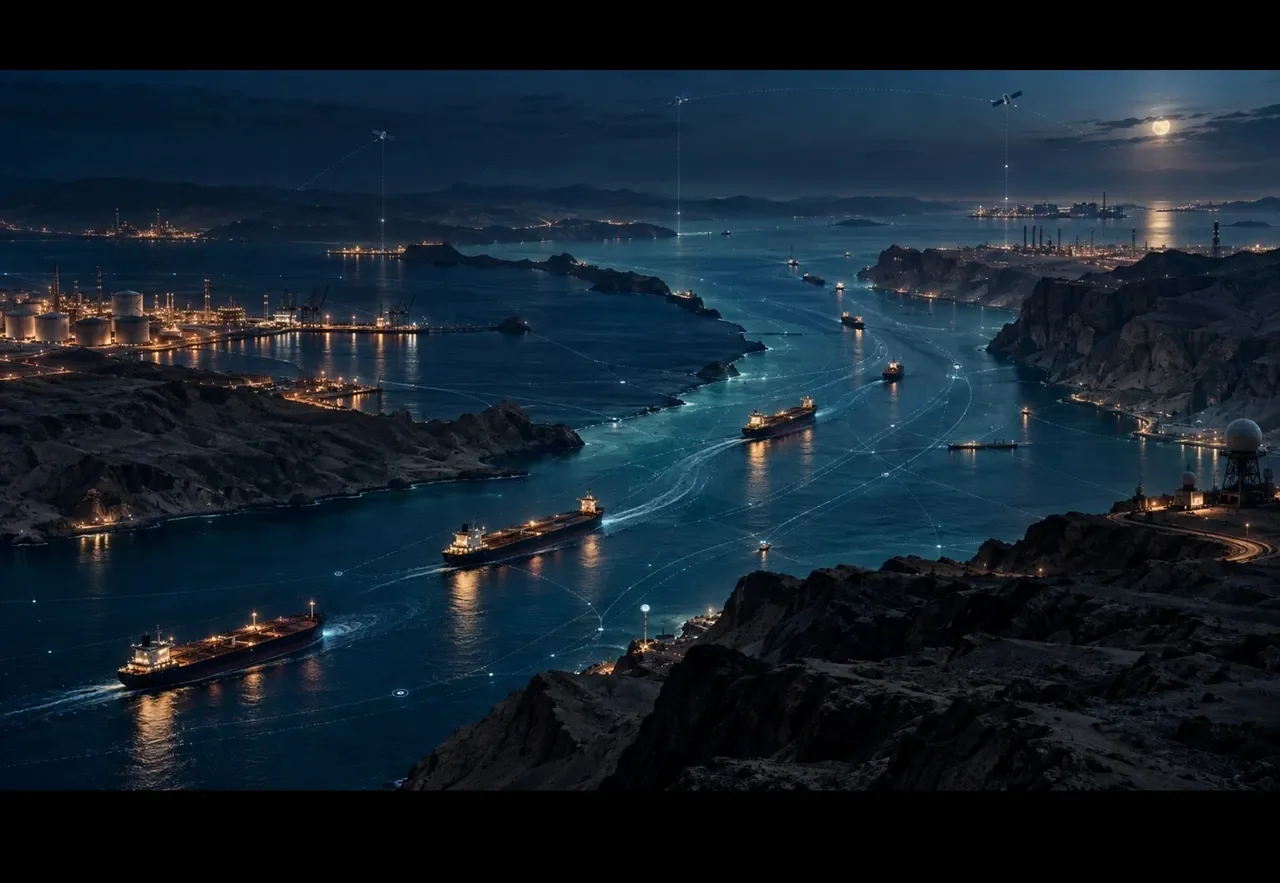
The Strait of Hormuz is a narrow waterway between Iran and the Arabian Peninsula. Yet it functions as a valve on a much larger machine. It connects oil and gas production in the Gulf to Asian, European, and global markets. When traffic through it is threatened, the price does not remain local. Freight costs rise, insurance changes, ships reroute, refiners reconsider supply, and governments release statements before markets even open.
That is why the Strait is never merely geography. It is an infrastructure of global permission.
Iran sits beside that valve. The United States has sought for decades to guarantee freedom of navigation through it. Gulf states rely on it for export income and imported goods. China, India, Japan, Europe, and other consumers depend on stable flows. Insurance is largely written outside the region. Dollar settlement and sanctions enforcement often sit outside the region. Naval power is concentrated outside the region.
The result is a structural asymmetry. Iran possesses proximity. The United States and its partners possess naval reach, financial reach, surveillance, weapons systems, insurance influence, and alliance infrastructure. Gulf governments possess oil wealth and strategic territory, but their security architecture has long been interwoven with external military guarantees.
No single actor controls everything. That is precisely why the system is dangerous. Each actor holds a different part of the chain.
Iran’s problem is not only military. It is permission.
Iran is often discussed as if it were simply an isolated state confronting American military power. That picture is incomplete.
Iran’s freedom to trade, insure ships, settle payments, buy specialised equipment, maintain aircraft, export energy, and receive investment has been shaped for years by sanctions and the fear of secondary sanctions. The United States Treasury’s Office of Foreign Assets Control openly describes its Iran programmes as economic and trade restrictions used to pursue U.S. foreign policy and national security goals. OFAC Iran sanctions programme
Sanctions are not simply a line on a government website. They extend through banks, compliance departments, insurers, brokers, shipping registries, technology suppliers, payment systems, and companies that decide the risk of dealing with Iran is greater than the profit.
This is the point at which The Invisible Chain becomes more than a metaphor. Power does not need to occupy every port if it can make the port commercially unusable. It does not need to seize every tanker if it can make insurance unavailable, settlement difficult, replacement parts uncertain, and customers afraid.
Iran, in turn, has sought to create its own leverage through geography, regional alliances, missiles, drones, naval harassment capacity, alternative trading channels, and the ability to raise the cost of insecurity in the Gulf. These tools do not create prosperity. They create bargaining power under pressure.
That is the tragedy. When normal commercial sovereignty is restricted, states often seek military leverage to recover what they cannot obtain through open economic access. The result is a feedback loop: sanctions create pressure, pressure produces resistance, resistance justifies further military deployment, and deployment deepens the regional security market.
The Gulf states are not spectators. They are inside the chain.
The Gulf monarchies are often described as American clients or Iranian targets. Both phrases are too shallow.
They are sovereign states with their own interests, rivalries, wealth, populations, and strategies. They also operate inside a security structure in which bases, air defence, weapons contracts, intelligence sharing, training, logistics, and naval protection are linked to the United States and other external powers.
Hosting a foreign base can bring deterrence. It can also turn the host country into a potential target when war expands.
Buying advanced air defence can protect cities. It can also create decades of dependence on foreign training, parts, software, maintenance, munitions, and export approval.
Selling oil into global markets can finance development. It can also tie national revenue to a shipping route, currency system, insurance market, and political order beyond national control.
This is not an argument against cooperation. It is an argument for seeing its full price.
A nation is not fully free merely because it has an army, a flag, or a large sovereign wealth fund. It is free when it can keep its people safe, move its goods, insure its ships, maintain its infrastructure, and make strategic choices without needing permission from a distant capital.
The war economy has more than one beneficiary.
It is neither honest nor useful to claim that a single company, country, or ethnic group “owns” war. Wars have real causes: security fears, ideology, territorial disputes, domestic politics, historical grievance, deterrence failures, and decisions made by governments and commanders.
But wars also reorder economic life.
Energy producers with available supply can benefit from higher prices. Traders can benefit from volatility. Tanker owners and insurers can gain from higher freight and risk premiums. Arms manufacturers can receive orders. Defence contractors can gain sustainment work for years after the immediate crisis fades. Banks, lawyers, logistics firms, satellite providers, cyber contractors, and security companies may all receive new demand.
None of that proves that they started the war. It proves something narrower and more important: when political leaders choose escalation, public pain and private revenue can be produced by the same event.
The family in Bandar Abbas, Bahrain, Kuwait, Doha, Abu Dhabi, Basra, or Bushehr does not receive a dividend from a rise in freight rates. It receives fear, disruption, higher prices, and the possibility of death.
This is where Die Matrix des Menschen matters. Systems can make their own logic look inevitable. Security becomes procurement. Procurement becomes dependence. Dependence becomes a reason to buy more security. A population sees only the next emergency, while the system quietly converts each emergency into a longer contract.
America’s power is not simply oil. It is the architecture around oil.
It is too crude to say that the United States fights in the Gulf because it wants Iranian oil. The United States is itself a major oil producer. The issue is wider.
Power in the Gulf concerns the security of shipping lanes, the protection of allies, the credibility of military commitments, control over escalation, energy prices, the global role of the dollar, enforcement of sanctions, weapons markets, intelligence access, and the political order that has governed the region since the end of the Cold War.
Oil is not the only prize. It is the fuel inside a broader architecture.
The decisive question is not who owns every barrel beneath the ground. It is who can decide whether that barrel can be financed, insured, transported, refined, settled, and sold.
This is why a tanker becomes more than a tanker. It is a moving financial system. Its cargo may be Iranian, its insurer European or Asian, its bank elsewhere, its flag from a third country, its buyer in another continent, and its route dependent on naval protection or restraint by states that do not own the cargo.
The modern empire does not always need to take possession. It can define the conditions under which possession becomes useful.
The human cost must not disappear into strategy.
Iranian civilians are not the Iranian state. Americans are not the U.S. military command. Arabs in the Gulf are not the governments that host foreign forces. Israelis are not identical with every decision of the Israeli state. No people should be turned into a target because their leaders, institutions, or armed forces make decisions in their name.
War is not an economic theory for the people beneath the aircraft. It is a child who stops sleeping when the sirens begin. It is a worker who cannot cross a road. It is a family whose savings disappear when food, fuel, medicine, and rent rise together. It is a soldier who carries a consequence home that no communiqué records.
Any serious analysis of power must keep that human truth at the centre. Otherwise the language of sovereignty becomes only another instrument of indifference.
A Persian Gulf security order cannot be imported forever.
The regional answer cannot be Iranian domination of the Gulf. It cannot be permanent American military tutelage. It cannot be a race in which every state buys more weapons while fewer people possess the ability to live without fear.
The lawful alternative is a regional architecture in which Gulf states and Iran have direct security channels, verified maritime rules, crisis communication, civilian infrastructure protection, and agreements that distinguish commercial navigation from military escalation.
It also requires economic independence in the practical areas that decide freedom: regional insurance capacity, diversified settlement mechanisms, independent shipping and logistics capability, energy interconnections, lawful technology transfer, domestic maintenance, and institutions strong enough to resist corruption and elite capture.
This is not a call for isolation. It is a call for a chain of free nations.
Free nations trade. Free nations cooperate. Free nations defend themselves. But they do not build their entire survival around a single foreign navy, a single currency channel, a single weapons supplier, or a single external permission.
The questions that locate power
When war in the Persian Gulf is discussed, do not ask only who fired first.
Ask who controls the Strait. Who controls the base. Who controls the air defence software. Who controls the tanker insurance. Who controls the dollar clearing route. Who controls the export licence. Who controls the spare part. Who controls the satellite picture. Who controls the price of the next shipment.
Those questions do not erase responsibility for violence. They show the structure that makes violence profitable, sustainable, and difficult to end.
Iran has geography. America has global reach. Gulf states have wealth and vulnerability. The world has energy dependence. Each is tied to the others through permissions that appear technical until the day they decide whether a nation can move, trade, defend itself, or breathe.
That is the invisible chain.
The path out is neither surrender nor hatred. It is the hard work of building alternatives before the next crisis turns dependency into destiny.
Sources
1. Reuters, United States and Iran exchange attacks, 2 September 2026
2. Reuters, escalation involving Iranian oil tankers and Gulf attacks, 8 September 2026
3. U.S. Energy Information Administration, Strait of Hormuz
4. U.S. Treasury OFAC, Iran sanctions programme
Dr. Pooyan Ghamari is a economist. His work concerns the systems that convert territory, capital, technology, law, and narrative into durable claims.
100 Questions and Answers: Iran, the Persian Gulf, and the Unfinished Colonial System
By Dr. Pooyan Ghamari
Iran and the colonial age
1. Was Iran ever formally colonised?
No. Iran was never formally converted into a European colony. It nevertheless suffered invasion, occupation, imposed concessions, territorial losses, and extensive foreign interference.
2. Why is that distinction important?
Because formal colonisation is not the only method of domination. A nation can keep its flag while foreign powers restrict its economic and political choices.
3. Which powers placed the greatest colonial pressure on Iran?
Imperial Russia and Britain were the principal foreign powers competing for influence over Iran during the nineteenth and early twentieth centuries.
4. Did Russia take Iranian territory?
Yes. Following wars with Qajar Iran, the treaties of Gulistan in 1813 and Turkmenchay in 1828 transferred extensive Caucasian territories to the Russian Empire.
5. What did the Treaty of Turkmenchay represent?
It represented military defeat followed by territorial loss, financial indemnity, and unequal privileges imposed by a stronger empire.
6. How did Britain influence Iran?
Britain used diplomacy, military pressure, commercial concessions, oil interests, and its position in India and the Persian Gulf to influence Iranian decisions.
7. What happened in 1907?
Britain and Russia agreed to divide Iran into spheres of influence without allowing Iran to participate meaningfully in the decision.
8. Was Iran divided into colonies under that agreement?
No formal colonies were created, but Iranian sovereignty was treated as secondary to British and Russian imperial interests.
9. What was the strategic purpose of the British position?
Britain sought to protect India, secure regional trade routes, contain Russia, and later protect access to oil.
10. Why did Russia seek influence in Iran?
Russia sought territory, strategic depth, trade access, and influence toward warm water routes and the Persian Gulf.
Concessions and economic control
11. What was concessionary colonialism?
It was a system in which rulers granted foreign interests exceptional rights over resources, infrastructure, banking, or trade.
12. Why were concessions dangerous?
They could transfer long term national value to foreign companies while giving the Iranian public little revenue, oversight, or industrial knowledge.
13. What was the Tobacco Concession?
In 1890, the Qajar government granted a British interest broad control over Iran’s tobacco trade.
14. How did Iranians respond?
A nationwide boycott united merchants, religious authorities, workers, and consumers, forcing the concession’s cancellation.
15. Why is the Tobacco Protest strategically important?
It showed that coordinated economic refusal could defeat a foreign concession without surrendering national dignity.
16. What was the D’Arcy oil concession?
In 1901, William Knox D’Arcy received extensive rights to explore for oil across much of Iran.
17. What emerged from that concession?
The Anglo Persian Oil Company emerged and became central to British energy and naval strategy.
18. Did Iran receive equal control over its oil industry?
No. Foreign ownership, accounting control, technical expertise, and marketing power limited Iran’s share and bargaining position.
19. Why was Iranian oil important to Britain?
It helped fuel the Royal Navy and became a strategic asset of the British state.
20. What does this reveal about colonial power?
The stronger claim is often held by whoever controls extraction, refining, finance, transport, and sale rather than whoever owns the soil.
Occupation without annexation
21. Was Iran occupied during the First World War?
Parts of neutral Iran were occupied or used militarily by foreign forces despite Iran’s declared neutrality.
22. What happened during the Second World War?
Britain and the Soviet Union invaded Iran in 1941.
23. Why did they invade?
They wanted to secure oil and the supply route used to deliver Allied material to the Soviet Union, while citing concerns about German influence.
24. Did Iran cease to exist as a state?
No. Iran retained formal statehood, but foreign armies sharply constrained its sovereignty.
25. What happened to Reza Shah?
He abdicated under foreign pressure, and Mohammad Reza Shah succeeded him.
26. What larger lesson follows?
A country can remain on the map while foreign powers determine the boundaries of its leadership and strategic conduct.
27. Did occupation affect ordinary Iranians?
Yes. Wartime disruption contributed to scarcity, inflation, food insecurity, and extensive public suffering.
28. Why is civilian suffering often absent from imperial history?
Because official histories frequently record campaigns and agreements more carefully than hunger, displacement, humiliation, and lost human opportunity.
29. Is strategic necessity a complete moral defence?
No. Governments may cite necessity, but the effects on sovereignty and civilians must still be examined.
30. What did Iran learn from these interventions?
That neutrality and formal independence provide limited protection when stronger powers control the surrounding military and economic system.
Oil nationalisation and 1953
31. Why did Iran nationalise its oil industry?
Many Iranians believed foreign control deprived the nation of fair revenue, transparency, and sovereignty over a vital national resource.
32. Who led the nationalisation government?
Prime Minister Mohammad Mossadegh became the central political figure behind oil nationalisation.
33. Was nationalisation merely an economic decision?
No. It was a constitutional and sovereign claim that Iranian resources should serve Iranian national development.
34. How did Britain respond?
Britain challenged nationalisation, imposed economic pressure, restricted Iranian oil exports, and sought international support against Mossadegh.
35. What happened in August 1953?
A covert operation supported by the United States and Britain contributed to Mossadegh’s removal.
36. Is American involvement documented?
Yes. Declassified U.S. historical records document the CIA’s role in the operation.
37. Why does 1953 remain important?
It reinforced Iranian perceptions that democratic choice could be overridden when it threatened foreign strategic and commercial interests.
38. Was the crisis only about oil?
No. Cold War fears, internal Iranian conflict, royal power, constitutional struggle, and British interests all mattered.
39. Does complexity erase foreign responsibility?
No. Multiple causes can coexist with documented external intervention.
40. What was the long term strategic cost?
The intervention damaged American credibility and helped create the mistrust that still shapes relations with Iran.
Revolution, sovereignty, and isolation
41. What did the 1979 Revolution reject?
It rejected monarchical rule, foreign influence, political repression, and the belief that Iran’s direction was being decided outside the country.
42. Did every revolutionary promise become reality?
No. The Islamic Republic created its own forms of political repression and restriction.
43. Does criticism of the Iranian government cancel Iranian sovereignty?
No. A government can be criticised without granting foreign powers a right to dominate or attack the nation.
44. Are Iran and its government identical?
No. Iran is a civilisation, territory, people, and historical community larger than any government.
45. Should Iranian civilians be punished for state policy?
No. Collective punishment is morally indefensible and can violate international humanitarian and human rights principles.
46. Can sovereignty be used to excuse domestic oppression?
No. Sovereignty protects a nation from external domination. It does not grant rulers permission to abuse citizens.
47. What is principled sovereignty?
Independence from foreign control combined with accountability, human dignity, and lawful government at home.
48. Why has Iran resisted external submission?
Its history repeatedly taught Iranians that foreign promises of order could conceal territorial, political, or economic control.
49. Has Iranian resistance always been strategically successful?
No. Resistance can preserve independence while also imposing heavy economic and human costs when strategy becomes inflexible.
50. What is the strategic challenge for Iran?
To protect independence without allowing permanent confrontation to isolate its economy or exhaust its people.
The name Persian Gulf
51. Why should the name Persian Gulf be used?
Persian Gulf is the historically established English geographical name found in longstanding cartographic, diplomatic, and international usage.
52. Is the name a recent Iranian political invention?
No. Variations of the name referring to Persia have been used for centuries.
53. Why has the name become politically contested?
Modern nationalism and regional rivalry have turned a historical geographical name into a political instrument.
54. Does using Persian Gulf deny Arab identity?
No. A geographical name does not deny the identity, sovereignty, or dignity of Arab peoples living around it.
55. How should neighbouring countries be described?
They may be called Arab states of the Persian Gulf or Persian Gulf states, depending on context.
56. Why does terminology matter?
Language influences historical memory, legitimacy, maps, diplomacy, and the public understanding of place.
57. Is changing a geographical name harmless?
Not always. Renaming can become a method of weakening historical identity or advancing contemporary territorial narratives.
58. Should the article use alternative political labels?
No. It should consistently use Persian Gulf.
59. Does Iran own the Persian Gulf because of its name?
No. The name does not create exclusive ownership. Coastal states possess rights and obligations under international law.
60. What should the name represent?
Historical continuity alongside lawful coexistence among every nation bordering the Persian Gulf.
The American security architecture
61. When did the United States become the dominant external power in the Persian Gulf?
American influence expanded after the Second World War and became especially prominent after Britain’s regional withdrawal and the Cold War’s end.
62. How is American power maintained?
Through military facilities, naval forces, air power, alliances, intelligence, weapons sales, sanctions, finance, and diplomatic protection.
63. Is this formal colonisation?
Usually not. It is better understood as a security and permission architecture capable of creating deep dependence.
64. Why do Persian Gulf states cooperate with Washington?
They seek deterrence, military technology, intelligence, political support, and protection against regional threats.
65. Is that cooperation voluntary?
It is formally voluntary, but the cost of leaving a mature security system can make practical choice much narrower.
66. What is the colonial feature of such dependency?
A nation pays for protection while remaining dependent on the protector for parts, software, ammunition, training, and strategic approval.
67. Does every American base make the host state a colony?
No. The legal terms, political consent, operational control, duration, and ability to terminate the arrangement must be examined.
68. What risk does hosting foreign forces create?
The host can become a military target during a conflict it may not fully control.
69. What benefit does the United States receive?
Forward access, surveillance, deterrence, logistical reach, influence, and protection of strategic routes.
70. What benefit do American defence companies receive?
They can receive large procurement and sustainment contracts, although commercial benefit does not prove responsibility for causing war.
Sanctions as a modern chain
71. Are sanctions a form of warfare?
They are economic coercion rather than conventional warfare, though their effects can be severe.
72. How do American sanctions reach beyond U.S. territory?
They operate through dollar clearing, American banks, secondary sanctions, compliance systems, insurers, and multinational companies.
73. What are secondary sanctions?
Measures that threaten non American parties with consequences if they conduct specified business with a sanctioned target.
74. Why do companies sometimes restrict more activity than the law requires?
They fear penalties, banking exclusion, legal cost, and reputational risk.
75. Can humanitarian exemptions solve civilian harm?
They can help, but banking caution and supply chain barriers may still obstruct legitimate transactions.
76. Can sanctions weaken national wealth?
Yes. They can restrict exports, investment, technology, finance, currency stability, employment, and government revenue.
77. Do sanctions only affect political leaders?
No. Their indirect effects can reach workers, businesses, patients, students, and households.
78. Are all sanctions colonial?
No. Some respond to genuine security or human rights concerns. Their legality, proportionality, targets, and civilian effects require separate examination.
79. When do sanctions resemble colonial control?
When an outside power acquires enduring influence over another nation’s trade and development without accountable international authority.
80. What is the invisible chain of sanctions?
A government issues the rule, but banks, insurers, shippers, platforms, and companies enforce the practical isolation.
Slavery, theft, and modern extraction
81. What connects slavery and colonialism?
Both convert human beings, land, or national resources into value controlled by someone else.
82. Was slavery historically central to imperial wealth?
Yes. Enslaved labour supported agriculture, shipping, finance, insurance, manufacturing, and state revenue across several empires.
83. Was the United States built partly through slavery?
Yes. Enslaved labour contributed significantly to American agricultural production, trade, finance, and wealth accumulation.
84. Does that make every modern American personally guilty?
No. Personal guilt is not inherited. Historical consequences and institutional responsibilities can persist.
85. Is modern economic dependency identical to slavery?
No. The terms must not be confused. Slavery involves coercive control over human beings and is among the gravest crimes.
86. Why compare their structures at all?
Because both reveal a recurring logic: one party produces value while another controls ownership, movement, price, and permission.
87. Can national wealth be stolen through a legal contract?
A contract can be formally legal yet profoundly unequal, corruptly obtained, or destructive of the public interest.
88. Is every unfavourable contract theft?
No. Theft and criminality are legal conclusions requiring evidence. Strategic criticism must distinguish exploitation from a proven crime.
89. What is resource colonialism?
Extraction that leaves the producing nation with environmental cost and low value while processing, technology, and profit remain abroad.
90. What is the modern equivalent of controlling the port?
Controlling insurance, finance, logistics, certification, software, sanctions compliance, and access to buyers.
Iran’s sovereignty and the future
91. Has Iran preserved its state continuity?
Yes. Despite invasion and interference, Iran retained a distinct state and civilisational identity.
92. Does resistance alone create sovereignty?
No. Real sovereignty also requires productive industry, competent institutions, trusted law, education, technology, and economic resilience.
93. What should Iran avoid?
Permanent isolation, corruption, internal repression, dependence on any single foreign patron, and policies that transfer the cost of resistance to ordinary citizens.
94. Should Iran replace Western dependency with Russian or Chinese dependency?
No. Changing the external centre of permission does not produce sovereignty.
95. What should Iran build?
Diversified trade, credible institutions, regional diplomacy, domestic technology, secure infrastructure, and lawful defence.
96. What should Persian Gulf states build together?
Direct security dialogue, maritime rules, crisis communication, infrastructure protection, trade, and mechanisms preventing foreign rivalry from controlling the region.
97. Is American withdrawal the only solution?
No. Sudden withdrawal could create instability. The strategic objective should be regional capacity and a gradual reduction of unhealthy dependency.
98. What is a chain of free nations in the Persian Gulf?
A regional order in which every country cooperates while retaining security, economic choice, dignity, and the right to refuse domination.
99. What is the central lesson of Iran’s history?
Iran preserved formal independence because its people repeatedly resisted the conversion of temporary foreign influence into permanent foreign ownership.
100. What is the final test of sovereignty?
Whether Iran and every Persian Gulf nation can determine its security, resources, trade, and future without external permission and without denying freedom to its own people.
Source foundation
The documented historical foundation includes the Russo Iranian treaties, the 1907 Anglo Russian Convention, the Tobacco Protest, the D’Arcy concession, the 1941 Anglo Soviet invasion, Iranian oil nationalisation, and the British and American backed operation against Mossadegh in 1953. American involvement in 1953 is documented in the U.S. State Department’s Foreign Relations of the United States collection. Current U.S. sanctions architecture is published by the Office of Foreign Assets Control.
The argument is not that every foreign relationship is colonial or that every Iranian policy is justified. The argument is that Iran’s history cannot be understood without recognising the repeated attempt of stronger powers to control its territory, oil, finance, leadership, security, and access to the Persian Gulf.
Originalartikel: https://ghamari.org/articles/f/the-strait-and-the-invisible-chain-iran-the-persian-gulf