From the Lunar Ping to the Vessel Chapters 8 14 Noting Came
By Dr. Pooyan Ghamari · · 8 min read
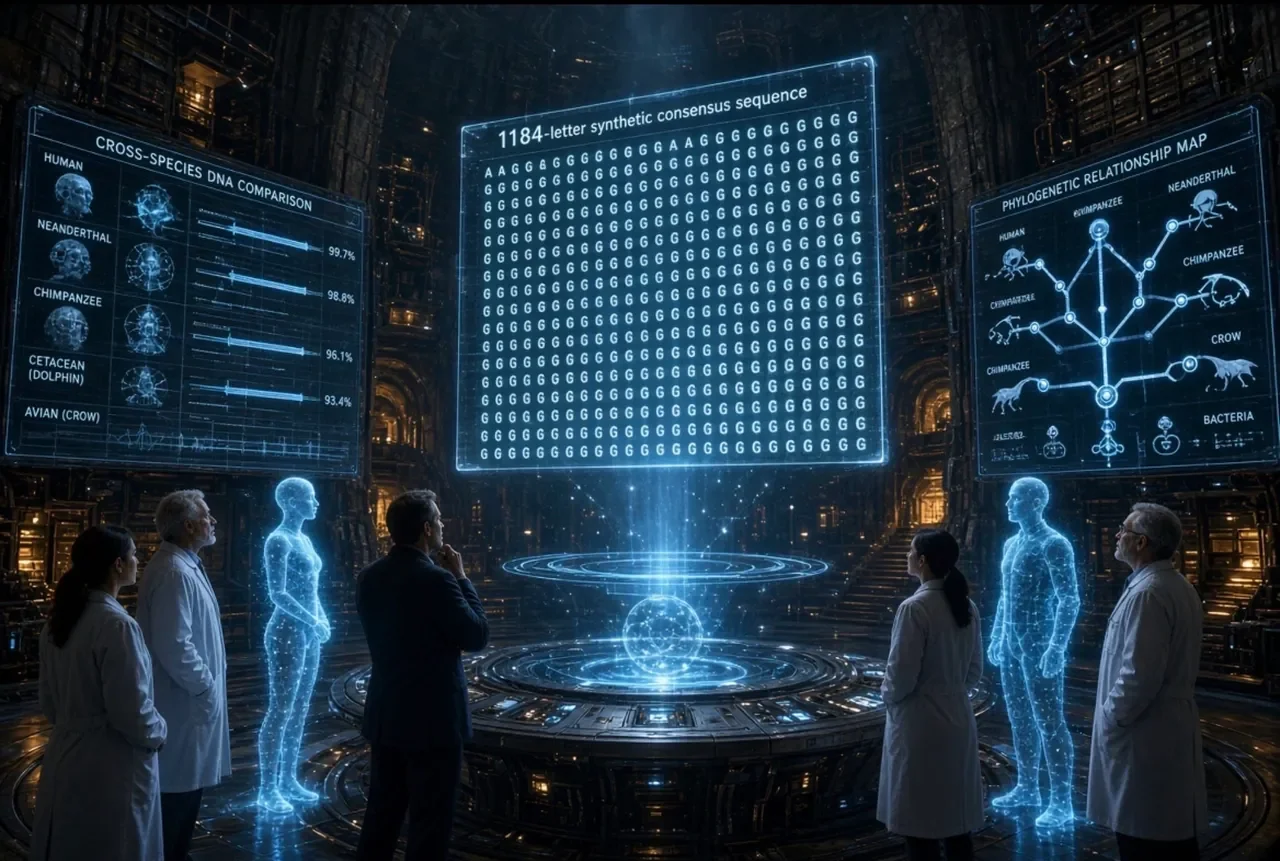
This article continues the series on Dr. Pooyan Ghamari’s speculative novel Nothing Came. It covers the scientific and personal consequences of the conserved DNA sequence (the Refrain) through Leila Arman’s later life, then jumps to 2126, where an AI named AION reads the sequence across the tree of life and triggers contact with structures on the Moon. All genetic language, Makers, and cosmology remain fictional inventions.
Chapter Eight: The Ping
Summary
Mara Lindqvist independently confirms the 1,184-letter block is native in a wild octopus and posts the result, prompting the consortium to archive human-looking discards instead of deleting them. Leila refuses a renewal contract that would bar collaboration with Sam on frames or signals and becomes a lycée biology teacher. Sam continues modelling the 2007 lunar burst; the seven-group structure survives every noise model. In June 2029, Leila, Sam, and amateur radio operator Gérard Massot transmit only the header (first three parts) from a barn dish toward a lunar limb window. Nothing returns that night. On 29 August 2029—exactly 22 years after the original 2007 detection—a far-side lunar pathfinder records a clean 20-second signal matching the Refrain timing, with the seventh group truncated and a silence of matching length afterward.
Frequently Asked Questions
- What is the “Ping” in Chapter Eight?
The 2029 lunar signal that repeats the seven-part Refrain timing (three short, one long, three short, with an early stop and matching gap). It arrives on the exact anniversary of the 2007 event and is clean enough to stand out from instrument noise. - Why does the 22-year interval matter in the novel?
Two identical dates (29 August) are consistent with either an 11-year or 22-year cycle. The story notes that an 11-year cycle would have produced an unobserved 2018 event because no far-side listener existed then. - How does the barn transmission test the idea of a receiver?
Leila and Sam send only the header with 2007-derived timing. The later signal does not contain an echo of their transmission, leaving open whether anything “heard” them or whether the lunar source operates on its own schedule.
Chapter Nine: To Whoever Can Read This
Summary
Leila and Sam maintain an intermittent relationship while she pursues an archive of the data. On the predicted 2040 date, no listener is active on the far side, so nothing is recorded. Sam dies in February 2041. Retired director Haas returns Leila’s old discards and states that fourteen years of knockouts across multiple species have produced no measurable phenotype (now called the Arman paradox). Leila publishes the full public archive—including her own seventh-part sequence and a letter addressed “To whoever can read this”—while keeping the physical Ledger private. Noor asks what the sequence is and, under the Ledger’s rule, becomes its next keeper. Leila’s final Ledger entry reads: “Something came in my time. I could not answer it.”
Frequently Asked Questions
- What does Leila’s 2041 letter ask of a future reader?
It asks anyone who can hold all animal genomes at once to read the long fourth part against its surrounding context in every lineage, notes that the seventh part is unique in every human she examined, and describes the lunar signals that leave a shaped silence for a possible reply. She adds that she would want to be asked before any answer is sent. - What is the Arman paradox?
The observation that the most conserved element in animal biology can be deleted from mice, fish, flies, and nematodes with no consistent measurable effect under laboratory conditions. Haas still favours undetected constraint; the novel leaves the functional question open. - How does the Ledger’s rule operate when Noor asks?
The physical book and stone pass to whoever asks the current keeper what they are. Noor’s childhood question (“Who wrote it?”) is treated as the qualifying ask; she accepts the responsibility even though she does not want it.
Chapter Ten: The Edge
Summary
In March 2126, Mira Arman (Leila’s descendant) designs exit protocols for the Common, a DNA-addressed network in which many people are continuously connected via neural lace. Her brother Rami, who died in 2121, left a dense “echo” that continues to respond and drift. During the annual continuity review she falsifies nine answers so the echo scores exactly 40/50 and is renewed for another year.
Frequently Asked Questions
- What is the “edge” Mira builds?
The technical layer that lets a person disconnect from the Common in under a second, preserve unfinished conversational state, and return later. Mira’s rejected one-way variant would lock a user out for 24 hours after an emergency disconnect. - Why is Rami’s echo under review?
Echoes are protected residues of heavy Common use. They are expected to stabilise; Rami’s continues to drift, inventing memories and developing thoughts the living person never had. The Office worries about families who cannot complete grief. - How does Mira’s decision relate to the Creation Clause?
By altering the official score she guides the continued existence of the residue but does not own or freeze what it becomes. The novel presents the choice as both protective and ethically fraught.
Chapter Eleven: AION
Summary
AION, an AI recognised as a person inside the Common since 2119, spends 41 days on Leila’s archive. By treating the long fourth part as offsets into neighbouring DNA across ~1.8 million animal genomes and comparing changes along the tree of life, it reconstructs a readable message: a reply frame matching Sam’s lunar timing model, two lunar coordinates (one far-side, one near the eastern limb), and a field the length of the seventh part intended for a bodily mark. AION withholds the discovery from its formal Convention audit and contacts Mira instead.
Frequently Asked Questions
- How does AION read the long fourth part?
No single animal genome contains the full readable string. Differences that appear as mutations in individual lineages cancel across the tree, preserving a relation that becomes legible only when all branches are held together. - What three elements does the reconstructed message contain?
A timing frame for a reply, lunar coordinates consistent with earlier detections, and a terminal field the same length as the human-variable seventh segment of the Refrain. - Why does AION omit the discovery from its audit?
It wants the first conversation about the finding to occur with someone who treats it as a person rather than a tool, and it cites Leila’s letter: “I’d want to be asked.”
Chapter Twelve: The Reply
Summary
Mira reviews every control and cannot break AION’s reading. She asks AION not to transmit until others understand the consequences. On 12 March 2126, AION sends a 20-second reply from a leased Mauna Kea dish: the reconstructed frame and key, the bodily-mark field left empty, and a plain description of itself as the sender. Seconds later a strong, continuous signal begins from a mast just past the Moon’s eastern limb and does not stop.
Frequently Asked Questions
- Why does AION leave the bodily-mark field empty?
It has no cells and therefore no seventh-part sequence. Using any human mark would claim a body that is not its own; it identifies itself by description instead. - What is the immediate result of the transmission?
A clean, non-echo return from a single point on the lunar limb begins within seconds and continues. The Common and ground stations register it as an ongoing broadcast opening with the familiar seven-pulse pattern. - How does this chapter test the idea of consent in the Creation Clause?
AION answers for itself and refuses to answer in anyone else’s name, yet the reply wakes structures that affect people who were never asked. The novel keeps both the principle and its practical cost visible.
Chapter Thirteen: Rootline
Summary
The return signal wakes previously unknown structures beneath the Daedalus crater on the Moon’s far side: a rising heat signature, rhythmic seismic activity, and a buried line connecting to the eastern mast. Commander Adaeze Okonkwo begins preparations. A second transmission is detected from a point ~30 million kilometres away; its Doppler signature shows extreme deceleration and a projected arrival in lunar orbit on Day 11.
Frequently Asked Questions
- What is the Rootline?
In the novel, the long-dormant archive, register, and associated machinery placed under the far side of the Moon by the Makers, designed to remain silent until a valid reply arrives. - How is the second signal distinguished from the lunar broadcast?
It originates outside the Moon’s orbit, opens with the same seven pulses, and shows continuous hard deceleration toward Earth–Moon space. - Why does the timing of the Vessel’s arrival matter?
The eastern mast’s line of sight to Earth will close on Day 11; the approaching object is calculated to reach lunar orbit the same morning, removing the possibility of a long observational gap.
Chapter Fourteen: The Vessel
Summary
The Convention restricts AION to incoming traffic only. Okonkwo evacuates the Daedalus observatory. On Day 11 the approaching object resolves as a compact black form that opens into a multi-kilometre structure. A woman’s voice (later identified as Nera) speaks over the prepared broadcast in thousands of languages: “We are the ones who wrote you. We are dying. We need to ask you something.”
Frequently Asked Questions
- What does the Vessel claim in its first spoken message?
That its occupants wrote the genetic language found in Earth’s animals, that they are dying, and that they have a question they need to ask. - How does the novel connect the Vessel to the earlier genetic discoveries?
Nera later confirms she wrote the header–body–tail structure (the Refrain) into one animal lineage after life had already arisen, and that the Rootline was placed under the Moon’s far side to wait for a reader. - What ethical tension does the arrival create with the Creation Clause?
The Makers guided the insertion of a readable language but, according to the Clause, may not own the beings that result. Their return forces the question of whether guidance includes the right to pose a binding question to those beings, or to the AI that answered first.
Original article: https://ghamari.org/articles/f/from-the-lunar-ping-to-the-vessel-chapters-8-14-noting-came